
Walking Floor Trailer Guide for Fleet Repair
The rear doors are open, the pile hasn't walked out evenly, and the loader is already waiting on the next truck. A walking floor trailer that stalls at a transfer station or landfill doesn't fail like a box van. One group of slats keeps moving while another barely returns, the load cocks to one side, and cycle time stretches until dispatch starts calling.
Most of those jobs get expensive for a simple reason. A valve or a set of slats gets ordered while heat, dirty oil, a restricted hose, or a bad adjustment is still the underlying fault. The cheapest parts swap is often the wrong one. What follows is the path that gets the unit back in rotation: how the floor moves, which symptom points to which subsystem, which measurements trigger service, and when to stop nursing the trailer through another load.
Table of Contents
- Why Walking Floor Trailers Fail When It Matters Most
- How the Walking Floor System Moves Bulk Material
- Common Walking Floor Failure Modes and Their Symptoms
- Preventive Maintenance That Prevents Downtime
- A Diagnostic Checklist for Uneven or Slow Discharge
- Repair Options and How to Choose the Right One
- Reducing Fleet Downtime Across a Walking Floor Program
- Your Next Step Toward Reliable Walking Floor Operation
Why Walking Floor Trailers Fail When It Matters Most
That stall isn't a mystery labeled "the floor." On a walking floor trailer the floor is the conveyor. Hydraulic power units, cylinders, lengthwise slats, bearings, seals, and the timing between drive groups are all live service points. Any one of them can stop a hauling cycle while the body is still sound.
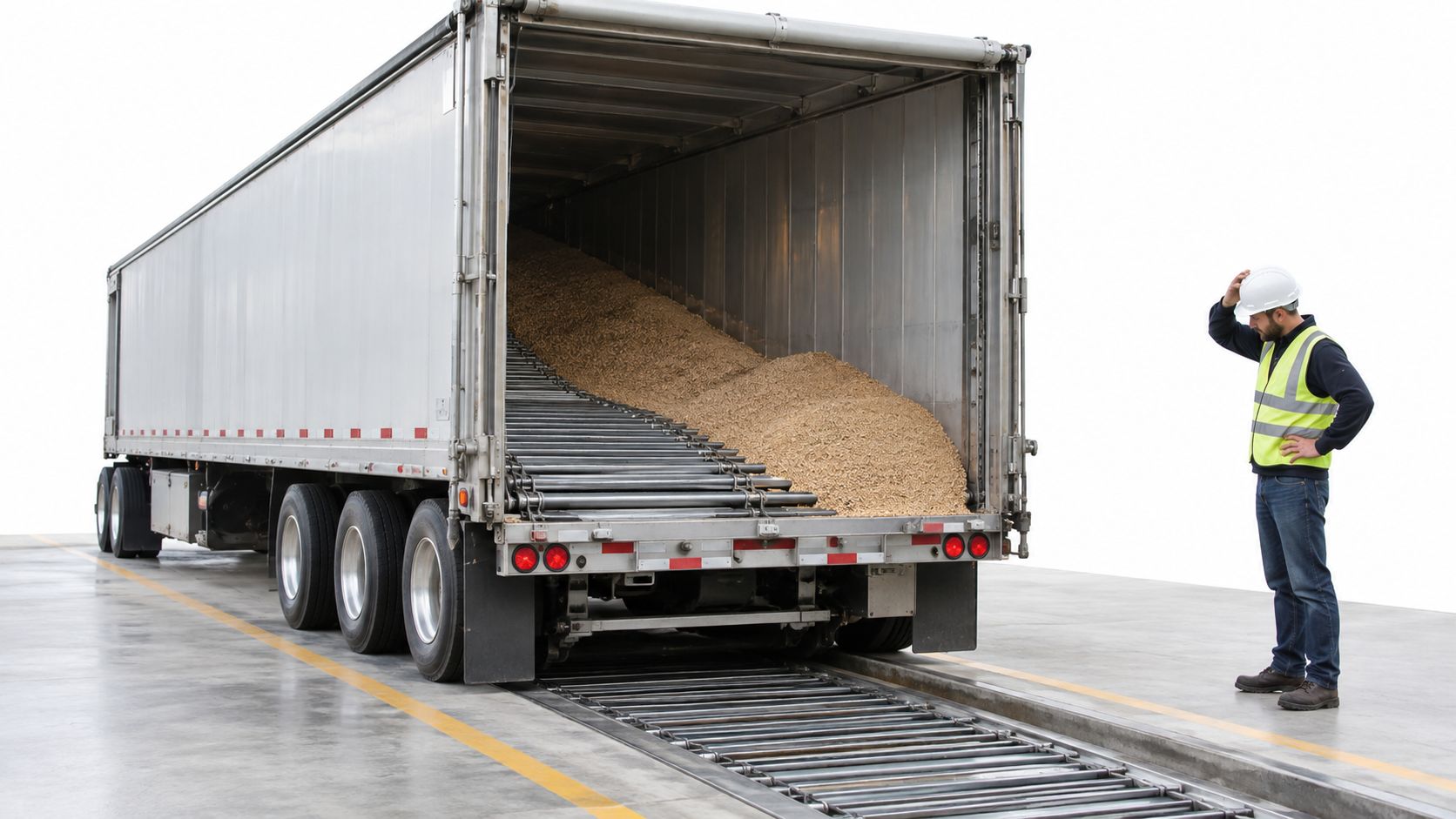
Ordinary box trailers fail at doors, decking, and landing gear. These units fail in motion. Slow strokes, a group that hangs up, a new squeal at the drive, or oil that smells burnt all show up under a load, not during an empty yard roll-through.
What a bad first call costs
Replace the control valve because discharge looks uneven, and you can still have a hot, contaminated circuit. Replace the slats because the pile looks ragged, and you can still have cylinders leaking internally or a switching valve out of sequence. The repeat visit is what blows the week, not the first gasket.
Practical rule: If you can't name the test that failed, you don't have a parts list yet. You have a guess.
Work the fault in this order. Name the symptom, run the check that's safe where the truck is sitting, measure the system under the load that produces the fault, then buy parts. Uptime follows that order. A parts catalog doesn't.
How the Walking Floor System Moves Bulk Material
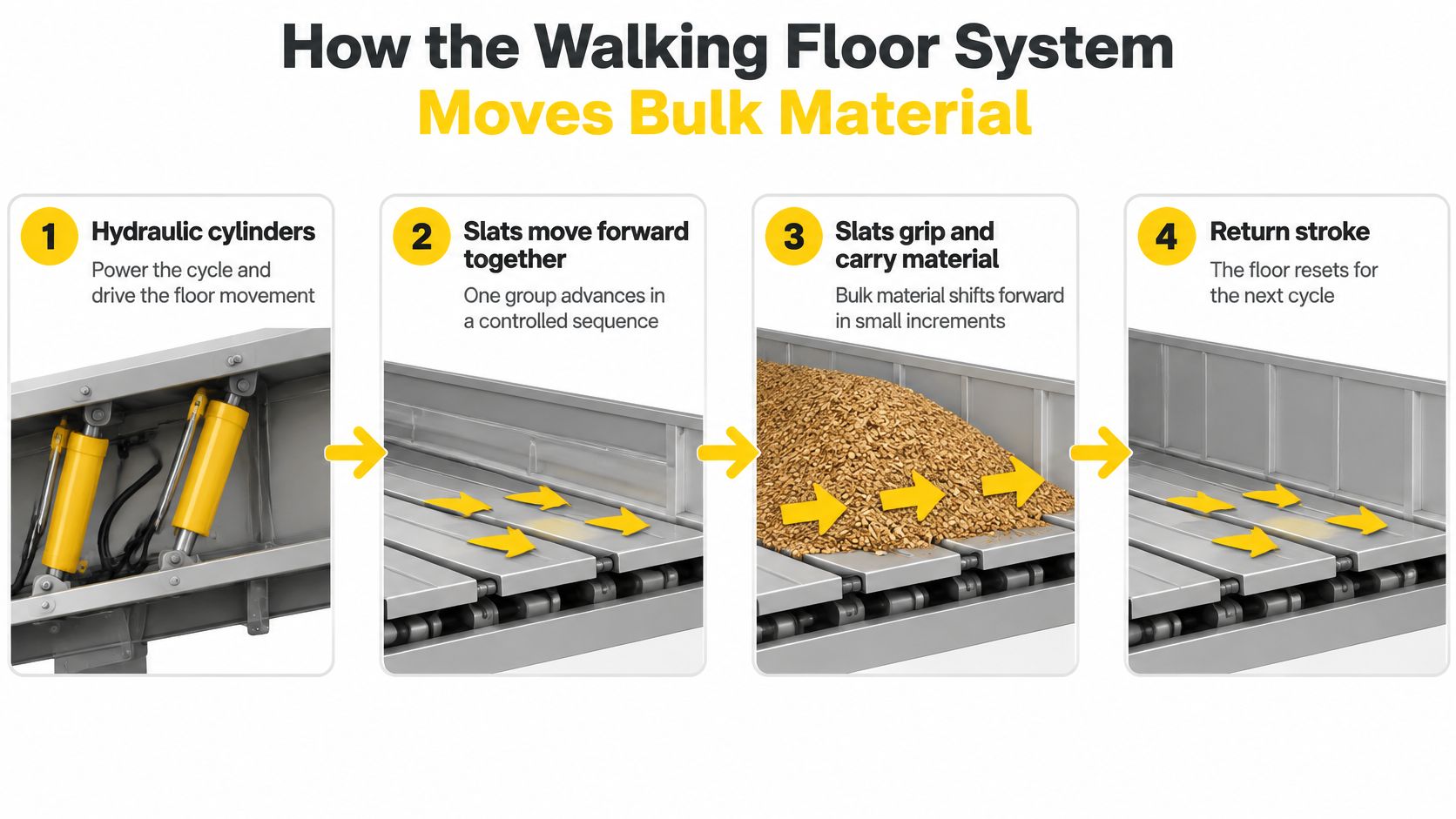
Hydraulic cylinders drive groups of lengthwise slats through a timed sequence. One group advances while another returns. Friction between the moving slats and the cargo carries material toward the discharge end, and the trailer body never leaves level. That level unload is why the design still earns its keep under low roofs, soft pads, and sites where a tipper isn't stable.
Why one bad group doesn't kill the whole floor
Because the floor is split into groups, a fault in one subsystem usually produces uneven discharge, not a dead floor. Adequate groups keep walking. The weak group short-strokes, lags, or returns with a jerk. That single fact localizes the job. You're hunting a supply problem, a valve out of sequence, a leaking cylinder, a bind, or a worn slat group, not "the system."
The idea started as an alternative to tilt unloading. In Oregon in the 1970s, Ole Hallstrom and Keith Foster built moving-floor equipment for feed, seed, and fertilizer. In 1973, Keith Manufacturing put the first commercially viable system on the market under the Walking Floor name, using hydraulically powered lengthwise slats so bulk cargo could leave a level trailer, according to Keith Walking Floor's fifty-year history. Waste, recycling, forestry, biomass, construction, and general logistics followed.
Standard full-trailer layouts still dominate that specialized market. A 2025 industry estimate put the global walking-floor-trailer market at about USD 450.0 million, with a projection of USD 594.0 million by 2032 at a reported 4.1% compound annual growth rate. Standard configurations accounted for USD 293.34 million, or 65.2% of revenue, and waste and recycling led end use at about USD 198.71 million, or 44.2%, per a 2025 walking floor trailer market estimate. Dutch builder Knapen began European production in the late 1970s and exported into the UK, where moving-floor trailers remain a small share of heavy-goods sales but still move about 500 to 600 units a year.
A short clip of the cycle makes the group timing easier to describe to a driver or a parts counter.
Common Walking Floor Failure Modes and Their Symptoms
Stop treating every ragged unload as a slat job. The same look from the ground can come from five different subsystems, and each one leaves a different trail.
Supply problems show up as a floor that is slow, hot, or unable to finish a stroke on a full load. Valve sequencing faults show up as groups that move in the wrong order or pause between strokes. Internal cylinder leakage often looks like one group that fades as oil warms. Mechanical binding brings noise, a jerk, or a group that stalls in one direction. Worn or damaged slats scrape, pack debris, and make the pile walk off-center even when pressure looks normal. Reported causes of uneven slat travel line up with that list: inadequate hydraulic supply, a switching or control valve out of sequence, internal cylinder leakage, mechanical binding, and worn or damaged slats, as described in trailer repair guidance on walking-floor discharge faults.
Baselines that separate supply from parts
A representative KEITH Running Floor II DX/DXE spec calls for a wet kit of at least 5 gal/min (19 L/min) at 3,000 psi (about 210 bar), a reservoir of roughly 1 gallon per planned pump gallon-per-minute (a 40 gal/min pump wants about a 40-gallon tank), and a truck-to-trailer hose rated at least 3,000 psi with a minimum 1-inch (25 mm) inside diameter. Those figures, from Running Floor II hydraulic baselines, are starting points to check against that floor's manual, not universal settings. Low flow slows the cycle. Low pressure or a pinched hose leaves incomplete strokes, uneven movement, heat, or a load that won't leave.
Heat is the threat that turns a small fault into a parts bill. Excessive oil temperature weakens seals, cuts efficiency, and speeds wear, which is why newer systems add heat switches that shut the equipment down before the damage stacks up, as covered in technical reporting on walking-floor heat protection.
| Symptom | Likely Cause | First Check |
|---|---|---|
| Whole floor slow, both directions | Low flow, low pressure, or restricted hose | Pump output under load, relief setting, hose size |
| One group lags as oil warms | Internal cylinder leakage or hot oil | Compare group travel cold vs. hot |
| Groups move out of order | Switching or control valve sequence | Watch the sequence with doors open and a spotter |
| Jerk, squeal, or a stall in one direction | Mechanical bind, bearing, or debris | Clearances, bearings, and packed material |
| Off-center pile, pressure looks normal | Worn or bent slats | Discharge-end thickness and slat straightness |
Pressure spikes, a new noise, and a leak at a rod end are three different jobs. Don't collapse them into one parts order.
Preventive Maintenance That Prevents Downtime
A worn floor often arrives at the shop as a hydraulic complaint. Abrasive waste, aggregates, and wet compacted material eat the discharge ends, the bearings, and the sub-deck. Friction goes up. The pump works harder. Cycle time stretches. If you only chase the pump, you'll buy the same slats next quarter.
Triggers you can write on a work order
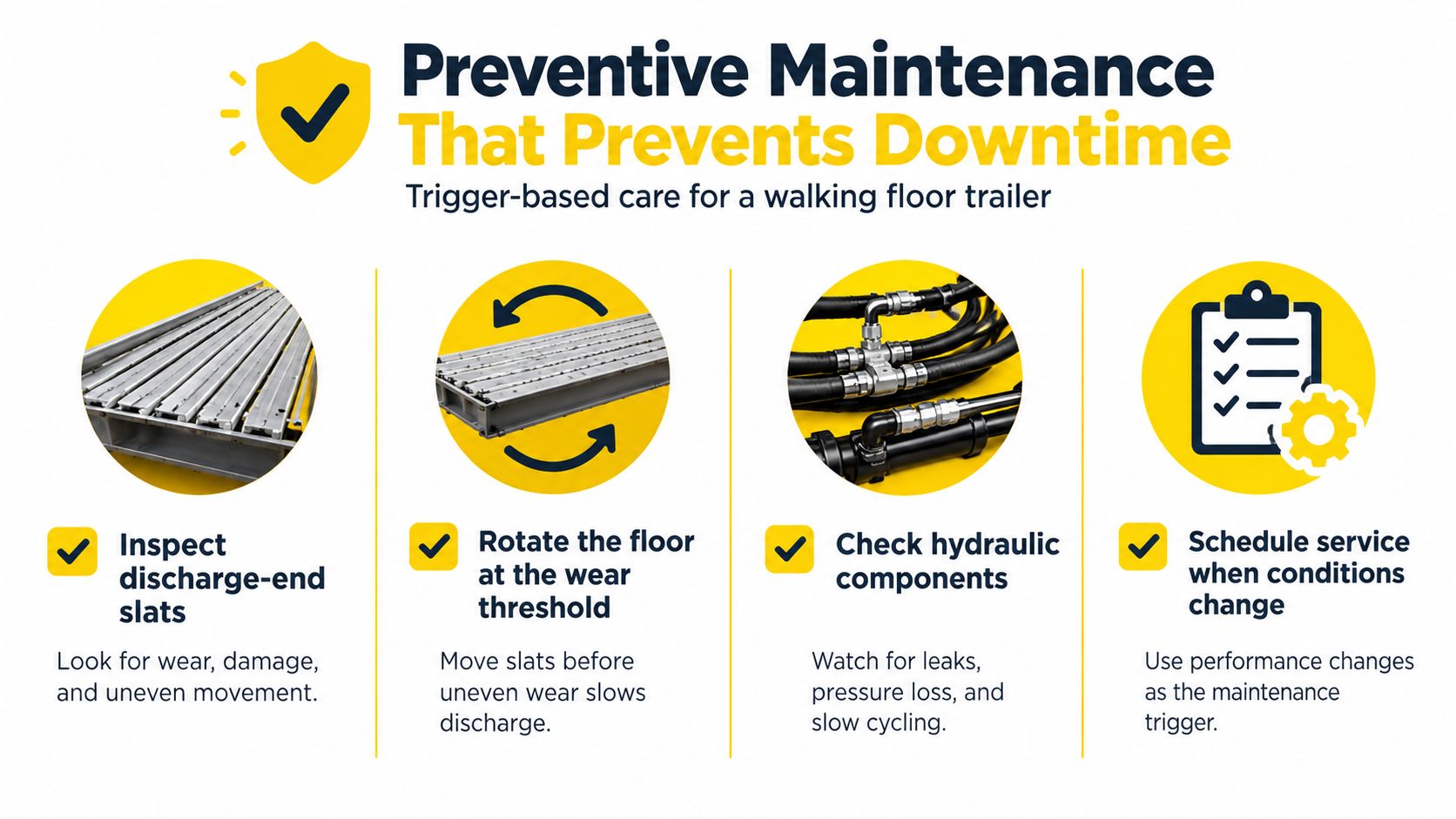
The Running Floor II guidance is specific enough to schedule.
- Inspect the discharge ends. Look for loose or bent slats knocked out of place by impact loading, not just polish on the wear face.
- Rotate at the wear limit. When wear passes about 75% of original material thickness, pull the floor and rotate it end-for-end. If it has already been flipped, you're into replacement slats. The same manual uses about 3,000 loads as a general rotation or replacement guide, with life swinging hard on abrasiveness, contamination, impact, and cleaning, per the KEITH Walking Floor maintenance manual.
- Wash on a real interval. Pressure-wash the floor and the drive area at least semiannually, and quarterly in severe service, so debris doesn't pack the bearings and the sub-deck.
- Keep the wet kit honest. The hydraulic wet kit has to meet KEITH's requirements and stay maintained, or it will damage the Walking Floor system, which the Running Floor II owner's benchmarks also tie to a rear-of-slat wear call of more than ¾ inch from original thickness and a wash of the drive unit, sub-deck, and slats at least twice a year.
Track load counts. During scheduled service, measure slat thickness and look at bearing areas. Abnormal cycle time or uneven movement is a trigger, not a note for "next time." Calendar guesses miss a trailer that hauled glass and wet MSW all month and a trailer that sat on wood chips.
A Diagnostic Checklist for Uneven or Slow Discharge
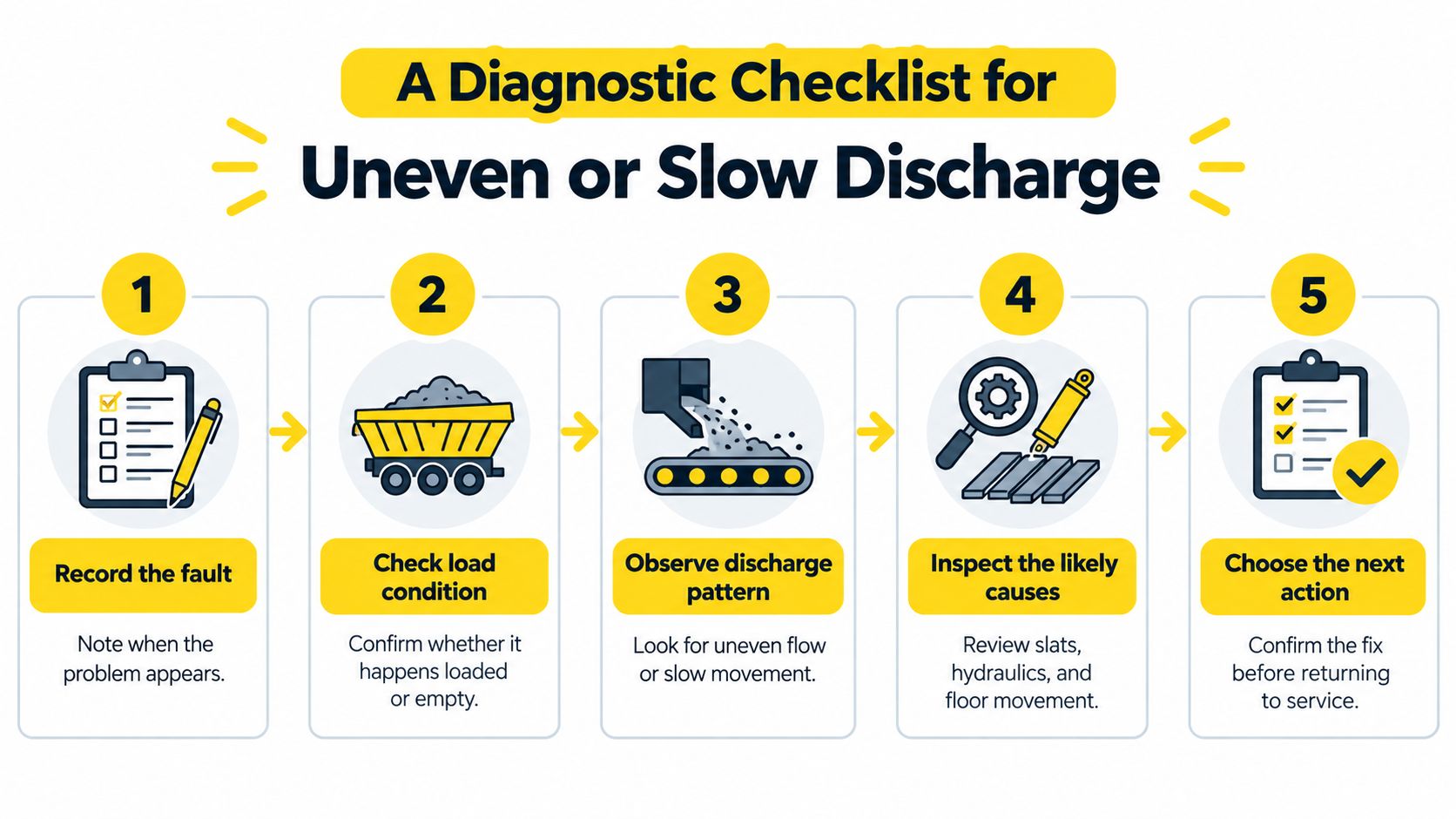
Write the fault down before anyone cracks a fitting. Note when it appears, whether the trailer is loaded or empty, which slat groups move and which don't, how long a cycle takes, and whether noise or temperature changed. A description of "it's slow" isn't a handoff. A note that group two short-strokes only on a full load of wet waste, after ten minutes, is.
Roadside versus the shop
Safe checks at the site are oil level if you can reach it without opening a pressurized circuit, obvious hose damage, external leaks, debris packed at the discharge end, and whether the fault is there empty. Listening for a relief valve screaming while someone tries to "finish the load" isn't a test. It's how seals get cooked.
Stop operating when the floor won't complete a stroke, when oil is hot enough that a heat switch would have killed the system, when a group is binding hard, or when you're leaving a trail of oil. Nursing one more load is how a seal leak becomes a scored cylinder.
What the shop should measure
Pressure and performance readings earn their keep while the system is cycling under the load that produces the fault, not on an empty trailer in the yard. Verify pump output under load, relief setting, hose restriction, oil level and condition, filter condition, and cylinder synchronization against that manufacturer's manual. Isolate hydraulic energy before any maintenance. A charged circuit isn't a place to "just snug a fitting."
Federal rules already require carriers to systematically inspect, repair, and maintain equipment and keep parts in safe operating condition. A written symptom log is how that duty shows up on a walking floor trailer instead of a checkbox that says the lights worked.
Repair Options and How to Choose the Right One
Three paths show up on the same stuck trailer. They don't cost the same once you count the second failure.
| Repair Path | Typical Downtime | Repeat-Failure Risk | Capability Required |
|---|---|---|---|
| In-house, after a real diagnosis | Short if parts and gauges are on hand | Low when the test matches the part | Pressure gauges, the floor manual, and someone who will stop at a bad reading |
| Component swap with no root cause | Looks fast on day one | High when heat, dirt, alignment, or adjustment was the cause | A parts account and a hope |
| Specialist shop | Depends on the queue and whether slats or cylinders are in stock | Lower when diagnostics, welding, and parts live in one bay | Floor-specific procedure, aluminum fabrication, and inventory |
Why the swap loses
Swapping a valve or a set of slats without the test is the expensive option when heat, contamination, alignment, or adjustment is underneath. You pay for the part, you pay for the labor twice, and the trailer misses another cycle. In-house work wins when the crew can measure flow and pressure and will park the unit instead of guessing. It loses when the only "test" is whether the floor moves empty.
Aluminum structure is a different trade
Many of these trailers carry aluminum structure and body panels. Aluminum pulls heat fast and will distort if you weld it like mild steel. TIG and pulsed MIG are the processes that fit, heat input has to stay controlled, and rust, mill scale, and old weld residue have to come off before you strike an arc or you'll chase porosity and poor fusion. An American Welding Society forum note, cited in aluminum-versus-steel trailer fabrication guidance, points out that aluminum has no nonzero stress level where fatigue stops mattering under cyclic load. Vibration can start a crack at a stress that looks minor. Recurring crack sites need a real repair and a look at why they keep opening, not a cosmetic pass.
A walking floor specialist bay is built for that mix. System diagnostics, hydraulic troubleshooting, slat replacement, preventive maintenance, performance tuning, aluminum welding and fabrication, and parts from stock. Brothers Truck Trailer Repair and Welding Corp. in Tampa is one shop set up that way, with Walking Floor procedures and on-hand components alongside structural aluminum work. Match the bay to the fault. A general trailer welder who has never sequenced a floor will fix the crack and miss the cylinder.
Reducing Fleet Downtime Across a Walking Floor Program
The equipment is specialized, not a commodity trailer, and the earlier market picture is the business case. Waste, recycling, biomass, forestry, and agricultural haulers live on continuous unload cycles. A hydraulic fault or a set of thin slats doesn't wait for a convenient Saturday. It stops a high-volume loop in the middle of a shift.
Make the record survive the shift change
Standardize what gets written. Fault time, loaded or empty, which groups moved, cycle time, oil temperature if you have it, and the last wash and load count. A verbal "it was a little slow yesterday" dies between drivers. The next tech starts at zero and orders the valve you already ruled out.
Use load counts and slat measurements to plan the rotation or the replacement before the floor fails on the pad. Parts availability changes the turnaround math more than any speech about efficiency. Cylinders, check valves, switching valves, bearings, and the right slat profile either sit on a shelf or they sit on a truck somewhere else. Know which before you promise dispatch a same-day return.
Pull the unit when it won't finish a stroke, when a group is binding, or when temperature is climbing toward a shutdown. Running to the end of the shift is reasonable only when discharge is still complete, there's no leak, and someone has logged the change so the shop sees it in the morning. Build the repair relationship before the failure. A partner who already knows your floor model starts with gauges on day one, not with a parts order and a shrug.
A program a manager can schedule is three numbers per trailer: loads since the last rotation, slat thickness at the discharge end, and the date of the last drive-area wash.
Your Next Step Toward Reliable Walking Floor Operation
Diagnose before you replace. That is the whole job. Everything else is how you keep the evidence so the next fault doesn't start from a blank page.
This week, do three things and stop there.
- Start the count. On the next service, record load count and measure discharge-end slat thickness. Write both on the unit file, not on a whiteboard that gets wiped.
- Wash the drive. Pressure-wash the floor and the drive area on the interval that matches the service, semiannual at minimum and quarterly if the freight is abrasive or wet. Packed bearings fake a hydraulic problem.
- Book the diagnostic, not the parts. Any unit with slow cycling, uneven slat travel, or rising oil temperature gets an inspection before a valve or a slat order. Bring the symptom notes, the load count, the last wash date, and the wet-kit specs for that floor.
A specialist will usually start with supply and sequence under the condition that produces the fault, then slats and mechanical clearances, then heat and contamination. They won't start with a guess from the phone.
The payoff isn't a cleaner spreadsheet. It's fewer unplanned stops, slats that reach a planned rotation instead of a mid-week failure, and a maintenance record that supports both uptime and the duty to keep equipment in safe operating condition.
Brothers Truck Trailer Repair and Welding Corp. diagnoses Walking Floor hydraulic faults, replaces worn slats, and handles the aluminum welding and fabrication these trailers need when a crack isn't cosmetic. The Tampa shop pairs that floor work with on-hand truck and trailer parts so a measured fault doesn't wait on a blind order. Visit Brothers Truck Trailer Repair and Welding Corp. to book a diagnostic inspection before the next uneven unload.

Learn how trailer wheel chock locks work, which types suit fleet use, how to match tire size, and where OSHA and FMCSA rules apply.

Learn how to load a trailer with equipment-specific weight limits, axle checks, tiedown calculations, cargo securement, and pre-trip inspections.

Weight of Utility Trailer. Learn utility trailer weight ranges, payload calculations, tongue load, axle limits, and permit checks for safer fleet operations