Trailer Wheel Chock Locks: Types, Fit, and Compliance
The advice to “lock the chock and you're done” leaves out the most important question: what prevents the trailer from moving? A locked device can look convincing while the brakes, tire fit, or loading procedure remain wrong. Treat trailer wheel chock locks as part of a restraint system, not as proof that the trailer is ready for work.
Table of Contents
- Why Trailer Wheel Chock Locks Deserve a Closer Look
- How Trailer Wheel Chock Locks Work as a Physical Barrier
- Comparing Chock Lock Types and Dock Restraint Options
- How to Choose the Right Chock Lock Fit and Size
- Understanding When Compliance Rules Require Chocks
- Placing, Inspecting, and Storing Chock Locks
- Next Steps for Your Fleet's Chock Lock Program
Why Trailer Wheel Chock Locks Deserve a Closer Look
A trailer is parked at a customer dock. A forklift operator is preparing to board, and the driver hears the chock lock click shut. Everyone assumes the trailer is secured, but nobody has confirmed whether the device seats correctly or whether the parking brake is applied.
That's an illustrative scenario, not a reported incident. It shows the difference between closing a lock and verifying a restraint. OSHA's guidance allows alternative securing methods only when they effectively prevent movement and receive appropriate maintenance, not just because they have a locking mechanism. See OSHA's interpretation of wheel chocks and mechanical restraints.
A closed lock confirms that someone operated the lock. It doesn't, by itself, confirm that the trailer is restrained.
Start with the work being performed
For Tampa Bay fleet managers and owner-operators, the useful starting point isn't the product catalog. It's the loading operation, the trailer configuration, and the condition of the equipment already in service.
That applies to waste and recycling haulers using Walking Floor trailers, construction and aggregate operators, and municipal and public works fleets in Hillsborough County. A customer dock, an unpaved unloading area, and a repair bay deserve separate evaluations rather than the same automatic equipment choice.
- Security question: Are you trying to discourage unauthorized removal or interference?
- Restraint question: What equipment prevents unintended movement during the actual work?
- Maintenance question: Who verifies fit, condition, placement, and release before the trailer returns to service?
Keep those questions separate when evaluating types, measurements, compliance, and storage. For repair teams, that also keeps a damaged mount, worn lock, brake concern, or structural defect from being dismissed as a simple accessory problem.
How Trailer Wheel Chock Locks Work as a Physical Barrier
A wheel chock works like a doorstop for a tire. Its shape provides a physical obstacle against rolling. A locking feature acts more like a latch on that stop, making deliberate removal harder, depending on the design.
The diagram separates the tire-contact function from the locking function.
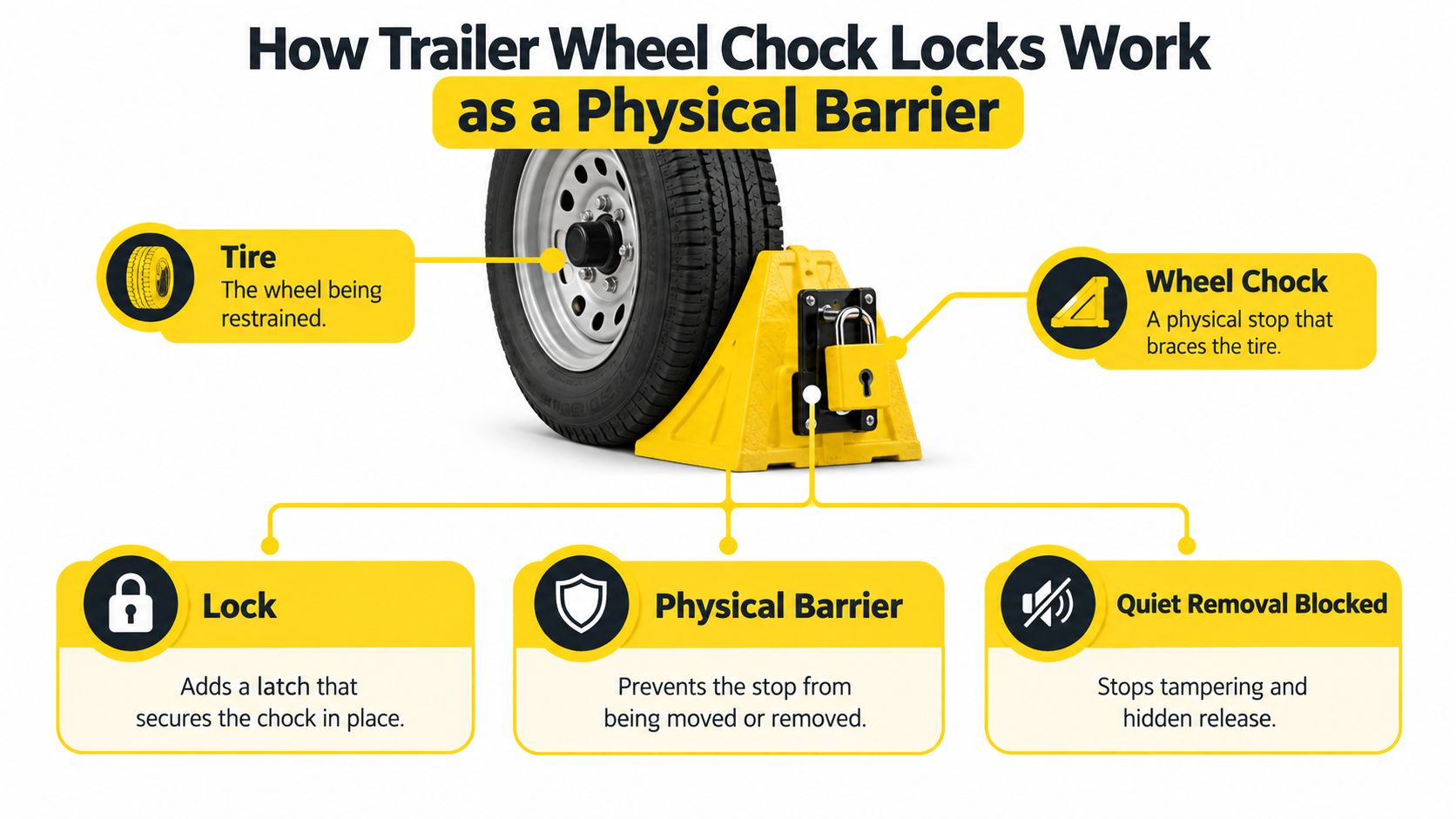
That distinction matters because the locking mechanism and the wheel-contact surfaces do different jobs. Technicians should be able to explain both: how the device opposes movement and how its lock discourages removal. A security feature doesn't establish the capacity of the complete restraint arrangement.
Why the loading-dock history matters
Trailer wheel chock locks make more sense within the history of dock safety than as a separate regulatory product category. The foundational requirements concern preventing movement, not buying a product with a particular name.
Under the loading-dock requirements and enforcement history summarized in Directive STD 1-11.7, 29 CFR 1910.178(k)(1) calls for highway-truck brakes to be set and rear wheels chocked when powered industrial trucks board them; 29 CFR 1910.178(m)(7) addresses wheel blocks or another effective method during loading and unloading. The directive, dated August 5, 1981, recognized positive mechanical securing systems that provide protection equivalent to chocks.
The practical lesson is straightforward: evaluate the whole method, including its installation and use. Don't read the presence of a lock as evidence that every operating condition has been addressed.
Separate the barrier from the release control
At the wheel, ask the technician to identify the parts that contact the tire and the parts that hold the device closed. Then check the manufacturer's instructions against the actual application rather than relying on appearance.
- Physical engagement: Confirm where the device bears against the tire.
- Locking engagement: Confirm how the device stays in its intended position.
- Operational release: Establish who authorizes removal and who verifies that work has stopped.
Use the following video as a visual reference, while keeping product-specific instructions and the site's securing procedure in control of the job.
Comparing Chock Lock Types and Dock Restraint Options
Choose the equipment around the operation, not around how substantial the lock looks. A warehouse dock, an unattended storage trailer, and a Walking Floor trailer at a transfer station present different questions about access, security, and restraint.
The comparison below helps separate equipment form from its intended use.
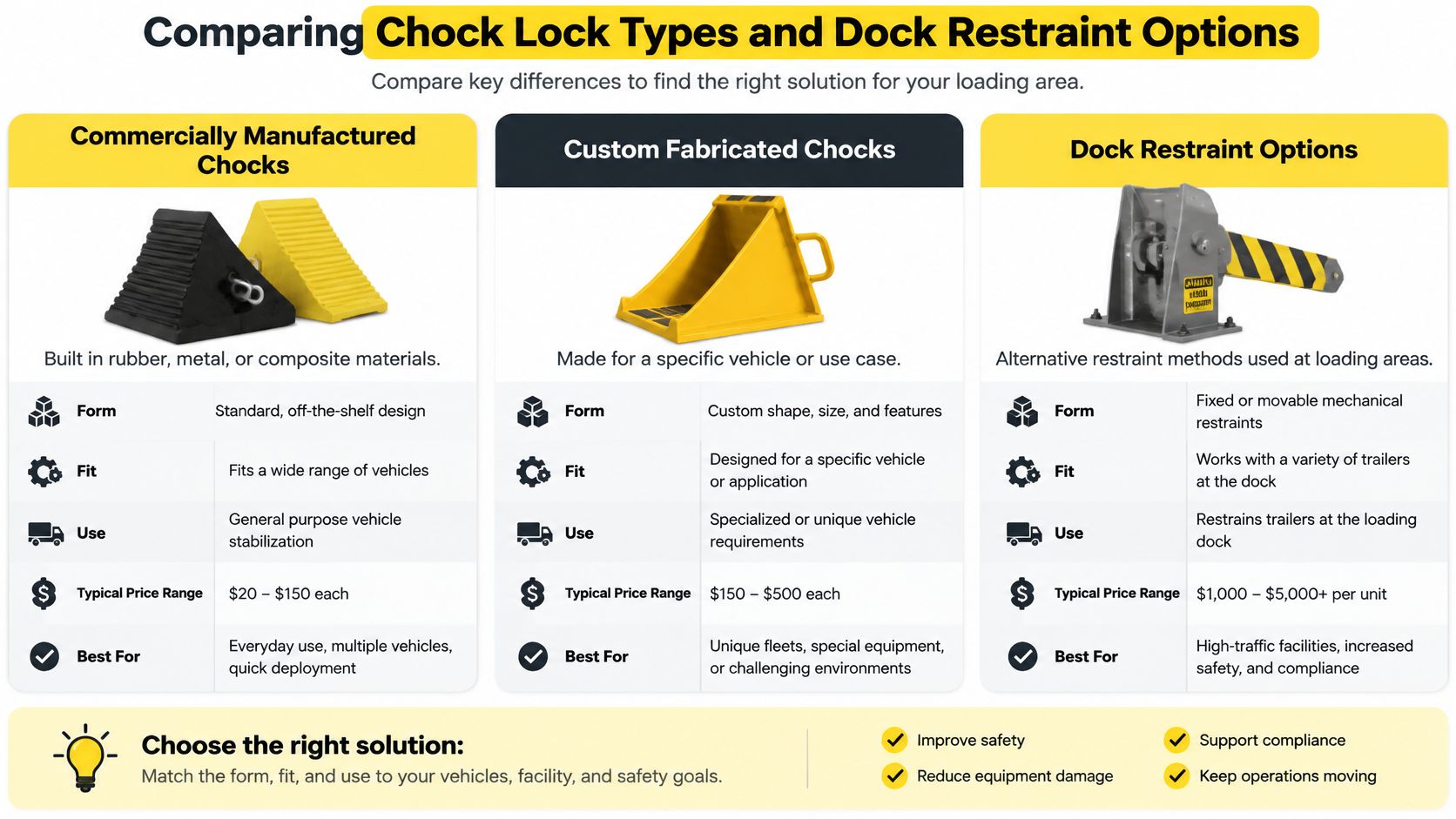
Compare functions rather than labels
| Option | What to evaluate | What not to assume |
|---|---|---|
| Commercially manufactured chock | Dimensions, material, intended application, and placement instructions | A familiar wedge shape proves suitability |
| Locking chock | Tire engagement, release control, and locking-mechanism condition | Resistance to removal establishes dock-restraint equivalence |
| Positive mechanical dock restraint | Compatibility with the trailer and dock, engagement, and maintenance | Installed equipment is necessarily engaged and serviceable |
| Application-specific fabricated component | Defined dimensions, intended function, and documented acceptance criteria | Custom fabrication automatically establishes compliance |
Commercially manufactured chocks may use rubber, plastic, steel, or aluminum. Minnesota's wheel-chock and mechanical-restraint guidance recognizes those materials and emphasizes that mechanical alternatives must remain in good repair.
Material alone isn't a selection method. A steel device with the wrong geometry isn't preferable just because it looks stronger, and aluminum fabrication still requires an appropriate design for the intended job.
Match the security need to the operating need
For an unattended trailer, controlled removal may be a major buying consideration. For forklift loading, the deciding issue is the effectiveness of the securing arrangement. A pick-resistant mechanism addresses interference with the lock, not every possible cause of trailer movement.
Buying rule: Ask what the device is designed to restrain, under what conditions, and how the manufacturer requires it to be installed.
A standard product is a reasonable starting point when its documented application and dimensions match the trailer. When they don't, stop before modifying it in the yard. Treat an interference problem, damaged mounting area, or cracked trailer structure as a repair or engineering question.
For shop planning, separate structural trailer repair, aluminum welding, custom fabrication, and parts sourcing into distinct work items. That gives maintenance personnel a clearer job scope than asking someone to “make the chock fit,” especially around Walking Floor equipment and previously repaired trailer structures.
How to Choose the Right Chock Lock Fit and Size
Fitment is a measured requirement, not a universal-accessory choice. Before ordering, bring the actual tire dimensions and wheel-area measurements to the parts counter. A tire designation alone shouldn't replace checking the device's stated fitment method.
The documented example below illustrates why. These are specifications for a particular design, not recommended dimensions for every commercial trailer.
Example chock lock fitment specifications
| Specification | Documented value |
|---|---|
| Opening, reach, and stated tire fit | Approximately 7 inches locked, 11.25 inches unlocked, 10.5-inch reach, and a stated 7- to 11.25-inch tire-size fit range |
| Padlock interface on the documented model | The same manufacturer sheet specifies a 0.373-inch opening for a 5/16-inch or smaller shackle |
| Construction and lock description | Heavy-gauge powder-coated steel with a pick-resistant locking mechanism |
Treat those specifications as a prompt to measure, not as evidence that the model suits a semi-trailer. Also distinguish the stated opening from the reach: those dimensions describe different parts of the device's geometry.
Measure the tire and the surrounding space
Start with the tire section and sidewall profile where the device is intended to engage. Compare those measurements with the manufacturer's instructions, then check whether the lock reaches its designed position without forcing the mechanism.
- Check access: Measure clearance around mudflaps and wheel-end components.
- Check operating clearance: Account for suspension movement rather than judging only the parked appearance.
- Check the lock interface: Verify shackle compatibility before purchasing a separate padlock.
- Check removal: Confirm the installed device can't be lifted or worked off without deliberate disengagement.
A device that's too narrow may not seat fully. One that's too wide can permit movement before its jaws bear evenly, creating concerns about bending or slipping. Don't correct either problem by improvising spacers or altering the locking parts without an approved design.
Dual tires require a separate check. Minnesota's dual-wheel chock guidance specifies that the chock must be long enough to span both tires in the dual-wheel set on each side.
Record the verified combination in the trailer's preventive-maintenance file. For Tampa Bay fleets, include the device identification, tire compatibility, clearance observations, and condition after corrosive exposure or repeated use in unpaved loading areas. That record helps the next technician distinguish an approved combination from a device borrowed from another trailer.
Understanding When Compliance Rules Require Chocks
A locked chock answers a security question: who can remove the device. A compliance rule answers a different question: what keeps the trailer from moving while work is being done. Mixing those two questions is how fleets end up buying hardware for a problem the hardware does not solve.
The federal parking-brake rule is the starting point. 49 CFR 393.41(a) requires commercial motor vehicles manufactured since March 1990 to have a parking-brake system capable of holding the vehicle or combination under any loading condition; agricultural-commodity trailers, converter dollies, heavy haulers, and pulpwood trailers receive separate chocking treatment, as explained in the parking-brake and dock-securing enforcement clarification. That distinction matters to mixed fleets because a rule applicable to one equipment category should not be copied across every asset without checking classification.
Understand the overlap before writing a policy
OSHA's dock rule is task based. When a powered industrial truck boards a truck or trailer, the loading rule looks for a secured vehicle, and the agency's interpretation addressing commercial vehicles and wheel chocking ties that analysis to the vehicle, the brake system, and the work being performed rather than to one universal device. The enforcement clarification linked above also recognizes situations where a spring parking-brake system or an engaged dock lock serves as the securing method for covered trucks and trailers at the dock.
The practical lesson is narrower than “chocks are optional” and narrower than “chocks are always required.” Classify the trailer first, then confirm which securing method the site and the rule expect for that activity. A yard move, a dock load with a forklift, and an unhitched trailer waiting for pickup are three different restraint problems.
Use a written applicability review rather than a verbal rule passed between shifts:
- Vehicle status: Establish whether the equipment falls within the relevant commercial-motor-vehicle category or an exception.
- Loading activity: Identify whether a powered industrial truck will enter or load the trailer.
- Coupling status: Record whether the trailer remains connected to its tractor.
- Site conditions: Review dock equipment, grade, and the location where loading occurs.
- Local procedure: Obtain the customer's or facility's written securing and release requirements.
A lock is not a compliance label
A chock lock can be the right purchase and still be the wrong answer to the wrong question. If the parking brake is not set, the dock restraint is not engaged, or the chock does not match the tire arrangement, locking the chock in place only preserves a bad setup. The lock controls removal. It does not create restraint.
Keep the purchase justification honest. Choose locking chocks for accountability and tamper resistance where they fit the restraint plan, and record the intended application in the maintenance file. When applicability is uncertain, have the safety lead resolve it with the responsible regulatory authority before the next trailer reaches the dock.
Placing, Inspecting, and Storing Chock Locks
A useful chock-lock routine should be repeatable by the driver, dock crew, and maintenance technician. Give each person a defined check rather than expecting the last person near the wheel to take responsibility.
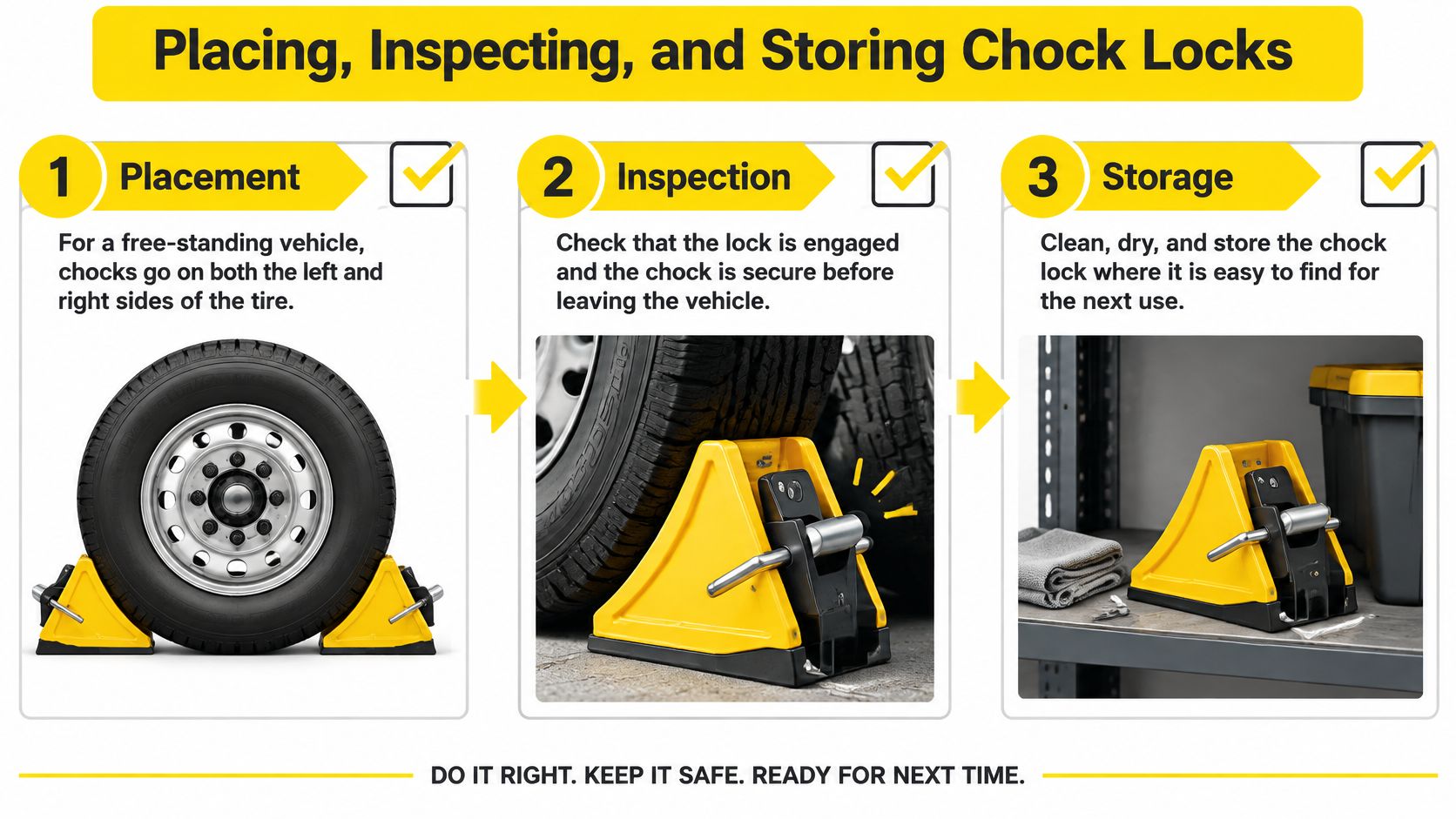
Use the placement, inspection, and storage sequence as a daily handoff aid.
Placement before work begins
For a free-standing vehicle, USDA guidance calls for chocks at the left and right rear axle wheels and identifies drivers, dock workers, and forklift operators as sharing responsibility for verification. Its chocking and blocking safety guidance covers loading, unloading, hitching, unhitching, service, and maintenance.
Follow the applicable equipment instructions and site procedure for the actual arrangement. Before dock work, separately verify brake application, dock-restraint engagement where fitted, landing-gear condition, and the trailer's connection status.
For Walking Floor maintenance, keep restraint verification distinct from the repair task. Troubleshooting hydraulics or inspecting slats doesn't remove the need to establish how the trailer is secured.
Inspection before accepting the device
Inspect the jaws, hinge or adjustment mechanism, locking cylinder, welds, and contact surfaces. Look for deformation, corrosion, packed debris, and incomplete engagement, using the maintenance principles in the earlier mechanical-restraint guidance.
- Engagement: Confirm the locking pin or cylinder reaches its designed position.
- Damage: Flag bent components, cracked welds, and distorted contact areas for evaluation.
- Operation: Don't treat a lock gripping the tire as proof that it prevents loading-related movement.
- Recordkeeping: Log defects, corrective action, and return-to-service authorization.
Check again after pressure washing or repeated use on unpaved loading areas. If a mechanism won't operate normally, remove it from use pending evaluation rather than forcing it shut and passing the problem to the next shift.
Storage that keeps equipment available
USDA recommends keeping purpose-designed chocks inside the truck or trailer, or secured at the loading dock. It advises against substitutes such as lumber, rocks, and cinder blocks, as noted in its guidance above.
Shop handoff: Record where the chocks belong, who reported the defect, and whether a serviceable replacement is available.
Use a designated storage location and an identifiable key-control arrangement. Include storage brackets or mounts in the inspection when they're part of the setup, so the next driver doesn't discover missing equipment only after reaching the loading area.
Next Steps for Your Fleet's Chock Lock Program
Build the program around the trailer and its work, not around a preferred accessory. The strongest starting point is an asset record that connects the equipment classification, loading method, approved device, and inspection procedure.
That record should let a replacement driver or technician answer the practical questions without guessing. Which device belongs with this trailer? Where does it go? Who checks it, and what happens when it fails inspection?
Turn the decisions into a usable fleet record
Use the findings from the fitment and applicability checks to establish an approved arrangement for each relevant trailer configuration. Keep the instructions accessible to both dispatch and maintenance rather than storing them only with purchasing paperwork.
- Identify the application: Record commercial-vehicle status, loading method, coupling arrangement, and site requirements.
- Approve the fit: Retain tire measurements, dual-wheel checks, and manufacturer instructions.
- Assign responsibility: Name the roles responsible for placement, verification, release, and defect reporting.
- Document condition: Add chock locks, related mounts, and storage locations to preventive-maintenance inspections.
- Control substitutions: Require review before moving a different device onto the trailer.
Avoid a form that asks only whether a chock is present. Presence is easy to check, but it doesn't tell the mechanic whether the equipment is the approved unit or whether a known defect remains unresolved.
Keep repair decisions separate from improvisation
If the current device doesn't fit, document the interference before ordering another one. Photographs and measurements of the tire area, mounting location, and damaged components give the workshop a more useful starting point than a request for a larger lock.
For structural or aluminum damage, define the repair scope separately from the accessory selection. A mounting problem may require fabrication, while a damaged trailer structure requires its own assessment. Don't assume that repairing one automatically resolves the other.
The same discipline applies to Walking Floor fleets. Keep hydraulic, floor, brake, suspension, and restraint observations identifiable in the maintenance record so technicians can address the actual defects instead of treating every symptom as part of the chock-lock problem.
A chock lock supplements the parking brake and the applicable dock-securing arrangement; it doesn't replace them. Use the lock as a controlled component in a documented process, with an explicit path for inspection, repair, replacement, and storage. That gives drivers and shop personnel something more dependable than the sound of a latch closing.
Brothers Truck Trailer Repair and Welding Corp. offers truck and trailer maintenance, Walking Floor diagnostics and repair, structural repairs, aluminum welding, custom fabrication, and an on-hand parts catalog. If your chock doesn't fit, or a lock or mount shows wear, corrosion, or weld damage, visit Brothers Truck Trailer Repair and Welding Corp. to discuss a trailer inspection, fitment requirements, and the appropriate repair or parts options.
Learn how to load a trailer with equipment-specific weight limits, axle checks, tiedown calculations, cargo securement, and pre-trip inspections.
Weight of Utility Trailer. Learn utility trailer weight ranges, payload calculations, tongue load, axle limits, and permit checks for safer fleet operations
Plan truck and trailer maintenance in Tampa with practical inspection, brake, Walking Floor, aluminum repair, and parts checks to reduce avoidable downtime.