Weight of Utility Trailer: A Fleet Operations Guide
Most listings answer the weight of utility trailer question with one tidy number. That number is almost never the one that decides whether you can dispatch the load safely. A trailer you weigh empty in the yard runs loaded with dense cargo, tools, ramps, a spare tire, and welded additions, and each of those items changes what the axles, tires, hitch, and tow vehicle carry. Treating a catalog figure as a towing clearance skips the ratings that protect the frame and the running gear.
Fleet teams can't afford that shortcut. You need to know what the trailer weighs empty, what it's rated to weigh fully loaded, how much each axle can carry, and how much lands on the hitch. Those are four different questions, and a load that's fine on one can fail on another.
Table of Contents
- Why Utility Trailer Weight Is More Than One Number
- Typical Utility Trailer Weights by Configuration
- Understanding GVWR, GVW, GAWR, and Payload
- Calculating Payload With Worked Examples
- Measure Empty Weight and Actual Payload
- How Repairs and Upgrades Reduce Remaining Payload
- Tongue Weight and Load Distribution
- Trailer Ratings and Commercial Combination Limits
- Permits, Inspections, and Return-to-Service Checks
- Quick Reference for Weights, Payload, and Safety
Why Utility Trailer Weight Is More Than One Number
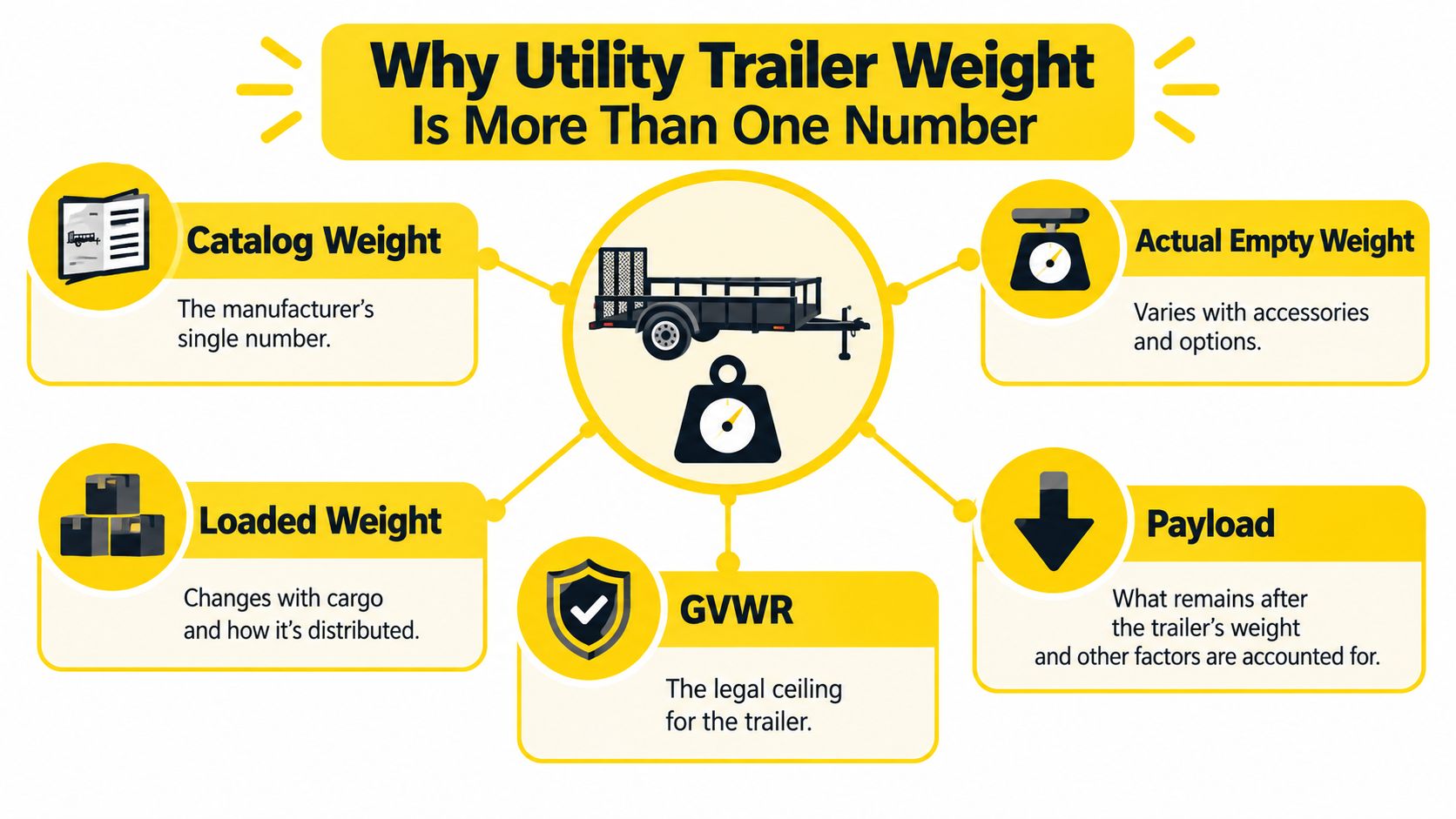
A single advertised weight tells you almost nothing about remaining capacity. Empty weight, payload, GVWR, GAWR, and tongue weight answer different dispatch questions, and mixing them up is how a deck that doesn't look full ends up over its rating.
The Different Jobs Each Number Does
- Empty or curb weight: What the trailer weighs with its baseline equipment, before cargo.
- Payload: What you can still add after the trailer itself is accounted for.
- GVWR: The ceiling for the fully loaded trailer, including cargo and accessories.
- GAWR: The limit for an individual axle system, measured where the tires meet the ground.
- Tongue weight: The share carried by the hitch instead of the trailer axles.
Your allowable loaded weight isn't set by the highest number on the plate. The allowable loaded weight is limited by the lowest applicable rating among the GVWR, axle ratings, wheels, tires, coupler, and frame, as explained in NHTSA guidance on trailer weight definitions and ratings. That's the rule that matters in the shop.
Practical rule: Find the empty weight, the fully loaded rating, the axle and component limits, and the hitch load. If any one fails, the combination fails.
Construction and landscaping loads expose the gap fast. Dense materials can reach the payload limit before the deck looks full, while a physically small trailer can be harder to tow safely than a larger one if its payload or tongue load is misunderstood.
Typical Utility Trailer Weights by Configuration
Published specifications show how wide the range runs once you vary size and axle count. Empty weights span from roughly 780 pounds for a small single-axle model to approximately 2,595 pounds for larger tandem-axle models, with GVWRs from about 2,995 pounds to 9,899 pounds, according to published utility trailer model specifications from Nationwide Trailers. Those are orientation points, not clearances for your unit.
What Moves Empty Weight Up or Down
Frame material sets the baseline. Steel structures, aluminum body work, and heavier deck sections don't weigh the same, and neither do the repairs that replace them. Deck dimensions add metal with every extra foot of length and width. Axle configuration changes both empty weight and rating, since a tandem setup carries a second axle, additional suspension, wheels, tires, and often brakes.
Installed options are where estimates drift. Ramps, spare tires, toolboxes, brake packages, enclosed panels, hydraulic components, and walking-floor assemblies all ride on the trailer every trip. None of them shows up in a bare catalog figure for a base model, but all of them consume payload.
Single Axle Versus Tandem Axle in Practice
A small single-axle trailer suits lighter, bulkier work where deck space runs out before weight does. Larger tandem-axle models suit denser or heavier equipment, and they spread load across more tires, but they also start heavier empty. That trade-off is why a bigger deck doesn't automatically mean more usable capacity for a specific load.
Read the VIN plate and manufacturer documentation for the exact unit in front of you. A broad category range can't confirm that a particular trailer, in its current configuration, is safe for a particular load.
Understanding GVWR, GVW, GAWR, and Payload
Shop conversations go sideways when four terms get used as synonyms. They aren't. Getting them straight prevents the most consequential error in trailer loading, which is reading GVWR as the amount of cargo you may carry.
Definitions You Can Use at Intake
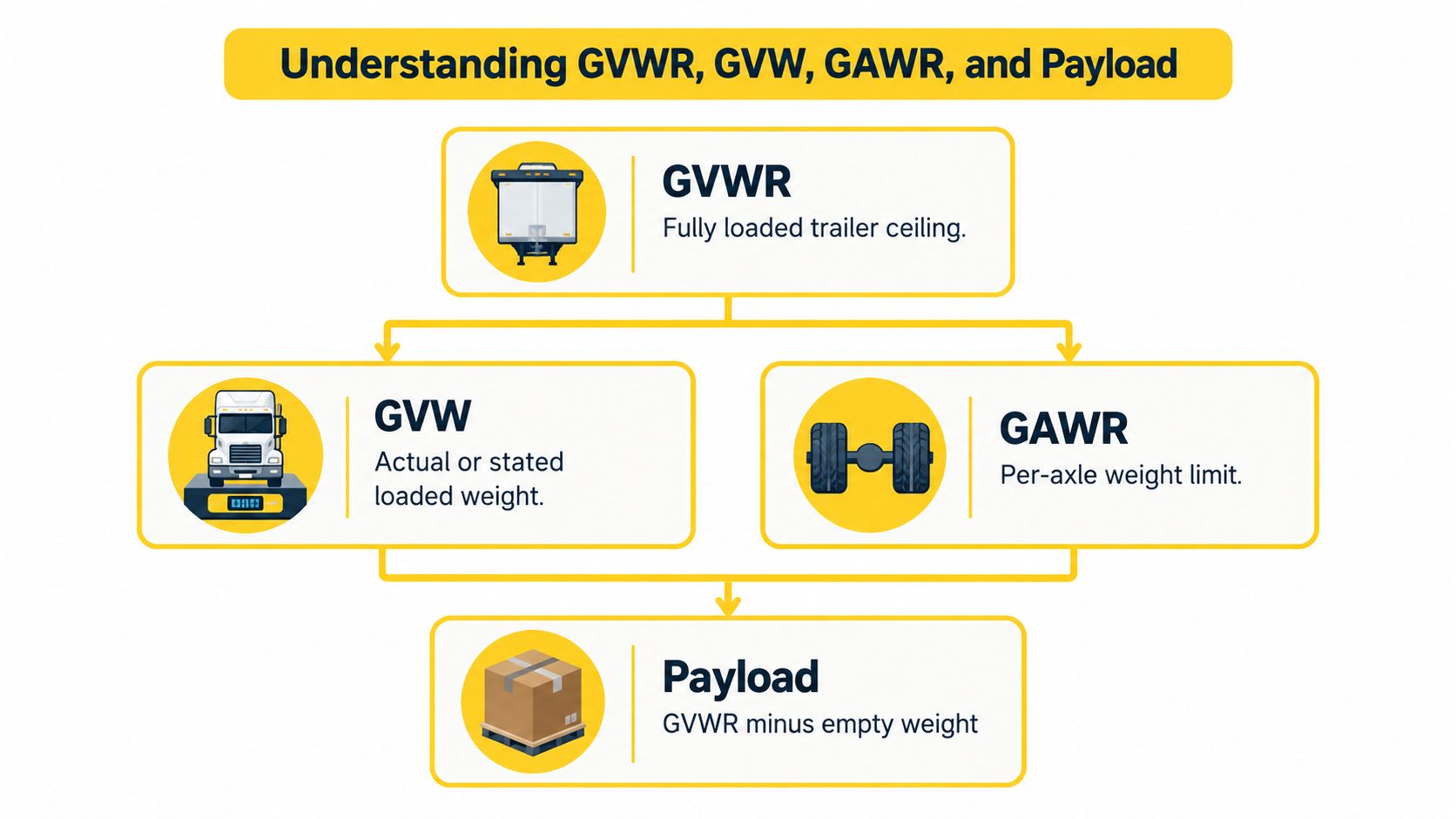
- GVWR: The manufacturer-specified maximum loaded weight of the complete trailer. It's a ceiling, not a cargo allowance.
- GVW: The actual or stated loaded weight at a given moment. This is the number a scale gives you.
- GAWR: The maximum load assigned to an individual axle system, measured at the tire and ground interfaces.
- Payload: Usable capacity, starting with GVWR minus empty weight.
- Empty or curb weight: The trailer with its baseline equipment and no cargo.
- GCWR: The combined rating covering tow vehicle and trailer together, distinct from the trailer's own GVWR.
NHTSA defines trailer GVWR as the empty trailer weight plus its rated cargo load, and cautions that dry or empty weight alone is insufficient for selecting a tow vehicle, as set out in NHTSA interpretation on GVWR and dry weight. You need the fully loaded figure, including cargo, equipment, fuel, and passengers in the tow vehicle.
The Working Formula
- Record GVWR and each GAWR from the VIN plate before loading or repair planning.
- Weigh the trailer empty in its normal operating configuration.
- Subtract empty weight from GVWR to get theoretical payload.
- Compare against every component rating and treat the lowest as the operating ceiling.
A rating is a limit set by the manufacturer. A scale reading is a measurement. Confusing the two is how overloads get documented as compliant.
Keep trailer ratings separate from tow vehicle ratings. The trailer's GVWR doesn't ask what your truck can carry, and the truck's ratings don't raise the trailer's ceiling.
Calculating Payload With Worked Examples
Two published examples show how quickly the arithmetic separates a rating from usable capacity. Both use the same formula, GVWR minus empty weight equals theoretical payload, and both stop short of being a dispatch clearance.
Side by Side Comparison
| Item | Small single-axle example | Larger tandem-axle example |
|---|---|---|
| Empty weight | 780 pounds | 2,595 pounds |
| GVWR | 2,995 pounds | 9,899 pounds |
| Theoretical payload | About 2,215 pounds | About 7,304 pounds |
The tandem model carries far more in absolute terms. It also starts more than three times heavier empty, so a larger share of its rating is already spent on its own structure, axles, and running gear before you load anything.
The small trailer makes the opposite point. Its rating looks modest, yet most of that rating remains available for cargo because the trailer itself is light. If you're hauling dense material, that remaining share is the number that decides the trip, not deck size.
Why Theoretical Payload Isn't Guaranteed Payload
Call these figures theoretical for a reason. GAWR, tires, wheels, coupler, frame, and hitch ratings can each impose a lower operating ceiling than the subtraction suggests. A trailer can sit under GVWR in total and still overload one axle or one tire through poor placement.
Accessories come out of the same pool. List permanently carried equipment first, including toolboxes, spares, ramps, and any fluids, then estimate cargo against what's left. If the remainder doesn't cover the load with margin, the answer is a different trailer or a second trip, not a creative reading of the plate.
Use these examples for quick estimates in the yard. Verify with actual scale readings before towing or releasing equipment to service.
Measure Empty Weight and Actual Payload
Estimates don't survive contact with wet aggregate or a toolbox nobody logged. A repeatable weighing routine turns the weight of utility trailer question into a record you can defend at dispatch.
A Repeatable Weighing Procedure
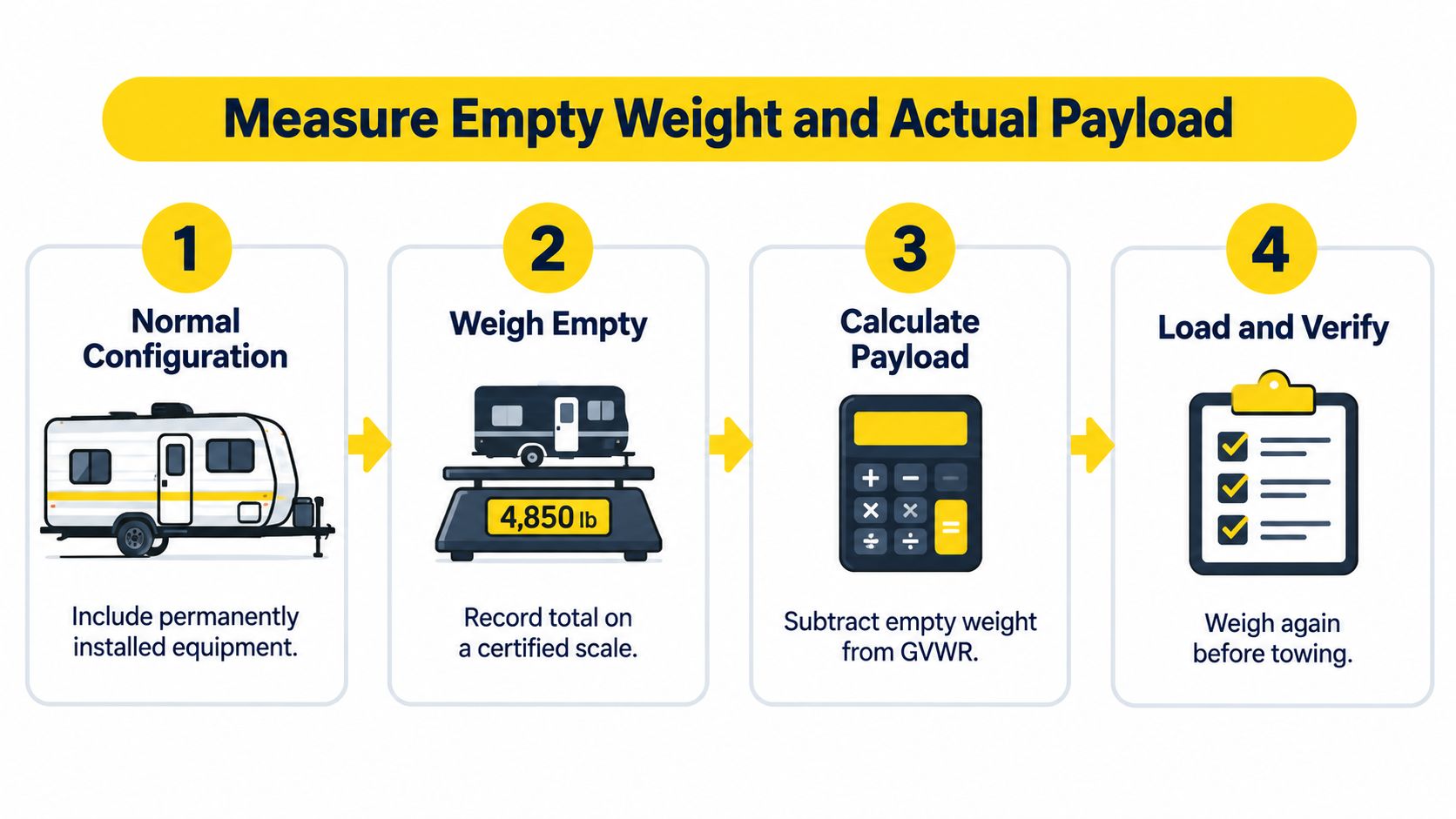
- Set the normal configuration: Include floor structure, ramps, toolboxes, spare tires, hydraulic equipment, and other accessories carried on every run.
- Weigh empty at a certified scale: Record the total, and capture axle and hitch readings where the scale setup allows.
- Calculate remaining payload: Subtract that configured empty weight from GVWR, then check it against each GAWR and tire rating.
- Load and weigh again: Compare the loaded result with GVWR, axle ratings, and hitch limits before dispatch.
Don't turn an estimate into a compliance record. Where cargo weight is unknown, get a direct measurement instead of guessing from volume. Dense loads are exactly where volume misleads.
Documenting the Configuration for Repair Work
Record the pre-repair configuration at intake, including installed equipment and empty weight if you can capture it. That baseline lets the next technician distinguish original specification from weight added later by flooring, welded components, or accessory installs.
Shop habit: Weigh in the configuration you actually operate. A dry figure for a trailer that never runs dry is decoration, not data.
Weighing also catches drift over a trailer's life. Equipment accumulates, floors get replaced, and panels get repaired. A current scale ticket tells you what you're dispatching today, not what left the factory.
How Repairs and Upgrades Reduce Remaining Payload
A plate rating doesn't change when you weld in new structure. Your remaining payload does. Every pound added in the shop is a pound subtracted from cargo, whether or not anyone updates the paperwork.

Where Added Weight Hides
- Replacement flooring: Heavier deck material or added crossmembers raise empty weight across the whole deck.
- Aluminum welding and structural fabrication: Reinforced panels, repaired body sections, and custom work add mass even when they restore strength.
- Ramps, toolboxes, and spares: Convenient, permanently carried, and rarely weighed after installation.
- Hydraulic and walking-floor equipment: Slats, drive components, lines, and fluids change the operating configuration substantially.
- Enclosed body additions: Panels and framing convert open capacity into structure you carry on every trip.
None of this means the repair is wrong. It means the repair must be accounted for, checked against the manufacturer's system, and flagged for documentation or engineering review when the change goes beyond restoring original configuration. An axle upgrade doesn't create payload if the frame, coupler, or plate rating still governs.
A Maintenance Log That Tracks Capacity
| Record entry | What to capture |
|---|---|
| Pre-repair empty weight | Scale reading in operating configuration |
| Added components | Each item installed, with its weight |
| Post-repair empty weight | New scale reading before release |
| Remaining payload | GVWR minus post-repair empty weight |
That log keeps a cosmetic upgrade from being mistaken for a harmless one, and it gives dispatch a current capacity instead of a factory-era assumption.
Tongue Weight and Load Distribution
Total weight being legal doesn't mean the trailer is balanced. How the load splits between the hitch and the trailer axles decides handling, and it's the check most often guessed instead of measured.
The Conventional Ball Hitch Benchmark
For a conventional ball-hitch utility trailer, a useful benchmark is approximately 10 to 15% of fully loaded trailer weight on the tongue, per manufacturer towing instructions for conventional ball-hitch trailers. On a trailer weighing 7,000 pounds loaded, that targets about 700 to 1,050 pounds of tongue load, leaving approximately 5,950 to 6,300 pounds on the trailer axle system, subject to GAWR and tire limits, from that same guidance.
NHTSA states the same range, noting that a 3,000-pound loaded trailer produces approximately 300 to 450 pounds at the hitch, and recommends using a public scale to compare the tow vehicle alone against the hitched combination, according to NHTSA guidance on tongue weight and public scale verification. That's how you calculate tongue weight instead of guessing it.
What Goes Wrong at Either Extreme
Too little tongue weight can promote sway. Too much can unload the tow vehicle's steering axle and impair handling. Both failures can occur while total trailer weight sits comfortably under GVWR.
Tongue load also consumes the tow vehicle's payload and rear-axle capacity. A truck can be below its advertised tow rating and still be overloaded at the rear axle once passengers, tools, fuel, and cargo go in.
- Load heavy items low: Keep the center of gravity down and centered laterally.
- Position weight over or slightly forward of the axle group: Achieve the tongue percentage without piling everything at the front.
- Adjust for uneven materials: Aggregate, landscaping debris, wet loads, and front-heavy equipment shift distribution in ways a level deck hides.
- Measure at coupled height: Check tongue weight with the trailer level, as it will run.
Safe trailer weight isn't one number. It's where loaded weight, tongue percentage, axle distribution, hitch rating, and door-label ratings all agree.
Trailer Ratings and Commercial Combination Limits
A utility trailer's GVWR and federal combination limits govern different things. Confusing them leads fleet managers to treat a trailer plate as a complete legal answer. It isn't.
Two Frameworks, Two Scopes
The trailer's GVWR covers only the fully loaded trailer and excludes the tow vehicle. Federal Interstate rules address the combined vehicle in commercial trucking. The Federal-Aid Highway Act of 1956 established foundational Interstate limits of 18,000 pounds for a single axle, 32,000 pounds for a tandem axle, and 73,280 pounds gross, and later amendments effective in 1975 raised single and tandem limits to 20,000 and 34,000 pounds, as summarized in federal history of Interstate weight limits. Current federal references commonly summarize the framework as an 80,000-pound gross ceiling, 20,000 pounds on a single axle, 34,000 pounds on a tandem axle, plus Bridge Formula limits based on axle spacing, per that same summary.
Those figures are regulatory context for commercial combinations. They don't raise your trailer's rating, and your trailer's rating doesn't authorize an overloaded tow vehicle.
What Fleet Managers Must Check Together
- Trailer GVWR and GAWR: The manufacturer's ceiling for the trailer and each axle system.
- Tow vehicle GVWR, GAWR, and hitch limits: The truck's own ceilings, including rear axle load from the tongue.
- Combination and Bridge Formula limits: Applicable where commercial combination rules govern the route.
- State and local requirements: Additional constraints may apply beyond the federal Interstate framework.
Added equipment and repair work sit inside all of these at once. A walking-floor installation, hydraulic addition, or structural repair that's fine against the trailer plate still has to clear axle, bridge, and combination limits for the specific dispatch. Evaluate the trailer, the truck, and the route together before treating any single rating as clearance.
Permits, Inspections, and Return-to-Service Checks
Weight verification only protects you if it gates the dispatch decision. Build it into a return-to-service routine that runs after repair, after storage, and before any load that pushes near a rating.
The Decision Sequence
- Read the VIN plate: Confirm GVWR and each GAWR for the specific unit.
- Compare scale readings: Check empty and loaded weights against payload, axle, tire, and hitch limits.
- Verify tongue and combined weight: Confirm both before dispatch, not after the first mile.
- Address permits for the route: Confirm state or local requirements for the specific combination, since no single federal number replaces that review.
Don't treat the brake threshold as a loading limit. Under FMCSA regulation 49 CFR 393.42(b)(3) on trailer brake equipment, a trailer with a gross weight of 3,000 pounds or less must be equipped with brakes. That's an equipment threshold. Manufacturer ratings and state requirements may impose additional limits.
Maintenance Release Checklist
- Brakes, tires, and wheel ends: Inspect together, since excess weight increases stopping demand and exposes defects across the running gear.
- Suspension and fasteners: Check bushings, alignment, and corrosion, especially after idle periods.
- Lighting and electrical: Test the plug, ground circuit, brake lights, and turn signals at every connection.
- Welded or fabricated areas: Recheck harnesses and grounds disturbed during aluminum repair or panel replacement.
Trailer light connection failure is identified as a common problem and serious safety hazard in NHTSA safety advisory guidance on trailer light checks, which specifically advises checking brake lights and turn signals. A trailer at correct weight with failed lighting still isn't road ready.
Stored equipment needs the same scrutiny. Suspensions left idle for prolonged periods must be inspected before renewed operation, including trailers used for storage or submerged in water, according to suspension preventive maintenance guidance in the NHTSA technical service bulletin repository. Document that inspection so pre-existing deterioration is distinguishable from damage on the next haul.
Quick Reference for Weights, Payload, and Safety
Keep this where dispatch and shop handoffs happen. It condenses the checks without replacing the scale ticket or the plate.
Definitions at a Glance
- Empty weight: Trailer with baseline equipment, no cargo.
- Payload: GVWR minus empty weight, then limited by the lowest component rating.
- GVW: Actual loaded weight on the scale.
- GVWR: Maximum permitted fully loaded trailer weight.
- GAWR: Maximum load for an individual axle system.
- Tongue weight: Load carried at the hitch, benchmarked at roughly 10 to 15% for conventional ball hitches.
- GCWR: Combined rating for tow vehicle and trailer together.
The Formula and the Records to Keep
Theoretical payload equals GVWR minus configured empty weight. Then verify against GAWR, tires, wheels, coupler, frame, hitch, and tow vehicle ratings, and weigh the loaded combination before dispatch.
Retain these records for each unit:
- VIN plate values: GVWR and each GAWR as listed.
- Configured empty weight: Current scale reading with installed equipment.
- Loaded readings: Total weight, axle weights, and hitch load per dispatch.
- Service history: Inspection findings, repairs, fabrication, and added components with weights.
For detail, revisit the configuration ranges, the measurement procedure, the repair and payload effects, tongue weight distribution, and the permit and inspection gate in the sections above. Every decision stays tied to verified manufacturer ratings and applicable requirements, not to a catalog average.
If a floor replacement, structural repair, or walking-floor installation has changed what your trailer weighs empty, Brothers Truck Trailer Repair and Welding Corp. can help you sort the repair work from the rating questions, with trailer repair, aluminum welding, custom fabrication, and Walking Floor service for fleets and owner-operators. Bring the unit in for inspection and repair planning so the work, the added components, and your remaining payload are documented before the trailer goes back into service.
Plan truck and trailer maintenance in Tampa with practical inspection, brake, Walking Floor, aluminum repair, and parts checks to reduce avoidable downtime.

Practical guide to semi trailer tail lights covering types, FMVSS No. 108 requirements, wiring basics, troubleshooting, and step-by-step replacement procedures.
Get trailer coupling bolts right with this fleet guide to specs, torque procedures, inspection intervals, and pre-tow safety checks for North American trailers.