Truck and Trailer Maintenance in Tampa That Cuts Downtime
Dispatch is calling, a driver is waiting beside a loaded trailer, and the Walking Floor unit parked outside still needs a hydraulic diagnosis. Meanwhile, the tractor scheduled to leave next has a brake concern that nobody has closed out. That's where truck and trailer maintenance in Tampa gets practical: deciding what can leave, what needs a bay, and what information is missing before anyone authorizes parts.
Table of Contents
- The Tampa Maintenance Reality Most Guides Skip
- Building the Inspection Routine That Actually Holds Up
- Truck Systems That Decide Whether a Unit Rolls
- Diagnosing Walking Floor Trailers the Right Way
- Aluminum Welding and Structural Repair Done Right
- Parts, Inventory, and How Tampa Shops Cut Wait Time
- Choosing and Working With a Tampa Repair Shop
The Tampa Maintenance Reality Most Guides Skip
A maintenance schedule looks orderly until equipment comes back with a problem between service dates. For a regional fleet, owner-operator, construction hauler, or recycling operation, the difficult work isn't printing the schedule. It's handling defects without letting dispatch pressure become the release-to-service decision.
Consider that morning lineup as a planning example, not a completed repair story. The loaded trailer needs a safety decision. The Walking Floor trailer needs fault isolation before a pump gets ordered. The tractor needs measured brake findings, not a note saying someone looked at it.
Those are different jobs with the same operational consequence: unavailable equipment. Treating them all as emergency repairs makes it harder to reserve technician time, identify parts, and explain realistic completion dates.
Roadside readiness belongs in the maintenance plan
Florida's fiscal-year 2025 Commercial Vehicle Safety Plan projected 114,317 driver and vehicle safety inspections, with 25% designated as Level I inspections and 35% as driver-focused Level III inspections, according to the Florida commercial-vehicle inspection plan. Those were statewide projections, not completed Tampa inspection totals.
The distinction matters. A driver-focused inspection and a thorough examination don't ask the same questions, but a fleet needs to be prepared for both. A truck that runs well can still have unresolved vehicle defects or incomplete records.
Tampa-area equipment also works through heat, heavy rain, roadway debris, and changing loads. An oil-service appointment doesn't automatically address a damaged coupling, cracked trailer member, or hydraulic leak discovered during unloading.
A workable program needs clear ownership:
- Drivers report conditions: Identify the unit, location, operating circumstances, and changes from normal behavior.
- Technicians establish the repair scope: Separate the reported symptom from the underlying defect.
- Maintenance controls release: Confirm that required repairs and verification are complete before dispatch assigns the equipment.
Practical rule: Dispatch can explain how urgently a unit is needed. Maintenance must establish whether it's ready.
The trade-off is real. Planned shop time interrupts utilization, and inspecting equipment that still operates can feel unnecessary. But a scheduled interruption gives the fleet control over the load, technician assignment, and repair authorization. Waiting until the equipment can't continue gives that control away.
Building the Inspection Routine That Actually Holds Up
A useful inspection record describes condition, not just attendance. A checked box proves little if the technician can't tell which wheel position was inspected, what was measured, or whether the repair passed verification.
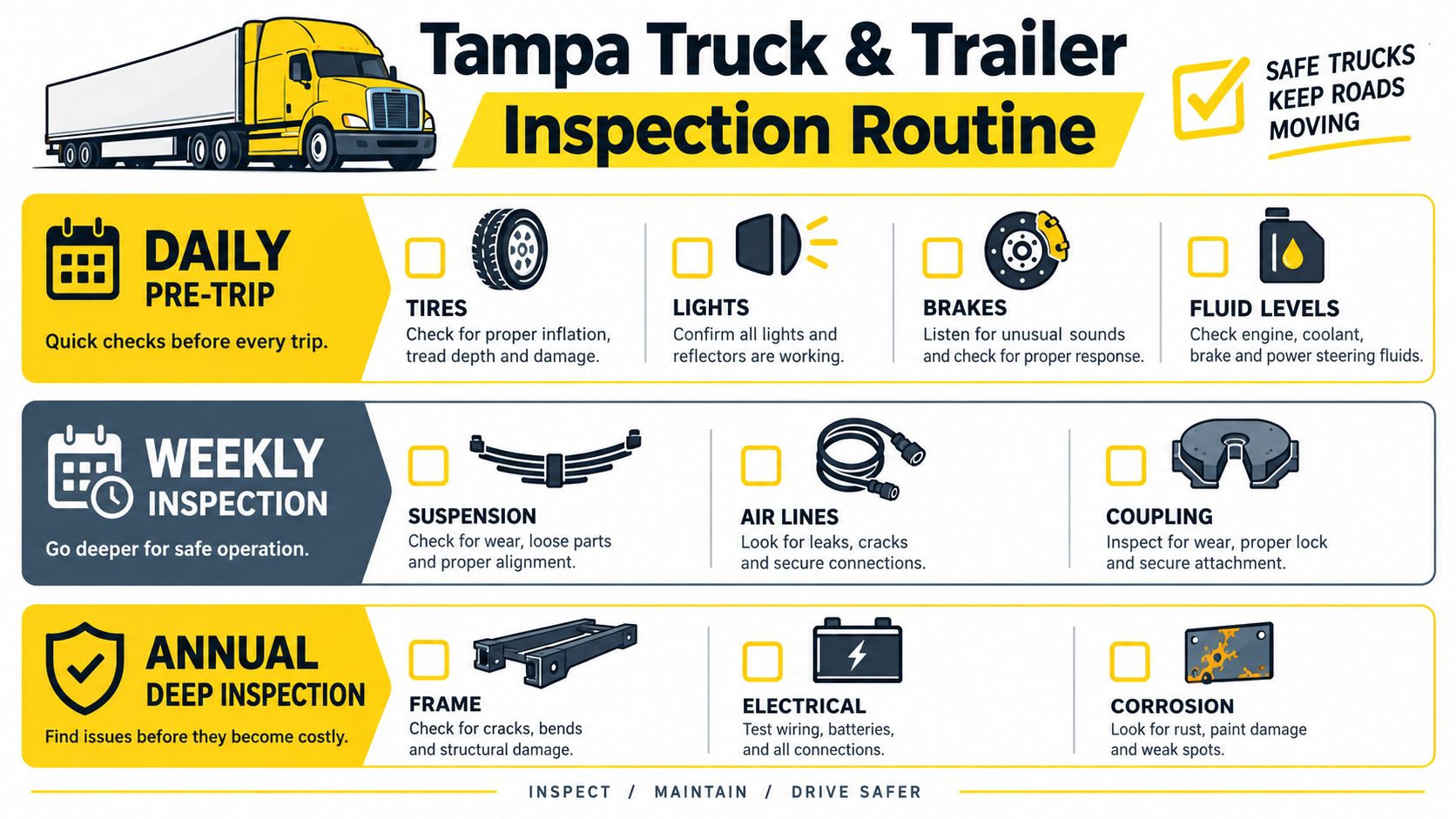
Start with a layered routine rather than asking the annual inspection to carry the whole program. Drivers need a repeatable pre-trip process, technicians need scheduled system checks, and maintenance needs an event-triggered inspection after a curb strike, hard unload, unusual noise, or reported leak.
Use this checklist as a planning aid, then adjust shop frequency to the equipment's manufacturer requirements and actual work.
Inspect by system and trailer zone
On the truck, work through brakes, air lines, suspension, tires, wheels, lighting, coupling devices, and frame condition. On the trailer, follow a physical route through landing gear, coupling, undercarriage, wheel ends, floor, walls, rear structure, and electrical connections. A consistent route helps prevent the easy-to-reach components from getting attention while concealed areas get skipped.
For brake work, record adjustment and lining condition along with drum or rotor findings, hose routing, and leaks. FMCSA's 2021 figures recorded 1,962,717 inspections and 629,170 out-of-service violations, with brake adjustment, defective brakes, damaged brake hoses, and trailer ABS-lamp defects among frequent vehicle violations; the same FMCSA Pocket Guide identifies an out-of-service condition when defective brakes equal or exceed 20% of service brakes on the vehicle or combination.
That threshold is an enforcement criterion, not permission to dispatch equipment with a known brake defect.
Write findings another technician can use
Build the maintenance form around fields that support an actual repair:
- Location and measurement: Unit identification, axle or component position, measured condition, and applicable specification.
- Repair traceability: Component part number, corrective action, technician identification, and relevant photographs.
- Closeout: Post-repair test results, unresolved findings, and release authorization.
Trend recurring findings by unit, route, mileage, and load type. Repeated hose damage should prompt a routing investigation rather than another identical hose installation.
Keep roadside and periodic inspections distinct. Florida's commercial-vehicle enforcement guidance distinguishes North American Standard roadside inspections from federal periodic inspections, because a roadside examination may not cover every periodic-inspection component. That historical statewide material also recorded 8,803 reportable commercial-vehicle crashes and 300 related fatalities in 2016, not a current Tampa-specific risk rate.
Truck Systems That Decide Whether a Unit Rolls
A tractor can start cleanly and still be unfit for its next assignment. Brakes, steering, suspension, tires, and wheel ends need their own release criteria, independent of whether the engine sounds right.
Start brake diagnosis with the measured findings established in the inspection routine. If adjustment is wrong, investigate the mechanism and related components rather than treating adjustment alone as a completed repair. Contaminated linings, damaged hoses, or recurring uneven wear require a cause-and-correction decision.
The previously noted brake out-of-service threshold doesn't establish a safe operating allowance. A technician must assess the specific defect and applicable criteria; a fleet manager shouldn't translate a percentage into permission to finish a load.
Truck System Service Intervals by Duty Cycle
These are scheduling priorities, not universal service intervals. Use manufacturer requirements as the baseline and shorten inspection spacing when condition or operating history warrants it.
| System | Regional P&D | Long-Haul Tractor | Heavy Haul or Off-Road | Out-of-Service Trigger |
|---|---|---|---|---|
| Brakes and air system | Review stop-intensive wear and air-system findings | Coordinate checks with mileage and route returns | Inspect after severe loading or contamination | Applicable brake criteria or unsafe air-system condition |
| Suspension and steering | Track curb-contact and maneuvering complaints | Trend tire wear, handling, and component condition | Examine after impacts and abnormal loading | Unsafe steering condition or compromised load support |
| Tires and wheel ends | Check position-specific wear and seal condition | Coordinate pressure and wheel-end checks with trip planning | Review cuts, impact damage, and contamination | Unsafe tire, wheel, or wheel-end condition |
| Engine fluids and cooling | Account for stop-start work and idle time | Use manufacturer intervals and operating records | Review severe-duty requirements | Condition that makes continued operation unsafe |
| Engine and emissions diagnostics | Investigate recurring faults and operating complaints | Plan diagnosis before extended routes | Evaluate heat and load-related symptoms | Active condition requiring shutdown or restricting safe operation |
Use operating data without replacing inspection
Mileage alone won't describe every truck's workload. Review route conditions, load changes, driver reports, and diagnostic history before moving a service date. Oil analysis can inform fluid decisions when interpreted alongside manufacturer guidance, but it shouldn't become an excuse to extend service without a defensible basis.
During engine diagnosis, preserve fault codes and operating conditions before clearing anything. Connect the complaint to fuel-system behavior, cooling performance, or aftertreatment operation instead of replacing the component named in the first code.
Make the final bay check deliberate:
- Aftertreatment and DEF: Review regeneration history and investigate fluid-quality concerns.
- Wheel ends: Look for seal weep and evidence requiring further inspection.
- Steering and suspension: Check play, bushings, air bags, and attachment condition.
- Verification: Confirm that the original complaint no longer appears under an appropriate test.
A fast bay turn only helps if the truck doesn't return with the same unresolved condition.
Diagnosing Walking Floor Trailers the Right Way
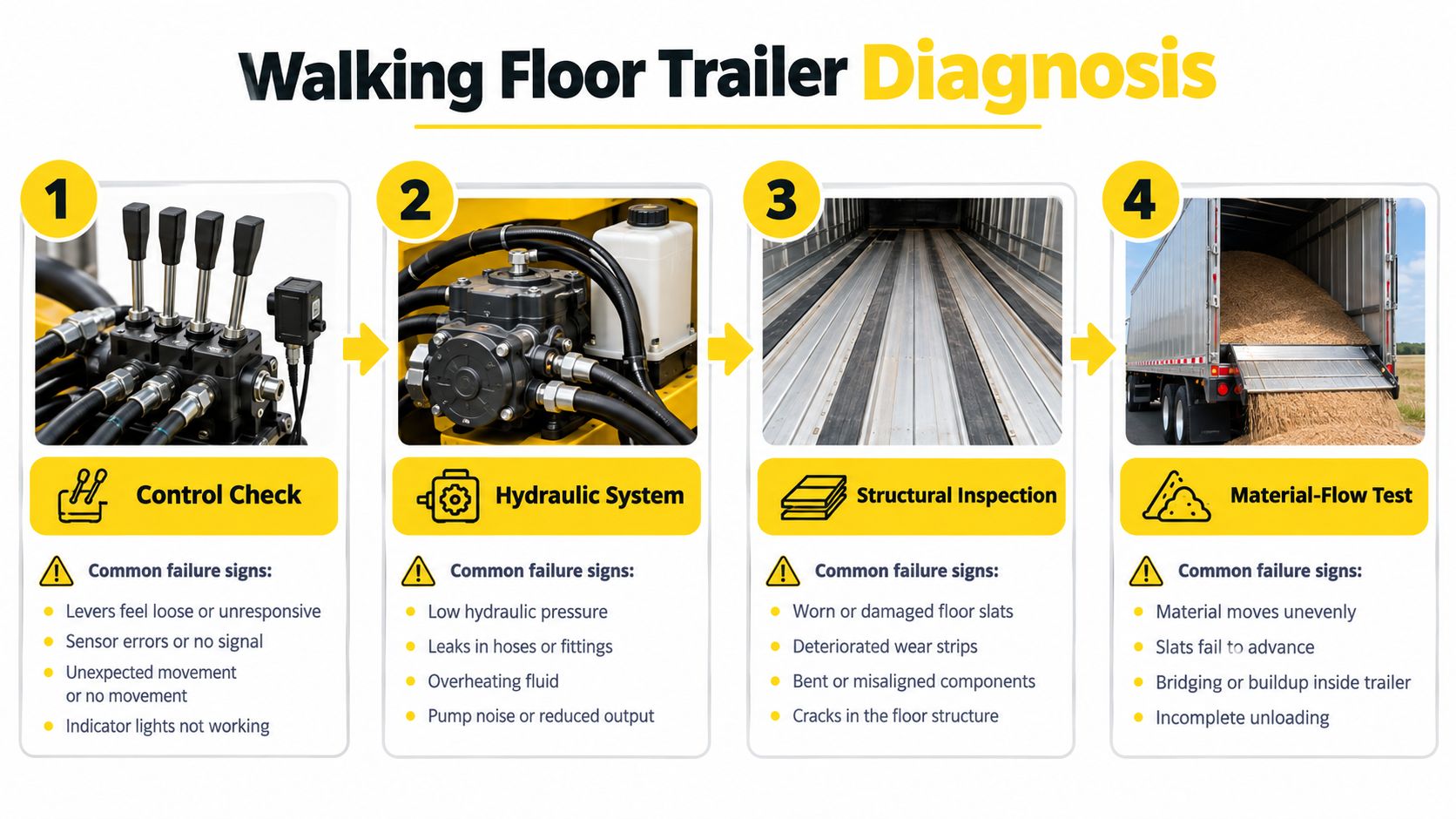
Slow unloading isn't a pump diagnosis. A Walking Floor complaint can originate in controls, fluid supply, hydraulic components, mechanical drag, or the material being discharged. Replacing the most expensive-looking component before separating those possibilities is poor troubleshooting.
Begin by isolating hydraulic energy, chocking the wheels, and properly supporting components that could move. Inspect visible leaks before operating the system, and keep personnel clear during controlled testing.
Use a system-level sequence rather than jumping straight to component replacement.
Establish hydraulic condition before condemning parts
Verify reservoir level and fluid condition, filter restriction, suction-side air entry, hose abrasion, fitting condition, cylinder leakage, and valve operation. Then observe pump noise and pressure during a controlled cycle. Record whether the floor stalls, moves unevenly, or drifts under load.
The KEITH Workhorse owner's manual specifies service after the first 6 operating hours, then every 6 months or 150 operating hours, whichever comes first; it also specifies a 10-micron return-line filter, no component exceeding 70°C during inspection, 170 Nm for cylinder-clamp bolts, and 200 Nm for cylinder-to-frame bolts. These are model-specific requirements, not settings to apply indiscriminately across Walking Floor systems.
A filter rating isn't a complete fluid-cleanliness diagnosis. Confirm the installed system's manual, fluid compatibility, and contamination-control requirements before selecting oil, filters, or replacement components.
Separate hydraulic weakness from mechanical resistance
Uneven movement should send the technician beneath the symptom: inspect slat fasteners, guides, bearings, crossmembers, seals, and accumulated debris. The KEITH Running Floor II maintenance guidance specifically calls for checking hydraulic leaks, loose or bent slats, floor-bearing wear, operation in both directions, and fastener torque.
Don't ask a replacement pump to overcome a floor that still binds.
Before blaming the trailer, check the tractor's wet kit. KEITH's troubleshooting guidance recommends a minimum 40-gallon, or 151-liter, reservoir and calls for correctly sized, undamaged quick disconnects, matched pressure-to-pressure and return-to-return connections, and a ball valve positioned fully open or fully closed.
Closeout should include unloaded cycling, controlled loaded discharge where appropriate, pressure readings, leak checks, and reinspection after heat soak. Recheck reservoir level after bleeding. The repair isn't verified merely because the floor moved across an empty bay.
Aluminum Welding and Structural Repair Done Right
A smooth weld bead doesn't establish that a trailer structure is ready for service. Aluminum repair is a load-path, fatigue, and corrosion decision before it's a welding decision. The first question is whether the damaged member can be restored through an appropriate repair, not whether someone can cover the crack.
Preparation and access matter as much as the visible finished bead.

The European Aluminum Association's guidance on aluminum-intensive vehicle repair warns that non-professional aluminum chassis repairs can reduce structural and fatigue performance. It also recommends eliminating or sealing crevices where trapped moisture can promote corrosion.
Decide what failed before choosing the repair
Inspect beyond the visible crack. Look at adjacent attachments, structural transitions, deformation, corrosion, and evidence of earlier repairs. A crack beside a mounting point deserves investigation of the surrounding load path, not just a longer weld.
Ask the shop to distinguish impact damage from fatigue or corrosion-related deterioration. That diagnosis determines whether a localized repair is defensible, whether a section needs replacement, or whether manufacturer or engineering input is necessary.
- Repair may be appropriate: Sound surrounding material, understood damage, adequate access, and an applicable repair procedure.
- Replacement needs consideration: Distorted members, extensive material loss, repeated cracking, or damage that prevents a reliable repair.
- Fabrication needs fitment control: Replacement geometry and attachments must suit the application rather than merely fit the available space.
The video provides a visual companion to the welding discussion.
Evaluate the process behind the quote
A credible aluminum repair scope should address cleaning, joint preparation, alloy identification, compatible filler selection, and heat-input control. Don't select filler from appearance or habit when the base material and repair requirements haven't been established.
Ask how the shop will handle nearby contamination, hydraulic components, and heat-sensitive materials. Also ask how it will restore corrosion protection, manage dissimilar-metal contact, and avoid leaving moisture-trapping seams.
The cheaper quote may cover welding alone while the other includes removal, preparation, replacement material, finishing, and verification. Compare those scopes before comparing totals. A cosmetic finish and a documented structural repair aren't equivalent purchases.
Parts, Inventory, and How Tampa Shops Cut Wait Time
A technician can identify a defect quickly and still lose the bay to a missing component. Diagnosis time, authorization time, and parts wait time are separate problems. Track them separately if you want to know where equipment gets held up.
The MICHELIN Connected Fleet industry outlook cites repair and maintenance costs rising 8.6% from 2024 to 2025, to an average 21.5 cents per mile. That industry benchmark isn't a Tampa shop rate or a fleet-specific budget, but it reinforces the need to account for repair decisions carefully.
Stock from failure history, not catalog size
Build a critical-parts list from completed work orders. Review which failures stopped equipment, which components repeat across units, and which items created the longest procurement problems.
Useful categories to evaluate include:
- Brake and electrical components: Brake chambers, slack adjusters, ABS sensors, and unit-specific lighting parts.
- Hydraulic service items: Compatible hoses, fittings, seals, and filter elements matched to installed systems.
- Walking Floor components: Slats, bearings, guides, and seals identified by the actual floor configuration.
- Fabrication material: Aluminum sheet and extrusions selected for known repair applications.
Inventory has a cost, too. Buying rarely used components ties up money and creates identification and storage work. Stocking common, confirmed applications can make more sense than keeping expensive assemblies that may never match the next failure.
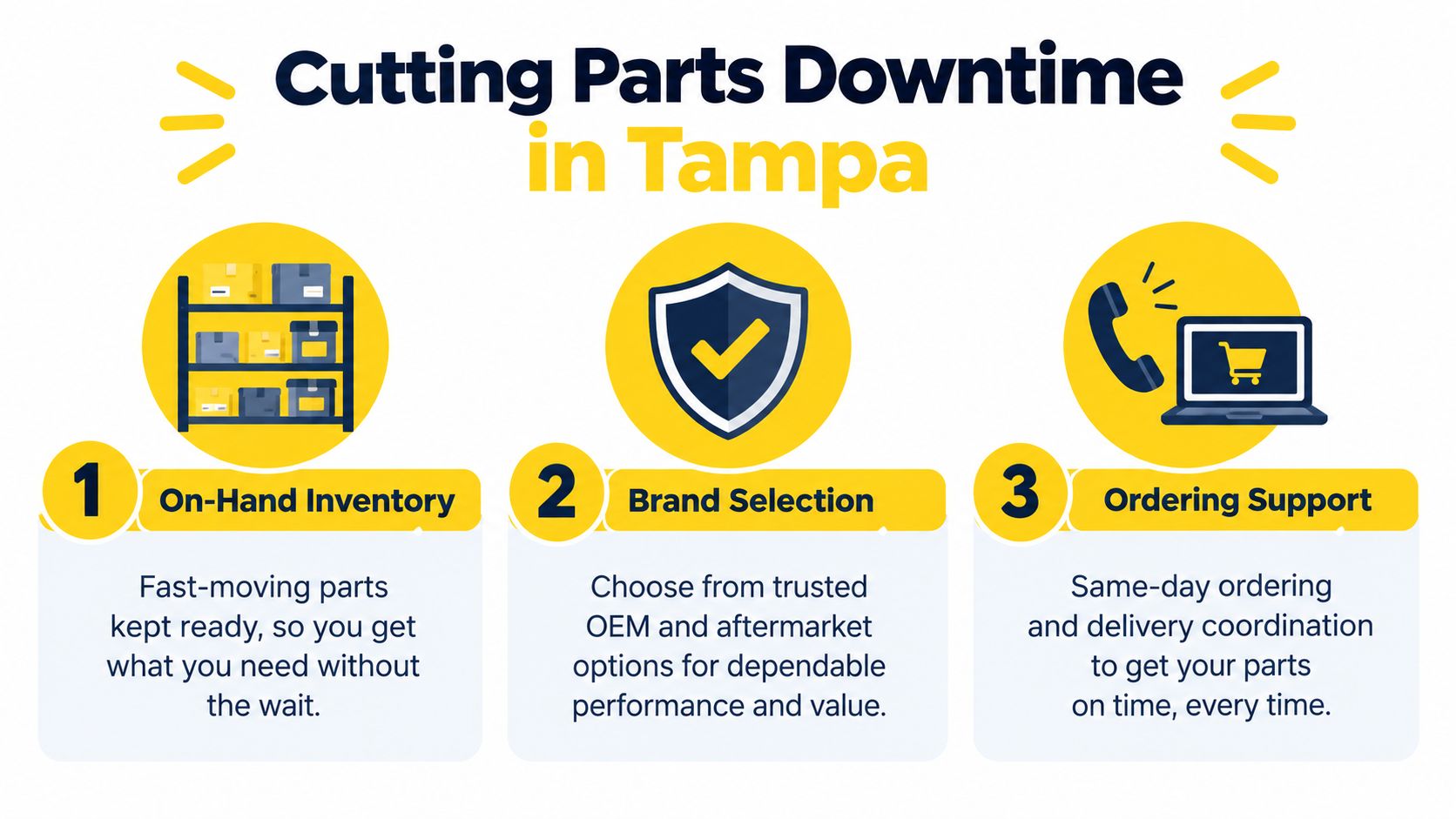
Use this parts-planning checklist when discussing inventory and ordering support.
Ask what is available before authorizing teardown
Review the truck and trailer parts catalog with unit details, existing part numbers, and photographs available. A catalog listing helps identify options; it doesn't establish that a particular component is on the shelf or ready for immediate installation.
Ask the shop to separate stocked parts, locally obtainable items, and special orders on the estimate. Confirm whether a seal kit, sensor, extrusion, or complete assembly has been matched before equipment is dismantled.
Ordering discipline: Verify fitment and availability before promising dispatch a completion time.
For OEM and aftermarket choices, compare compatibility, application, warranty terms, and replacement support rather than brand familiarity alone. Ask about freight charges and return restrictions before approving heavy or special-order components.
End the exercise with a fleet-specific minimum stock list and a person responsible for replenishment. Otherwise, the part used today becomes the missing part on the next repair.
Choosing and Working With a Tampa Repair Shop
Choose a shop by how it handles an unresolved problem, not just a straightforward service appointment. Ask who diagnoses the complaint, who communicates the findings, and who authorizes release after the work is complete.
The historical Florida crash figures noted earlier establish the safety stakes, not a way to predict whether an individual truck will fail. Your shop-selection criteria should therefore emphasize evidence of sound inspection, repair, and verification practices.
Ask to see the working process
During a first visit, use specific questions:
- Inspection records: Can the shop show a sample report with measurements, corrective actions, and closeout?
- Specialized work: Which Walking Floor diagnostics, aluminum repairs, and fabrication tasks are performed in-house, and which are sublet?
- Parts and scheduling: What is confirmed in stock, what needs ordering, and when will the next status update arrive?
- Communication and rework: Who explains findings to drivers and fleet staff, what language support is available, and how are warranty concerns handled?
The Tampa truck and trailer workshop overview is a starting point for reviewing repair, Walking Floor, aluminum welding, fabrication, maintenance, and parts capabilities. Confirm the scope for your specific equipment directly rather than assuming every job follows the same process.
Give the shop usable information
Send the unit identification, driver complaint, operating conditions, relevant fault history, and previous repair details before the appointment. Agree on diagnostic authorization limits and require approval before the shop expands the repair scope.
Keep a maintenance file with the fleet, accessible when equipment changes assignments or shops. Include inspection findings, estimates, approvals, parts records, and verification results.
A steady shop relationship can improve continuity, but familiarity shouldn't replace documentation. The standard remains the same: a clear complaint, an explained repair decision, and evidence that the equipment is ready for its intended work.
The shop offers truck and trailer maintenance, Walking Floor diagnostics and repair, aluminum welding, custom fabrication, and parts support for Tampa Bay operators. Visit Brothers Truck Trailer Repair and Welding Corp. with your unit details, current symptoms, and service history to discuss the inspection, repair scope, and parts needed before your next dispatch.
Practical guide to semi trailer tail lights covering types, FMVSS No. 108 requirements, wiring basics, troubleshooting, and step-by-step replacement procedures.
Get trailer coupling bolts right with this fleet guide to specs, torque procedures, inspection intervals, and pre-tow safety checks for North American trailers.
15 ton trailer specs, configurations, and selection criteria for fleets. Compare axles, brakes, frames, and maintenance points before you buy or repair.