What Is Corrosion Resistant Steel? Grades and Coatings
Corrosion resistant steel is steel engineered to slow or prevent attack from water, oxygen, road salt, acids and industrial pollutants, usually through a chromium based surface film or a protective coating. You're likely looking at that definition because a trailer that looked sound last season now shows rust bleeding from a crossmember, white corrosion around fasteners, or flaking near a repaired weld. The label on the steel didn't fail you by itself. The exposure underneath the unit, in its crevices and along its weld zones, decided the outcome.
Table of Contents
- What Corrosion-Resistant Steel Means for Trucks and Trailers
- How Chromium Films and Coatings Stop Rust
- Common Grades and Coatings Compared
- Matching Steel to Truck and Trailer Exposure
- Weighing Trade-Offs for Truck and Trailer Parts
- How to Protect Corrosion Resistance During Repairs
- Maintenance Habits That Extend Service Life
- Specify the Right Steel Before Your Next Repair
What Corrosion-Resistant Steel Means for Trucks and Trailers
When you ask what is corrosion resistant steel, you're asking about a performance, not one grade. Two routes deliver it. Alloying builds protection into the steel through its full thickness, so a scratch doesn't expose unprotected metal. Coating puts a metal layer over plain carbon steel, and that layer can be scratched, cut or welded away.
Three families cover most fleet work:
- Stainless steel: An alloyed steel where chromium forms a protective surface film. It's used for fittings, panels and components that see repeated wetting.
- Coated carbon steel: Galvanized steel carries zinc, and aluminized sheet carries an aluminum silicon layer. Both shield the base steel underneath.
- Weathering steel: Products such as CORTEN form a protective patina only when surfaces wet and dry in cycles. Persistent damp defeats it.
None of these is maintenance free, and the stakes aren't cosmetic. Corrosion thins structural sections, weakens weld areas, opens leaks and shortens the life of frames, crossmembers, body panels and fasteners. The NACE IMPACT assessment of the global cost of corrosion estimated that cost at US$2.505 trillion in 2013, equal to 3.4% of global gross domestic product.
Core idea: Judge a steel by what protects it, what breaks that protection, and whether your routes let the protection keep working.
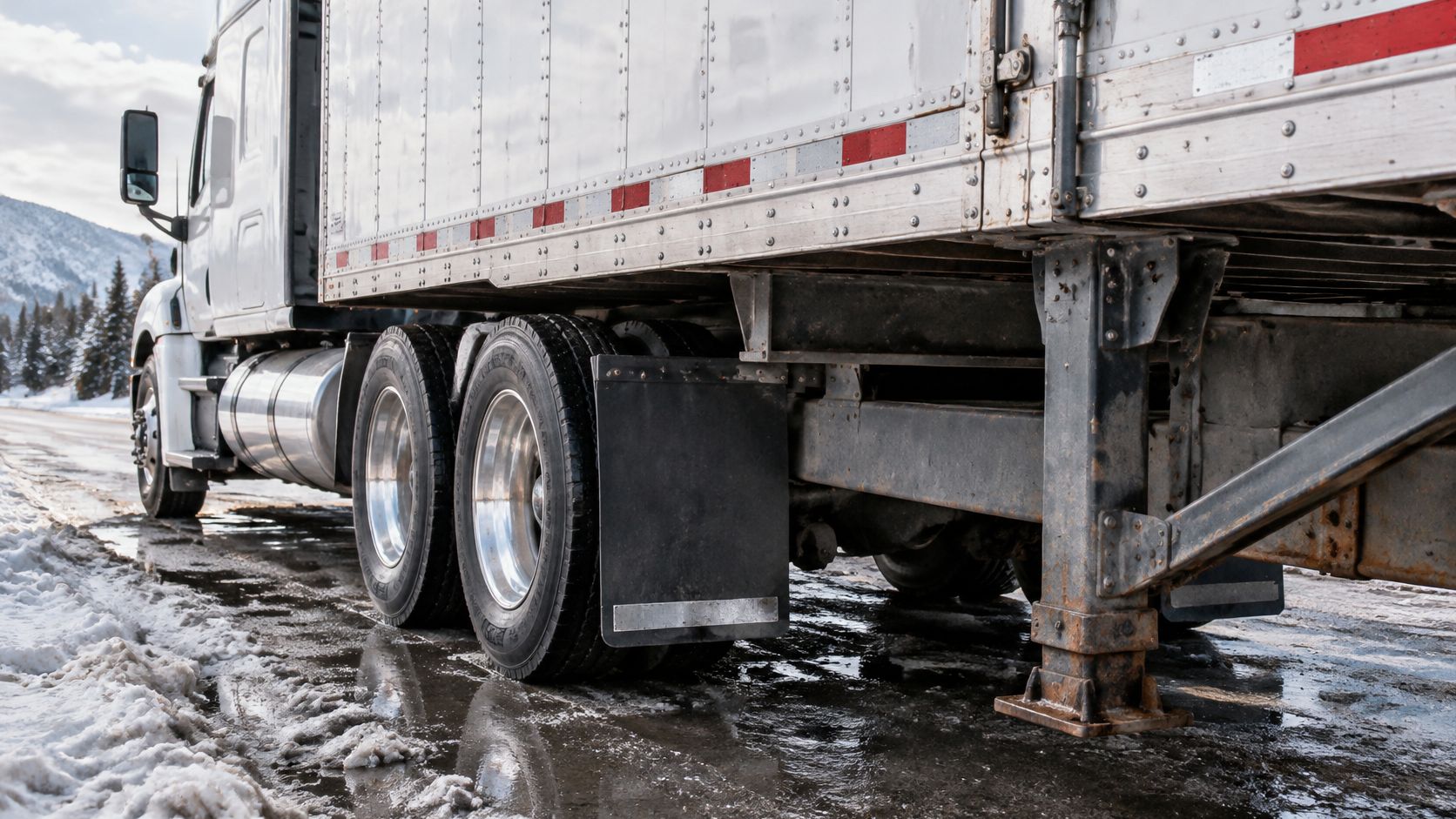
That frame guides every comparison that follows. A grade that thrives on a dry inland route can pit quickly on a coastal, salt laden one.
How Chromium Films and Coatings Stop Rust
Three mechanisms do the work, and each fails in a different way. Understanding the mechanism tells you where to inspect.
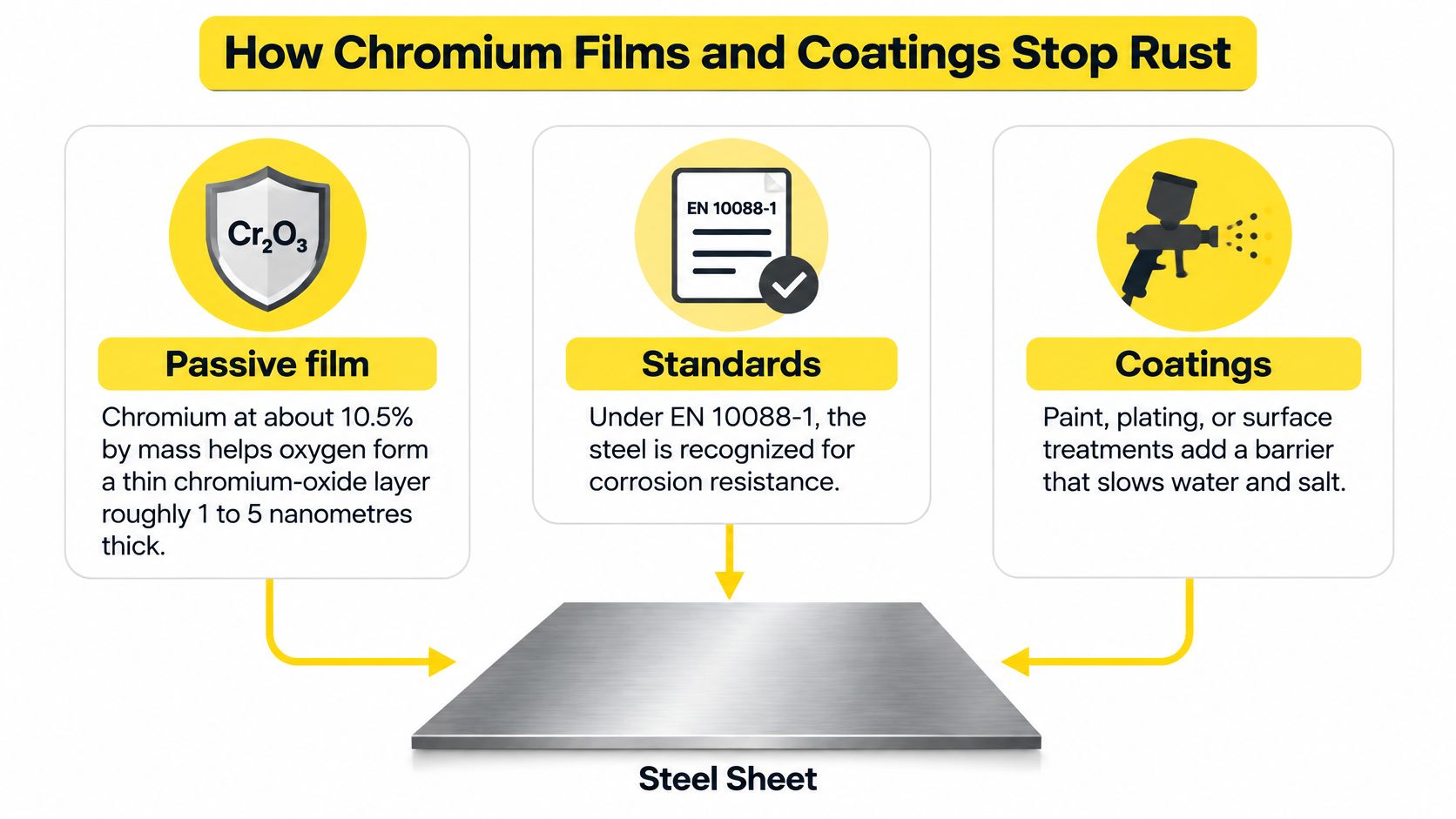
The diagram below maps the three mechanisms to a single steel surface.
The Self Patching Skin on Stainless
Think of stainless protection as a self patching skin. The British Stainless Steel Association article on formation of the passive layer explains that stainless steel is classified under EN 10088-1 as steel containing at least 10.5% chromium by weight and no more than 1.2% carbon, and that chromium reacts with oxygen to form a passive oxide film approximately 1 to 5 nanometres thick. Scratch it and the film re forms, provided oxygen reaches the surface.
That condition matters. A tight lap joint, a deposit of road grit or a sealed crevice can starve the surface of oxygen right where salty water sits. The skin can't patch itself there.
The Sacrificial Shield and the Slow Crust
Galvanized steel works differently. Zinc is a sacrificial shield. It blocks water as a barrier, and where a scratch exposes bare steel, the zinc corrodes first and protects the small exposed area. The shield is consumed in the process, so its thickness sets its life.
Weathering steel builds a slow forming crust. Its alloying elements make the oxide layer denser and more adherent than ordinary rust, so attack slows once the patina stabilizes. It needs drying between wetting cycles to do that.
The video below walks through how these surface layers form and break down in service.
What Breaks Each Mechanism
Chlorides from road salt and coastal air, fluorides, acids, deposits and surface damage can break the passive film at a single point. Attack then concentrates there as pitting or crevice corrosion instead of spreading evenly, which is why stainless can look bright overall while a deep pit grows under a washer.
Apply three questions to any part on the unit:
- What protects it: A chromium film, a zinc layer, or a patina?
- What breaks it: Chloride, trapped moisture, abrasion, or heat from welding?
- Can it recover here: Does the surface get oxygen, drainage and drying, or does it stay wet and salty?
Common Grades and Coatings Compared
Start with the side by side view, then read each row against your exposure rather than its name.
| Material | Protection method | Typical truck or trailer use | Main limitation |
|---|---|---|---|
| 304 stainless steel | Chromium nickel alloy film (about 18% Cr, 8% Ni) | Interior panels and fittings in mild to medium service | Pits in chloride rich road salt and brine |
| 316/316L stainless steel | Chromium nickel molybdenum alloy film | Parts in coastal or salt exposed service | Higher material cost, weld cleaning still critical |
| Hot dip galvanized steel | Zinc coating on carbon steel (at least 3.9 mils on structural steel of 1/4 inch or more) | Frames, brackets, underbody supports | Coating lost at cuts and welds, zinc consumed faster in chlorides |
| Aluminized steel | Aluminum silicon coating on carbon steel | Heat exposed components such as exhaust zone shields | Damaged coating exposes steel, not a substitute for structural stainless |
| CORTEN weathering steel | Low alloy steel forming a protective patina | Exposed structural members with good drainage | Persistent moisture, salt and pollutants prevent a stable patina |
Reading the Stainless Rows With PREN
The 304 and 316 rows differ by one element that matters in salt. The Outokumpu Core range datasheet on stainless grades and PREN gives the Pitting Resistance Equivalent Number as PREN = %Cr + 3.3(%Mo) + 16(%N), and describes 304 as approximately 18% chromium and 8% nickel for mild to medium corrosive service while 316/316L adds molybdenum for more demanding chloride containing environments.
PREN lets you rank stainless grades for chloride pitting on one scale. Chromium supports the passive film, but molybdenum and nitrogen carry extra weight in the formula because they disproportionately resist localized attack. A higher PREN grade isn't automatically the right buy, though. Surface finish, weld cleaning and crevice geometry can undo an alloy advantage.
Say you're spec'ing a bracket that sits behind a drive axle on Tampa Bay routes. It sees salt spray, standing brine and grit packed around its fasteners. That's a pitting and crevice problem, so PREN comparison between 304 and 316/316L is directly relevant. For a dry interior fitting, it mostly isn't.
Why Coated and Weathering Steels Sit Outside PREN
Galvanized, aluminized and weathering steels aren't ranked by PREN because their protection doesn't come from an alloy film through the section. Galvanized protection depends on zinc thickness. The Galvanized Steel Specifiers Guide on ASTM A123 coating requirements states that under ASTM A123, structural steel at least 1/4 inch thick must receive at least 3.9 mils of zinc, equivalent to about 99 micrometres.
That same guide reports hot dip galvanized structural steel thicker than 1/4 inch can provide approximately 72 to 73 years to first maintenance in an industrial exposure environment. Don't carry that number onto a trailer underside. Road salt, abrasion from debris and cuts made during later repairs consume or remove zinc far faster than a stationary industrial structure experiences.
Aluminized steel earns its place near heat, not in structural salt service. Its aluminum silicon coating tolerates exhaust zone temperatures, but once you grind or gouge through it, plain carbon steel is exposed.
CORTEN's row carries the most conditional limitation in the table. Its patina needs wet and dry cycling and free drainage. Put it where moisture, salt or waste residue sits against the surface and the protective layer never stabilizes.
Match each row to an exposure before you order. A material name without an exposure attached to it is an incomplete specification.
Matching Steel to Truck and Trailer Exposure
Coastal and road salt service cause most fleet failures, so start there when you review a unit. Dry inland equipment forgives choices that Tampa Bay routes punish within a few seasons.
| Exposure | Main attack | What to specify |
|---|---|---|
| Dry inland service | Slow uniform rust | Standard galvanizing or carbon steel with intact paint |
| Coastal salt air | Chloride pitting and faster zinc loss | 316 grade stainless or thicker galvanizing, washed regularly |
| Road salt and brine | Crevice and underside corrosion | Galvanized parts with sealed joints and open drainage paths |
| Wet waste or fertilizer residue | Concentrated, acidic attack | Stainless or coated surfaces, frequent wash down, chemical compatibility check |
| Downward facing or sheltered surfaces | Faster corrosion from trapped moisture | Drain holes, sealed seams and routine underside inspection |
Why Exposure Class Changes the Math
Zinc consumption shows the spread clearly. A study of galvanized steel corrosion across atmospheric exposure classes reports zinc corrosion of approximately 0.1 to 0.7 micrometres per year in a low corrosivity C1 environment, compared with 4.2 to 8.4 micrometres per year in a highly corrosive C5 environment. The same research found higher rates in marine atmospheres and linked the increase to chlorides weakening the passive zinc layer.
Run that against a coating thickness and the point lands. A zinc layer that lasts decades in clean rural air can be consumed in a fraction of that time where salt accumulates around fasteners, seams and crossmembers. The coating didn't change. The air and the residue did.
The Underside Is a Different Environment
Orientation matters as much as geography. Bridge exposure research summarized in a study of weathering steel corrosion in chloride affected microclimates found corrosion rates as high as 95 µm per year on downward facing surfaces, compared with about 29 µm per year in sheltered areas. Chloride and moisture collect where rain can't rinse them away.
On a trailer, that's the underside of frame rails, the tops of lower flanges, crossmember pockets and the sheltered faces behind landing gear. The top rail you can see from the dock is the last place trouble shows. Inspect the surfaces you have to get under the unit to see.
A material name without an exposure rating is not a replacement interval. Set inspection intervals by route and load, not by the steel label.
Weighing Trade-Offs for Truck and Trailer Parts
Every option trades cost, repairability and tolerance for abuse differently. The cards below set the main contenders side by side.
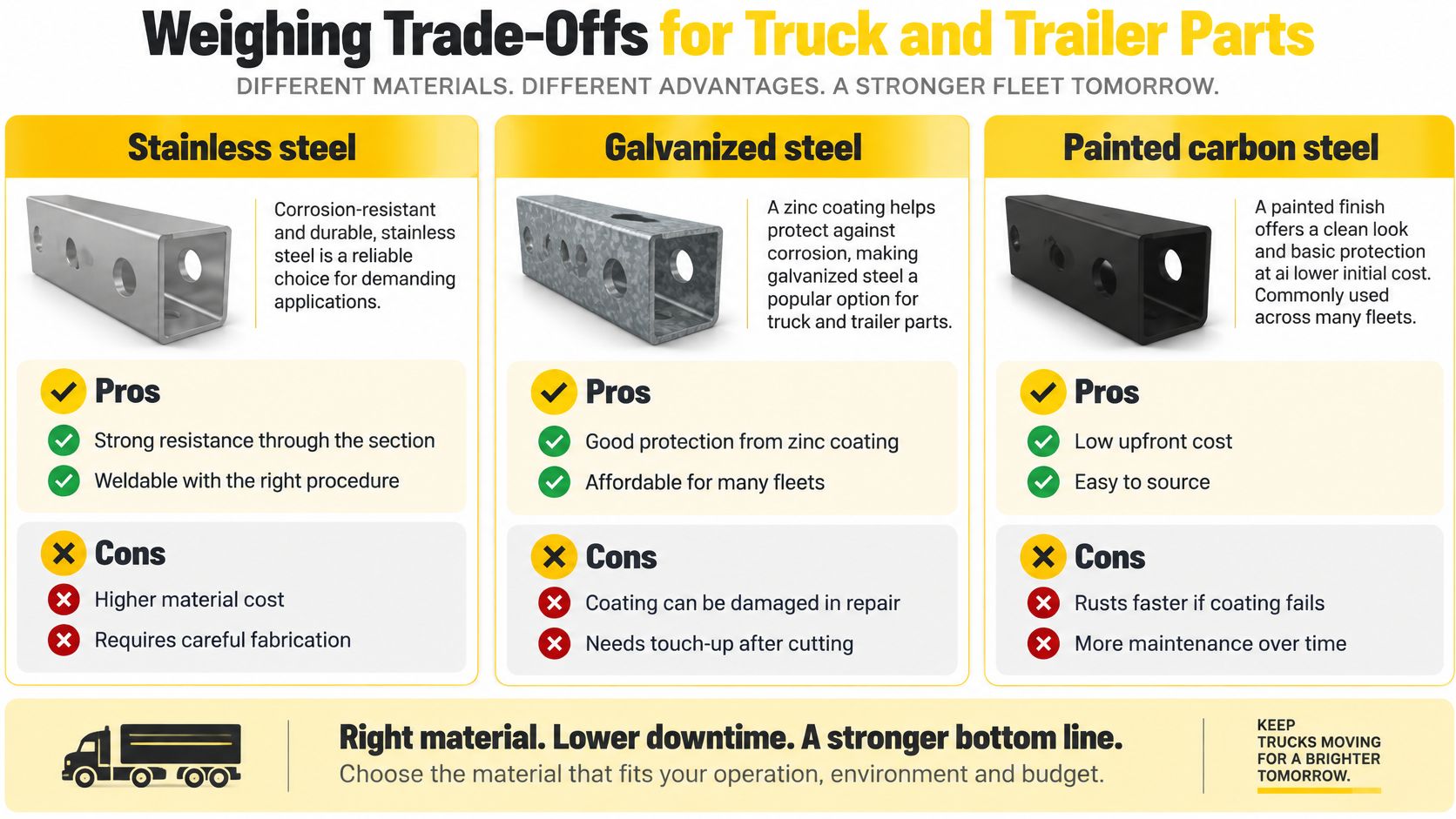
Stainless steel resists attack through the full section and welds well with compatible filler, so a gouge doesn't strip its protection. Against that, material cost runs higher and weld zones need careful cleaning to perform. It suits parts that are hard to recoat once installed.
Hot dip galvanized steel tolerates small scratches because surrounding zinc protects the exposed spot, and it's cost effective for frames and brackets. Its weakness shows up in the shop. Cutting, drilling and welding remove the coating exactly where you've disturbed the part, and those areas need zinc restoration.
Aluminized steel handles heat that would degrade other coatings, which makes it practical for exhaust zone shields. Its structural use is limited, and damaged coating leaves ordinary steel exposed to the same salt as everything else under the unit.
CORTEN weathering steel needs no coating renewal and holds a durable appearance on exposed, well drained members. It depends entirely on drainage and dry cycles, though, and runoff from its surface can stain adjacent trailer panels. In persistently wet or salt laden spots it's the wrong tool.
Lifecycle Cost and Weight
Compare total cost, not purchase price. Add coating renewal, downtime for repeat repairs and eventual replacement to the initial figure. A costlier grade often wins where a coated part would need frequent touch up in a location that's expensive to reach.
Weight and repairability belong in the same decision. A heavier section specified to tolerate corrosion loss costs payload every trip. A material your shop can weld, clean and restore correctly in house may outlast a superior alloy that gets repaired with the wrong filler or no coating restoration.
Pick the material whose main weakness your operation can manage. If nobody will wash undersides or restore zinc after welding, don't specify a system that depends on it.
How to Protect Corrosion Resistance During Repairs
A repair is where corrosion resistance is most often lost. The parent metal may be sound while the weld, the cut edge and the disturbed coating around it become the first failure points.
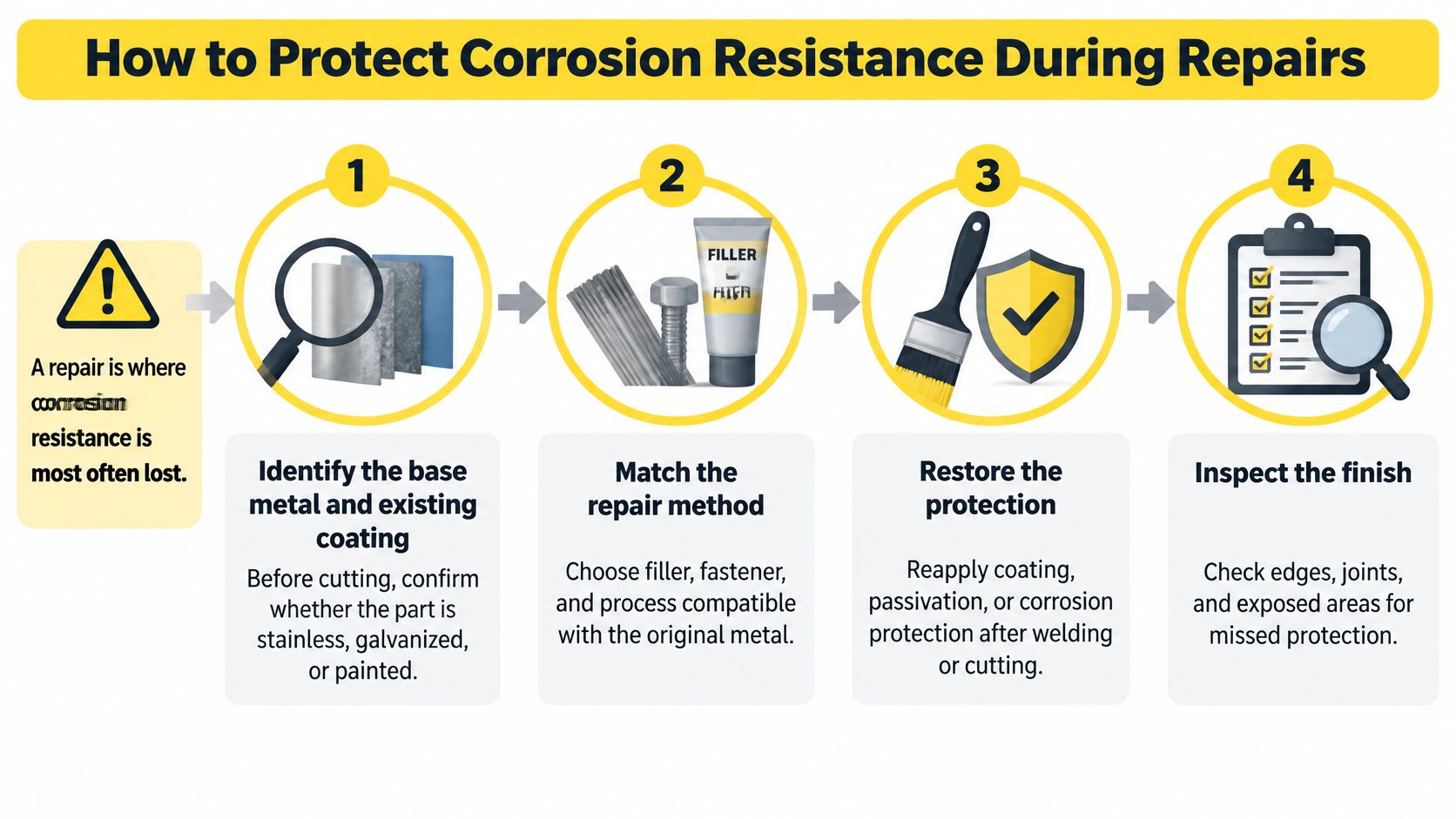
Research on saline exposed weathering steel supports that caution. A study of weathering steel and its welded connections under saline conditions found sample cross section losses of 3.6% to 4.7% and mass losses of 4.6% to 7.5%, and reported that welding technology and rolling direction affect weld corrosion resistance. A repair doesn't inherit the parent metal's rating automatically.
Follow this sequence on every structural repair:
- Identify the base metal and coating before cutting. Stainless, galvanized carbon steel, weathering steel and aluminum each need different filler, cleaning and restoration. Guessing here locks in errors at every later step.
- Control heat input and clean the weld zone. Remove discoloration and embedded iron from the weld and heat affected zone, because both create initiation sites for localized attack.
- Use compatible filler and restore passivity on stainless. Clean the weld and passivate where the specification requires it so a uniform passive surface re forms.
- Restore zinc on galvanized repairs. Apply a zinc rich repair coating to cut, drilled or welded areas rather than assuming the original galvanizing remains continuous.
- Isolate aluminum from carbon steel. Separate the metals so no conductive path remains through the joint or its fasteners.
- Seal and drain the finished joint. Close crevices that trap water and leave a path for water that does enter to escape.
- Inspect after the first season. Check the repair once it has seen salt, waste or coastal service, and record what you find by unit.
Passivation and Dissimilar Metal Isolation
For stainless work, a UK P&I risk focus document on stainless steel cargo tank corrosion notes that post weld cleaning and, where specified, chemical passivation under practices such as ASTM A380 and ASTM A967 help restore a uniform passive surface. Weld tint left in place isn't just discoloration. It's a chromium depleted surface that pits first.
Dissimilar metal contact needs equal attention, especially where aluminum bodies and panels meet steel brackets or fasteners. Guidance from the U.S. National Institutes of Health facilities technical resources on galvanic corrosion identifies carbon steel and aluminum as a high galvanic potential pairing and recommends nonconductive gaskets, shims, sleeves, coatings or sealants to isolate the metals.
Shop rule: A sound weld inside a wet, electrically connected joint still fails early. Isolation and drainage are part of the weld repair, not finishing touches.
Isolation must be continuous, including through bolt holes where a sleeve matters as much as a gasket face. Trapped salty water supplies the electrolyte galvanic attack requires, so a dry, drained connection is far less hazardous than a sealed looking joint that holds brine against both metals.
Maintenance Habits That Extend Service Life
Protection systems keep working when residue doesn't sit on them. Most of the routine below costs wash time and inspection discipline, not parts.
Wash and Drain Before Residue Sets
Rinse undersides, frame rails and fastener areas after salt, brine or waste service, before residue dries and concentrates. Pay attention to crossmember pockets, landing gear mounts and the sheltered faces behind mud flaps, where spray deposits build up and rain never rinses them.
Then check drainage. Clear blocked drain holes, open low points where water pools and repair seals that channel water into a joint instead of away from it. A part that dries between trips corrodes far more slowly than an identical part holding wet, salty grit against its surface all week.
Inspect on a Fixed Schedule
Walk the unit with the same checklist each time so findings are comparable:
- Undersides cleaned: No packed grit or waste residue against rails and crossmembers.
- Drain paths clear: Holes open and no standing water in pockets or channels.
- Galvanized areas sound: No white zinc corrosion spreading and no bare spots at cuts or fastener holes.
- Isolation intact: Gaskets, sleeves and sealant between aluminum and steel are present and undamaged.
- Fasteners checked: Tight, with no rust streaks bleeding from the joint.
- Weld zones examined: No cracks at welds or brackets and no rust concentrated along a heat affected zone.
- Weathering steel stable: No flaking, laminar rust or persistently wet patches on patina surfaces.
Look for the early signals between full inspections too. Blistering or flaking coating, rust bleeding from a crevice and white corrosion products on zinc all tell you protection is being consumed. They're cheap warnings compared with section loss.
Act on Findings and Record Them
Touch up small bare spots in galvanizing with a zinc rich repair product while they're still small. Arrange professional repair where you find measurable structural thinning, cracked welds or perforation, because coating over lost section doesn't restore strength.
Record each finding by unit, with location and route notes. Patterns emerge quickly. You'll learn which routes, loads and axle positions corrode fastest in your fleet, and that record drives better material choices at the next repair than any generic recommendation can.
Specify the Right Steel Before Your Next Repair
Two trailers can leave the same shop with the same grade of steel and then corrode at completely different rates, because one hauls fertilizer on coastal routes and the other runs dry freight inland. The steel did not change. The exposure did. That is why the last decision before a repair should be a specification written for the unit, not for the grade label.
Write it as a short sheet that travels with the part:
- Name the exposure. Coastal routes, road salt, waste or fertilizer loads, wash frequency and where the unit parks overnight. Flag the worst of it by axle position.
- Name the corrosion sites. Underside crevices, weld zones, surfaces that sit against steel, and any pocket where road spray collects. Each site favors a different material or coating.
- Name the mating details. Galvanic pairing, isolation at aluminum-to-steel joints, and drain paths the repair might close off.
- Attach the repair history. What was welded or patched before, where it failed, and how long it held.
That sheet gives any shop something concrete to work against. Welders at Brothers Truck Trailer Repair and Welding Corp. have specialized aluminum expertise and handle aluminum welding for trailers and trucks, including repair of aluminum trailer bodies and components, with welds designed to resist corrosion. Custom fabrication for specific truck and trailer requirements and Walking Floor repair round out the work, with parts on hand to shorten the schedule.
Bring your unit's exposure record and repair history to Brothers Truck Trailer Repair and Welding Corp. before your next structural repair, and the steel, filler and aluminum-to-steel isolation can be chosen for the routes and loads that unit runs.
Build a truck preventive maintenance schedule using mileage, hours and calendar intervals, plus component checks and audit-ready records.
Learn how to perform a commercial trailer suspension inspection step by step, covering airbags, leaf springs, U-bolts, torque checks and pass or fail criteria.
Hitch ball size must match the coupler: 1-7/8, 2, 2-5/16, or 3 inches. Check shank, stamped capacity, and the weakest rated part before towing.