Hitch Ball Size Chart for Safe Coupler Match
The four common hitch ball diameters are 1-7/8, 2, 2-5/16, and 3 inches, and the coupler stamp, not trailer weight or hitch class, selects the diameter. After that match, the lowest-rated part in the loaded hookup determines whether the combination can go to work.
The familiar advice to buy a bigger ball for a heavier trailer skips the dangerous part. A stronger-looking sphere doesn't correct an incompatible socket, an undersized shank, or a cracked mounting plate. For fleet technicians swapping equipment trailers between trucks, diameter is the lookup; the complete connection is the decision.
This applies to ball-coupled equipment in the fleet, not automatically to every commercial trailer. A Walking Floor trailer with a different coupling system needs its own coupling inspection, even when the same maintenance team handles its hydraulics, aluminum body repairs, and supporting equipment trailers.
Table of Contents
- Hitch Ball Size Chart by Coupler Diameter
- Duty Categories on Mixed Fleets
- Shank Size and Related Ratings That Set Capacity
- How to Match Ball Shank and Capacity
- Identifying Unmarked or Worn Hitch Parts
- Coupler Wear Limits and Inspection Record
- Mismatch Scenarios in Mixed Fleets
- Release the Trailer Only After the Weakest Link Clears
Hitch Ball Size Chart by Coupler Diameter
| Ball diameter | Typical duty | Published GTW band | Coupler match |
|---|---|---|---|
| 1-7/8 in | Light utility and small equipment trailers | About 2,000 to 3,500 lb | Exact 1-7/8 in socket; a smaller ball can disconnect |
| 2 in | Medium-duty cargo and equipment trailers | About 3,500 to 12,000 lb | Exact 2 in socket; a larger ball will not engage correctly |
| 2-5/16 in | Heavier tag and equipment trailers | About 6,000 to 30,000 lb | Exact 2-5/16 in socket; capacity must suit the specific ball, shank, and mount |
| 3 in | Gooseneck equipment primarily | Read the gooseneck hardware's marked GTW | Not a substitute for a smaller coupler |
These diameter categories and approximate gross trailer weight bands come from CURT's trailer-ball selection guidance, and the overlapping bands don't replace the rating stamped on an individual product.
Use the chart to narrow the parts search, not to authorize a tow. GTW means gross trailer weight, including the trailer and everything loaded on it. A ball's diameter describes its mating surface; its rating describes the load it's designed to handle in the specified installation.
Start at the trailer socket
Clean the coupler identification area with a rag and a nylon brush. Look for the required ball diameter and the coupler's own capacity markings, then photograph them before ordering anything. If the information isn't readable, identify the coupler through its manufacturer rather than copying whatever ball happens to be installed.
An old ball isn't proof of correct fitment. A previous operator may have installed the wrong part, or someone may have moved a ball mount between trucks without checking the trailer. Treat the existing hardware as something to inspect, not as the specification.
An undersized sphere can leave enough clearance for the coupler to separate. An oversized sphere can keep the socket from seating and the latch from engaging correctly. Forcing the handle down doesn't establish a sound connection.
Parts-counter rule: Order from the coupler identification and required capacity, not from a photograph of a ball that looks similar.
Keep diameter separate from capacity
Once the socket requirement is established, move to the ball's load markings and mounting details. The usable connection is limited by the lowest-rated applicable component, including the vehicle, receiver, ball mount, ball, coupler, and safety chains.
That distinction matters when maintenance teams keep shared ball mounts near the dispatch area. A technician can pick up the correct sphere diameter and still select an assembly that doesn't belong under the assigned trailer.
Keep identified assemblies together when practical. Label the storage location with the relevant fitment and rating information, but don't let a shelf label replace the permanent markings on the hardware. If a driver changes trucks or trailers, the hookup needs verification for the new combination.
A replacement order should therefore identify the coupler requirement, ball capacity, and mounting fit. Ordering only by hitch ball size leaves the parts department guessing about the rest.
Duty Categories on Mixed Fleets
A mixed yard needs coupling categories that help technicians sort work without turning those categories into approval rules. Light utility trailers, service trailers, heavy equipment tags, and gooseneck equipment have different jobs, but a job description alone doesn't identify the correct replacement ball.
The most useful distinction is between what the trailer does and what its coupling requires. Dispatch may call a trailer the utility trailer or the welding trailer. Maintenance needs a coupler identity, a loaded weight requirement, and a compatible truck.
Sort by the actual coupling job
Light utility duty includes small mower, maintenance, and light equipment trailers. These units can be easy to overlook because they spend much of their time inside a yard or on short runs. Short travel doesn't make an unreadable coupler or an improvised connection acceptable.
Medium-duty cargo and service work creates a different problem: trailers can share a socket diameter while carrying materially different loads. A ball mount that works for an empty service trailer may not suit another trailer carrying tools, stock, and equipment. The parts can look interchangeable without carrying the same rating.
Heavy tag work puts more attention on the mounting assembly. Inspect the drawbar, plate, receiver attachment, and supporting trailer structure rather than concentrating only on the polished sphere. A sound ball installed in damaged steel doesn't make a sound hookup.
Gooseneck work needs its designated coupling arrangement. Don't treat a bed-mounted coupling as a stronger version of a tag-trailer connection or mix components because their shapes seem close.
Assign the truck before approving the combination
Build the intake around the equipment that will leave the yard:
- Identify the trailer: Record the coupler specification against the trailer's fleet number.
- Establish the load: Use the intended loaded condition, including equipment and supplies.
- Check vertical loading: Confirm tongue-load requirements separately from total trailer weight.
- Name the tow vehicle: Verify the assigned truck and installed receiver, not a similar truck parked beside it.
For a maintenance team responsible for Walking Floor equipment as well as support trailers, keeping coupling systems separate is especially useful. The same work order process can capture identification and damage, but a fifth-wheel inspection isn't a ball-coupler inspection.
Avoid putting unverified loose balls into a common replacement bin. Segregate unidentified parts and keep usable replacements organized by complete specifications. That saves the next shift from making a fitment decision by appearance.
Shank Size and Related Ratings That Set Capacity
A shared ball diameter doesn't establish a shared towing rating. The Connecticut DMV trailer-inspection guide lists a 2-inch ball with a 3/4-inch bolt at 3,500 lb, a 1-inch bolt at 5,000 lb, and a 1-3/8-inch bolt at 10,000 lb, alongside the other ball and nominal hitch-class figures below.
| Ball diameter | Bolt or shank | Listed GTW | Nominal hitch class |
|---|---|---|---|
| 2 in | 3/4 in bolt | 3,500 lb | Class 2, 3,500 lb |
| 2 in | 1 in bolt | 5,000 lb | Class 3, 5,000 lb |
| 2 in | 1-3/8 in bolt | 10,000 lb | Class 4, 10,000 lb |
| 1-7/8 in | As listed for this size | 2,000 lb | Class 1, 2,000 lb |
| 2-5/16 in | 1 in bolt | 5,000 lb | Class 3, 5,000 lb |
| 2-5/16 in | 1-1/4 in bolt | 7,500 lb | Between Class 3 and Class 4 |
These are inspection examples, not universal ceilings for commercial balls. The class column compares nominal weight categories; it doesn't prescribe a ball diameter or approve a particular installation.
Purdue Extension's trailer-connection guidance warns that balls with the same diameter can have different towing ratings because their shank dimensions can differ. That's why ordering by sphere diameter alone is incomplete.
The threaded connection needs its own inspection
Measure the shank and mounting hole with calipers. Inspect the hole for elongation, damaged edges, or evidence that a loose shank has been moving against the plate. A ball that passes through the hole isn't necessarily a correct fit.
Mount thickness determines the required shank length. The shank must accommodate the mounting plate and specified hardware while allowing full nut engagement. A thicker fabricated plate can make a previously suitable shank too short.
Washer type and orientation also matter. Assemble the hardware in the manufacturer's specified order and use the specified tightening procedure. Don't substitute a generic torque figure based only on thread diameter, and don't use an impact wrench as proof that the required torque was achieved.
Keep the load limits distinct
The vehicle's towing limit, receiver rating, ball-mount rating, ball rating, coupler rating, and safety-chain suitability all need checking. Include the trailer's own rating when establishing what the complete combination may carry.
Tongue weight is a separate limit, not a percentage to assume from appearance. A short equipment trailer with machinery positioned forward can create a vertical-load problem even when its total weight appears acceptable.
Keep the manufacturer's required equipment ratings distinct from the trailer's current load. Reducing cargo doesn't waive an instruction requiring towing components to meet the trailer's GVWR.
A higher-rated ball doesn't upgrade the receiver behind it, the mount below it, or the coupler around it.
The practical trade-off isn't small ball versus large ball. It's selecting a compatible, documented assembly without creating another weak point elsewhere in the connection.
How to Match Ball Shank and Capacity
Selection is three fits, checked in order: sphere to socket, shank to mount, and capacity to the required load. The North Carolina Division of Marine Fisheries safe-trailering guide distinguishes those checks, identifies common shank diameters from 3/4 to 2 inches, and describes SAE J684 as relevant to ball-and-socket coupling systems primarily serving trailers up to 10,000 lb GVWR.
Use the fit checks as a visual reminder, but measure the threaded shank against the ball-mount hole, not the coupler socket.
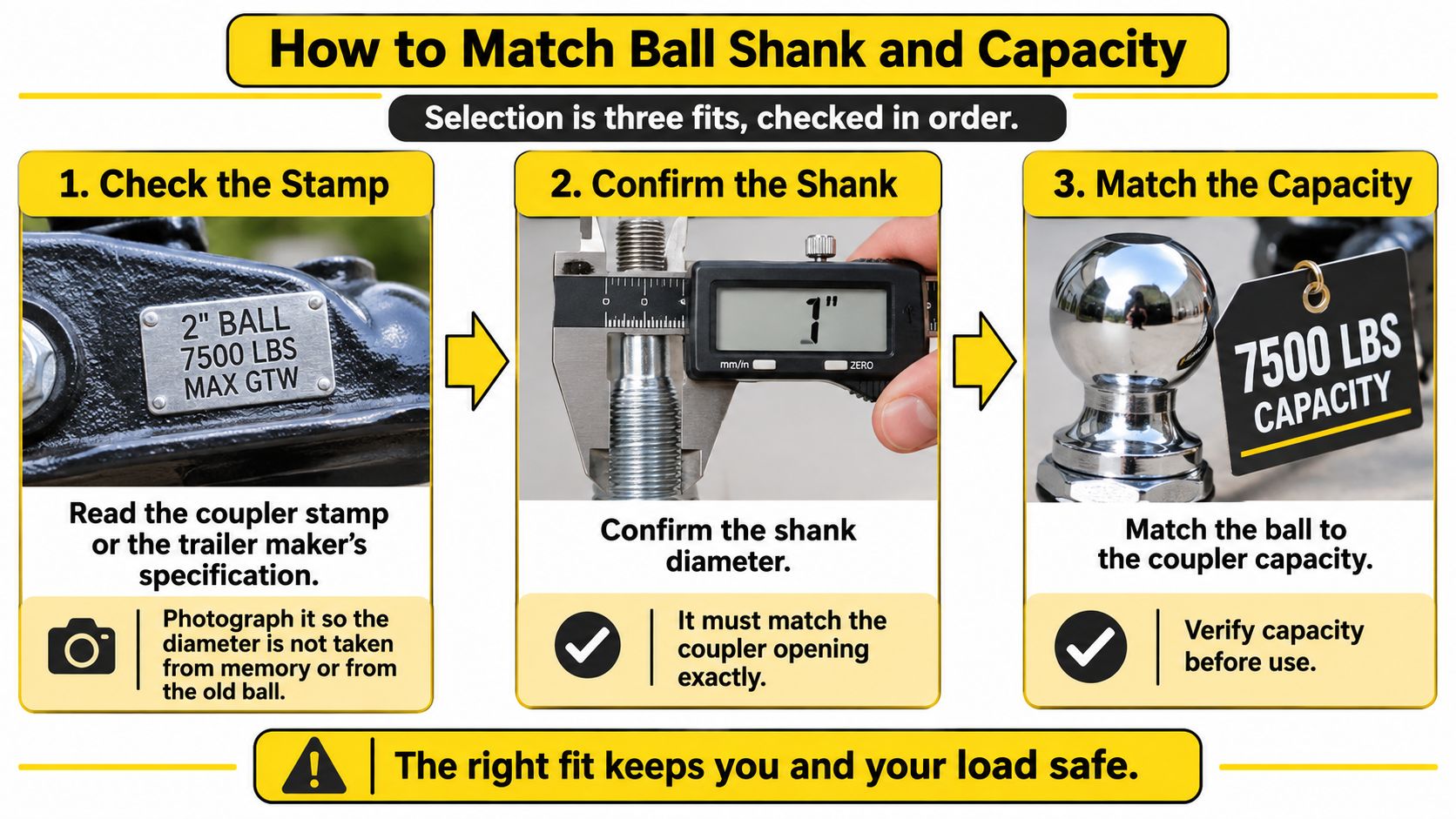
Drawbar checks in working order
Read and photograph the coupler identification. Use the coupler stamp or trailer manufacturer's specification. Include the trailer fleet number in the work record so the photograph can't be confused with another unit.
Verify the required sphere. Compare the specified diameter with the replacement ball's marking. Reject a part that is merely close, even if the socket can be lowered over it.
Measure the mount hole and shank. Use calipers on clean surfaces. If the hole is oval, burred, or visibly damaged, stop and assess the mount rather than selecting hardware to fill the damage.
Check shank length and hardware stack. Measure plate thickness and confirm the specified washer and nut can be installed with full thread engagement. Don't omit a washer to gain usable threads.
Read the load markings. Confirm gross trailer-weight and maximum tongue-weight limits against the trailer's requirements. Include the intended cargo rather than checking an empty trailer.
Compare the rest of the hookup. Check the assigned vehicle, receiver, ball mount, coupler, trailer, and safety-chain requirements. Write down the governing limit instead of leaving the next technician to repeat the comparison.
Inspect before tightening. Check the sphere, neck, threads, socket, and latch for wear, cracks, deformation, and corrosion damage. Install sound hardware using the manufacturer's torque specification and a suitable torque wrench.
Latch and verify. Seat the coupler, confirm the locking mechanism engages, and inspect the completed installation. Recheck the connection after the initial move in accordance with the equipment instructions.
Make the handoff usable
Record the coupler photograph, mount-hole diameter, shank diameter, shank length, and governing rating on the work order. Add the installation torque specification and the source of that specification.
A larger sphere isn't a safety margin when the socket calls for something else. It can prevent correct seating while leaving a handle that appears nearly closed.
Use the video alongside the written checks, not as a substitute for the instructions supplied with the actual parts.
Identifying Unmarked or Worn Hitch Parts
An unreadable part isn't automatically a scrap part, but it is an unidentified part until its specification can be established. Cleaning, manufacturer identification, and measurement have different purposes. Measuring the sphere can help identify nominal size; it cannot establish an unknown load rating.
Identify before returning to service
Look for the ball's permanent diameter marking. Remove dirt and loose contamination without grinding or filing the identification area. Inspect around the neck and accessible surfaces as well as the top.
Find the coupling equipment's load ratings. Record both gross trailer-weight and vertical-load information where provided. Don't substitute a rating from another part with a similar finish or shape.
Identify an unreadable coupler through its model. Use the trailer manufacturer's specification or the coupler manufacturer's documentation to establish the approved ball. A trailer description alone isn't enough.
Measure the mounting interface. Confirm the mount-hole diameter and shank dimensions with calipers. Inspect mounting thickness and usable thread length before selecting a replacement.
Quarantine unresolved hardware. If identification has been ground away, hidden by coating, or damaged beyond recovery, keep the part out of service until its identity and suitability are established. Looking correct isn't a release condition.
Separate evidence from assumption
Write down which values came from a permanent mark, which came from manufacturer documentation, and which were measured. That distinction prevents a measured diameter from being copied into the record as though it were a certified capacity.
For a painted-over mark, avoid aggressive removal methods that could damage the part or erase shallow lettering. If identification can't be recovered reliably, replace the component with a documented part rather than improvising a rating.
Inspection boundary: A caliper can confirm dimensions. It can't certify the capacity of an unknown ball.
Keep the identified specification with the repair record before release. A clear photograph and a manufacturer reference are more useful to the next shift than a note saying the part looked heavy-duty.
Coupler Wear Limits and Inspection Record
For a concrete example of why wear measurements matter, the manufacturer instructions filed with NHTSA for the Model 80LP/85LP coupler specify an approved 2-inch ball rated for at least 8,000 or 8,500 lb, depending on the applicable configuration, warn that a ball larger than 2.00 inches or out of round may cause improper fit and coupler failure, and warn that a ball smaller than 1.97 inches can cause shock loading and sudden disconnection.
Those instructions also require the vehicle, towing hitch, and ball to be rated at or above trailer GVWR, with coupler checks before every tow and at each stop on long trips. These thresholds belong to that coupler, not to every socket with the same nominal diameter.
Keep the model-specific requirements with the inspection record.
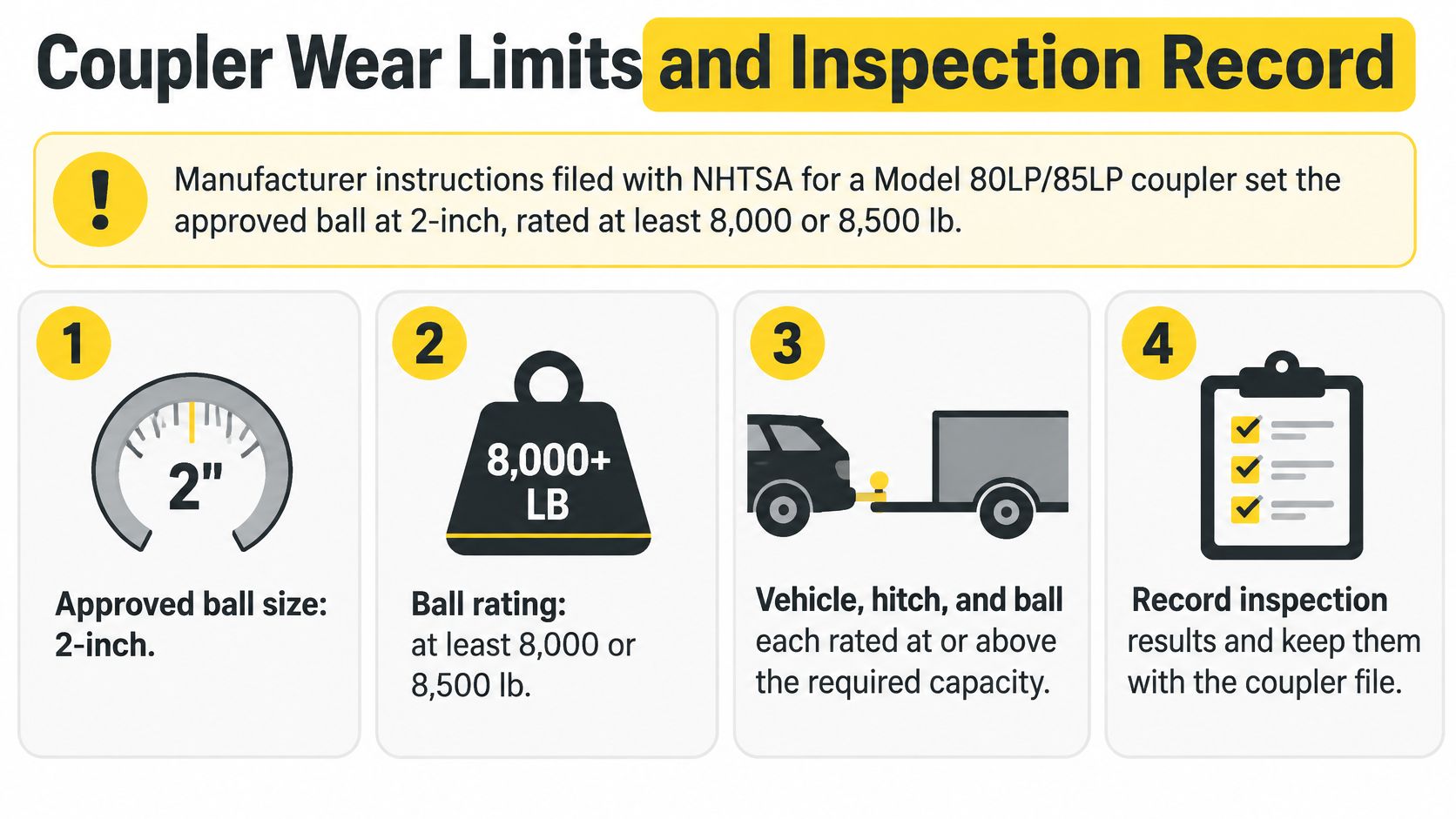
Inspect the contact surfaces and retention hardware
Clean the ball before measuring it. Check across different directions where practical, because a flattened or out-of-round sphere can produce a misleading reading if measured only across an unworn area.
Inspect the socket and latch with adequate lighting. Look for a latch that doesn't reach its intended locked position, damaged retention parts, heavy socket wear, and evidence that the ball has been striking rather than bearing normally.
Don't tighten a latch indiscriminately to hide looseness. Follow the coupler manufacturer's adjustment procedure, and replace components that are worn beyond their permitted condition. Shimming a loose ball-to-socket fit isn't a repair.
The surrounding attachment deserves the same attention. Inspect the mounting plate, receiver connection, fasteners, and nearby structure for cracking, bending, corrosion damage, and movement marks.
Record enough to reproduce the decision
A useful inspection record includes:
- Part identity: Trailer fleet number, coupler model, approved ball diameter, and manufacturer reference.
- Capacity information: Ball and coupler markings, relevant vehicle and hitch limits, and the governing allowable load.
- Mounting dimensions: Shank diameter and length, mount thickness, and mounting-hole condition.
- Hardware assembly: Washer orientation, nut engagement, and the specified torque used.
- Operating condition: Sphere condition, socket wear, latch operation, and any observed movement.
- Disposition: Parts replaced, defects awaiting repair, and the technician responsible for release.
Representative SAE J684 coupler specifications listed by McMaster-Carr reinforce that capacity belongs to a particular coupler configuration, while shank fit, threaded engagement, installation, and latch condition also need documenting.
A check mark beside coupler is too vague for recurring trailer transfers. Record what was examined and what the technician found, especially if wear is being monitored against a manufacturer's limit.
Recheck after initial movement as the equipment instructions require. If the nut backs off, the ball moves in the plate, or the latch condition changes, stop and resolve the cause. Retightening without inspecting the affected parts can leave damaged threads or an elongated mount in service.
Mismatch Scenarios in Mixed Fleets
The difficult errors aren't always obvious size mismatches. Some hookups seat normally and still fail the capacity check. Others look substantial but never establish proper latch engagement.
A correctly seated ball with an inadequate rating
Say a technician installs a medium-duty ball under an equipment trailer whose loaded requirement exceeds the ball's stamped capacity. The socket seats, the latch closes, and the truck has adequate towing capability.
The ball is still unsuitable. A correct sphere and a capable truck don't cancel the ball's own limit.
The useful correction is a compatible ball and mount combination with documented capacity, not a larger sphere that the coupler doesn't accept. If the manufacturer requires components rated to trailer GVWR, merely removing some cargo doesn't satisfy that requirement.
The same sphere with a different shank
A replacement from the bin matches the old ball's diameter, but its shank is narrower and its marked capacity is lower. The technician recognizes the sphere and overlooks the threaded connection.
Compare the full part specification before installation. If the mount hole and shank aren't compatible, don't improvise with loose hardware to take up the clearance.
A purpose-designed adapter, where explicitly permitted by the relevant manufacturer, is different from a shop-made workaround. The installation still needs the correct rating and instructions.
A gooseneck component offered as an upgrade
A larger gooseneck ball doesn't upgrade a tag-trailer socket. Coupler geometry and approved components determine compatibility, not the apparent amount of metal.
Stop the substitution before modifying either part. Grinding the sphere or opening the socket destroys the original fitment basis.
A receiver class used as the whole specification
A driver asks for a ball based only on the receiver class. That identifies neither the trailer's required socket nor its vertical-load demand.
Require the trailer identity and intended loading before choosing the assembly. Receiver class is one item in the decision, not a complete parts request.
The failure in each scenario is accepting one correct attribute as proof that the whole connection is correct.
These are preventable selection errors. A documented parts request gives the technician a defensible choice and gives dispatch a clear reason when a combination must stay parked.
Release the Trailer Only After the Weakest Link Clears
Release requires agreement on diameter, mounting fit, and capacity. The ball must match the coupler specification, the shank must fit the mount with proper hardware engagement, and the complete assembly must meet the trailer's applicable loaded and manufacturer-required ratings.
If a component falls short, replace it with a compatible rated part or reduce the load where the equipment instructions permit. Don't reduce cargo as a workaround for damaged hardware, an incompatible socket, or a component-rating requirement tied to trailer GVWR.
Make the release decision explicit
The work order should identify the approved combination, not merely report that a new ball was installed. Record the trailer, assigned truck, coupler requirement, mounting specification, and governing rating so dispatch knows what was approved.
Use clear disposition language:
- Released: Identification, installation, condition, and applicable load limits have been verified.
- Held for parts: The required replacement is identified, but the correct component isn't installed.
- Held for structural assessment: Damage affects the mount, coupler attachment, or supporting trailer structure.
- Held for identification: Required specifications or ratings remain unresolved.
Don't leave an unresolved defect buried beneath completed maintenance items. A trailer can have serviced brakes, repaired lights, and fresh lubrication while still being unsafe to connect.
A new ball won't repair damaged structure
If the sphere and latch are sound but the mounting plate is cracked, the coupler housing is bent, or the attachment area is corroded, stop treating the job as a ball replacement. The repair must address how the towing load passes into the vehicle or trailer structure.
Brothers Truck Trailer Repair and Welding Corp. handles truck and trailer repair and maintenance; we also offer aluminum welding for truck and trailer bodies and components, plus custom fabrication built to specific requirements. Those capabilities matter when the defect is in the mount or surrounding structure, rather than in the selected ball diameter.
Fabrication must preserve a sound, appropriate attachment. A thicker plate alone doesn't establish a higher towing rating, and a repair shouldn't be released on appearance without resolving the underlying fitment and structural requirements.
For fleets maintaining Walking Floor trailers alongside ball-coupled support equipment, keep those repair scopes distinct. Hydraulic performance, slat condition, body integrity, and coupling security require their own checks.
Approve the complete hookup, not the replacement part. The driver should receive an identified, serviceable combination with its restrictions recorded, not an assortment of components that happen to latch together.
Brothers Truck Trailer Repair and Welding Corp. offers truck and trailer repair, aluminum welding, custom fabrication, and parts and supplies from our inventory. If your hitch inspection finds a damaged mount or trailer structure, bring the coupler identification, load requirements, and inspection photographs so the repair addresses more than the ball itself. Visit Brothers Truck Trailer Repair and Welding Corp. to discuss the repair and parts your equipment needs.
Learn aluminum welding and fabrication for trucks and trailers, from alloy weldability and strength loss to repair rules and shop selection.

Check trailer hitch ratings, vehicle tow limits, GCWR, GVWR and measured coupling loads; verify labels, axle weights and repairs before release.

Select, mount, and inspect a trailer door latch; distinguish towing and anti-theft locks, and check alignment, mounts and engagement.