Trailer Hitch Ratings by Class and Load
The most popular shortcut for choosing a trailer hitch is to match its class to the trailer's weight. That's not enough for commercial work. A hitch class is a capacity band, not permission to tow up to the band's top figure. The working limit is set by the lowest-rated part of the loaded combination, verified against labels, manufacturer limits, and scale weights.
For fleet maintenance, that distinction matters when trucks and trailers change assignments, cargo shifts, or a repair changes the mounting structure. A receiver can pass its own rating check while the tow vehicle's rear axle, tires, or another component is already over its limit. Treat the stamp as one line on the inspection sheet, not the release decision.
Table of Contents
- Trailer Hitch Ratings by Class
- Coupling Types and Their Rating Fields
- How Hitch Ratings Are Tested and Marked
- Tongue Weight for a Loaded Trailer
- The Lowest Rated Part in the Combination
- Federal Coupling Rules Behind the Rating
- When Repairs and Load Shifts Change the Rating
- Confirm the Rating Before Release
Trailer Hitch Ratings by Class
| Class or coupling | Receiver or interface | Weight-carrying GTW | Tongue or vertical load | Weight-distributing GTW and TW |
|---|---|---|---|---|
| Class I | 1-1/4 in | 2,000 lb | Commonly 200 lb | Not conventionally rated |
| Class II | 1-1/4 in | 3,500 lb | Commonly 350 lb | Not conventionally rated |
| Class III | 2 in | 6,000 lb | Commonly 600 lb | Label-specific, only when both vehicle and hitch permit it |
| Class IV | 2 in | Commonly 10,000 lb | 800 lb | Label-specific, only when both vehicle and hitch permit it |
| Class V | 2 in or 2-1/2 in | About 12,000 lb, model specific | Label-specific | Label-specific, only when both vehicle and hitch permit it |
| Pintle and lunette | Pintle hook and lunette eye | Model label, commonly 10,000 lb into the tens of thousands | Vertical load on the hook label | Not a weight-distribution class |
| Fifth wheel | Frame-mounted fifth wheel and kingpin | Tractor GCWR and fifth-wheel rating | About 15 to 30 percent of loaded trailer weight | Not a receiver class |
Read the Class III row this way: a 2-inch receiver opening and a commonly published weight-carrying figure of 6,000 pounds identify a class band. They don't prove that the installed receiver, its mounting structure, or the truck can safely handle that load. Check the hitch's metal label for the actual gross trailer weight and tongue-weight limits, then check the vehicle and all connected equipment.
The table gives a practical comparison, not a substitute for the installed label. Common class figures can differ by product and configuration, so use the table to see whether a label falls in the expected band, not to fill in a missing or unreadable rating. For weight-distributing use, rely only on the separate figures printed by the hitch manufacturer and the vehicle's permitted configuration.
Match the coupling to the truck
A Class III and Class IV receiver can both have a 2-inch opening, yet carry different ratings. Receiver size alone doesn't identify class or capacity. A larger opening or heavier-looking tube is no more conclusive: even a 2-1/2-inch Class V receiver can't outrank the tow vehicle's limits.
For a pintle, fifth wheel, or other commercial coupling, read the rating fields on the actual components instead of trying to assign a consumer receiver class. A hook's draft rating, a fifth wheel's vertical-load rating, and a vehicle's gross combination weight rating describe different parts of the system.
Working rule: The lowest-rated part of the combination sets the load, not the highest class in the yard.
Coupling Types and Their Rating Fields
Choose a coupling by following how the load enters the truck, then identify every rating that controls that load path. Marketing class is useful for a receiver comparison, but it doesn't replace the labels on a pintle, ball mount, gooseneck ball, or fifth wheel.
Receiver and ball mount
A receiver hitch carries trailer load through a removable drawbar or ball mount and a trailer ball. Check the receiver label and the ball-mount and ball markings for gross trailer weight and tongue-weight limits. If the setup uses a weight-distributing head, treat its rating as a separate field. The receiver, head, shank, ball, and vehicle must all be approved for that configuration.
This arrangement can suit a service body that needs a Class III or IV receiver for compatible trailers. The practical advantage is straightforward interchangeability; the risk is that a replacement ball mount may have a lower rating than the receiver it fits.
Pintle and lunette
A pintle hook engages a lunette eye, often on a full trailer or converter dolly. The coupling carries draft load and a stated vertical load, so inspect both the hook and lunette markings. Both must clear the intended load. A high pound rating doesn't make worn hardware acceptable: the connection must articulate without excessive slack and lock against accidental separation.
A pintle on a dump or equipment trailer is a common commercial arrangement. Its articulation can suit equipment that needs more movement at the connection, but the hook, lunette, mounting plate, and frame attachment still need to work as a rated assembly.
Gooseneck and fifth wheel
A gooseneck transfers load through a ball in or near the truck bed. The ball, shank, and bed structure must be rated together, with the truck's axle and vehicle limits checked against the vertical load. This can suit a regional flatbed operation, but bed reinforcement and installation details matter as much as the ball's stamp.
A fifth wheel is frame-mounted and engages the trailer kingpin. Its rating fields include vertical load and the drawn trailer load, checked against the tractor's gross combination rating. A fifth wheel ahead of a Walking Floor trailer is a different load path from a receiver on a service truck, even if both combinations appear to have ample hardware.
Compare the actual rating fields for each option that fits the truck. The worksheet later in this article determines which component governs; changing coupling type doesn't remove that check.
How Hitch Ratings Are Tested and Marked
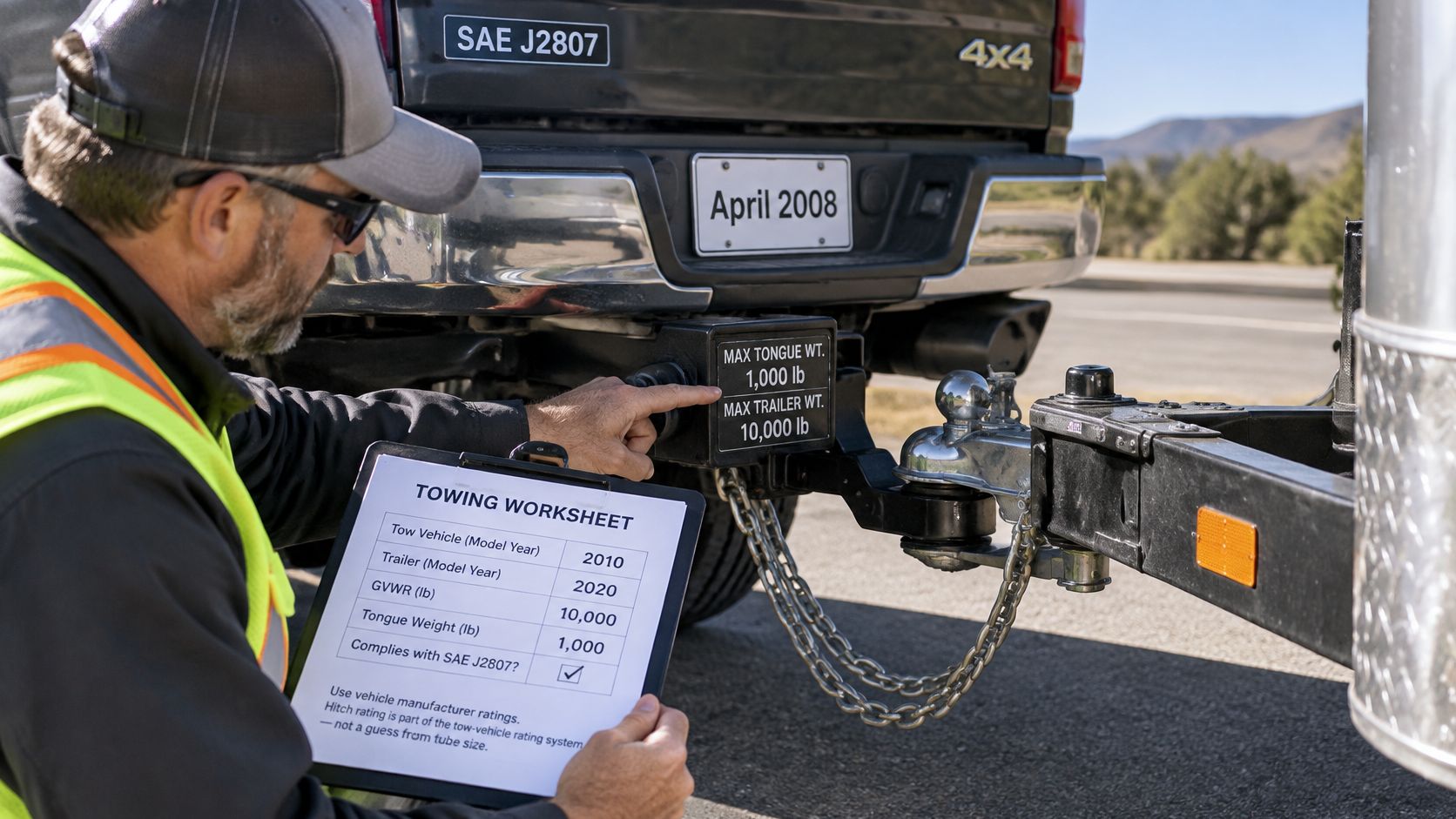
A trailer-hitch rating belongs inside a broader vehicle-and-trailer capacity system. It isn't a number a technician can infer from receiver size, a clean weld, or the fact that the unit moved the same load before.
SAE International's J2807 standard provides a repeatable method for determining vehicle gross combination weight rating and trailer weight rating. First issued in April 2008 and revised in 2010 and 2020, it establishes minimum performance criteria for vehicles up to 14,000 pounds GVWR. Its checks include acceleration, braking, handling, parking-brake performance, and launching on a grade, using a test trailer configured and loaded by a defined procedure so vehicle ratings are more comparable.
Read the label field by field
Use the hitch label and the vehicle documentation together. Check:
- Maximum gross trailer weight. Compare it with the loaded trailer weight, not an empty or advertised figure.
- Maximum tongue or vertical load. This is a separate limit from gross trailer weight.
- Weight-carrying and weight-distributing figures. Use only the rating for the configuration installed.
- Manufacturer and model. Match the label to the hitch's instructions and product identification.
- Receiver opening or coupling size. Use it to confirm fit, not to establish capacity.
A fresh-looking weld doesn't create a new rating. Neither does a larger receiver, a replacement component with no matching documentation, or last year's successful trip. The hitch number can't override the vehicle's own limits or the ratings of the connected hardware.
Use the inspection video as a prompt to examine the assembly, not as a replacement for labels and measurements.
Tongue Weight for a Loaded Trailer
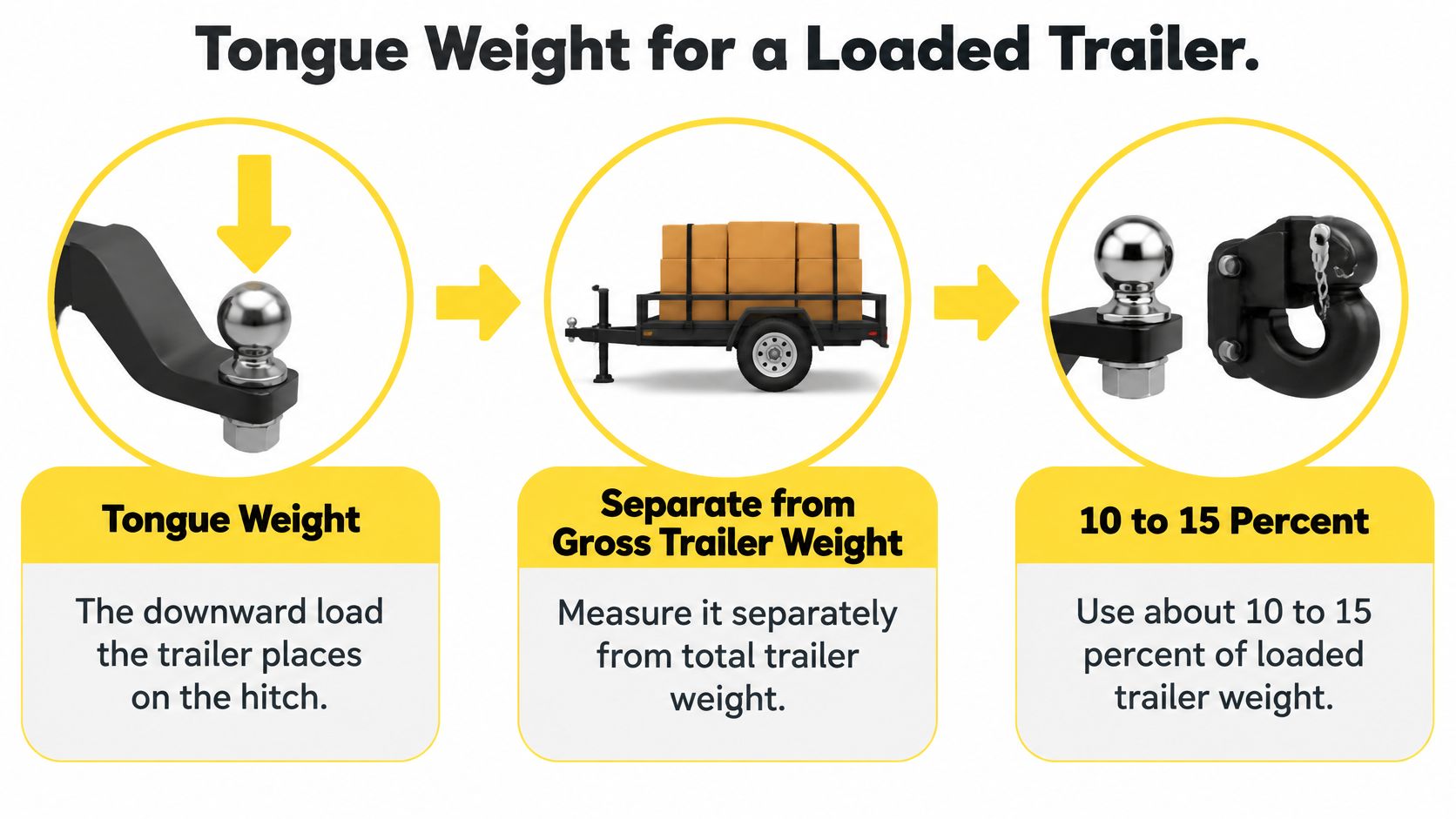
A hitch class is only a rating band; the loaded setup still has to stay within every component's limit. As typical industry targets, conventional ball-mounted trailers carry about 10 to 15 percent of their loaded weight on the tongue. Gooseneck and fifth-wheel combinations typically target 15 to 30 percent on the coupling.
For a 20,000-pound loaded conventional trailer, that means a typical tongue-weight target of 2,000 to 3,000 pounds. Treat the range as a loading guide, not permission to exceed any component's rating.
Weigh the combination in travel trim
Measure the trailer loaded as it will travel, with cargo in its working position. For a conventional setup:
- Weigh the tow vehicle unhitched.
- Connect the loaded trailer. Weigh again with the trailer wheels off the scale and the tow-vehicle axles on it.
- Subtract the unhitched vehicle weight from the connected reading. The difference is tongue weight.
Cargo position changes the load at the coupling. Material shifted forward or rearward in a Walking Floor, dump, or aggregate trailer can change tongue weight and axle loads. An empty-trailer reading does not establish the loaded condition.
Too little tongue weight can promote sway. Too much can overload the hitch, rear axle, tires, or suspension, and reduce front-wheel traction and steering control. Correct the load distribution rather than relying on a higher-rated hitch to compensate.
At release, record the loaded trailer weight, measured tongue weight, hitch rating, and axle loads. Correct cargo placement or use an approved weight-distribution system only where the vehicle and hitch permit it.
The Lowest Rated Part in the Combination
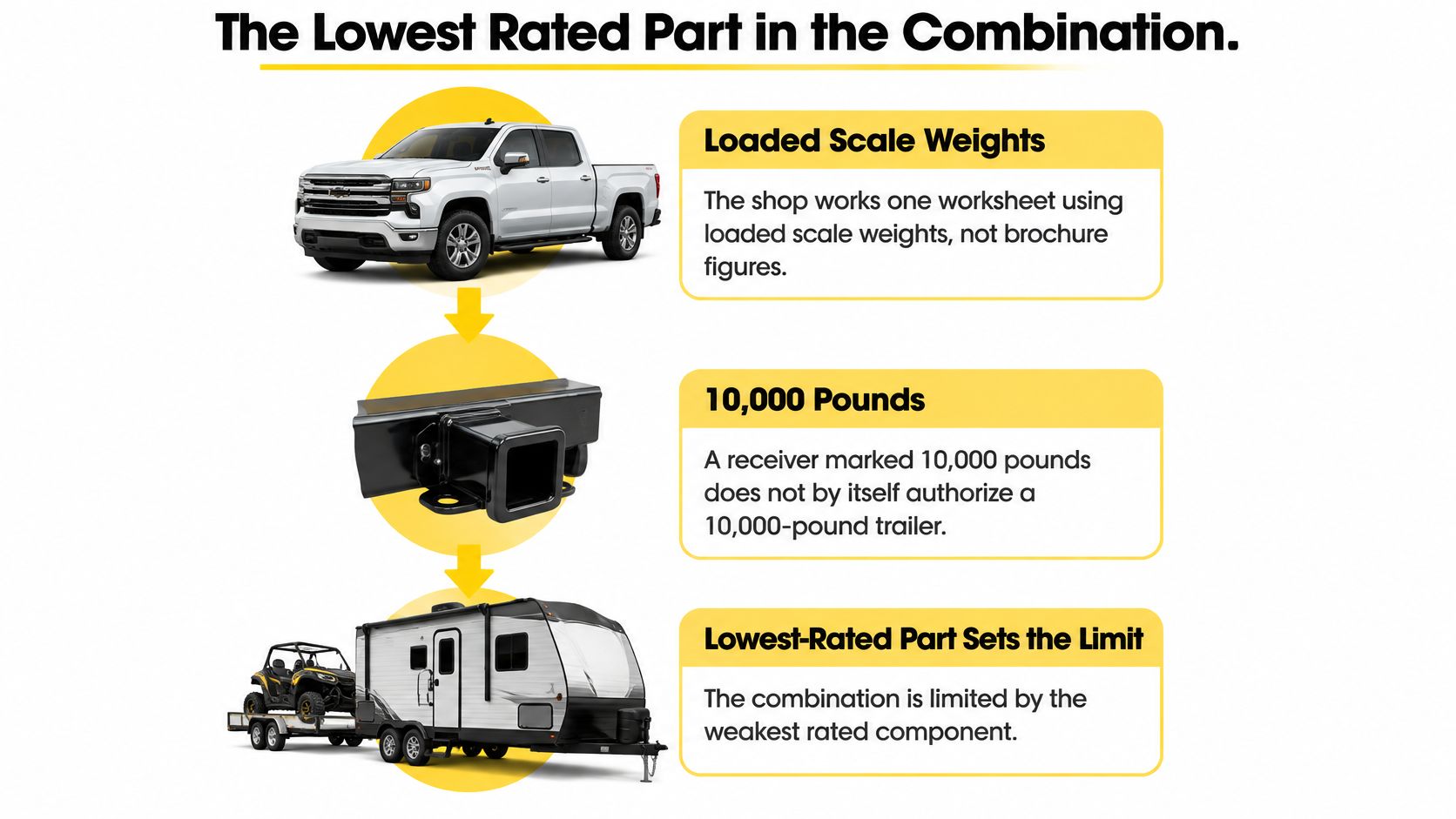
A receiver marked 10,000 pounds doesn't by itself authorize a 10,000-pound trailer. The truck's available payload, rear axle, vehicle tow rating, and other parts may limit the combination first. Government trailering guidance also emphasizes that the lowest-rated component controls, and that passengers, fuel, tools, cargo, and tongue weight consume capacity that might otherwise be available.
Build one worksheet from loaded weights
Use actual scale readings and component labels. Work through each row before deciding whether the combination passes.
| Limit | Where it is found | Compare against | Pass when |
|---|---|---|---|
| Hitch gross trailer weight | Hitch label | Loaded trailer weight on scale | Loaded weight at or below label |
| Hitch tongue weight | Hitch label | Measured tongue weight | Measured weight at or below label |
| Vehicle tow rating and GCWR | Vehicle certification label or placard | Loaded combination weight | Combined weight at or below rating |
| Rear gross axle weight rating | Vehicle certification label | Rear axle load with tongue weight and payload | Axle load at or below rating |
| Trailer axle ratings | Trailer data plate | Trailer axle loads from scale | Each axle at or below rating |
| Coupler, pintle, lunette, ball mount | Component labels | Loaded tongue or draft | Each rating at or above the load |
| Tires and brakes | Tire placard and brake specification | Loaded axle weights | Adequate for loaded weight |
| Safety devices and chains | Attachment hardware | Gross weight being towed | Ultimate strength at least gross weight |
For example, a receiver stamped 10,000 pounds can pass its own check while the truck fails. If payload and a 1,500-pound tongue load push the rear axle above its gross axle weight rating, the receiver's printed limit doesn't make the combination acceptable. Load distribution hardware also doesn't automatically increase the vehicle's tow rating or axle limits.
Mixed fleets need this check each time the assignment changes. A tractor pulling a light equipment trailer on one shift may be paired with a loaded Walking Floor trailer on another, and the operating load and axle distribution won't necessarily match. Yesterday's pass doesn't establish today's rating.
The usable gross trailer weight is the smallest capacity remaining after every applicable limit is compared with the loaded combination. If a rating label is missing or unreadable, don't replace it with a guess based on class, tube size, or prior use. Identify the component and verify its approved rating before release.
Federal Coupling Rules Behind the Rating
Federal commercial-vehicle rules don't assign one universal hitch class in pounds. Under 49 CFR 393.70, a full trailer's tow-bar and attachment system must be structurally adequate for the weight drawn, securely mounted, able to articulate without excessive slack, and fitted with a lock that prevents accidental separation.
Where a pintle hook or equivalent is mounted, the towing frame needs sufficient reinforcement or bracing to resist undue distortion. If a tow-bar fails or disconnects, required safety devices must have ultimate strength at least equal to the gross weight of the vehicle or vehicles being towed. The coupling's working limit therefore depends on its attachment and retention hardware, not just its stamped class.
Inspect beyond the stamp
A legible label doesn't make damaged hardware fit for service. During repair and inspection, check for:
- Mounting problems: cracked plates or welds, loose fasteners, or a distorted frame attachment.
- Coupling wear: excessive slack, a damaged locking mechanism, or a hook and lunette that don't engage securely.
- Weak safety attachments: chains, devices, or attachment points that don't meet the load requirement.
- Related system limits: inadequate brakes or a hitch structure that can't carry the actual towed weight.
When a defect affects structure or retention, hold the unit until the repair restores a suitable assembly and the inspection record captures the finding. Record the applicable component ratings alongside the loaded combination's scale weights.
When Repairs and Load Shifts Change the Rating
A component swap or structural repair can change what needs to be verified without changing the stamp on the hitch. NHTSA guidance on vehicle, hitch, and axle-rating verification explains that hitch capacity alone isn't enough: the vehicle's tow rating, hitch label, loaded tongue weight, vehicle and trailer axle ratings, and other applicable limits all need to be checked. For a repair shop, that means treating modified receivers, replacement drawbars, welded brackets, and changed operating loads as reasons to recheck the complete installation.
A replacement drawbar, ball mount, or pintle needs a rating at least equal to the intended service load. A thicker plate or neater weld doesn't raise an approved system rating, and the original hitch label must remain readable. A higher-rated coupler on a lower-rated receiver is still limited by the receiver.
Recheck after fabrication or loading changes
Use the same worksheet when a receiver or bracket has been modified, including work on an aluminum trailer frame or truck structure. The hitch stamp describes only one component; mounting strength and the surrounding structure still need inspection. Any repair must maintain a sound load path and leave the rating information available for verification.
Weight-distributing equipment counts only where the vehicle and hitch manufacturers permit it. It may change how load is transferred, but it doesn't raise the vehicle's gross combination or axle ratings. A setup that appears more level still needs to pass the same component-by-component checks.
Cargo position is another source of rating error. In Walking Floor, dump, and aggregate trailers, material carried farther forward can raise the tongue or kingpin load without changing the hitch label. Reweigh after a body or floor repair that changes how the load sits, and measure with the unit in travel trim.
A strong-looking weld or a higher-rated replacement part is not proof that the complete combination has a higher approved capacity.
Before returning a repaired or modified unit to service, record loaded trailer weight, measured tongue or kingpin load, hitch rating, and axle loads. If the mounting structure is damaged or the load has shifted, update the inspection rather than relying on a previous scale ticket.
Confirm the Rating Before Release
Go or no-go: don't send the combination out until the loaded trailer weight and measured tongue or kingpin load fit inside every applicable limit. If one limit fails, reduce the load or replace the limiting component. Don't move up a class on paper and call the problem solved.
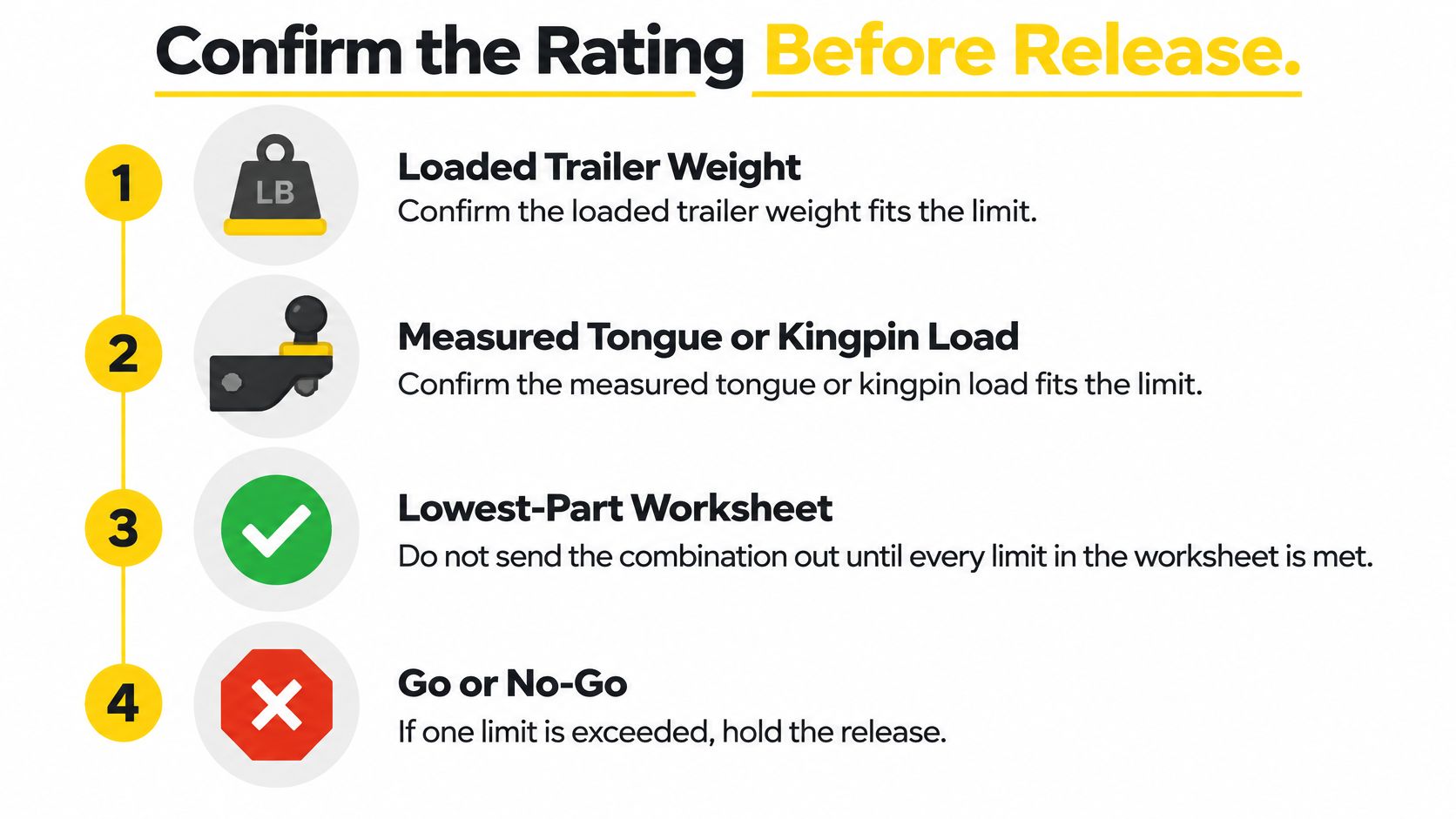
Make the release decision
Record the loaded trailer weight, measured tongue or kingpin load, hitch label rating, and axle loads with the inspection. Then confirm that the vehicle, hitch, coupling parts, tires, brakes, trailer axles, and safety devices all pass for that load. If any single component fails, the unit stays out of service until the load or component is corrected.
When the failure is structural rather than a capacity mismatch, treat it as a repair and fabrication job. A cracked aluminum trailer or truck structure, distorted pintle plate, or bracket that needs to fit a particular fleet setup can't be cleared by installing a higher-class receiver. Brothers Truck Trailer Repair and Welding Corp. offers custom fabrication for specific truck and trailer requirements, along with aluminum welding for trucks and trailers, including repair of aluminum trailer bodies and components. Its aluminum welds are designed to resist corrosion.
Once the structure is repaired, repeat the loaded scale comparison before the trailer returns to work. That check confirms the repaired mounting structure and the existing component ratings still suit the combination as it will operate.
If a damaged truck or trailer structure is holding up a rating check, contact Brothers Truck Trailer Repair and Welding Corp. for custom fabrication and aluminum welding for truck and trailer repairs. The shop also sells truck and trailer parts and supplies from its inventory.
Select, mount, and inspect a trailer door latch; distinguish towing and anti-theft locks, and check alignment, mounts and engagement.

Walking floor slat replacement for fleets: when to rotate, plate, or replace slats, plus welding, hydraulic, and safety checks.

Aluminum trailer crack repair for fleets: classify the crack, inspect the full path, weld sound metal, and know when a shop should do it.