Aluminum Welding and Fabrication: A Trailer Repair Guide
The most popular advice in aluminum welding and fabrication is also the most misleading for a fleet manager. You're told to look for a clean, even bead, check that the edges have fused, and send the trailer back out. A bead can look perfect and still sit in metal that has lost a third of its strength, hide porosity under the surface, or cross an alloy that should never have been arc welded in the first place.
That's not a cosmetic problem. It's a repair decision problem.
Aluminum is not a niche material on trucks and trailers. The U.S. Geological Survey aluminum summary reported that transportation applications represented 36% of U.S. domestic aluminum consumption in 2024. Fleets use it for bodies, panels, cross-members, brackets and custom components because low mass helps payload and corrosion resistance helps service life. Those same parts carry very different loads, and they're not all made from the same alloy or temper.
I would judge an aluminum repair by four things before I judged the bead. Identify the alloy. Understand what heat did beside the weld. Check the repair history and the load path. Then decide, with inspection records in hand, whether welding is the right answer at all.
Table of Contents
- Aluminum Alloys and How Welding Reduces Strength
- Fabrication Methods Used on Trucks and Trailers
- Repair or Replace Aluminum Trailer Parts
- Common Problems and How to Fix Them
- Safety and Inspection Rules for Aluminum Shops
- Choose a Shop That Documents Aluminum Repairs
Aluminum Alloys and How Welding Reduces Strength
Start with one rule. Alloy identification comes before any weld. Weldability and post-weld strength vary substantially by alloy and temper, so a shop that quotes a structural repair before asking what the part is made from is quoting blind.
Check stamped marks first. Then check drawings, build sheets and supplier records. If those don't agree, stop and verify before you strike an arc. Once you know the designation, select filler from an approved compatibility chart, not from whatever spool is already loaded in the gun.
What the joint efficiency numbers tell you
Joint efficiency is a useful reality check. It compares the ultimate tensile strength of the welded joint with the strength of the unwelded base metal. A 2023 review compiled in PMC reported that AA5083 retained 303 MPa compared with 304 MPa for the base metal, equivalent to 99.6% joint efficiency, while AA6061 declined from 331 MPa to 237 MPa, or 71.6%, and AA6082 declined from 293 MPa to 195 MPa, or 66.6%. The same review reported AA2A14 at 73.3% efficiency and AA2219 at 72.4%.
Walk the table row by row and the pattern is clear. AA5083 keeps nearly all its strength in conventional fusion welding. Heat-treatable structural alloys such as 6061 and 6082 lose roughly a third. That loss doesn't mean they can't be welded. It means the joint must be designed, sized and placed as a weaker zone from the start.
Weldability and joint efficiency by aluminum alloy
| Alloy | Typical use | Weldability and risk | Joint efficiency |
|---|---|---|---|
| AA5083 | Marine and transport plate | Retains strength well in conventional fusion welding | 99.6% (303 vs 304 MPa) |
| AA6061 | Structural extrusions and frames | Heat-treatable, loses strength in the weld-affected zone | 71.6% (237 vs 331 MPa) |
| AA6082 | Structural sections | Heat-treatable, significant strength loss after welding | 66.6% (195 vs 293 MPa) |
| AA2A14 | Forgings and high-strength parts | Strength loss after fusion welding | 73.3% |
| AA2219 | High-strength aerospace parts | Strength loss after fusion welding | 72.4% |
| 2024 | High-strength structural alloy | Generally unsuitable for conventional arc welding, cracking risk | No arc weld rating, replace or use approved procedure |
| 7075 | High-strength structural alloy | Generally unsuitable for conventional arc welding, cracking and stress-corrosion risk | No arc weld rating, replace or use approved procedure |
Alloys you shouldn't treat as routine weld jobs
Some alloys move the conversation from how to weld to whether to weld. The American Welding Society guide to aluminum welds identifies 2024 and 7075 as generally unsuitable for conventional arc welding because their chemistry creates increased risks of solidification cracking and, in some conditions, stress-corrosion cracking. The same source notes that the Aluminum Association reports a welded 6061 tensile yield strength of approximately 15 ksi versus 16 ksi for 6061-T4, and that aluminum welds and heat-affected zones can commonly be 30% or more weaker than the parent material.
That's the trap. A weld on 2024 or 7075 can look visually acceptable and still be structurally unreliable. Without an approved repair procedure, I wouldn't authorize it for a load-bearing part. If a shop can't identify the alloy, treat the part as load-critical until verified. Unknown doesn't mean average. It means unknown.
Why the metal beside the bead matters most
Think of a paperclip. Bend it back and forth and the bend zone changes. It gets harder in one spot, then weakens and snaps, even though the rest of the wire looks untouched. Welding creates a comparable local change, but with heat. The bead melts, the metal beside it gets hot enough to lose temper, then cools in a new condition. That band is the heat-affected zone, and it's often the weakest part of the repair.
Strength isn't the only loss. Ductility drops too, and ductility is what lets a part flex a little instead of cracking. The review data above recorded AA6061 elongation falling from 11.7% in the base metal to 5.2% in the welded joint. On a trailer that twists over dock plates, potholes and uneven loads, that lost stretch matters. The joint gives less warning before it fails.
A welded joint must be designed as a weaker zone, not as equivalent metal. The bead is the visible part. The softened band beside it carries the load too.
For load-bearing components, weld size, joint geometry, access, heat input and any local reinforcement belong in a qualified welding procedure. Don't select them by eye at the bench. A wider bead doesn't automatically compensate for a softened zone, and piling on metal can add heat that softens a wider band.
Close every structural estimate with three checks. First, what's the alloy and temper, and how was it verified? Second, what heat input will the procedure use, and how will the welder control it? Third, does the weld sit in a high-stress location, such as a hinge, a cross-member junction or a suspension attachment? If you can't answer all three, you don't have a repair plan yet. You have a welding plan, and that's a different thing.
Fabrication Methods Used on Trucks and Trailers
Process choice follows the part's load role, not shop habit. A welder who reaches for the same gun for thin body sheet and thick structural plate will make one of those jobs worse. Compare the two main arc processes on the same criteria, thickness, speed, access and heat control.
The comparison below sums up where each method earns its place on truck and trailer work.
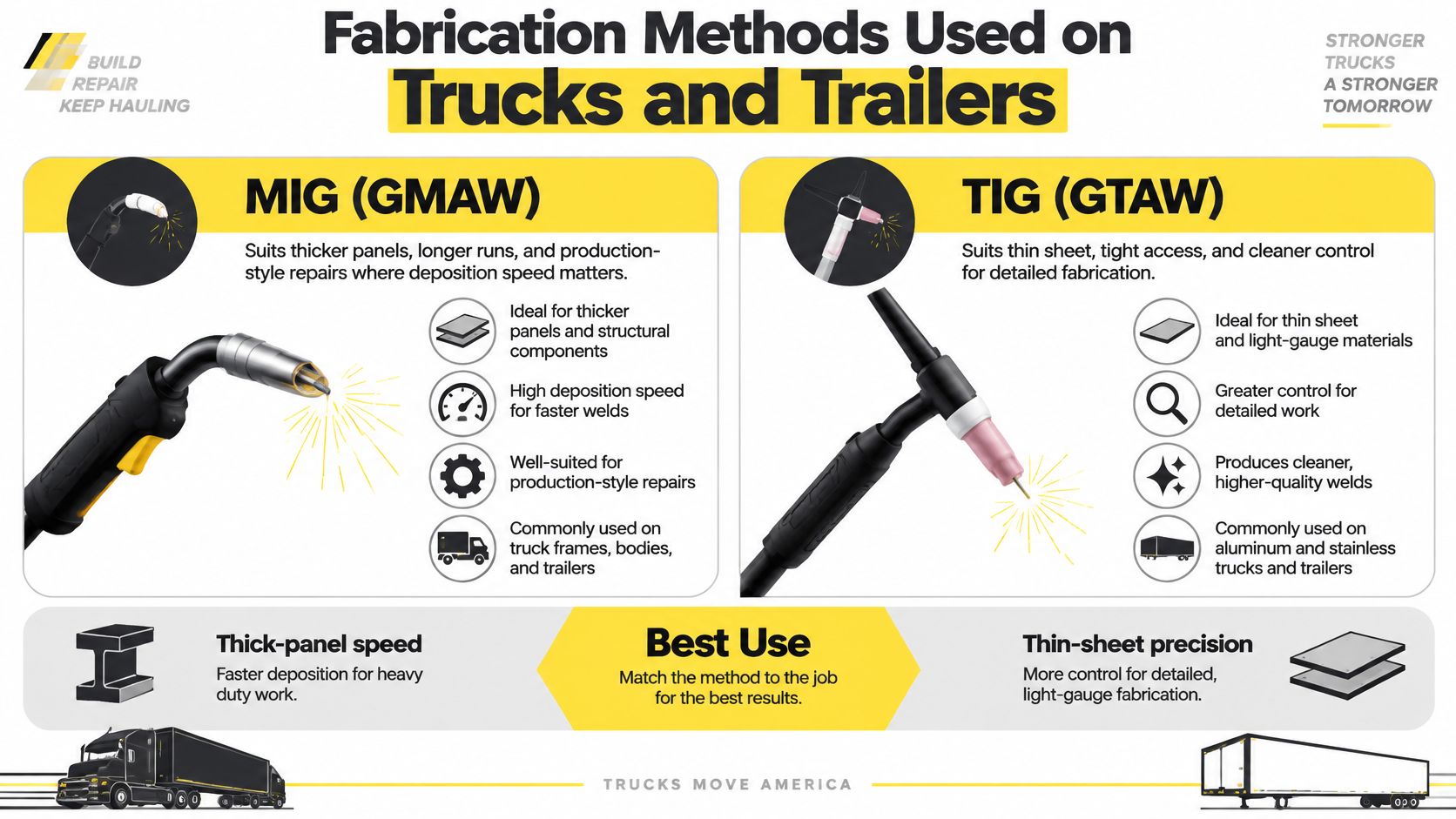
MIG, or GMAW, suits thicker panels, longer runs and production-style repairs where deposition speed matters. A spool gun or push-pull gun feeds soft aluminum wire without bird-nesting, and the welder can cover a long seam on a floor or side panel in reasonable time. The trade-off is control. It's easier to outrun your cleaning, trap porosity, or put down a tall, cold bead on a joint that wasn't ready.
TIG, or GTAW, suits thin sheet, tight access and precise restoration of body panels where heat control matters most. The welder feeds filler by hand, works slower, and can tie in edges without blowing through. The trade-off is speed and cost. On a long structural seam, TIG can turn a one-shift job into a bottleneck, and slow travel with poor technique can still overheat the part.
Cutting and forming set up everything that follows. Saw and shear cuts give clean, predictable edges for fit-up. Plasma cuts faster on heavier stock but leaves an edge that needs cleaning before welding. Bending needs planned radii for the alloy and thickness. A bend that's too tight creates a stress riser, and a weld placed right on that stressed bend inherits the problem.
The short demonstration below shows the control side of the work before we get to sequencing.
A fabrication sequence that prevents rework
- Confirm alloy and temper: Verify from marks or records so filler and procedure match the metal. The common slip is assuming all bright sheet is the same alloy.
- Cut and deburr: Square edges fit better and weld cleaner. Skipping deburring leaves sharp edges that trap oxide and contamination.
- Pre-clean joint and filler: Degrease, remove oxide with a dedicated stainless brush, and keep filler dry. Dirty filler defeats clean base metal.
- Fit up with the right gap: Even gaps give even penetration. Forcing a poor fit with clamp pressure builds in restraint and distortion.
- Weld with a qualified procedure: Settings, gas coverage and travel speed come from the procedure, not guesswork. Changing wire mid-job without checking compatibility is a frequent error.
- Inspect weld and heat zone: Look beyond the bead for cracks, undercut and distortion. Inspecting only the pretty center of the seam misses the ends, where defects cluster.
- Finish and protect the joint: Dress only where the design allows, then seal or coat so moisture doesn't sit in the joint. Grinding a structural weld flush for looks can remove reinforcement the design counted on.
Repair or Replace Aluminum Trailer Parts
A low repair count doesn't prove a part is safe, and a high repair count doesn't automatically condemn it. Both shortcuts fail. What matters is where the crack sits, what alloy you're dealing with, and what inspection finds in and around the old weld.
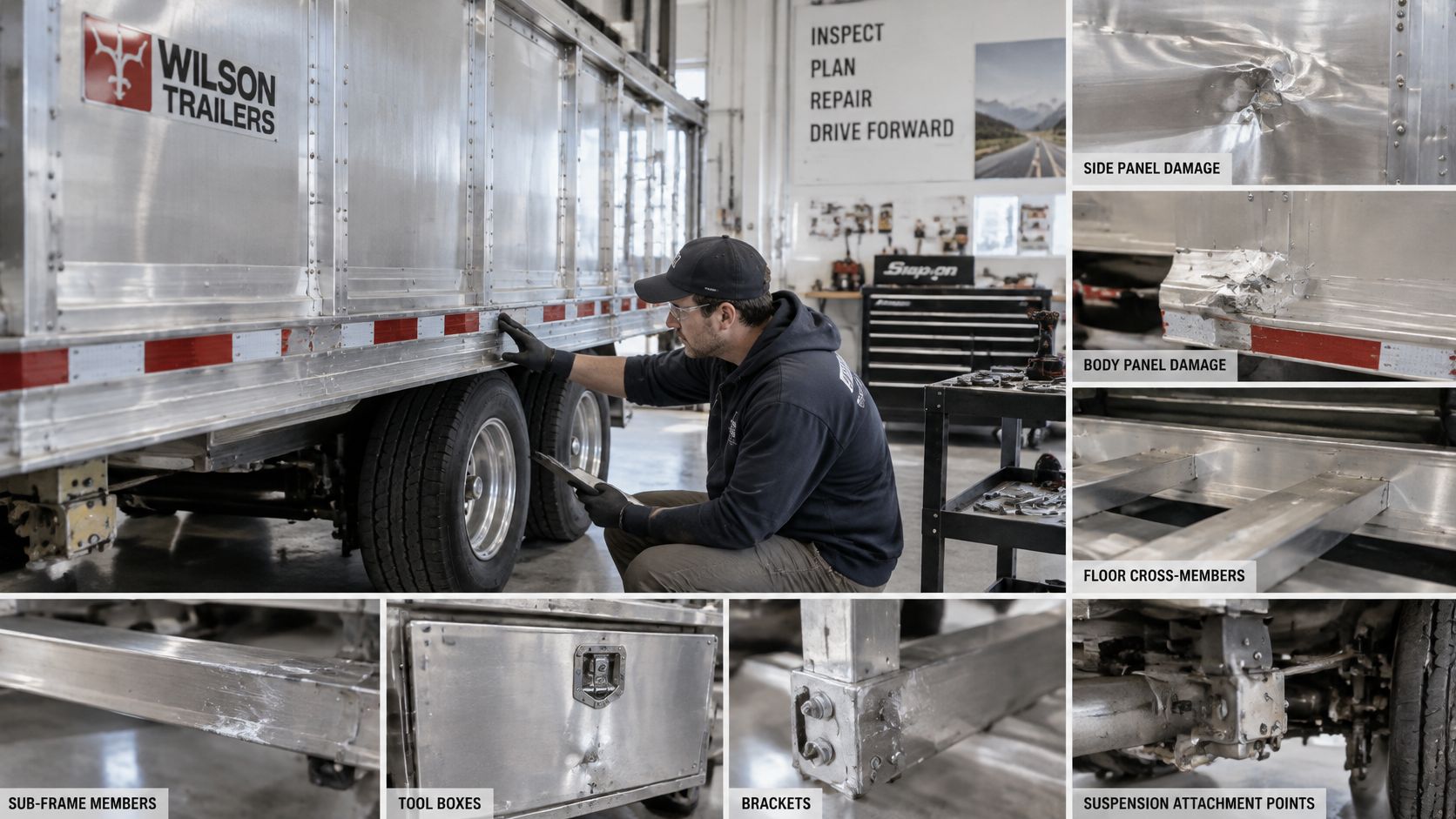
Aluminum welding applies across side and body panels, floor cross-members, sub-frame members, tool boxes, brackets, suspension attachment points and components near Walking Floor interfaces. Those parts don't share the same consequences. A cracked tool box lid is a nuisance. A cracked cross-member at a suspension hanger changes the load path for the whole trailer.
Separate the two categories before you price anything. Cosmetic panel repair restores shape, weather sealing and appearance. Load-bearing structural repair restores strength and fatigue life. The second category needs alloy verification, a procedure, and inspection. The first still needs clean work, but it doesn't carry the trailer.
The visual inspection stage matters more than most estimates admit, especially on older units with undocumented repairs.
What repeated repair research actually says
A study of welded 5083 aluminum found that specimens repaired twice and fourteen times had similar overall fatigue strengths, yet failures consistently occurred in the weld metal. Read that carefully. It doesn't say repeat repairs are harmless. It says repair count alone didn't separate the outcomes, and the weld zone remained where failures started.
Practical rule: Don't ask how many times it's been welded and stop there. Ask where it keeps cracking, and have that zone inspected.
A same-day decision sequence
- Identify the alloy and temper: Use marks and records. If you can't identify it, you can't qualify a structural weld on it.
- Locate the stress path: Trace how load moves through the part. Cracks at hinges, hangers and cross-member joints sit where stress concentrates.
- Check crack and repair history: A first crack from a known impact reads differently from the third crack in the same line with no impact.
- Inspect the weld zone: Pair visual inspection with dye penetrant or another qualified method before and after any repair. Surface cracks you can't see under road film will show up under penetrant.
- Decide and document: Record the decision, the method, and the inspector on the vehicle file so the next shop isn't guessing.
Replacement wins in a few clear cases. Favor replacement when cracks recur at a hinge, suspension attachment or cross-member joint with repeated prior welds. Favor it when the alloy can't be identified, when cracking runs through a softened zone from an earlier repair, or when access prevents a full, inspectable weld. In those cases another bead doesn't restore the part. It resets the clock on the same failure, usually at a worse time.
Repairs near Walking Floor interfaces deserve extra care because alignment and movement matter as well as strength. A bracket welded slightly out of position can survive structurally and still cause uneven slat movement or binding. For weld repairs on panels and non-critical brackets with a known alloy, a first-time crack and a clean inspection, welding is often the sensible call. Keep the record either way. A repair history that lives only in a driver's memory isn't a history.
Common Problems and How to Fix Them
Porosity is the defect you'll meet most often, and it's the one rushed jobs create. Those small gas holes in the bead mean hydrogen got into the molten pool, usually from oil, oxide or moisture on the base metal or filler. The bead may still look full. Inside, it's sponge. Under cyclic load, pores link up and the joint loses the cross-section you thought you paid for.
Real fleet conditions make this worse. Trailers arrive with road salt, hydraulic oil, waste residue and rain in the seams. Florida humidity doesn't help. The fix isn't more heat or a second pass over dirty metal. It's degreasing, mechanical cleaning, drying, and rejecting filler that's been stored damp or handled with dirty gloves. That preparation time is not overhead. It's the difference between one downtime event and two.
Same-day triage table
Aluminum weld problems, causes and fixes
| Symptom | Likely cause | Fix |
|---|---|---|
| Pores or gas holes in the bead | Oil, oxide or moisture on base metal or filler | Degrease, clean, dry and reject contaminated filler, same shift |
| Cracking near or along the weld | Filler mismatch, high restraint or hot cracking in susceptible alloys | Verify filler compatibility, redesign joint, inspect, engineering review |
| Softened zone next to the weld | Heat-affected zone in heat-treated alloy | Reinforce or redesign load path, replace if load-critical |
| Distortion or warping | Excess heat input or poor fit-up | Control heat, sequence welds, improve fit-up, same shift |
| Corrosion at a dissimilar-metal joint | Trapped moisture at contact | Isolate metals, seal joint, allow drainage, scheduled maintenance |
Cracking near or along the weld points to a different set of causes. Wrong filler can make the deposit crack-sensitive. High restraint, where rigid surrounding structure won't let the joint move as it cools, pulls the hot weld apart. Susceptible alloys hot-crack during solidification. Don't just grind it out and reweld with the same setup. Verify compatibility, reconsider joint design and restraint, and inspect the full length. This one needs engineering review when the part carries load.
A softened zone isn't visible, which makes it easy to miss in triage. You'll infer it from the alloy. If the part is heat-treated and the weld sits in the load path, assume the band beside the bead is weaker and act accordingly. Reinforce the joint, redesign how load crosses it, or replace the part if it's load-critical and reinforcement isn't practical. No amount of bead dressing restores lost temper.
Distortion usually comes from excess heat input, long continuous passes in one direction, or fit-up gaps the welder tried to fill. Sequence welds to balance shrinkage, stitch where the procedure allows, clamp sensibly, and fix the fit before welding. Straightening a warped panel after the fact can work-harden and thin the area you'll rely on later, so prevention beats correction.
Corrosion where metals meet
Corrosion at a dissimilar-metal joint, aluminum against steel fasteners or brackets, grows where moisture sits trapped at the contact face. The repair is unglamorous and effective. Isolate the metals with a suitable barrier, seal the joint so water can't wick in, and leave a drainage path so what gets in can get out. Sealing a joint shut with moisture already inside does the opposite of protecting it.
Note which fixes belong to a single shift and which don't. Porosity prevention and distortion control are same-shift disciplines. Cracking and softened-zone problems on structural parts require review or replacement. Faster welding isn't faster fleet service if poor preparation brings the unit back. Our welders have specialized aluminum expertise, and the slowest-looking step in our process is usually cleaning. It's also the step that keeps trailers out of the shop the second time.
Safety and Inspection Rules for Aluminum Shops
Fume control planning happens before welding starts, not after someone notices the air. The OSHA welding guidance identifies hazardous vapors from heating aluminum alloys and other base metals during welding, and states that mechanical ventilation is required when welding or cutting occurs in a space providing less than 10,000 cubic feet per welder or where the overhead height is less than 16 feet, under 29 CFR 1910.252(c)(2).
Confined spaces raise the stakes. Working inside a trailer body or an enclosed compartment increases exposure and the controls required. Where ventilation can't prevent hazardous exposure, that same OSHA framework requires airline respirators or hose masks under 29 CFR 1910.252(c)(4). Don't treat a box fan in a doorway as a ventilation plan for enclosed work.
Radiation is the other shop hazard that's easy to underestimate with aluminum. Its bright, reflective surface bounces arc energy, so nearby workers need shielding and skin coverage, not just the welder. Set screens, keep bystanders out of the reflection path, and cover exposed skin even for short tack welds.
Fleet inspection after the repair
The vehicle side has its own rules, and they connect directly to weld repairs. Under FMCSA periodic inspection requirements, a commercial vehicle, including every segment of a combination vehicle, must receive a periodic inspection at least once every 12 months, performed by a qualified inspector, with documentation maintained on the vehicle. That applies separately to the tractor, semitrailer, full trailer and converter dolly.
Daily records matter too. The FMCSA inspection guidance requires records to identify defects that could affect safe operation or cause mechanical breakdown, and its brake guidance includes checking air-system pressure between 90 and 100 psi, audible air leaks, pushrod travel and cracked or loose brake parts.
Put a short list on the shop floor and in the vehicle file:
- Structure: Recheck frame assemblies, suspension, axles and attaching parts near any weld repair for cracks, loose hardware and distortion.
- Brakes: After work near brake components, confirm trailer brake connections, listen for air leaks, and verify system pressure before release.
- Documentation: Record the defect, the repair, the inspection method and who signed it off. Keep periodic inspection documentation on the vehicle.
- Shop controls: Confirm ventilation or respirator needs for the space, plus screens for reflected arc exposure.
A repaired trailer that leaves without these checks isn't finished. It's just welded.
Choose a Shop That Documents Aluminum Repairs
A shop should be able to show you how it handled the alloy, the procedure and the record, not only the finished bead. Photos of pretty welds prove someone can run a torch on a good day. Documentation proves the shop can repeat the result on your trailer, under load, six months from now.
Use a checklist when you evaluate any provider for aluminum welding and fabrication work, including us.
- Asks for alloy identification before quoting: A structural quote issued without a material designation is a guess. The shop should ask for marks, drawings or supplier records, or tell you how it'll verify the alloy on arrival.
- Uses a qualified procedure and approved filler: Filler selection comes from a compatibility chart tied to your alloy. Wire choice by habit or availability isn't a procedure.
- Records the job inputs: Heat input approach, filler, shielding and process settings should land on the work order, along with pre-repair and post-repair inspection results.
- Separates cosmetic from load-critical: The shop should say plainly which repairs it treats as body work and which it treats as structural, because inspection and sign-off differ.
- Offers same-day triage: When downtime is the priority, you need a fast, honest repair-or-replace call, not a fast weld. Triage means inspection first, then a documented recommendation.
- Keeps a repair history per unit: Prior welds, crack locations and inspection results should follow the trailer. Repeat cracking in one zone is decision data, and it only exists if someone wrote it down.
- Connects repairs to periodic inspection: Structural and brake-related work should be checked against inspection expectations before the unit returns to service, by someone qualified to inspect commercial vehicles.
Two questions that test any shop
Ask how the shop identifies the alloy before a structural weld. A strong answer names marks, records, and what happens when neither is available. A weak answer is a shrug and a grinder.
Ask which inspection method follows the weld. You want a specific answer, dye penetrant or another qualified method, with acceptance criteria, not a visual once-over while the metal is still warm.
If a shop can't tell you what alloy it welded and how it inspected the result, it can't tell you how strong the repair is.
Brothers Truck Trailer Repair and Welding Corp. is one option to evaluate against these criteria. Our focus includes aluminum welding for trailers and trucks, including repair of aluminum trailer bodies and components, with welds designed to resist corrosion and custom fabrication designed to meet specific truck and trailer requirements. Ask directly how each checklist item is handled for your unit, and expect specific answers on alloy verification, filler and inspection.
Make the first step easy and useful. Before the unit is scheduled, send the alloy designation if you have it, clear photos of the damage and surrounding structure, and whatever repair history exists for that spot. Add how the trailer is used, waste, aggregate, general freight, and whether the damage sits near a Walking Floor interface or suspension attachment. That packet lets a shop triage, quote the right scope, and tell you before teardown whether you're looking at a weld, a reinforced repair, or a replacement part. That's how you buy one downtime event instead of two.
If your trailer needs aluminum welding for a body panel, a structural member or a custom fabrication, Brothers Truck Trailer Repair and Welding Corp. can assess the alloy, the load path and the repair history before recommending a weld or a replacement. Send the alloy designation, photos and prior repair details, and ask how the repair will be inspected and recorded for your vehicle file.

Check trailer hitch ratings, vehicle tow limits, GCWR, GVWR and measured coupling loads; verify labels, axle weights and repairs before release.
Select, mount, and inspect a trailer door latch; distinguish towing and anti-theft locks, and check alignment, mounts and engagement.
Walking floor slat replacement for fleets: when to rotate, plate, or replace slats, plus welding, hydraulic, and safety checks.