Truck Preventive Maintenance Schedule: How to Build One
In 2024, engine-control diagnostics averaged $192.70 and engine-control modules averaged $533.78 in Fleetio data reported by Fleet Maintenance. That's why a good truck preventive maintenance schedule isn't a calendar you copy from a manual. It's a cost and uptime control system that catches cheap faults before they turn into parts, towing, missed loads, and roadside violations.
Build yours around the trigger that arrives first. Miles, engine hours, calendar age, load severity, and defect history all count, and the most conservative one should set the service date.
Table of Contents
- Recommended Maintenance Intervals for Trucks and Trailers
- How to Build Your Schedule Step by Step
- Engine, Brake and Suspension Checks That Prevent Breakdowns
- Walking Floor and Trailer Checks Fleets Often Miss
- Recordkeeping Rules and What Auditors Look For
- Parts to Stock So Scheduled Work Does Not Wait
- Start Your Schedule This Quarter
Recommended Maintenance Intervals for Trucks and Trailers
A schedule matters because wear doesn't follow one clock. A highway tractor racks up miles, a municipal unit racks up idle hours, and a Walking Floor trailer wears through load cycles, hydraulic work, heat, and structural stress even when its road miles look modest.
The table below is the schedule most fleets build from. Each row pairs a trigger with the work it sets off, so drivers, technicians, and managers know what happens next and who owns it.
Maintenance Intervals by Trigger
| Interval | Trigger | Core tasks |
|---|---|---|
| Every dispatch | Daily driver inspection | Tires, wheels, lights, mirrors, fluid leaks, visible brake components, couplings, trailer doors |
| Weekly or 1,000-2,000 miles | Mileage or calendar | Tread, inflation, suspension fasteners, air leaks, belts, hoses, batteries, fluids, trailer structure |
| 10,000-15,000 miles (manufacturer interval) | Mileage or engine hours | Oil and filter, fault codes, lubrication, brake measurement, steering, suspension, road test |
| After each heavy Walking Floor load | Load cycle | Hydraulic function, floor slats, structural check |
| Every 12 months | Calendar | Periodic inspection of all safety-critical components |
At every dispatch, the driver inspection is your first filter. Tires, wheels, lights, mirrors, leaks, visible brake parts, coupling devices, and trailer doors either pass or they generate a defect report before the truck leaves.
The weekly or 1,000 to 2,000 mile check belongs to maintenance staff, not only the driver. Measure tread and inflation with a gauge, look for air-system leakage, check suspension fasteners, belts, hoses, batteries, and fluid levels, and walk the trailer for structural damage that a cab-focused checklist misses.
At the manufacturer service interval, commonly 10,000 to 15,000 miles for many highway tractors, do the deeper work. Change oil and filters, pull electronic fault codes, lubricate, measure brakes, inspect steering and suspension, and finish with a documented road test so the repair is verified under load, not just on a lift.
Practical rule: Whichever trigger arrives first sets the service. Severe duty shortens every row.
That legal floor matters, but it isn't the whole program. Under the federal rules in 49 CFR Part 396, every motor carrier must systematically inspect, repair, and maintain each commercial motor vehicle under its control, keep safety-critical components in safe operating condition, and complete a periodic inspection at least once during every preceding 12-month period. Frames, suspension systems, axles, wheels and rims, and steering systems all sit inside that obligation.
Treat the annual inspection as the minimum you must prove, not the interval you should run. High-mileage tractors, heavy-haul equipment, and Walking Floor trailers need more frequent brake, tire, suspension, hydraulic, structural, and lubrication checks because their failure modes develop long before twelve months pass.
Add a post-load inspection after every heavy Walking Floor cycle. Run the floor, look for hydraulic leaks, check slat movement, and inspect the structure around the drive before the next load hides the evidence.
How to Build Your Schedule Step by Step
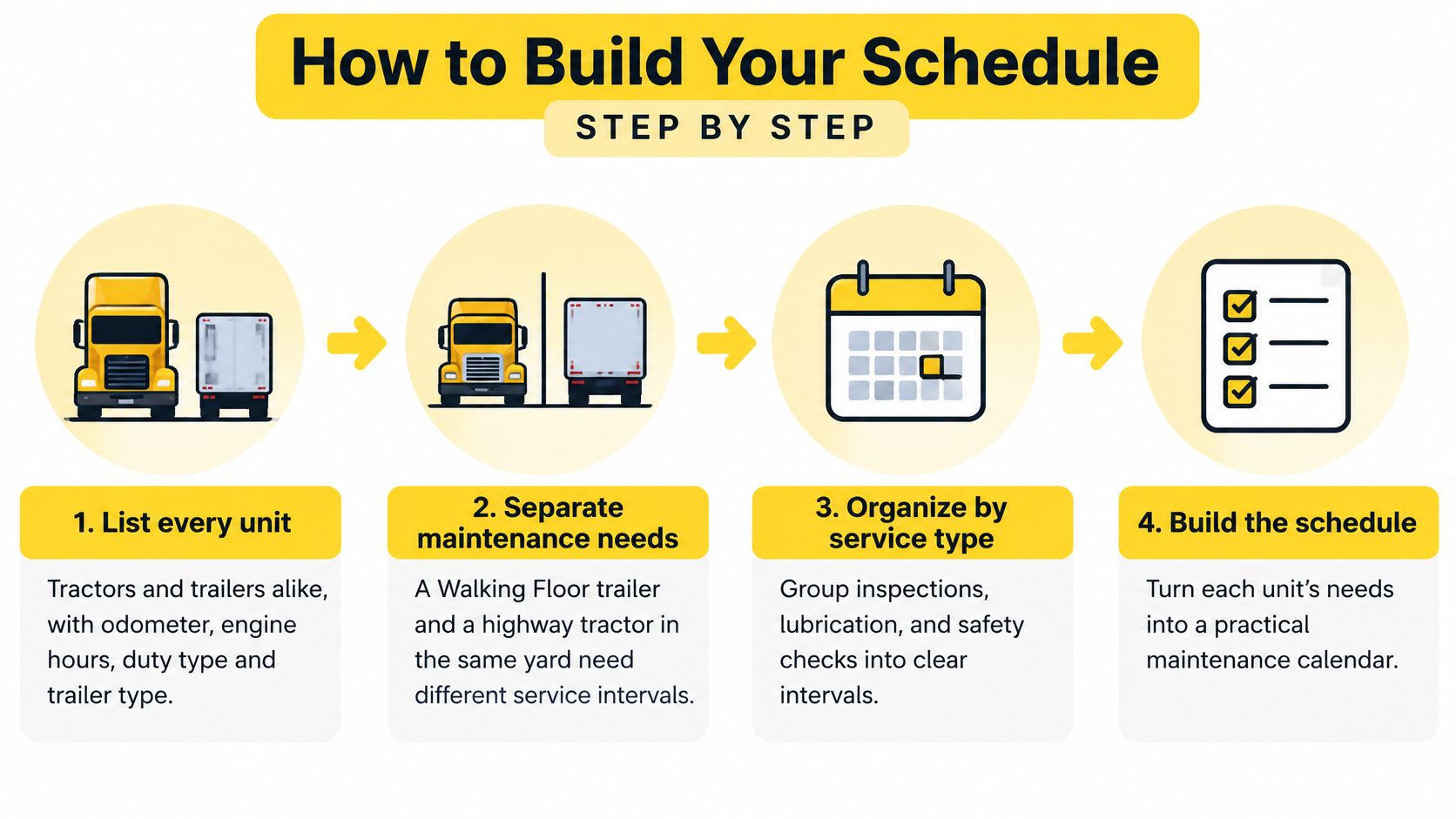
List every unit. Include tractors and trailers with odometer, engine hours, duty type, and trailer type. A Walking Floor trailer and a highway tractor in the same yard need different triggers, so don't force them onto one line.
Pull each manufacturer interval. Write the engine, transmission, brake, and hydraulic intervals beside each unit. This gives you a starting point you can defend, then adjust for real duty.
Set the first trigger to win. Use miles, engine hours, or calendar age, whichever occurs first. A technically useful strategy combines calendar, mileage, engine-hour, and condition triggers that way, as explained in this brake failure and maintenance overview.
Tighten for severe duty. Shorten intervals for stop-start, refuse, aggregate, idling, off-road, or hydraulic work. Don't extend service just because annual mileage is low when hours, short trips, or heavy loading are high.
Assign an owner and due date. Open a work order for every defect, not only the ones that stop the truck. Small leaks and loose fasteners become road calls when nobody owns them.
Sort defects by risk. Repair brake, steering, tire, coupling, structural, and hydraulic safety defects immediately. Monitor measurable wear with logged readings, and replace parts at condition limits or repeat-failure thresholds.
Review four numbers monthly. Track repeat-defect rate, overdue-PM rate, road calls per 10,000 miles, and mean time to repair. Those numbers tell you whether intervals are too long, parts are wrong, or closeout checks are weak.
Engine, Brake and Suspension Checks That Prevent Breakdowns
Brake defects account for a significant share of vehicle out-of-service violations. During the 2025 International Roadcheck, inspectors conducted 44,435 vehicle inspections, and brakes represented 24.4% of vehicle out-of-service violations, according to the Commercial Vehicle Safety Alliance's 2025 Roadcheck results.
Measure pad or lining thickness, then check adjustment, air leakage, trailer brake connections, and parking brake performance. Pads can remain within limits while poor adjustment or an air leak makes the vehicle unsafe for service.
Brake checks should cover function as well as wear. A thickness reading alone can miss the fault that stops a truck.
Component Checks and Warning Signs
| Component | What to check | Warning sign |
|---|---|---|
| Brakes | Pad or lining thickness, adjustment, air leakage, trailer brake connections, parking brake test | Air leakage or uneven adjustment even when pads are in spec |
| Suspension | Fasteners against torque records, bushings, U-bolts, air springs, axle attaching parts | Loose fasteners or worn bushings on tractor or trailer |
| Engine | Oil and filter at interval, electronic fault codes, belts, hoses, coolant | Active fault codes or cracked or swollen hoses |
| Fluids | Oil sample where justified, level logged against previous visit | Slow level loss trend across visits |
After the brake inspection, check suspension fasteners against torque records. Inspect bushings, U-bolts, air springs, and axle attaching parts on both tractors and trailers.
During engine service, pull fault codes and inspect belts, hoses, and coolant while changing oil and filters. Log fluid levels against the previous visit so gradual losses can be tracked and investigated.
Treat telematics and sensor alerts as prompts for physical inspection. Follow through with a work order, a parts decision, and a verified closeout. An alert alone cannot establish that a brake or suspension system is safe.
Close each work order only after retesting the original symptom. Include trailers in the inspection routine.
Walking Floor and Trailer Checks Fleets Often Miss
Trailers get missed because the tractor checklist is louder. The engine complains, the brakes get measured, and the trailer sits behind the cab until it won't unload, leaks hydraulic fluid across the frame, or shows a crack around an aluminum weld.
A Walking Floor depends on more than the floor itself. Its hydraulic power unit, cylinders, hoses, fittings, slats, drive components, rear door, and surrounding trailer structure all have to work together under repeated heavy cycles.
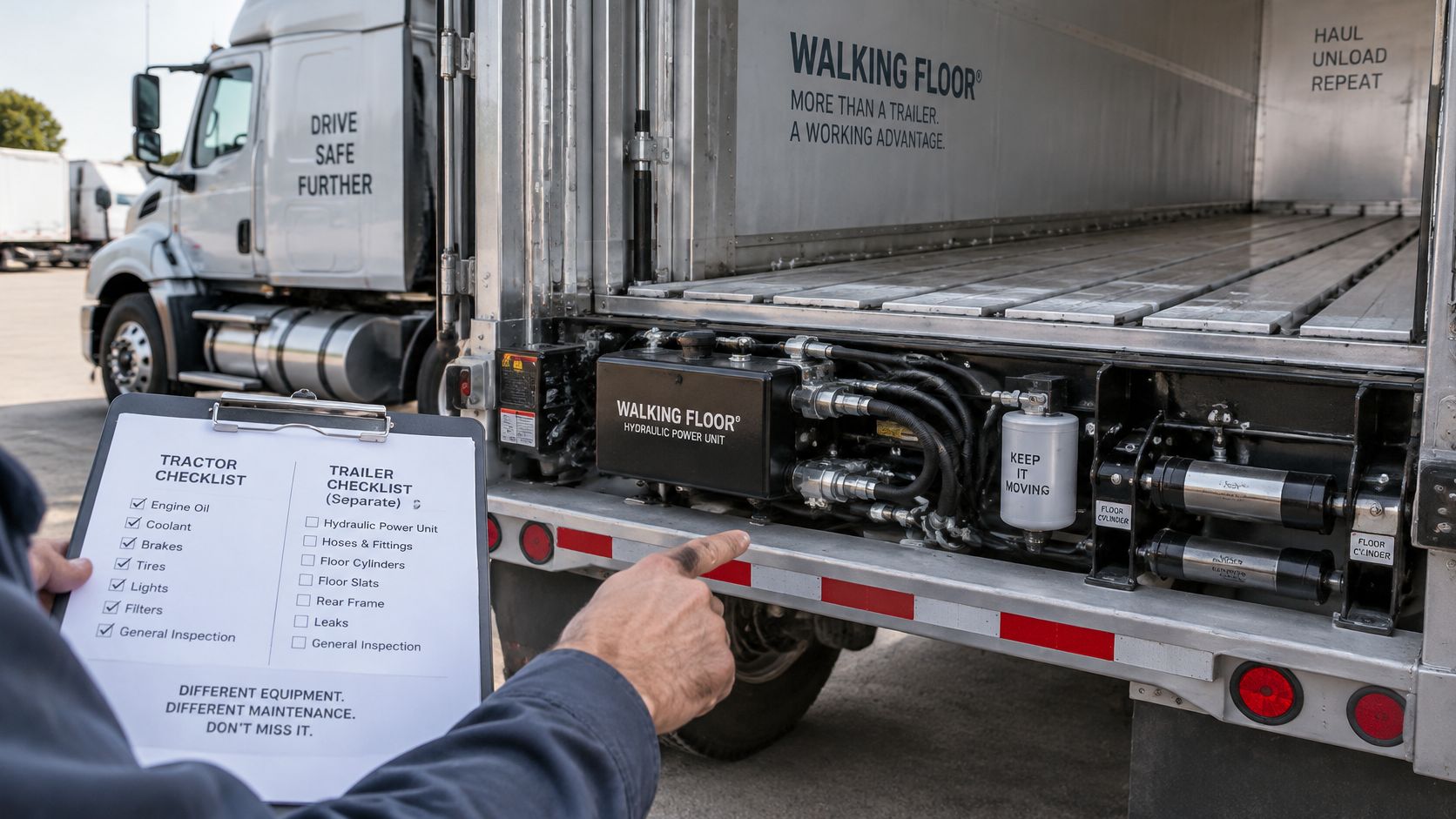
Each row below gives one component, what to check at service, and the warning sign that should trigger repair before the next load.
Walking Floor Checks by Component
| Component | What to check | Warning sign |
|---|---|---|
| Hydraulic hoses and fittings | Leaks, chafing, fitting tightness | Drips or wet trailer frame |
| Hydraulic power unit | Fluid level, color, contamination | Milky or dark fluid, slow floor movement |
| Cylinders and rod seals | Rod condition, seal weeping | Oil film on rod, drifting floor |
| Floor slats | Wear, cracks, alignment | Uneven unloading, slat drag |
| Trailer structure and aluminum welds | Cracks, corrosion around welds, fasteners | Hairline cracks, bubbling paint, loose fasteners |
| Rear door and gate seals | Seals, latches, alignment | Load spillage, air or water leaks |
Hydraulic leaks deserve immediate inspection even when unloading still works. A wet fitting today can become low fluid, slow cycling, contamination, and a failed load tomorrow, especially if drivers keep topping off without reporting the loss.
Uneven unloading usually points you toward slats, alignment, or drive components rather than the controls. Check for worn or cracked slats, drag through the cycle, bent sections, and material packed where movement should be clean.
An inspection trigger doesn't automatically mean replacement. A leak prompts a check, while a worn slat or cracked weld prompts a repair decision.
Tampa Bay operators should add humidity, heat, and salt exposure to every trailer pass. Inspect aluminum welds and fasteners for corrosion, look for paint bubbling around welds, and photograph structural repairs so later inspections can show whether a crack is stable or growing.
Before each Walking Floor load, the driver should confirm the floor runs through its full cycle with no hydraulic leaks. Log slow movement, uneven travel, or slat drag on the defect report so the shop sees it before the next load, not after the trailer is stuck at a customer site.
Recordkeeping Rules and What Auditors Look For
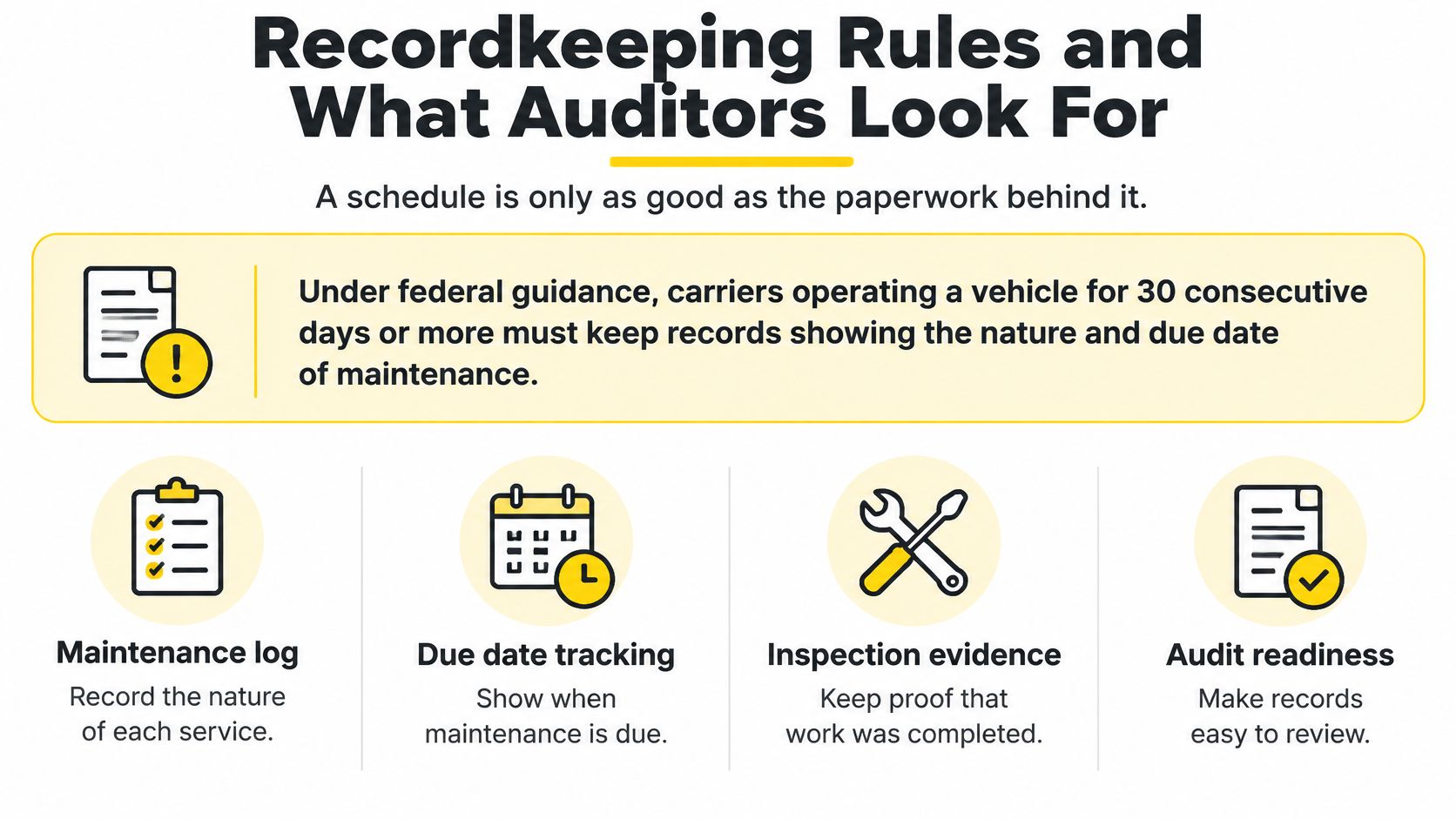
A maintenance schedule needs a record trail that shows what was due, what was inspected, what failed, and how the defect was closed. Keep those details with the unit's maintenance history so an auditor can follow the work from scheduled service to release.
Under 49 CFR Part 396, carriers must keep records for vehicles they control for 30 consecutive days or more. The records must identify the nature and due date of inspection and maintenance operations, along with the date and type of inspection, repair, or maintenance performed.
Records to Keep and Retention Periods
| Record | Required content | Retention |
|---|---|---|
| Driver vehicle inspection report | Defects, date, driver, unit | 3 months |
| Repair certification | Repair performed, parts, technician, date | 3 months |
| Periodic inspection report | Components checked, result, inspector, date | 14 months |
| Maintenance schedule entry | Unit ID, task, due date, last completed date | Keep through the next periodic cycle |
| Work order with release check | Symptom, diagnosis, labor, parts, release inspection | Keep through the next periodic cycle |
Keep the shorter and longer retention periods distinct. Driver vehicle inspection reports and related repair certifications generally must be retained for 3 months; periodic inspection reports must be retained for 14 months.
That distinction matters when an auditor asks whether a defect was repaired and whether the required periodic inspection remains current. A repair record alone does not show when the next inspection is due.
Use the same fields for every unit:
- Unit identity: Unit ID, task, due date, and last completed date.
- Defect trail: Defect found, diagnostic result, corrective action, and parts used.
- Closeout proof: Technician, labor, and the release inspection that closed the work order.
Electronic records work if they retain these details and can be retrieved promptly. Dated work orders that include inspection findings, parts used, and the next service mileage or date help keep the maintenance history consistent.
For roadside readiness, keep current periodic inspection documentation with the unit. Each truck, semitrailer, full trailer, or converter dolly in a combination should carry its own inspection record. Before an audit, check the next inspection date, unresolved defects, and release inspection for each closed repair.
Parts to Stock So Scheduled Work Does Not Wait
Stock from the schedule, not from guesswork. If a part is consumed by a planned interval, it should be on the shelf before the truck is in the bay, because a preventive service that waits two days for a filter or brake chamber isn't preventive anymore.
Group parts by the interval that consumes them:
- Manufacturer interval parts: Keep oil and filters for the next two services on your heaviest-use units. Add the fuel and air filters those services normally consume so technicians aren't mixing partial kits.
- Brake service parts: Stock linings or pads, hardware, air-system parts, and brake chambers that match your fastest-wearing duty cycle. Stop-start and heavy-haul units will consume these differently from highway tractors.
- Weekly check parts: Keep belts, hoses, clamps, lights, tire repair supplies, gladhand seals, and coupling pins where the weekly inspection happens. These are small parts that cause disproportionate delays when they're missing.
- Walking Floor parts: Keep hydraulic hoses, common fittings, cylinder seal kits, hydraulic fluid, and a small set of replacement slats. Those are the parts that decide whether a trailer loads tomorrow or waits.
Set reorder points from supplier lead time. Items that arrive next day can run lean if your ordering process is reliable, while long-lead items need a buffer sized to the interval they serve and the number of units that use them.
Reconcile stock quarterly against work orders. The parts-used column tells you what the fleet consumes, which is more useful than last year's purchasing habit or a manager's memory.
Don't stock only for the planned schedule while ignoring repeat defects. If the same hose, chamber, sensor, or slat keeps appearing, either shorten the inspection interval, change the part specification, fix the root cause, or raise the stock level until the pattern breaks.
Store consumables in bins labeled by the interval that consumes them. A technician should see at a glance whether the next two services are covered, and our parts catalog can help you match common truck and trailer components when you're building that shelf list.
Start Your Schedule This Quarter
Don't rebuild the whole fleet program in one week. Start with a pilot you can run, learn from its defects, then copy what works to the rest of the yard.
Choose three to five pilot units. Cover your main duty types, such as one highway tractor, one dry van, and one Walking Floor trailer. A mixed pilot exposes trigger problems faster than five identical units.
Build each profile. Use the interval table, manufacturer recommendations, and risk-ranked decision tree for each unit. Write down miles, engine hours, calendar limits, and load-cycle checks before the first service comes due.
Run the first 30 days tightly. Log every defect, even minor ones, so repeat-defect rate and overdue-PM rate have a real baseline. Minor leaks and loose hardware are data, not noise.
Confirm stock for the pilot. Check filters, brake parts, belts, hoses, lights, and Walking Floor spares against the next two scheduled services. Fix shelf gaps before they turn into bay delays.
Book work before it's due. Schedule Walking Floor preventive maintenance and annual periodic inspections early enough that parts, welding, or fabrication don't force a rushed decision.
Brothers Truck Trailer Repair and Welding Corp. in Tampa, Florida handles maintenance, Walking Floor service, aluminum welding, fabrication, and parts for commercial trucks and trailers. Our truck maintenance includes preventative maintenance programs, thorough vehicle inspections for roadworthiness, routine oil changes and fluid checks, brake and suspension system inspections, and engine diagnostics and repairs.
Our Walking Floor services include preventive maintenance to avoid costly breakdowns and optimization of system performance for maximum efficiency. When a scheduled inspection finds a defect that needs a welded or fabricated repair or a replacement part, having those capabilities tied to the maintenance visit can shorten the wait for the unit.
Pick the pilot units and write their triggers into the schedule this week. That's the first action, and it takes less time than the next avoidable road call.
Build your next service around the trigger that hits first, and let us help you turn inspection findings into finished repairs instead of parked equipment. Brothers Truck Trailer Repair and Welding Corp. offers preventative maintenance programs, brake and suspension inspections, engine diagnostics, Walking Floor preventive maintenance, aluminum welding, fabrication, and truck and trailer parts in Tampa. Visit Brothers Truck Trailer Repair and Welding Corp. to plan maintenance that keeps your tractors and trailers ready for the next dispatch.
Learn how to perform a commercial trailer suspension inspection step by step, covering airbags, leaf springs, U-bolts, torque checks and pass or fail criteria.

Hitch ball size must match the coupler: 1-7/8, 2, 2-5/16, or 3 inches. Check shank, stamped capacity, and the weakest rated part before towing.
Learn aluminum welding and fabrication for trucks and trailers, from alloy weldability and strength loss to repair rules and shop selection.