
Standard Trailer Ball Sizes: Chart, Ratings and Fit Guide
North American standard trailer ball sizes are four diameters: 1-7/8 in, 2 in, 2-5/16 in, and 3 in. Typical gross trailer weight bands start near 2,000 lb on the small ball and can run past 10,000 lb on a 3-inch ball, but the gross trailer weight stamped on the ball governs the final choice.
Counter advice that says "match the ball and you're done" is the part that fails in the yard. Diameter, shank and mount, and the stamped rating are three separate checks. A ball can drop into the coupler and still be the wrong shank or the wrong rating for a loaded commercial trailer. Empty weight and a ball that "looks close" don't decide whether the unit is fit to leave.
Table of Contents
- Standard Trailer Ball Sizes at a Glance
- Matching Ball Size to Real Trailer Loads
- SAE Load Classes Behind Each Diameter
- Torque and Mounting Specs for Ball Nuts
- Reading the Ball Stamp and Coupler Marking
- How to Match Ball, Shank and Coupler Before Hitching
- Why Standards and State Rules Matter Beyond Size
- Pre-Trip Checks Before Each Hitch
Standard Trailer Ball Sizes at a Glance
A ball that seats cleanly can still be the wrong part. Diameter has to match the coupler exactly, the shank has to fit the mount, and the stamped gross trailer weight has to cover the loaded trailer. Match diameter alone and you have checked one of three.
| Ball diameter | Metric size | Typical gross trailer weight range | Usual duty |
|---|---|---|---|
| 1-7/8 in | 47.6 mm | Up to about 2,000 lb (some to 3,500 lb) | Light utility trailers |
| 2 in | 50.8 mm | About 3,500 to 12,000 lb (some published near 8,000 lb) | Broad middle range, medium duty |
| 2-5/16 in | 58.7 mm | About 6,000 to 30,000 lb | Heavy equipment, livestock, travel, and commercial trailers |
| 3 in | 76.2 mm | Above 10,000 lb | Specialized heavy duty, industrial, and gooseneck-related equipment |
The North Carolina trailering guide lists the four diameters and notes that both diameter and maximum weight are stamped on the ball. Use that stamp as the rating. The chart is only a first filter for duty class.
The 1-7/8-inch ball is the light utility size. The 2-inch ball covers a wide middle band, with Lippert's trailer-ball listings showing 2-inch capacities from 3,500 to 12,000 lb, while other published ratings for that diameter top out near 8,000 lb depending on shank, material, and design. The 2-5/16-inch ball is the heavy size, typically rated well above the 2-inch range. The 3-inch ball is the specialized heavy-duty size for industrial and gooseneck-related equipment.
Practical rule: The number stamped on the ball governs. A correct diameter with a low rating is unsafe for a heavier load.
Check three measurements before any replacement. Coupler diameter. Ball rating. Shank fit.
Matching Ball Size to Real Trailer Loads
Start at the light end and work up by loaded weight, not by how the trailer looks.
Purdue University Extension treats a 1-7/8-inch ball as the usual choice on lighter trailers, and notes that trailers exceeding 7,000 lb frequently need a 2-5/16-inch ball. The same page warns that balls of one diameter can carry different ratings. Shank diameter and shank length often set that difference, so measuring only the visible ball is not a parts pick.
In the middle band, a 2-inch ball is fine only when its stamp covers the load you haul. Say a support trailer is loaded to 9,000 lb. You need a 2-inch ball stamped at least 9,000 lb, or you step up to 2-5/16 inches. You don't get there by assuming every 2-inch ball is a heavy one.
A worn livestock ball
A worn ball on a livestock trailer gets replaced with the same diameter and a rating that covers that load. A similar-looking ball from the bin can be rated far lower. Same diameter, different capacity, is a normal catalog fact, not a rare exception.
A ball that's too small or too large for the coupler can keep the latch from seating, or it can let the trailer uncouple. Diameter is never a close-enough choice.
Run three questions on any unit before you hitch:
- Coupler mark: What ball diameter is marked on the coupler?
- Loaded weight: What does the current load paperwork say, not the empty weight?
- Ball stamp: What diameter and maximum weight are stamped on the ball already fitted?
If any answer is missing, the unit stays put.
SAE Load Classes Behind Each Diameter
SAE hitch classes sort assemblies by gross trailer weight, then prove them with separate mechanical tests. Diameter is only one column in that table.
| SAE class | Ball diameter | Gross weight band (GVW) | Longitudinal test load | Transverse thrust | Vertical test load |
|---|---|---|---|---|---|
| Class 1 | 1-7/8 in | Up to 2,000 lb | 6,000 lb tension and compression | 2,000 lb | 2,500 lb tension and compression |
| Class 2 | 2 in | More than 2,000 to 3,500 lb | 10,500 lb tension and compression | 3,000 lb | 4,500 lb tension and compression |
| Class 3 | 2 in | More than 3,500 to 5,000 lb | 15,000 lb tension and compression | 4,000 lb | 7,000 lb tension and compression |
| Class 4 | Not stated for this class | More than 5,000 to 10,000 lb | Not stated | Not stated | Not stated |
An NHTSA summary of SAE classifications sets Class 1 at trailers up to 2,000 lb GVW, Class 2 at more than 2,000 up to 3,500 lb, Class 3 at more than 3,500 up to 5,000 lb, and Class 4 at more than 5,000 up to 10,000 lb. SAE J684 then splits the test loads. Class 1, on a 1-7/8-inch ball, calls for 6,000 lb longitudinal, 2,000 lb transverse, and 2,500 lb vertical. Class 2 and Class 3 both use a 2-inch ball, but Class 3's loads jump to 15,000 lb longitudinal, 4,000 lb transverse, and 7,000 lb vertical. Test loads for Class 4 aren't in that summary, so they stay blank rather than guessed.
Those figures are coupling test requirements, not the working load you hitch to every morning. A 2-inch ball can serve medium duty, and its rating still has to be read from the stamp or the maker's sheet. It isn't assumed to reach the top of the class. Nut torque and platform fit, next, finish the picture for the installed assembly.
Torque and Mounting Specs for Ball Nuts
Torque sorts by shank diameter. Ball diameter does not set it.
| Shank diameter | Published nut torque | Published rating example |
|---|---|---|
| 3/4 in | 160 ft-lb | Rating varies by maker, stamp governs |
| 1 in | 250 ft-lb | Rating varies by maker, stamp governs |
| 1-1/4 in | 450 ft-lb | Rating varies by maker, stamp governs |
CURT's trailer-ball specifications list 160 ft-lb for a 3/4-inch shank, 250 ft-lb for a 1-inch shank, and 450 ft-lb for a 1-1/4-inch shank. The ball maker's instructions override those numbers, because hardware and finish change from one part to the next. I recommend treating the chart as a reference and the install sheet as the rule.
Same coupler, different shank
A 2-5/16-inch ball accepts more than one shank. The smaller shank version suits lighter gross trailer weight. The larger shank version suits heavier gross trailer weight for the same coupler mouth. Diameter matches in both cases. Capacity and mount do not.
Mount fit is the second check. Platform thickness and hole size must match the ball maker's published mounting specification for that part number. An oversized hole lets the shank shift under the nut, and a thin platform flexes under load. Both conditions bleed clamp force.
On the work order, record ball diameter, shank diameter, shank length, rise, GTW rating, platform thickness, and installed torque. Before the unit goes back out, inspect for:
- Looseness at the nut and under the ball flange.
- Shank elongation where the threads have stretched.
- Cracks in the ball, flange, or platform.
- Corrosion that hides a reduced section.
- Damaged threads that won't hold torque.
Recheck nut torque after the first road run. Torque settles. A second wrench check catches it.
Reading the Ball Stamp and Coupler Marking
Read both marks before you compare them with any install step. The ball carries its diameter and its maximum weight rating in the stamp. That stamped rating governs the load. The nominal diameter doesn't.
The coupler marking states the ball diameter the socket has to accept exactly. The two readings have to agree before you check anything else.
- Record the coupler marking.
- Read the ball stamp for diameter and maximum weight.
- Compare the two diameters. If they differ, stop. Don't fit the ball.
- Compare the stamped rating with the loaded gross trailer weight on the load paperwork.
- If the stamp is worn, unreadable, or missing, treat the ball as unverified and replace it with one whose stamp you can read.
A stamp identifies that ball only. It doesn't show shank length, mount thickness, or hole fit. A readable stamp never clears a replacement by itself.
How to Match Ball, Shank and Coupler Before Hitching
CURT's ball selection guidance treats diameter, threaded shank, and GTW rating as three independent parameters. Capacity still depends on the specific ball, shank, material, and installation. Run the stamp and coupler reading first, then this order.
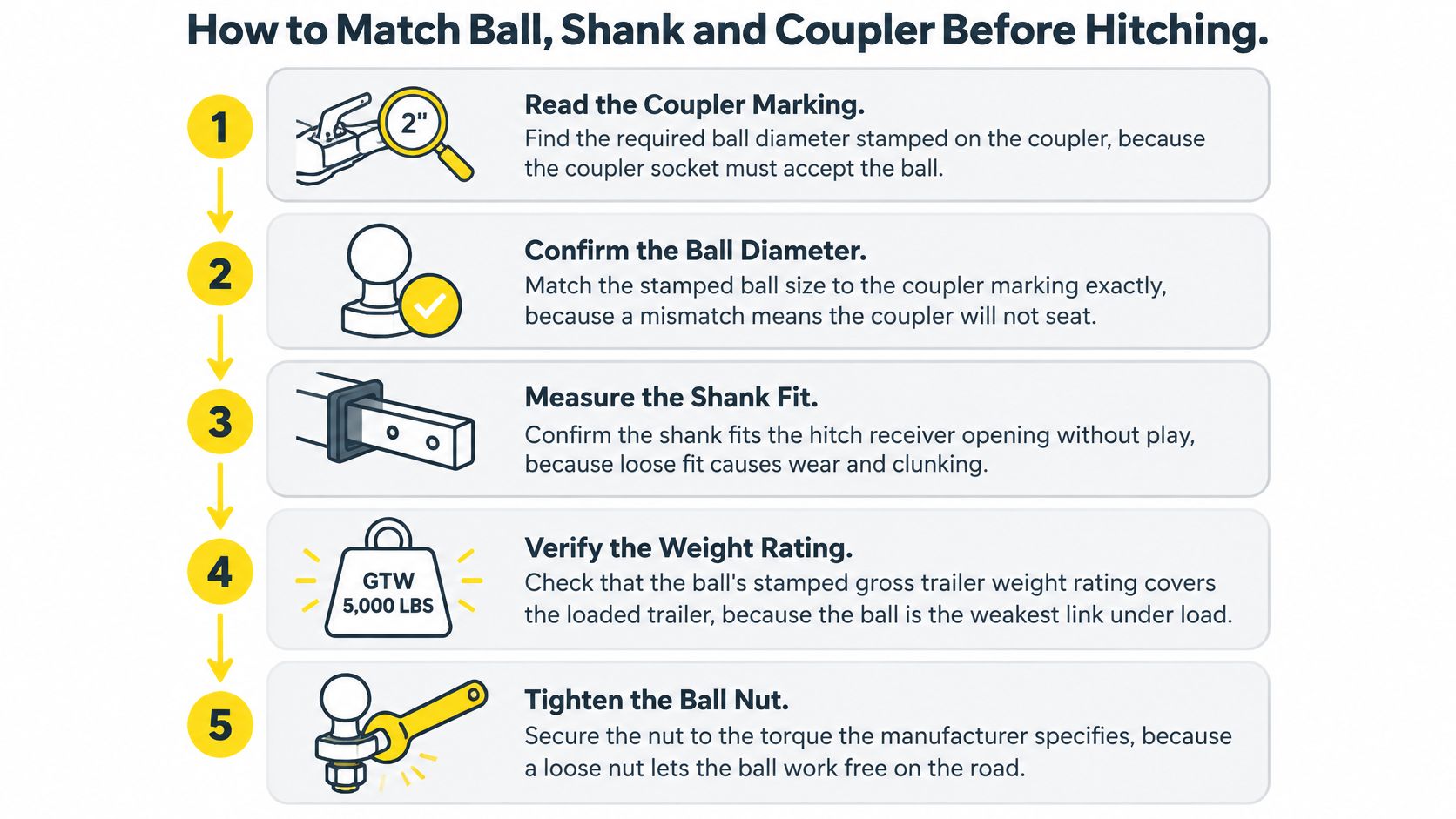
- Read the coupler marking for the required ball diameter. The socket has to accept that ball exactly, so this is the number you shop to.
- Verify loaded gross trailer weight from the load paperwork or the weight certificate, not the empty weight. The rating has to cover the trailer as it will roll.
- Measure the existing shank diameter and length, and the hole in the mounting platform. Those dimensions decide which replacement balls will physically fit.
- Check platform thickness and hole size. A thin plate or an oversized hole lets the shank and nut work, even when the diameter is right.
- Confirm the replacement stamp is at least the required gross trailer weight. Read the stamp. Don't infer capacity from the diameter.
- Install and record. Tighten the nut to the torque the ball maker specifies for that shank, using the published shank torque only as a cross-check. Log diameter, shank, rise, rating, platform thickness, and torque on the work order.
Don't substitute a larger or smaller ball because it appears to fit. An incorrect diameter can prevent proper coupler engagement or allow uncoupling. The same order applies when a shop replaces a worn ball on a fleet trailer. Nothing in the bin gets installed on looks.
Why Standards and State Rules Matter Beyond Size
A ball and coupler with the same diameter can still be an illegal or unsafe combination. Size controls fit. It sets neither capacity nor compliance.
An NHTSA interpretation states that no federal motor-vehicle safety standard specifically applies to towing a trailer, and that safety-chain requirements may instead come from state law. State transportation rules generally require the ball and coupler to match in size and latch securely, and roadside inspections typically cover the receiver, ball, coupler, safety chains, and breakaway switch for cracks, corrosion, twisting, wear, and proper torque.
SAE J684's scope covers automotive-type couplings, hitches, and safety chains on trailers whose GVWR does not exceed 4,540 kg, or 10,000 lb. That scope does not extend to heavier semitrailers or other coupling systems, so I treat those classes as limited to light and medium ball-type trailers.
Confirm the rules where each unit operates. They differ by state and trailer type. Diameter, shank and mount, and stamped rating have to line up together, and the mount rating, coupler condition, chains, and breakaway equipment still decide whether the unit should roll.
Pre-Trip Checks Before Each Hitch
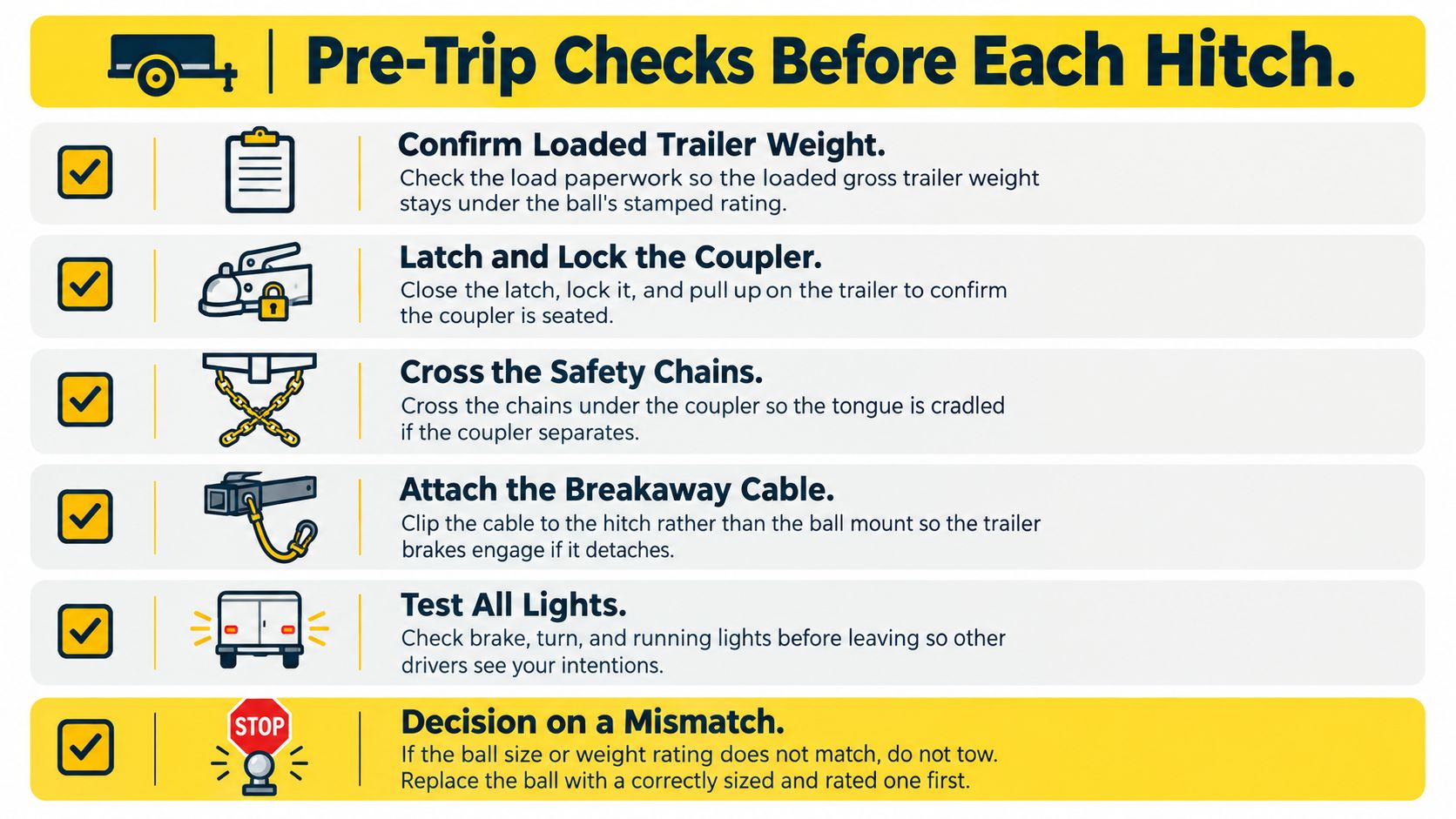
Before each hitch, confirm five items that change with the load and the day:
- Loaded weight: Current paperwork still falls under the ball's stamped rating.
- Ball security: No looseness at the nut in the platform.
- Coupler: Latches fully, with no cracks or wear on the socket.
- Safety chains: Attached, with undamaged links.
- Breakaway switch: Works where the trailer is fitted with one.
Diameter, shank, hole, and torque checks belong to the install, and they need repeating only after the ball or the mount has been changed.
A short walkthrough of the hitch sequence is worth watching once so the latch and chain routing stay consistent across drivers.
If any value doesn't match, don't move the unit. Replace the ball with one whose stamped rating covers the load, not one that only looks right, and record the change on the work order. When a mount needs inspection, a trailer structure needs repair, or a non-standard mount has to be fabricated, we build custom fabrication to the truck and trailer in front of us and pull truck and trailer parts from inventory.
Photograph the coupler marking and the ball stamp, log the measurements, and bring the unit in if any value doesn't match.
Brothers Truck Trailer Repair and Welding Corp. handles trailer repair, mount fabrication, and parts for commercial trucks and trailers, including the ball, shank, and platform checks that keep a hitch matched to the load. If a stamp, coupler, or mount on your unit doesn't line up, bring the photos and the paperwork with the trailer. Visit Brothers Truck Trailer Repair and Welding Corp. to schedule the inspection.
Trailer brake inspection steps, pushrod limits, pressure specs and pass-fail criteria for fleets and owner-operators, with the checks most often missed.
Single axle car trailers explained: real payload figures, tandem axle comparison, load placement and a pre-trip inspection checklist for owners and fleets.

A practical walking floor trailer guide for fleets covering how the system works, failure modes, maintenance intervals, diagnostics, and repair options.