Single Axle Car Trailers: Capacity, Limits and Inspection
You've got a small car waiting in the yard, a trailer with one pair of wheels, and a dispatch decision to make. The deck looks long enough, but the axle sticker doesn't tell you whether the complete combination can carry the car safely.
For commercial operators, single axle car trailers need a load calculation and a mechanical inspection, not a visual guess. Before a technician orders tires, repairs an axle mount, or fabricates a replacement bracket, the team needs to know what the trailer was rated to carry and what it really weighs.
Table of Contents
- What Makes a Trailer Single Axle
- Single Axle Car Trailer Sizes and Payload Ranges
- How to Calculate Usable Payload Step by Step
- Single Axle Versus Tandem Axle Trailers
- Load Placement and Tongue Weight Basics
- Tire and Wheel-Bearing Checks Before Every Trip
- Confirm the Trailer Before You Buy or Tow
What Makes a Trailer Single Axle
A hauler looking at an open trailer usually identifies the layout by its wheels: a pair across the trailer, supported by an axle assembly beneath the deck. Open utility trailers, light enclosed trailers, and small car haulers can all use this arrangement. The layout alone doesn't establish whether a particular car belongs on the deck.
Federal weight rules define a single axle by wheel centers lying between transverse vertical planes no more than 40 inches apart, extending across the vehicle's width. The federal Interstate single-axle ceiling is 20,000 pounds, but that road limit isn't the carrying capacity of a light trailer.
The trailer's own rating and component limits still control. Tires, wheels, suspension, frame, coupler, brakes, and the tow vehicle must suit the loaded application. A road-weight ceiling never authorizes exceeding the manufacturer's limits.
Read the label as a system
Start with these terms:
- Gross Vehicle Weight Rating, or GVWR: The manufacturer's maximum loaded weight for the complete trailer, including its empty weight and cargo. It excludes the towing vehicle, as explained in NHTSA's interpretation of trailer GVWR.
- Gross Axle Weight Rating, or GAWR: The manufacturer's capacity for the complete axle system, measured at the tire-to-ground interfaces. It isn't merely the strength of the axle beam, according to NHTSA's definition of GAWR.
- Tire load index: The tire's load-capacity designation. Maintenance staff must interpret it using the applicable tire specifications, not tire dimensions alone.
Workshop rule: Read the certification label before reading the axle advertisement.
These ratings answer different questions. GVWR concerns the whole trailer; GAWR concerns the supporting axle system; tire capacity determines whether the fitted tires can support their assigned loads. Keep those distinctions clear when calculating payload or selecting replacement parts.
Single Axle Car Trailer Sizes and Payload Ranges
A compact car may fit on a single-axle trailer, but fit alone does not establish capacity. The axle supports the trailer through one pair of tires, so an overloaded tire or wheel has less backup than it would on a tandem-axle setup. Compare the trailer's GVWR with its empty weight, then treat the lowest-rated component as the practical limit.
| Trailer (year, size) | GVWR (lb) | Empty weight (lb) | Calculated payload (lb) | Listed price |
|---|---|---|---|---|
| 2025 Texas Bragg 6x12 utility | 3,000 | 900 | 2,100 | $2,195 (MSRP $2,695) |
| 2025 MAXX-D S3X 83 in x 12 ft utility | 2,990 | 1,275 | 1,715 | Not provided |
| 2025 X-On U2 single-axle utility | 3,500 | 1,650 | 1,850 | $2,475 (reduced from $2,699) |
The payload figures are calculated by subtracting each listing's empty weight from its GVWR. For example, the Texas Bragg listing gives a 3,000-pound GVWR and a 900-pound empty weight: 3,000 minus 900 leaves 2,100 pounds on paper. That allowance includes everything added to the trailer, not just the car.
These listings show GVWRs from 2,990 to 3,500 pounds and calculated payloads from 1,715 to 2,100 pounds. They describe utility trailers, not proof that a trailer is suitable for carrying a car. Deck strength, ramps, tie-down locations, tire placement, brakes, and the intended use still need confirmation.
The calculation is a starting point, like the capacity marked on a shelf: the weakest support still sets the safe limit. If a tire, wheel, suspension part, or frame component has a lower applicable rating, use that lower limit rather than the advertised GVWR. Confirm component ratings and the trailer's certification label before relying on a listed payload.
Check physical fit separately from weight. Confirm that all car tires rest on supported deck surfaces, with adequate clearance, and that ramps and tie-down points suit the vehicle and loading method. A model name or outside dimension alone does not establish usable deck width.
The listed prices range from $2,195 to $2,475. They are seller-listing figures, not current quotes, so confirm price and specifications with the seller. The trailer's label and actual condition should match the listing before purchase.
How to Calculate Usable Payload Step by Step
Begin with measured weight, then check component compatibility. Subtraction gives an initial allowance; it doesn't approve a trailer whose tires, coupler, or frame are unsuitable.
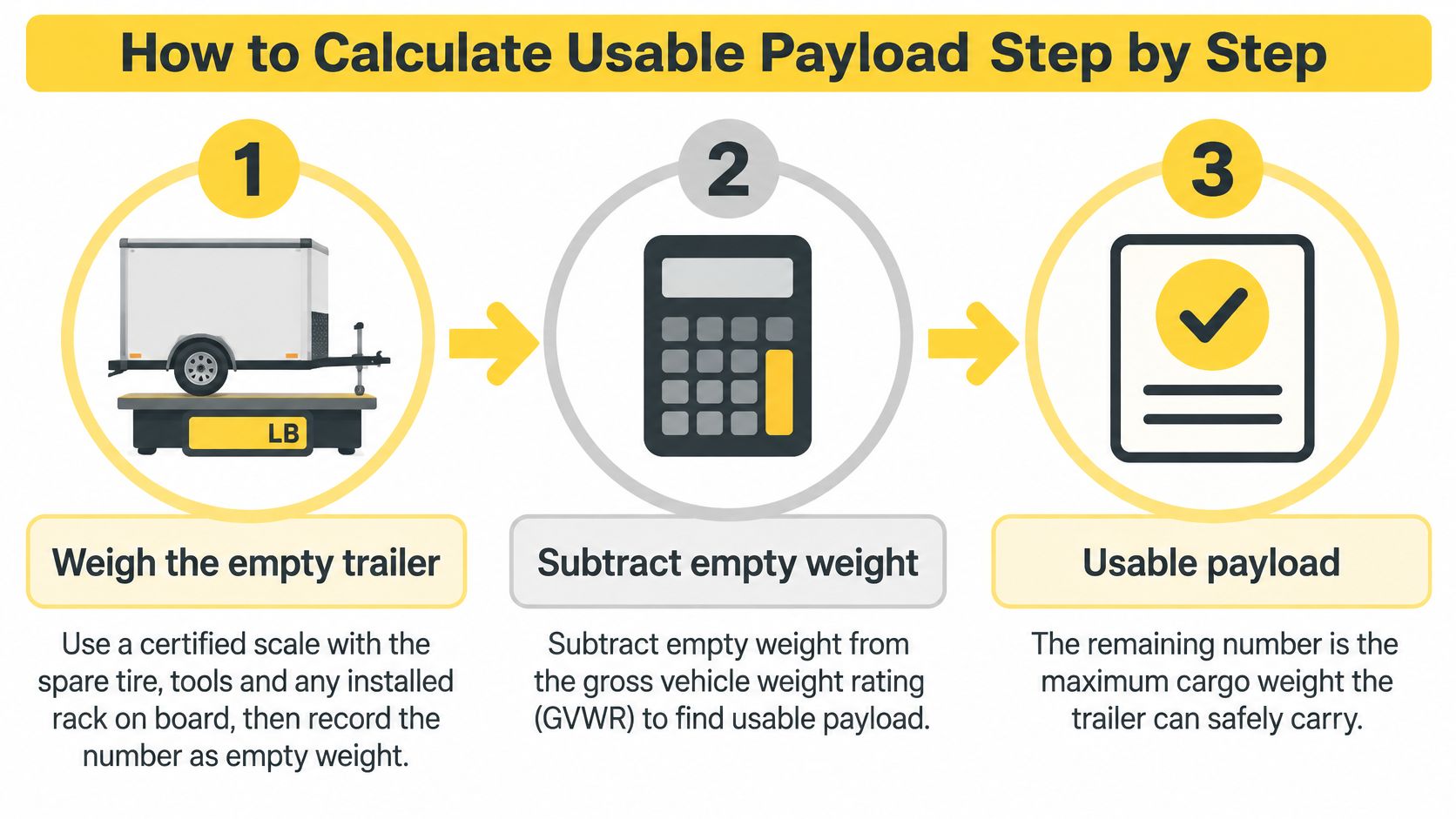
- Weigh the empty trailer. Use a certified scale with the spare tire, installed rack, and permanently carried tools aboard. Record that configuration so another technician can reproduce the measurement.
- Subtract empty weight from GVWR. This produces the paper payload. Use the certification label and measured weight, not a seller's estimate.
- Compare tire capacity with GAWR. Add the applicable tire capacities across the axle. Insufficient tire capacity is a mismatch that requires correction before release.
- Verify the remaining components. Check wheels, hubs, suspension, coupler, and frame documentation. Respect each component's limit in its proper application; don't treat a coupler rating as though it were an axle rating.
- Deduct additional carried equipment. Account for fuel cans, chains, straps, spare batteries, and anything else absent during the empty weighing. Don't count equipment twice.
- Weigh the car in transport condition. Include its fitted wheels, added battery, accessories, and carried contents. An old curb-weight specification isn't a substitute for the current load.
NHTSA-hosted technical documentation on trailer ratings and tire capacity supports checking the complete running gear rather than relying on a nominal axle rating. Replacement tires and wheels must meet the certification requirements, not merely fit the hubs and fenders.
The calculation graphic shows the starting subtraction. Its result remains subject to all component, axle-load, and towing limits.
Work the numbers before loading
Using the X-On figures in the seller-linked table, the calculation is:
3,500 pounds GVWR − 1,650 pounds empty weight = 1,850 pounds paper payload.
For an explicitly hypothetical car weighing 2,900 pounds, the comparison becomes 2,900 − 1,850 = 1,050 pounds over the allowance. Those are illustrative load figures, not a measured vehicle or a case study. Moving the car forward or fitting stronger tires won't resolve that whole-trailer overload.
Consider a separate hypothetical tire mismatch: tires rated at 1,520 pounds each provide 3,040 pounds combined, below a 3,500-pound GAWR. That configuration doesn't meet the labeled axle requirement. Don't write a lower number on the inspection sheet and approve it; correct the mismatch and verify the complete assembly.
The lowest-rated relevant component is the limiting factor, but it doesn't automatically rewrite the manufacturer's ratings. Likewise, a stronger replacement axle doesn't authorize a higher GVWR.
Reweigh after modifications that change transport weight. For fabrication work, include the completed rack, toolbox, reinforcement, or other installed equipment in the revised empty-weight record.
Single Axle Versus Tandem Axle Trailers
Single axle versus tandem axle on the same criteria
| Criterion | Single axle | Tandem axle |
|---|---|---|
| Typical rating range | About 3,000 to 4,400 lb in the seller-linked examples above | Often higher; confirm on the certification label |
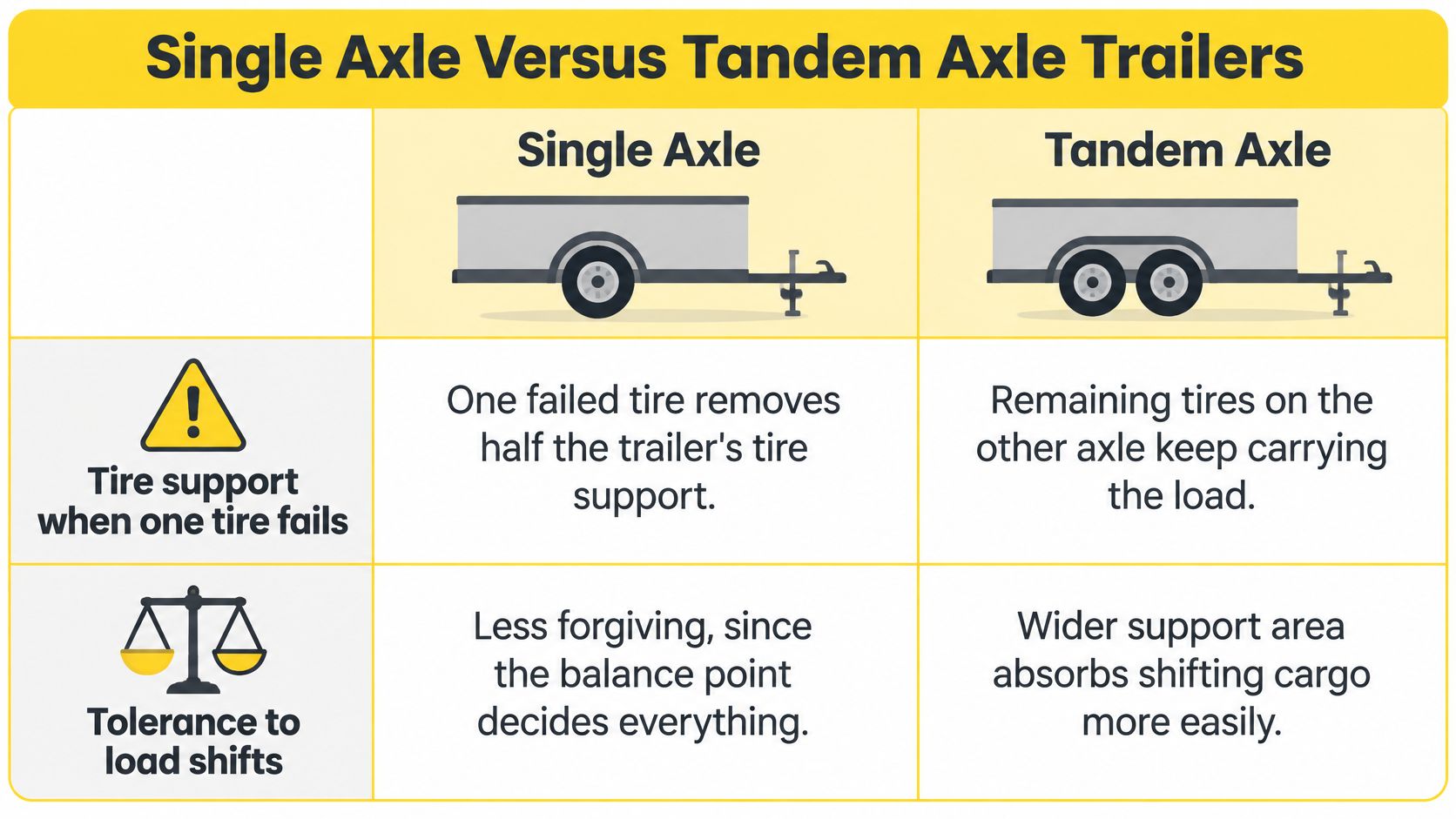
| Tire support when one tire fails | Half the tire support lost at once on the paired-tire layout | Other axle's tires may temporarily carry more weight |
| Tolerance to load shifts | Placement errors concentrate loading on the axle | Load shared across additional running gear |
| Maneuvering and backing | Generally easier to position in confined yards | Geometry and tire scrub can complicate tight turns |
| Brake components to service | An axle's brake assemblies, where fitted | Additional brake assemblies, where fitted |
| Purchase price | About $2,195 to $3,599 in the seller-linked listings | No comparable verified prices provided |
| Best fit | Light loads, short trips, verified payload | Heavier cars, highway work, limited single-axle margin |
The comparison is a selection guide, not a rating certificate. Actual wheelbase, hitch geometry, suspension design, and loaded weight matter more than the layout name.
The strongest reason to consider tandem isn't just “more capacity.” It's how the trailer supports the load when something goes wrong. Additional tires may provide temporary support after a failure, but they can become overloaded themselves. That's a reason to stop safely, not permission to continue the route.
The visual comparison highlights those support differences.
Choose for the work, not the axle count
My recommendation is to favor single axle only when the measured load leaves comfortable operating margin and the duty cycle suits the configuration. A short trip doesn't excuse an overload or defective bearing.
- Choose single axle when the loaded weight is comfortably within all limits, trips are short, yard access is tight, and staff verify each load.
- Consider tandem when the car approaches the single-axle allowance, routes involve sustained highway travel, or loss of tire support would create an unacceptable operational risk.
- Reject either layout when the label is missing, component compatibility can't be established, or structural condition is uncertain.
The government-hosted towing safety guide emphasizes matching the tow vehicle, hitch, axle limits, and tongue load rather than selecting by a single towing number.
For a car that leaves little margin on the proposed single-axle trailer, a suitably rated tandem is the safer default recommendation. Confirm its actual ratings; no tandem model specifications are established by the utility-trailer examples above.
Load Placement and Tongue Weight Basics
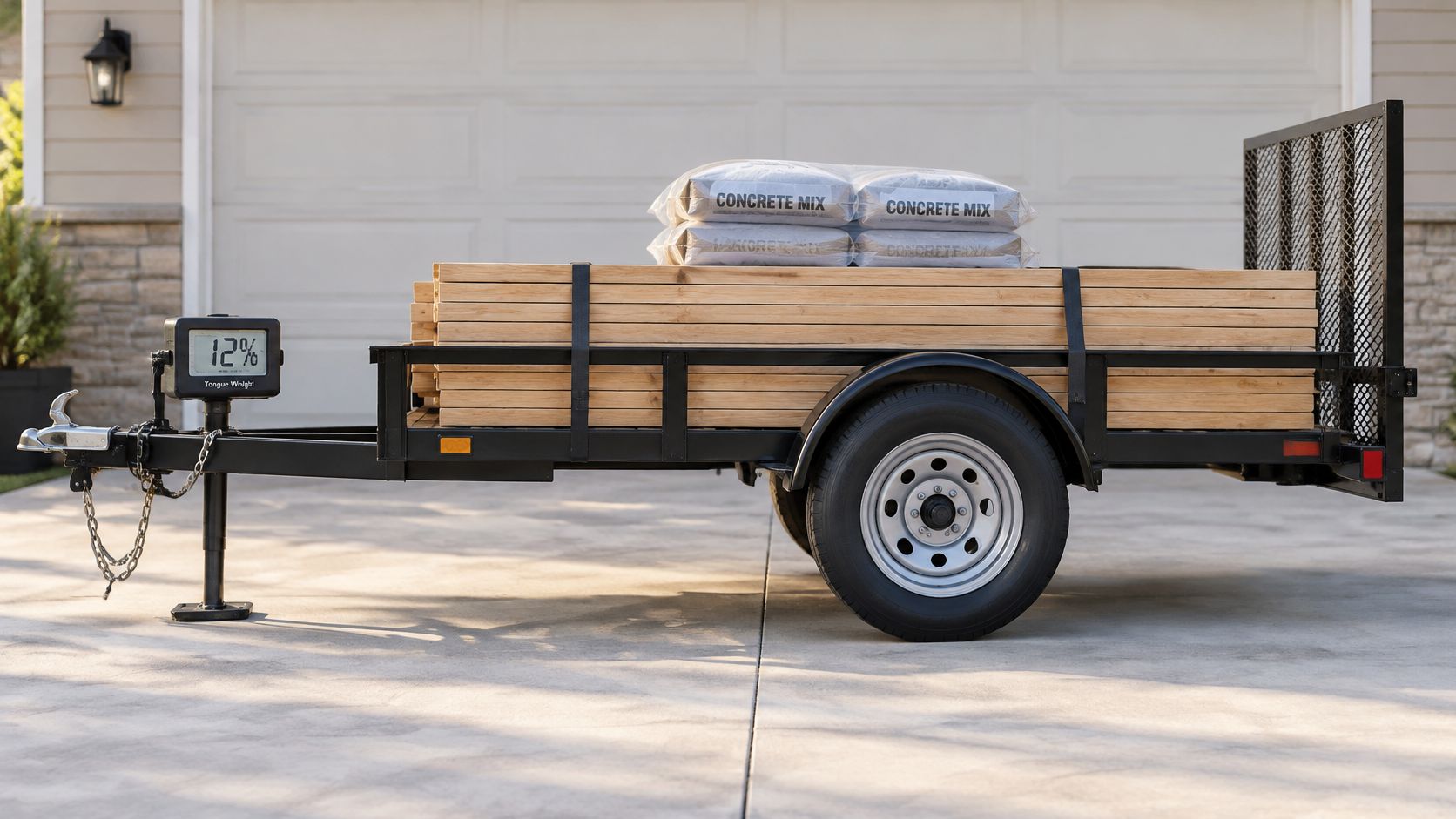
A car can sit fully on a trailer deck and still be badly balanced. On a single-axle trailer, one pair of tires supports the axle load, so a small shift in the car's position can change both tire loading and the force on the hitch.
Tongue weight is the downward force the loaded trailer applies to the tow vehicle through the hitch. Too little can contribute to sway; too much can exceed the limits of the vehicle, receiver, rear axle, or tires. Follow the limits specified by the trailer and tow-vehicle manufacturers, and measure the loaded setup rather than judging it by eye.
Position, measure, then secure
Start with the car's weight distributed around the axle area, with its center of mass slightly forward of the axle. This is a starting position, not proof of safe balance. Move the car in small increments, then measure tongue weight and axle loading with suitable scales.
A car positioned too far forward can place excessive weight on the hitch. Too far back can reduce tongue weight and increase sway risk. The car's engine location, wheelbase, and trailer-deck length all affect where it needs to sit.
Move the car, measure the loaded setup, and confirm that each component stays within its rating.
After securing the vehicle, check:
- Brake response: Test at low speed in a safe area.
- Clearance: Check that tires, fenders, ramps, and suspension parts do not contact the trailer.
- Restraints: Inspect tie-downs, anchor points, welds, and nearby frame material.
- Load distribution: Confirm the measured hitch and axle loads remain within their respective limits.
If the trailer sways or the tow vehicle needs repeated steering corrections, stop at a safe location and inspect the car's position, restraints, tires, and coupling. Reposition and reweigh before continuing.
Tire and Wheel-Bearing Checks Before Every Trip
Good tread isn't a roadworthiness certificate. Pressure, aging, load rating, damage, and wheel-end condition remain separate inspection questions, especially on the paired-tire layout described earlier.
Start with a cold-pressure measurement before road heat changes the reading.
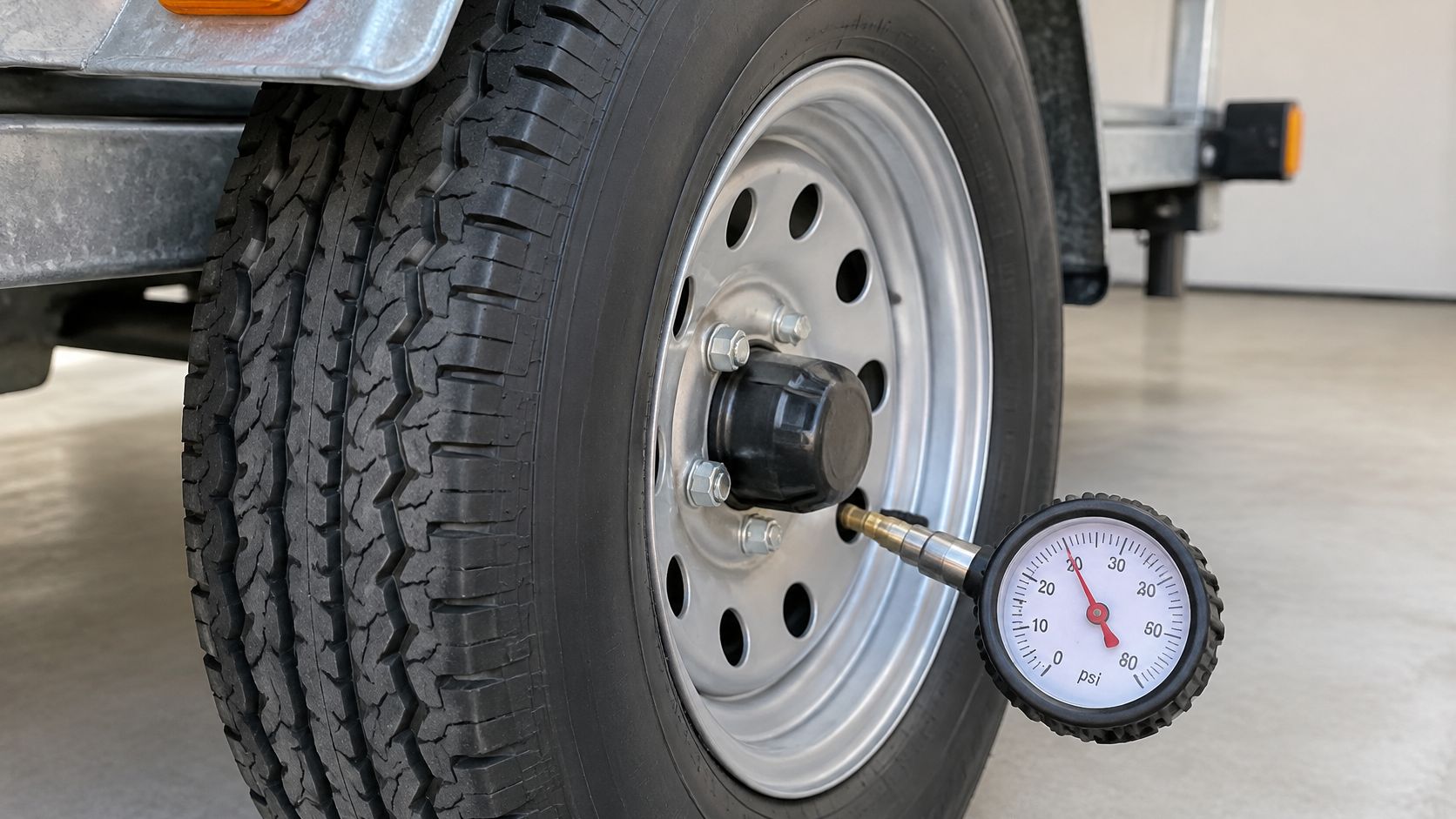
NHTSA's tire safety guidance emphasizes correct inflation, load limits, regular inspection, and road-hazard damage. Use that guidance alongside the trailer and component manufacturers' service procedures.
A repeatable wheel-end inspection
- Measure cold pressure with a gauge. Follow the placard and applicable manufacturer instructions. Don't automatically treat the sidewall maximum as the trailer's prescribed operating pressure.
- Inspect sidewalls and tire age markings. Look for cracking, bulges, dry rot, and deterioration even when the tread appears serviceable. Resolve questionable condition before dispatch.
- Confirm load compatibility. Compare the fitted tires with the certification requirements established during the payload check. Certain passenger-car tires used on trailers require a compliance load-rating reduction, so don't substitute them based on size alone.
- Examine the tread and carcass. Look for embedded objects, cuts, impact damage, and uneven wear. Record the wear pattern rather than merely marking “tires checked.”
- Check wheels and fasteners. Inspect for damage and verify lug-nut torque with a torque wrench using the manufacturer's specification. Appearance alone can't confirm torque.
- Inspect bearing condition safely. A trained technician should use approved lifting and support points, then check wheel movement, rotation, grease leakage, and abnormal noise. Don't work beneath an unsupported trailer or assume the axle tube is an approved jacking point.
- Compare wheel-end temperatures after a short test drive. Investigate a hub that's clearly hotter than its opposite number. Heat can indicate bearing or brake trouble; temperature comparison alone doesn't identify the failed part.
Use the following video alongside the applicable service instructions, not in place of them.
Carry a serviceable spare that meets the trailer's tire requirements, along with suitable wheel-changing equipment. Record pressure, observed damage, torque verification, and wheel-end findings in the maintenance log.
That record gives the next shift something useful to compare. A recurring wear pattern or repeated hot-hub observation deserves diagnosis, not another unexplained checkmark.
Confirm the Trailer Before You Buy or Tow
Buyer and pre-tow inspection checklist
| Item | What to verify | Pass sign |
|---|---|---|
| Certification label | GVWR, GAWR, and tire size listed and legible | Fitted tires and wheels meet the requirements |
| Empty weight | Measured on a scale rather than copied from a listing | Measured configuration used in payload math |
| Frame and axle mounts | Cracks, bends, or weld repairs near axle and coupler | No cracks; repairs documented and assessed |
| Brakes | Adjustment, actuation, wiring, pads or shoes, bearing play | Operable on all wheels where required |
| Coupler and safety chains | Latch wear, ball fit, chain attachment | Latch secure and chains intact |
| Lights | Running, brake, and turn signals | All function with the tow vehicle |
| Tongue weight | Measured at the hitch after loading | Within the loading guidance and all component limits |
Each row answers a different release question. The label establishes requirements; weighing establishes the actual condition; structural inspection determines whether damage or previous work needs further assessment.
An undocumented weld isn't proof of adequate repair. For aluminum structures, have the damaged area and proposed repair assessed before welding or fabricating reinforcement. Adding material also changes empty weight, so completed structural work belongs in both the repair record and the load calculation.
Verify the applicable commercial brake rule
FMCSA's commercial-vehicle brake guidance generally requires operable brakes acting on all wheels, subject to limited exceptions. Its light-trailer provision concerns certain trailers with gross weight of 3,000 pounds or less; that threshold must not be read as a blanket requirement or blanket exemption without checking the provision's conditions.
The operating configuration and applicable jurisdiction matter. Having a single axle doesn't settle the legal requirement, and the inspection must include actuation components, connections, brake assemblies, and wheel ends.
Use a clear release decision:
- Calculation fails: Don't buy or tow for the proposed job until the load or trailer changes.
- Documentation is incomplete: Hold approval until ratings and component compatibility can be established.
- Capacity passes but condition fails: Repair and reinspect before dispatch.
- Capacity and condition pass: Complete measured placement, restraint, lighting, and brake checks before release.
Keep the scale record, label photograph, component details, and defect notes together. That gives the repair shop a concrete basis for diagnosing structural or brake concerns and selecting compatible parts, rather than guessing from the trailer's appearance.
Brothers Truck Trailer Repair and Welding Corp. offers trailer repair, aluminum welding, custom fabrication, maintenance, and parts support, alongside specialized Walking Floor diagnostics and repair. For a single-axle trailer with structural damage, brake concerns, or uncertain replacement-part fitment, visit Brothers Truck Trailer Repair and Welding Corp. and bring the certification-label details, scale record, and inspection findings so the repair scope can be set from the trailer's actual condition.
A practical walking floor trailer guide for fleets covering how the system works, failure modes, maintenance intervals, diagnostics, and repair options.
Learn how trailer wheel chock locks work, which types suit fleet use, how to match tire size, and where OSHA and FMCSA rules apply.
Learn how to load a trailer with equipment-specific weight limits, axle checks, tiedown calculations, cargo securement, and pre-trip inspections.