Proper Weight Distribution on Trailers: A Fleet Guide
You can tell a load is wrong long before the scale ticket proves it. The trailer tracks straight, the driver says it “feels fine,” and then the axle readings come back ugly, or the rear suspension is sitting funny, or the Walking Floor keeps unloading unevenly because the cargo never should've been set that way in the first place.
That's the daily trap with proper weight distribution on trailers. A rig can look calm on the road and still be overloaded on one axle, too light on tongue or kingpin load, or stressed on one side hard enough to chew up tires, brakes, and frame parts. In Tampa, I've seen plenty of trailers roll into the yard with the whole problem hidden behind one simple phrase, “It handled okay.”
Table of Contents
- Why a Trailer Can Feel Balanced and Still Be Loaded Wrong
- Decoding GVWR, GAWR, Tongue Weight, and Kingpin Load
- A Controlled Loading Sequence for Proper Weight Distribution
- Shifting Loads on Walking Floor and Aggregate Trailers
- Axle-by-Axle Weighing and Pre-Trip Inspection Routine
- Where Generic Advice Breaks Down for Commercial Fleets
- Turning Proper Weight Distribution Into Less Downtime
Why a Trailer Can Feel Balanced and Still Be Loaded Wrong
A trailer that pulls straight doesn't automatically pass a weigh-in. I've watched units come back from a short shakedown with no sway, no drama, and no obvious lean, then fail because the cargo was stacked to one side, packed too far rearward, or shoved against the nose until one axle group took the punishment. The road feel only tells you the driver's hands and the tow vehicle's suspension are coping. It doesn't tell you what the axles are carrying.
The scale knows more than the mirror does
The hard truth is that total gross weight can hide a bad load plan. Federal guidance says to check axle loading, tongue or kingpin loading, side-to-side balance, cargo restraint, and how high the heavy items sit, because each of those factors changes stability and structural stress NHTSA towing safety guidance. That's why a trailer can stay under its overall GVWR and still be wrong if one axle group or one side is carrying too much.
Practical rule: if you only know the total, you don't really know the load.
Why fleet work exposes the gap fast
Consumer towing advice leans on a simple feel test and a single tongue-weight target. Fleet work doesn't have that luxury. A Walking Floor unit, an aggregate trailer, or a mixed commercial load can shift after loading, after a partial unload, or just from vibration and braking, so the axle picture changes while the truck is already in motion.
That's also why the certification plate matters more than a guess from the dock. Manufacturer ratings, axle ratings, and hitch ratings define the ceiling, while the load itself decides how close each axle gets to that ceiling. Federal bridge and axle rules make the point even sharper, because weight has to be distributed across the correct axles, not merely kept under one total number U.S. Department of Transportation testimony on truck weights.
Decoding GVWR, GAWR, Tongue Weight, and Kingpin Load
A trailer can look fine sitting still and still be wrong on the scale. The labels help you separate the limits. GVWR is the maximum total weight the trailer is allowed to carry, GAWR is the limit for each axle, tongue weight is the downward force on a hitch in a bumper-pull setup, and kingpin load is the vertical load carried through a fifth-wheel connection. Each one controls a different part of the rig, and each one fails differently.
What each rating controls
The certification plate on the trailer shows the manufacturer's numbers. The tow vehicle's door-jamb sticker or placard shows the vehicle-side limits, including payload-related limits and axle limits. If one of those ratings is lower than the federal ceiling, the lower number applies. That is the part rushed loaders miss when they only ask, “What's the trailer gross?”
| Common trailer weight terms at a glance | ||
|---|---|---|
| Term | What it limits | Where to find it |
| GVWR | Total vehicle or trailer weight | Certification plate or data plate |
| GAWR | Load on a single axle | Certification plate, axle tag, or manufacturer documentation |
| Tongue weight | Downward hitch force on bumper-pull trailers | Hitch and trailer setup documentation, then verified on a scale |
| Kingpin load | Vertical load on a fifth-wheel connection | Tractor-trailer configuration and load verification paperwork |
| Payload | Usable cargo capacity after empty weight and equipment are accounted for | Manufacturer data, scale verification, and fleet records |
Why the consumer rule is only a starting point
For many conventional bumper-pull trailers, tongue weight is often discussed in the 10–15% range of loaded trailer weight. NHTSA guidance points to a similar target and also says the trailer and tow vehicle ratings must be checked separately NHTSA towing safety guidance. That rule can help a smaller trailer behave, but it is not a universal answer for commercial equipment. Axle placement, cargo type, and the tow vehicle's own ratings can make the right number higher, lower, or irrelevant.
Shop-floor takeaway: you do not fix a bad axle distribution problem by staring at a tongue-weight rule.
Federal ceilings still matter
Interstate benchmarks are 20,000 lb for a single axle, 34,000 lb for a tandem axle group, and 80,000 lb gross vehicle weight. Those are compliance ceilings, not loading goals U.S. DOT testimony. The job is to stay under them and under the manufacturer's ratings at the same time.
A Controlled Loading Sequence for Proper Weight Distribution
A trailer can look balanced in the yard and still be wrong on the scale. The fix is a repeatable loading sequence, not a quick visual check or a last-minute shove into the nearest open bay.
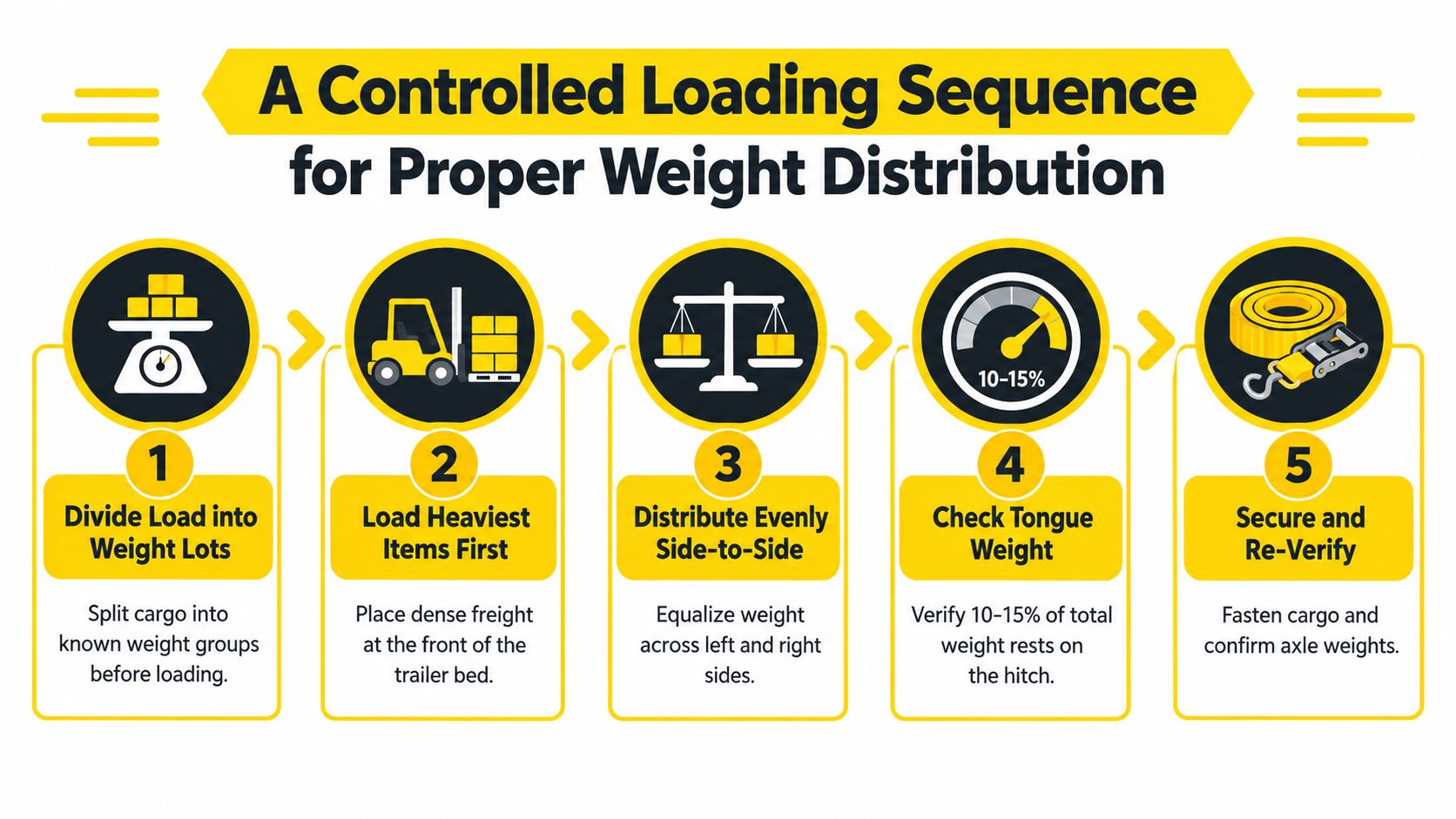
Start with known weight lots
Break the freight into measurable lots before the first forklift enters the trailer. Put the dense cargo in first and keep it low. That keeps the center of gravity down and gives you a stable base before you start correcting front-to-rear balance.
For shop planning, the 60% over the front half cue works as a starting placement rule. It is not a substitute for the ratings on the trailer or tow vehicle. On commercial equipment, I treat it as a rough loading guide, then let the scale confirm whether the axle loads are legal.
Build the load around symmetry and restraint
Keep left and right as even as the freight allows. A heavy pallet stack on one side and light freight on the other can leave the trailer looking fine overall while a tire, wheel, or axle is carrying more than it should.
Lock each lot down before moving to the next. A load that shifts in transit can turn a clean setup into a bad one fast, especially with loose aggregate, recyclables, or other cargo that moves as the trailer rolls and brakes.
Recheck after every meaningful change
Make fore-aft changes in small steps, not one hard shove to the nose or tail. Then reweigh. If the front starts to go light or one axle group starts to take too much, move the cargo a little at a time and stop when a rating is getting close, even if the gross number still looks acceptable.
The common failures show up every week. Heavy material gets parked at the rear, the sides are out of balance, the crew trusts the total weight and ignores axle split, and cargo that moves in service is loaded as if it were fixed in place. Visual judgment misses those problems. The scale does not.
Shifting Loads on Walking Floor and Aggregate Trailers
Walking Floor trailers and aggregate hauls punish static thinking. The load doesn't stay where you put it, and a plan that looked clean in the yard can be wrong by the time you hit the next stop or start a partial unload. That's not theory. That's what happens when material migrates toward the rear, settles in transit, or surges under braking and throttle.

Static balance can disappear mid-route
A Walking Floor trailer can leave the yard within spec and arrive with a different axle picture because the cargo moved during the trip or during unloading. That shift can drop tongue or kingpin load below a safe minimum, or it can load one axle group harder than the others after the material settles rearward.
That's why pre-weighing matters before the haul and again after meaningful unload points. If the cargo is expected to migrate, the route plan should account for it instead of pretending the load will behave like palletized freight.
What to watch in the floor system
In the shop, the problem often shows up as uneven unloading, slat wear, hydraulic trouble, or a floor that doesn't cycle cleanly. Those symptoms can point to a loading habit problem, but they can also point to a structural or mechanical issue that's making the trailer handle the load poorly.
A good inspection looks at the floor condition, slats, and the way the cargo is sitting before unload. If the load keeps drifting rearward or unloading lopsided, the trailer may need more than a different loading pattern. It may need floor-system repair or structural attention so the cargo stops creating the same imbalance every trip.
Use waypoint checks when the load is known to move
A route with a partial unload, a transfer point, or a known settling load should include a recheck before the next leg. The goal isn't perfection. It's catching the shift before it turns into sway, a roadside violation, or a floor that's fighting itself during discharge.
Axle-by-Axle Weighing and Pre-Trip Inspection Routine
A real compliance check starts at the plate, not at the entrance ramp. Read the trailer ratings, verify the tow vehicle limits, and then weigh the rig in the way it will run, with the cargo in place and the equipment in normal operating condition. If the trailer is wrong on one axle group, the gross number won't save it.
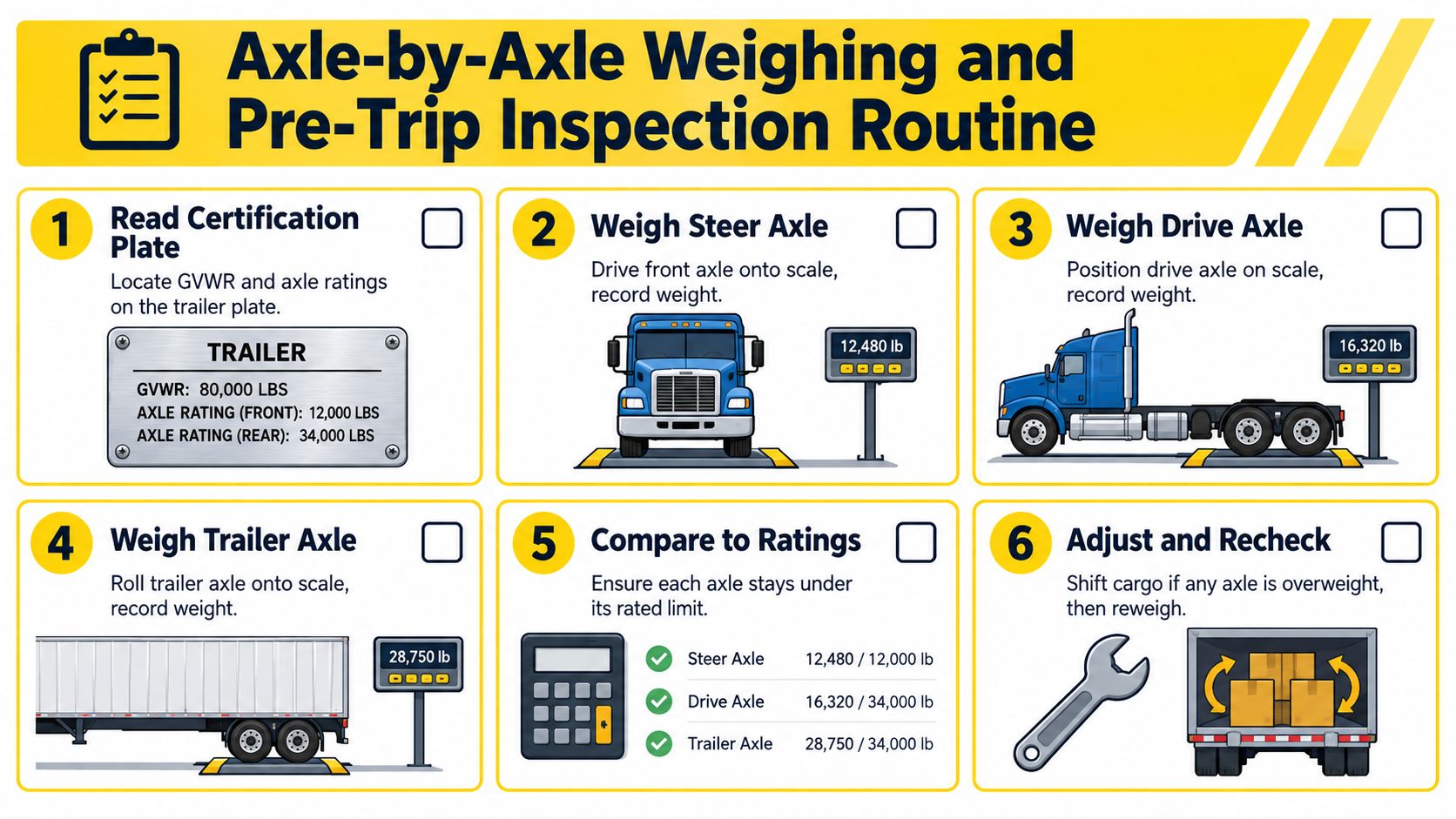
Weigh each group, not just the whole rig
Separate readings for the steer axle, drive axle group, and trailer axle group tell you where the load really sits. NHTSA specifically advises weighing axles separately and then adding the readings to verify total compliance NHTSA interpretation on weight distribution. That workflow catches overloaded axles that a single total weight would hide.
After the weigh, walk the unit. Check tires, wheels, suspension parts, brake components, frame rails, and the load securement points that bear the stress when the cargo isn't sitting right. The damage from a bad load usually shows up first where the force concentrates.
Use the numbers to diagnose the setup
A compliant gross weight doesn't mean the trailer is right. If the trailer axle group is over while the gross is still under, the cargo needs to move. If the tow vehicle's rear axle or hitch is overloaded, the front-to-rear placement needs correction before the next trip. If one side is carrying too much, the fix is side-to-side redistribution, not wishful thinking.
Here's the shop habit that saves time later:
- Read the plate first: Pull the GVWR, GAWR, hitch rating, and combination limits before changing the load.
- Weigh in operating trim: Use the trailer as it will run, not as it sits empty in the yard.
- Compare every axle reading: Match each reading to its own rating instead of relying on the total.
- Inspect the stress points: Tires, wheels, brakes, suspension, and frame areas tell you where the overload is landing.
- Document the setup: Keep scale tickets, axle readings, tire pressures, cargo notes, and any wear or damage you spot.
For parts and component planning, the Brothers Truck Trailer Repair catalog is one place fleets use to match trailer parts to the repair, especially when the issue turns out to be more than a loading mistake.
Recheck after adjustments
If you move cargo, reweigh. If the numbers are still off, the load plan isn't finished yet. That simple loop keeps a bad layout from becoming a roadside problem.
Where Generic Advice Breaks Down for Commercial Fleets
A trailer can look fine in the yard and still be wrong on the road. Fleet work changes the equation fast. Mixed trailer types, different axle spacings, shifting cargo, and unloads that happen mid-route all make one fixed loading rule too blunt to trust.
Why one rule can't cover every haul
The consumer-style 10–15% tongue weight guideline helps some bumper-pull trailers, but it does not answer the harder question of where the load should sit when gross weight is legal and one axle is still carrying too much. The practical fix is still the same, move the cargo forward, back, or side to side, then reweigh. Hardware changes do not cure a load that is sitting wrong.
A different hitch or weight-distributing setup can help when the trailer and tow vehicle are already matched and the issue is fine-tuning the coupling load. It will not fix cargo piled too far aft or leaned to one side. If one axle group is heavy, the loading plan is the problem.
Equipment changes help, but only in the right situation
A load that looks balanced from the tongue can still be out of compliance axle by axle. That is common on mixed fleets, especially when one trailer hauls palletized freight, another runs aggregate, and another handles material that shifts as it moves. The trailer may ride level while the wrong axle carries the stress.
The old federal milestones on axle weight limits make the same point without helping a loader solve today's problem. Rules matter because weight has to sit on the right structure, but a shop still has to set the cargo for the trailer in front of it, not for a generic standard.
What fleets should stop trusting
Stop trusting a single gross ticket as proof the trailer is ready. Stop trusting one short pull around the yard. Stop assuming the same loading pattern works for Walking Floor, aggregate, and palletized freight.
Keep common trailer components on hand through the Spanish-language parts catalog so a load issue does not turn into avoidable downtime when the problem is a worn part, not the cargo. The fleet that gets this right builds every load around axle readings, not habit.
Turning Proper Weight Distribution Into Less Downtime
Good weight distribution pays off in ways that show up in the shop before they show up in a safety meeting. Tires stay more even, suspension parts live longer, brakes work without being dragged by a crooked load, and the trailer spends less time getting patched because one side has been carrying the wrong kind of stress for months.
Log the load like a maintenance item
After every load, keep the records that explain what happened:
- Axle weights: Steer, drive, and trailer group readings.
- Cargo position notes: Where the dense material sat and whether anything moved.
- Tire pressures: A quick record catches a pressure problem before it looks like a load problem.
- Component condition flags: Suspension wear, floor issues, brake concerns, frame cracks, or bent hardware.
Those notes turn one driver's good habits into a shop trigger. When the same axle keeps showing up heavy, or the same trailer keeps unloading crooked, maintenance can stop guessing and start diagnosing.
Know when the problem is structural
If a trailer keeps drifting out of balance even with a careful load plan, the issue may be axle geometry, suspension wear, a floor-system fault, or cracked aluminum that's changing how the unit carries weight. That's where a Tampa shop with Walking Floor diagnostics, aluminum welding, trailer repair, suspension checks, axle realignment, and parts support can keep the problem from becoming a repeat outage. Brothers Truck Trailer Repair and Welding Corp. works in that space when the load issue isn't just load placement anymore.
Keep the workflow tight
The best fleets treat loading, weighing, and inspection as one routine, not three separate chores. Once the driver knows how to place the cargo, the tech knows how to verify it, and the shop knows how to read the wear pattern, the trailer stops wasting time in avoidable rework.
If your trailers keep scaling wrong, unloading unevenly, or leaning into the same suspension problems after every run, get the hardware checked as seriously as the load plan. Brothers Truck Trailer Repair and Welding Corp. handles trailer repair, Walking Floor diagnostics, aluminum welding, and parts support for fleets that need the problem fixed, not just documented. Visit Brothers Truck Trailer Repair and Welding Corp. and get the trailer, the floor system, and the axle geometry looked at together.
Technical reference for 3500 lbs trailer axles covering GAWR, tire ratings, brake rules, fitment specs, and inspection protocols for commercial fleets.
Learn how etracks in trailer systems work, installation best practices, and repair procedures to keep your cargo secure and compliant on the road.
Master trailer wheel bearings maintenance with expert steps for inspection, repacking, and replacement. Reduce downtime and prevent costly failures today.