3500 Lbs Trailer Axles: Fleet Maintenance Reference
The most common advice about 3500 lbs trailer axles is also the least useful: people talk as if the axle tag alone decides what the trailer can safely carry. It doesn't. The actual limit is the complete wheel-end system, and in fleet work that means the axle label, tires, wheels, brakes, bearings, hubs, springs, frame, coupler, and attachment hardware all have to line up with the trailer's actual loaded condition.
Table of Contents
- Why Axle Rating Alone Does Not Determine Safe Capacity
- Understanding Gross Axle Weight Rating Definitions
- Matching Tire Load Ratings to Axle Systems
- Verifying Physical Fitment Dimensions and Specifications
- Navigating Brake Requirements by Jurisdiction and Weight
- Preventing Attachment Hardware Failures Through Inspection
- Post-Installation Torque and Reinspection Protocols
- Documenting Compliance for FMCSA Annual Inspections
- Complete System Verification Checklist for Fleets
Why Axle Rating Alone Does Not Determine Safe Capacity
A 3,500-lb axle is not a free pass to load 3,500 lb onto a trailer and call it good. I've seen plenty of operators focus on the beam and ignore the rest of the load path, then get surprised when tires wear unevenly, bearings run hot, or the trailer doesn't meet the way it's being used.
That mistake shows up in plain sight. A trailer fitted with a 3,500-lb axle is listed at 2,990 lb official capacity because it lacks brakes, which proves that axle rating does not equal usable trailer capacity (Tractor Supply trailer listing). The practical limit is set by the lowest-rated component and the governing rule where the trailer runs.
What to check before you trust the number
Practical rule: Start with the trailer as a system, not the axle as a standalone part.
Before approving a repair or an upgrade, verify the axle tag, tire-and-wheel ratings, brake package, coupler rating, frame plate, and the trailer's actual loaded condition. On Tampa Bay work trailers, that usually means checking whether the trailer hauls with tongue weight transferred to the tow vehicle, or whether the axle is carrying nearly all of the load.
A stronger axle won't fix an undersized tire, a weak wheel, or missing brakes. It also won't correct a frame that wasn't built for the load, which is why a “bigger axle” can still leave the unit legally and mechanically limited. For owner-operators and fleet managers, the question isn't, “Is it a 3,500-lb axle?” The question is, “What is the weakest part in the whole path from cargo to pavement?”
Understanding Gross Axle Weight Rating Definitions
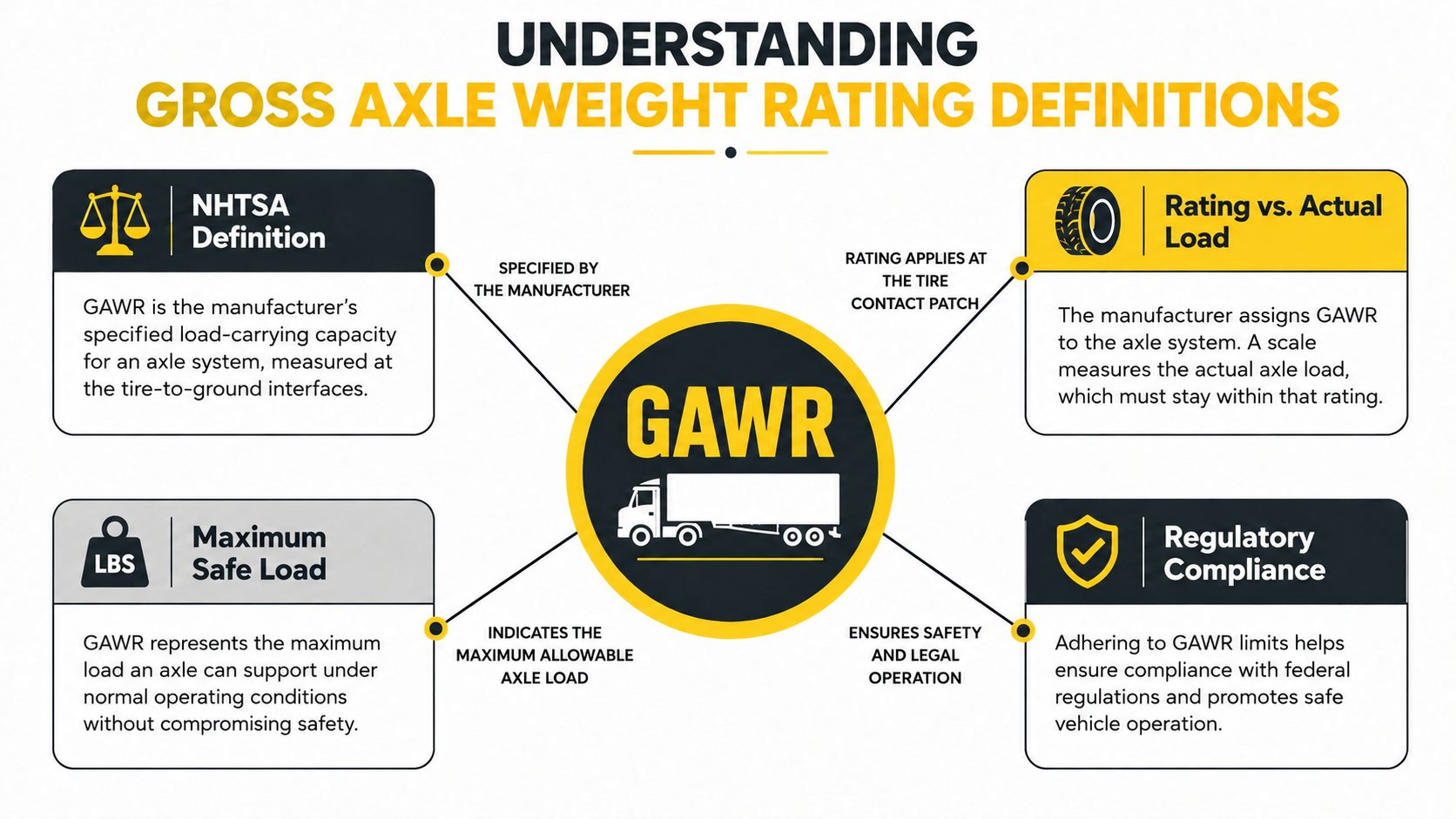
GAWR, Gross Axle Weight Rating, is the manufacturer-specified load-carrying capacity of an axle system, measured at the tire-to-ground interfaces, not just the steel tube in the middle (NHTSA interpretation). In practice, that means the rating depends on the complete wheel-end system, including the tires and wheels that carry the load. A 3,500-pound axle rating can still be lower than the trailer's GVWR when part of the weight transfers through the hitch to the tow vehicle.
Why GAWR and GVWR are not interchangeable
GAWR tells you what the axle system can carry. GVWR tells you the maximum loaded weight of the whole trailer as certified by the manufacturer. The two numbers are related, but they solve different problems, and mixing them up leads to bad repair calls.
A trailer can shift more weight onto the hitch and reduce what the axle sees. It can also shift load the other way and overload the axle while the trailer still looks acceptable from the outside. That is why bent spindles, hot bearings, damaged hubs, and tired tires need an actual load check, not just a look at the tag.
Where the certification data lives
The certification label identifies the GAWR for each axle in pounds and in front-to-rear order. That label is the starting point for service work because it shows the manufacturer's declared number for the axle system as installed on the trailer.
The tag does not replace inspection. It gives you the legal reference point for everything else you measure.
For fleet shops, the useful habit is simple. Compare the label to the tire sizes, wheel ratings, hub and bearing specs, and the load the axle is carrying on the day you inspect it. For Tampa Bay units that live in stop-and-go service, salt air, and heavy curbside loading, that check helps catch a wheel-end problem before it turns into a roadside failure or a failed inspection.
Matching Tire Load Ratings to Axle Systems
For trailers, the tire-selection standard depends on trailer GVWR, not a single axle rating: FMVSS 110 generally applies at 10,000 lb or less, while FMVSS 120 generally applies above that GVWR. Both require the tire load-rating total on an axle to meet its certified GAWR. For a 3,500-lb GAWR with two equally loaded tires, the basic comparison is 1,750 lb per tire; this table assumes those are effective ratings for the trailer application. Passenger-car tire ratings used on trailers must first be divided by 1.10 under the applicable standard. Confirm tire type, inflation, actual loading, and the trailer label before selecting replacements.
That's a minimum compliance comparison, not a green light to ignore inflation pressure, wheel limits, sidewall condition, or load distribution. A tire can look acceptable and still be the wrong fit for the axle system once you factor in the rest of the package.
Tire capacity calculation for a 3500 lb axle
| Configuration | Tires Per Axle | Min Rating Per Tire (lbs) | Combined Capacity (lbs) |
|---|---|---|---|
| Single axle with equal load | 2 | 1,750 | 3,500 |
| Single axle with lower-rated tire | 2 | Below 1,750 | Below 3,500 |
| Single axle with higher-rated tire | 2 | Above 1,750 | Above 3,500 |
A higher-rated tire doesn't raise the axle rating, and a 3,500-lb axle doesn't make under-rated tires acceptable. The wheel, hub, spindle, and suspension still have to match the same load path. In practice, that means a failed tire can't be replaced with a “close enough” option unless the replacement's rating, wheel compatibility, and inflation requirements support the axle system.
For maintenance managers, tire records matter. A fleet can own a mechanically sound axle and still run an unsafe package if one tire is mismatched, underinflated, or below the necessary load rating for the axle label.
Verifying Physical Fitment Dimensions and Specifications
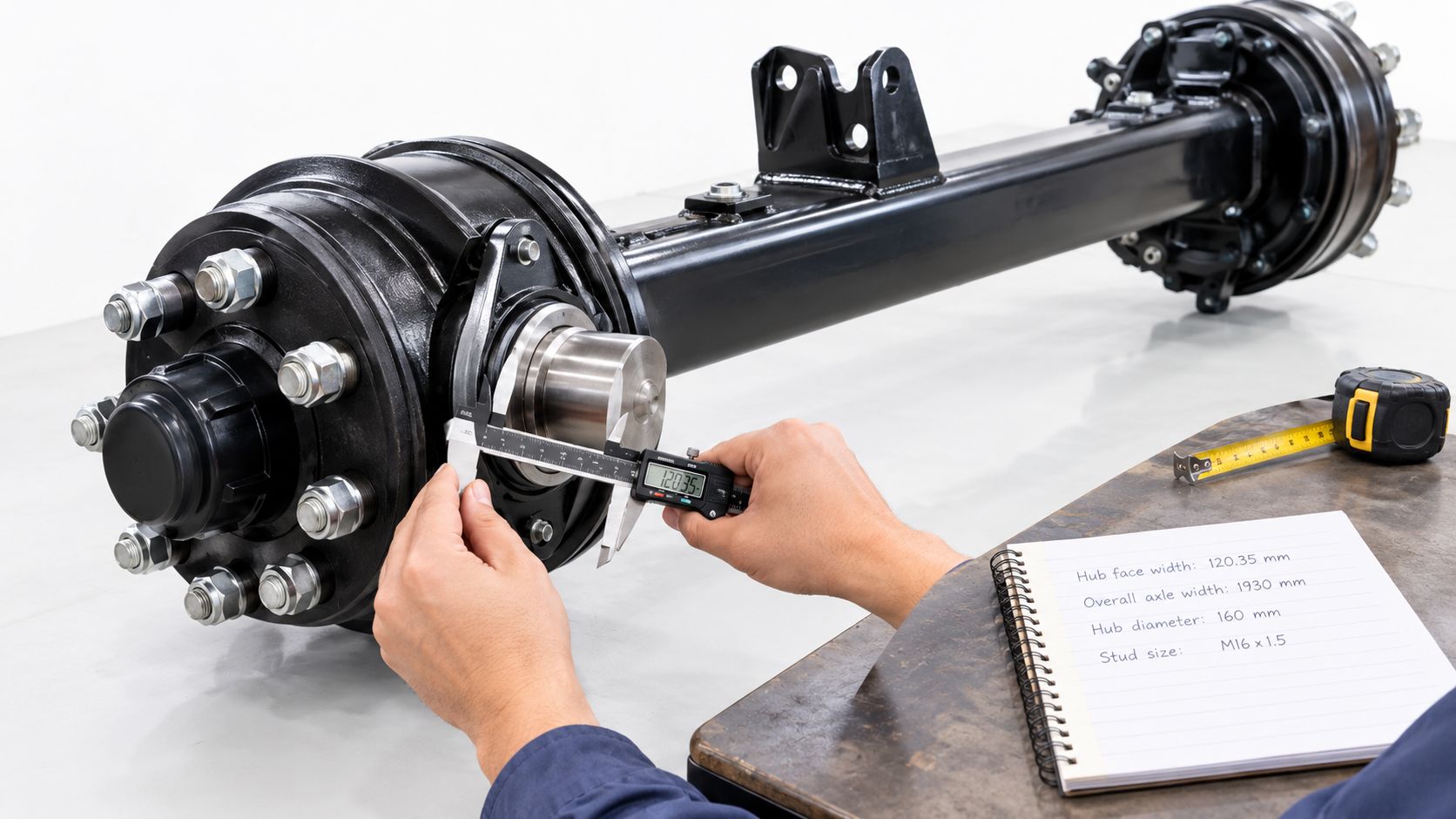
A capacity match doesn't guarantee a fit. A 3,500-lb axle still has to line up with the suspension and wheel-end geometry already under the trailer, and that's where measurements beat assumptions every time.
The dimensions that actually decide the job
A representative 3,500 lb configuration uses an 80-inch hub-face dimension, approximately 61–70-inch spring-center options, a 1-3/8-inch by 1-1/16-inch tapered spindle, and L68149 inner / L44649 outer bearings (ACFC trailer axle reference). Those are fitment points, not universal rules, so the existing hub-face, spring-center spacing, spindle, brake flange, wheel offset, and bolt pattern still have to be measured before a replacement is ordered.
The axle tube itself matters too. A common light-trailer build uses a 2-3/8-inch outside-diameter round tube, and the axle is often cambered so it runs close to straight when it's loaded. If that bow goes in upside down, the trailer can develop abnormal tire wear and overstressed suspension components.
What a shop should record before and after replacement
Hub-face width: Confirm the mounting width before ordering parts.
Spring-center spacing: Match the existing suspension geometry.
Spindle and bearing numbers: Verify the wheel-end package, not just the beam.
Brake-flange and wheel pattern: Prevent mismatch at installation.
Camber direction: Install the center bow upward.
A practical parts source can reduce downtime when the measurements are already known, and a shop like Brothers Truck Trailer Repair and Welding Corp. can work from those dimensions instead of guessing. That's especially useful on Tampa Bay fleet equipment where the trailer can't sit around while someone orders the wrong axle twice.
If the measurements don't match, the correct-rated axle is still the wrong part.
Navigating Brake Requirements by Jurisdiction and Weight
Brake requirements are where a lot of generic axle advice breaks down. A trailer can carry a 3,500-lb axle and still face different brake obligations depending on where it's registered and operated, because the legal trigger is the trailer's gross or loaded weight under the governing rule.
For Tampa Bay trailers, start with Florida Statutes 316.261. The exception to brakes on all wheels for trailers of 3,000 lb gross weight or less is conditional: the weight on and including the trailer wheels must not exceed 40% of the connected towing vehicle's gross weight, and the combination must meet section 316.262 stopping-performance requirements. Subsection (4) also addresses automatic braking upon breakaway, including trailers over 3,000 lb. Other states use different rules; Tennessee trailer inspection requirements are an out-of-state comparison, not the rule for Florida service. Axle capacity alone does not establish a brake exemption.
Why the jurisdiction matters
For vehicles subject to the federal motor carrier rules, 49 CFR 393.42 generally requires brakes on all wheels. Its paragraphs (b)(3) and (b)(4) provide conditional exceptions for specified trailers of 3,000 lb gross weight or less, using the towed vehicle's axle weight or axle-weight total compared with 40% of the towing vehicle's axle-weight total. This is not a universal federal 1,500-lb trigger. Determine federal applicability and the relevant state requirements for the actual vehicle combination and operation. FMCSA brake-compliance guidance addresses the motor carrier's responsibility for trailer brakes.
For inspection, look at the linings, drums, wiring, and breakaway system, not just whether the axle was replaced recently. A new beam doesn't fix contaminated linings, loose springs, or brake components that were already out of alignment.
Practical brake checks that hold up in service
Brake linings or pads: Make sure they're firmly attached and free of oil, grease, or brake-fluid saturation.
Wiring and connections: Confirm the circuit is intact and protected.
Drums and hardware: Look for visible damage or uneven wear.
Breakaway function: Verify the trailer can stop if the connection fails.
On commercial units, the goal isn't only to pass the local inspection lane. It's to make sure the loaded trailer is legal where it runs and still controllable if the tow vehicle or connection has a problem.
Preventing Attachment Hardware Failures Through Inspection
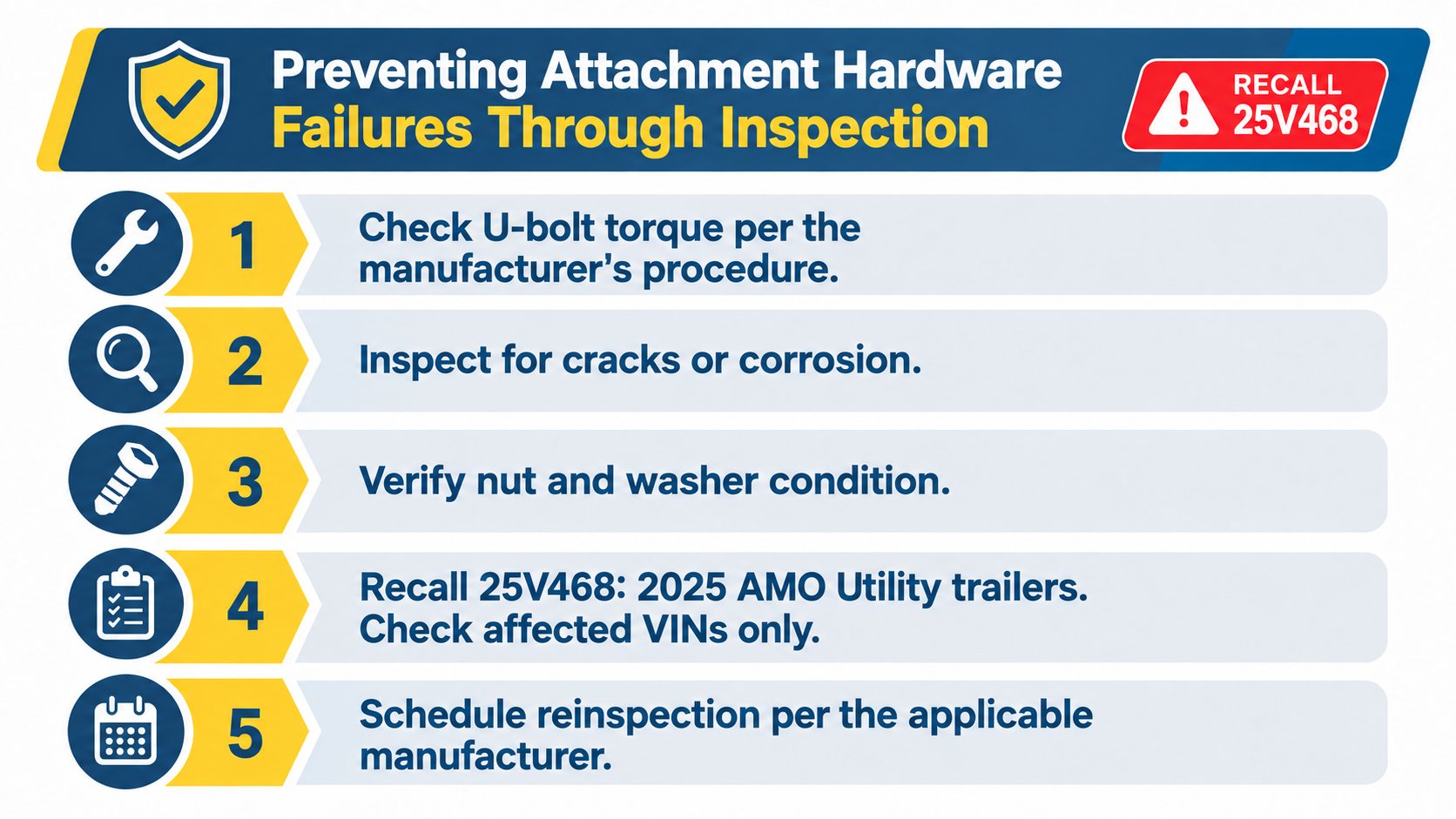
A correctly rated axle can still separate from the trailer if the hardware holding it in place fails. That's not theory, it's a real maintenance problem, and recent recall work shows how quickly a small fastening issue can become a roadside event.
NHTSA recall 25V468 identifies 2,294 potentially affected 2025 AMO Utility trailers from American Manufacturing Operations. Shackle nuts securing the axle to the chassis may loosen, allowing the axle to detach. The announced remedy is replacement of the shackle nuts. Check the trailer's VIN and the manufacturer's campaign instructions; this recall does not apply to every utility trailer or every 3,500-lb axle. The linked notice does not establish a January 2026 repair-completion count.
What reliable installation work actually looks like
Torque check all U-bolts: Fasteners need to be secured to the applicable procedure.
Inspect for cracks or corrosion: Hangers, spring seats, and brackets should be clean enough to inspect properly.
Verify nut and washer condition: Missing or damaged hardware changes clamp load.
Check recall 25V468 for 2025 AMO Utility trailers: Verify the VIN and campaign status; do not apply the recall to unrelated equipment.
Schedule manufacturer-specified reinspection: Use the applicable service procedure and fastener requirements.
For an affected unit, follow the manufacturer's recall remedy rather than assuming that adding thread-locking adhesive or re-torquing existing hardware completes the repair. For other trailers, use the applicable fastening procedure for the identified suspension, including the specified hardware and any replacement requirements. A correct axle rating cannot compensate for an incorrect locking method, damaged mount, or unsuitable installation.
For fleets that want the inspection trail documented, the same kind of axle, suspension, and wheel-end checks can be built into a repair process at the shop level, including parts sourcing through Brothers Truck Trailer Repair and Welding Corp. when the trailer needs matched hardware and a clean reinstall.
Post-Installation Torque and Reinspection Protocols
The linked Dexter service manual, hosted by NHTSA, gives model-dependent guidance, not a universal NHTSA maintenance schedule. Its setup section calls for wheel-nut torque checks after 10, 25, and 50 miles. For the manual-adjust electric brakes covered by that manual, adjustment is specified after the first 200 miles, then at 3,000-mile intervals or when performance requires it; the covered electric self-adjusting brakes do not require manual adjustment. Identify the installed axle, wheel, and brake models and follow their current manufacturer instructions before applying those examples to 3500 lbs trailer axles.
The point isn't paperwork for its own sake. It's making sure the fasteners settle correctly, the wheel end stays tight, and the brake package keeps working after the trailer has seen real road load.
What to inspect while the unit is back in service
A 3,500-lb axle should be treated as a complete wheel-end and braking system, not just a beam under the frame. That means checking the bearings for pitting, heat discoloration, looseness, or lubricant contamination, then confirming the linings, drums, wiring, and breakaway components are compatible with the axle and trailer.
A good work order should record:
Hub-face and spring-center measurements
Axle serial or rating data
Bearing numbers
Brake size
Tire load range
Post-repair torque
A repair that isn't documented is hard to trust when the same trailer comes back with heat, noise, or pull complaints.
For Tampa Bay fleets, that record also helps different people on the team make the same decision later. The next technician doesn't have to guess which spindle was used, whether the hub matched, or what torque was set on the last visit.
Documenting Compliance for FMCSA Annual Inspections
For commercial motor vehicles subject to the federal periodic-inspection rule, 49 CFR 396.17 requires each vehicle in a combination to pass the required inspection at least once every 12 months. The inspection includes applicable brake-system items. A 3,500-lb axle alone does not establish federal CMV status; determine applicability from the vehicle combination and operation. Keep the inspection report and the supporting repair records for the applicable requirements.
For a 3,500-lb axle, the compliance risk usually sits in the wheel end and brake system, not the beam alone. A trailer can have the right axle installed and still miss the mark if the brake package is inoperative, the connection hardware is loose or damaged, or the annual inspection record is missing.
What the work order should show
A solid fleet record should identify:
Axle rating and dimensions
Wheel-end parts
Suspension fasteners
Brake condition
Brake connections
Inspection date
Those details matter whether the job stayed in-house or went to an outside shop such as Brothers Truck Trailer Repair and Welding Corp., where inspection records and parts sourcing stay under one roof. The carrier still owns the compliance outcome, and a clean work order makes handoffs, audits, and repeat service easier to manage.
For Tampa Bay fleets, that record also shortens the next decision at the gate. If the axle, brakes, and attachment points are logged together, the trailer is easier to clear for service, assign to a driver, and defend during an inspection stop.
Complete System Verification Checklist for Fleets
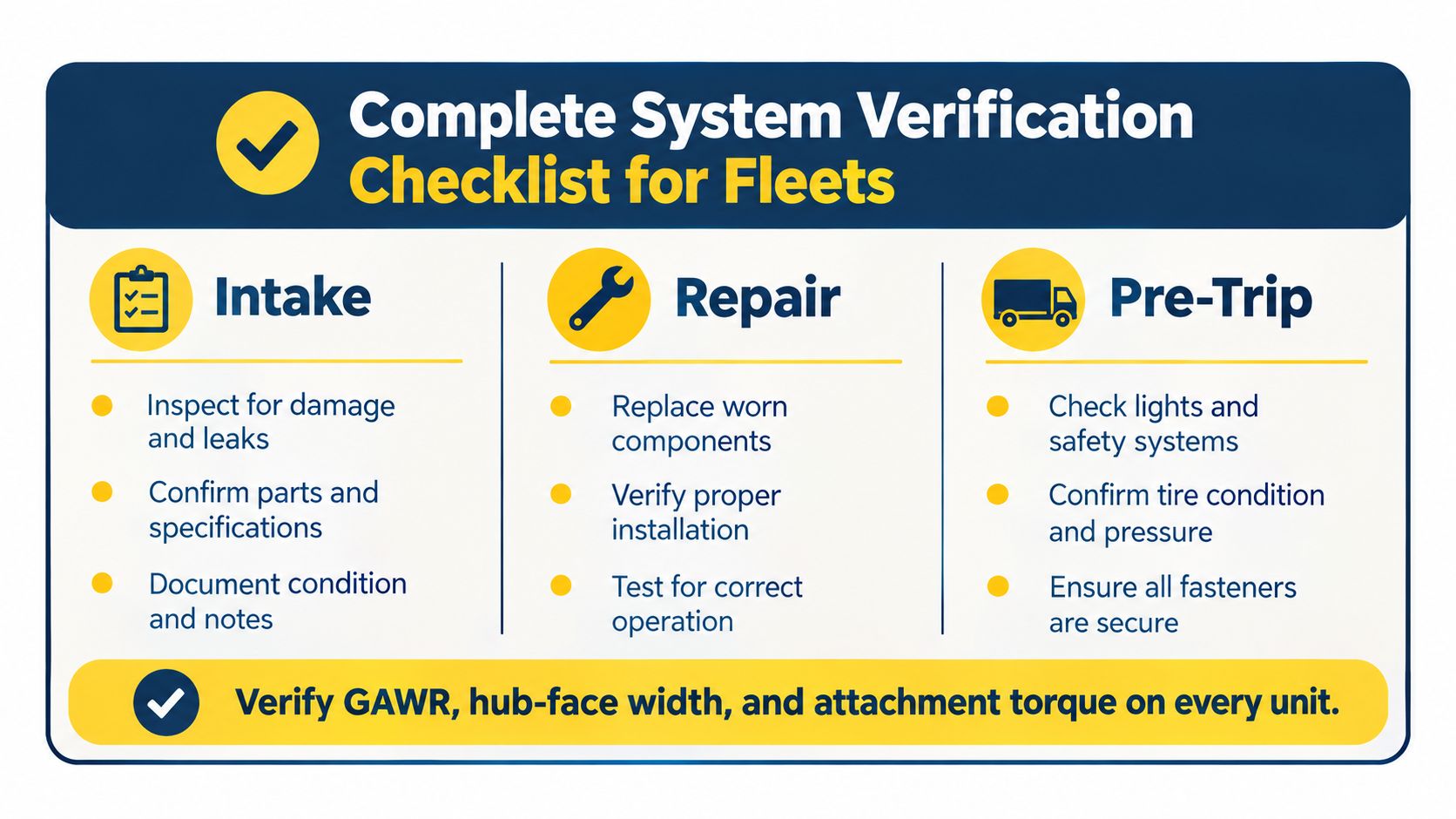
The fastest way to avoid bad axle decisions is to check the entire system in the same order every time. That keeps intake inspections consistent, keeps repair notes useful, and gives the driver a pre-trip checklist that doesn't rely on memory.
Intake
Verify the axle tag: Confirm the rating before ordering parts.
Read the certification plate: Match GAWR to the trailer's actual setup.
Measure loaded condition: Check what the axle is really carrying.
Repair
Match hub-face and spring-center dimensions: Fitment comes first.
Check tires and wheels: Ratings have to support the axle system.
Inspect attachment hardware: U-bolts, shackle nuts, and hangers have to be secure.
Pre-Trip
Confirm brake function: Test the actual braking system, not just the beam.
Check bearing condition: Heat, looseness, or contamination need attention.
Verify torque record: Recheck the wheel-nut history after installation.
The safest rule is still the simplest one. Verify GAWR, hub-face width, and attachment torque on every unit before it goes back into service. That applies whether the trailer is hauling aggregate, floor equipment, or regional freight around Tampa Bay.
If your trailer needs axle realignment, bushing replacement, suspension diagnostics, aluminum welding, or wheel-end repair work, Brothers Truck Trailer Repair and Welding Corp. handles truck and trailer maintenance with a focus on keeping fleets road-legal and moving. Visit Brothers Truck Trailer Repair and Welding Corp. to review their service and parts capabilities and get the right axle system work scheduled before a small fitment problem turns into downtime.
Learn how etracks in trailer systems work, installation best practices, and repair procedures to keep your cargo secure and compliant on the road.
Master trailer wheel bearings maintenance with expert steps for inspection, repacking, and replacement. Reduce downtime and prevent costly failures today.
2-inch ball hitch guide: match the coupler, verify component ratings, inspect mounting and locking hardware, and follow equipment-specific instructions.