2 Ball Hitch Guide: Sizing, Safety, and Fleet Inspection
The search phrase 2 ball hitch can mean a 2-inch hitch ball or a mount carrying two selectable balls. This guide focuses on 2-inch ball-and-coupler towing for compatible utility, boat, and similar trailers. A multi-ball mount is a different description: each selected ball must match the coupler diameter and its own rating. In either case, the safe limit is set by the lowest applicable gross-trailer-weight and tongue-load rating in the complete towing assembly.
A mechanic can spot the problem in the yard before it turns into a roadside failure. The coupler looks close, the ball looks heavy enough, and the trailer is only going a short distance, but that's exactly how mismatched hardware slips through a fleet.
Table of Contents
- Understanding the Two-Ball Hitch System
- Ball Diameter and Load Capacity Standards
- Choosing Between 2-Inch and 2-5/16-Inch Balls
- Installation Requirements and Structural Integrity
- The Weakest Link Principle and Tongue Weight
- Pre-Trip Inspection and Annual Compliance Checklist
Understanding the Two-Ball Hitch System
This ball-hitch guide does not describe the coupling procedure for a Walking Floor semitrailer equipped with a fifth wheel and kingpin. Identify the actual coupling type before using any checklist. A ball-coupled trailer and a fifth-wheel semitrailer need different hardware checks, even though both require sound mounting, positive locking, and a suitable load rating.
What the system is
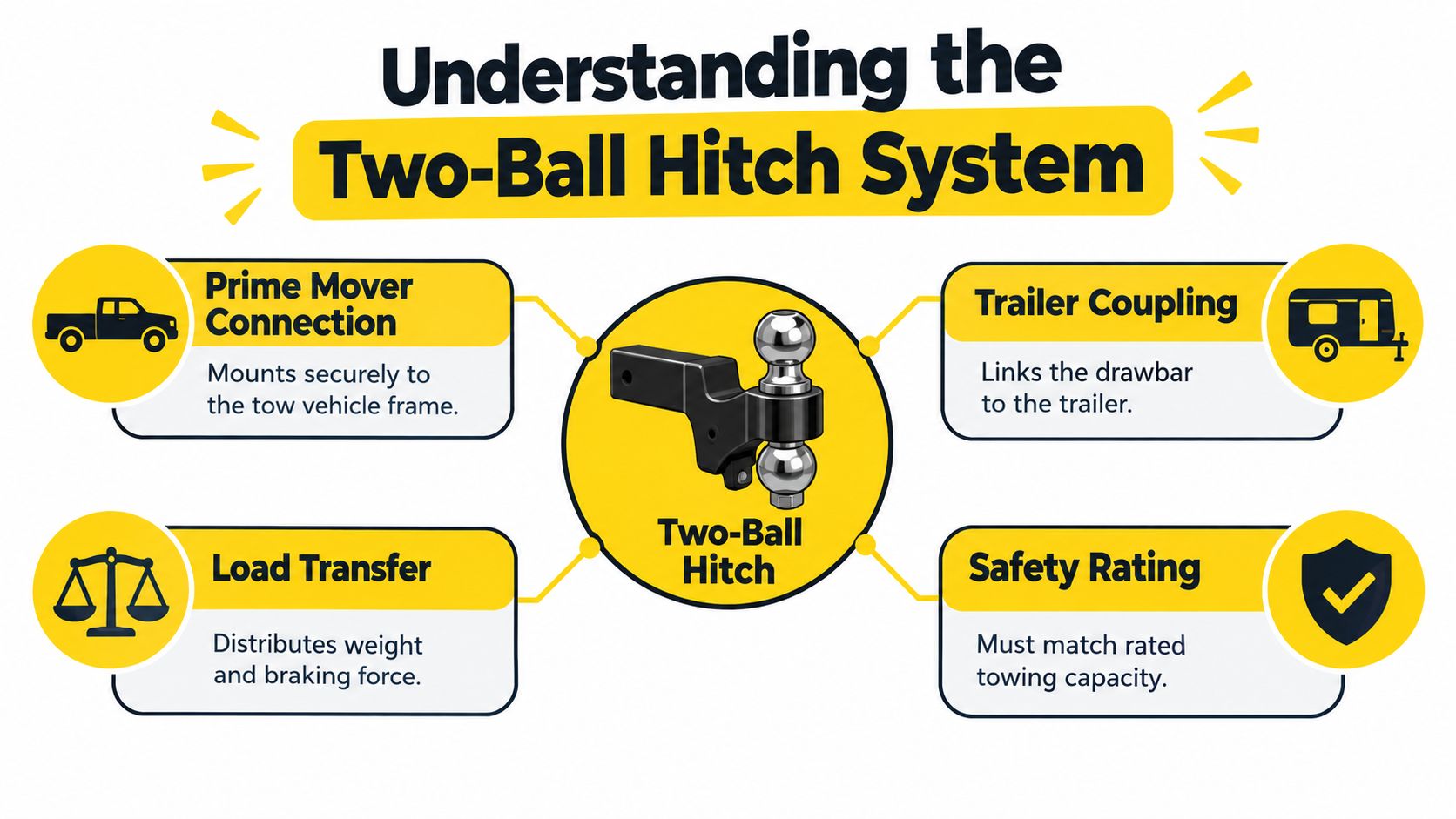
A 2-inch ball hitch uses a spherical ball with a 2-inch diameter and a coupler designed for that exact size. Common North American ball diameters include 1 7/8 inches, 2 inches, and 2 5/16 inches. The working limit comes from the complete assembly, not diameter alone. A two-ball or multi-ball mount carries separate selectable balls; the illustration below shows that type of mount and does not establish a towing capacity. CURT hitch-ball sizes and selection overview
Why the assembly matters more than the diameter
The common field mistake is treating the ball as the rating. Capacity belongs to the ball, coupler, mount, receiver, vehicle, and trailer together, because the weakest part sets the limit for the whole setup.
Practical rule: if any one component is under-rated, the hitch is under-rated.
The cited SAE J684_201405 standard, reaffirmed in 2014, covers couplings, hitches, and safety chains for trailers or towed vehicles with GVWR not exceeding 10,000 pounds, primarily in light-vehicle towing applications. That is the scope of this standard, not a universal maximum rating for every hitch ball or towing product. Check the actual equipment ratings and applicable installation requirements. SAE J684 scope and 2014 edition
What a fleet mechanic should check first
Start with fit, then verify the markings. The coupler has to match the ball diameter exactly, the stamped rating has to be readable, and the whole setup has to suit the trailer's actual load.
For a commercial trailer, the useful checklist is direct:
Match the coupler first: the hitch ball must fit the coupler, not just seem close.
Read the rating next: the stamped capacity has to cover the trailer's gross weight.
Inspect the mount last: a strong ball on a weak shank or receiver is still a weak hitch.
For a Walking Floor semitrailer using a fifth wheel and kingpin, inspect that coupling assembly under its own manufacturer instructions. Do not substitute a ball, coupler, and receiver checklist for the checks required by a different connection type.
Ball Diameter and Load Capacity Standards
A mechanic should not pick a ball by habit. The ball diameter, bolt size, and mounting pattern all affect the usable rating, and shortcuts here are how coupling failures start.
The three common sizes
Ball diameter does not set one universal capacity. Use the marked rating and the instructions for the exact part. For example, CURT part 40038 is a 2-inch ball rated at 12,000 pounds GTW; other 2-inch parts may have lower ratings. A matching coupler diameter alone does not authorize that load. The receiver, mount, coupler, trailer, and tow vehicle must all support the intended configuration. CURT 40038 specifications
The ball alone does not make the trailer safer. The coupler, receiver, shank, and tow vehicle all have to be built for the same load.
How the same diameter can rate differently
Connecticut DMV lists inspection reference values for certain unmarked ball-and-bolt combinations, including 3,500, 5,000, and 10,000 pounds for specified 2-inch configurations. These are Connecticut inspection criteria, not a way to assign a safe working rating to unidentified hardware in a Florida fleet. Prefer readable manufacturer markings and the exact product documentation; replace or obtain manufacturer confirmation for hardware whose rating cannot be established. Connecticut trailer inspection reference criteria
That spread matters in the yard and on the road. Two balls that look the same from across the lot can belong in very different jobs once the mounting hardware is checked.
What the rating tells you
The rating depends on the ball, coupler, and mount read together. A visually correct setup can still be wrong if the bolt size or bracket design is too small. For commercial towing, that means the ball size is only the first check. The actual limit comes from the weakest part of the assembly.
For fleet work, keep the inspection disciplined:
Do not judge by appearance: the same diameter can carry a different load.
Do not trust the heaviest-looking part: the weakest component sets the limit.
Do not skip the bolt size: mounting hardware changes the rating as much as the ball does.
Tampa Bay service conditions do not change the need to identify the exact coupling system. Inspect a ball-coupled trailer against its ball, coupler, and mount requirements; inspect a fifth-wheel semitrailer against its fifth-wheel and kingpin requirements. Never assume that a specialized trailer body determines which hitch checklist applies.
Choosing Between 2-Inch and 2-5/16-Inch Balls
A truck that pulls different trailers in the same week cannot treat ball size as a guess. The choice comes down to the trailer, the coupler, and the full hitch assembly, because a mismatch shows up fast in service.
When a 2-inch ball makes sense
A 2-inch ball is appropriate when the coupler is built for that exact diameter and every component supports the intended load. Read the rating on the exact ball and verify its shank, mount, receiver, coupler, and vehicle requirements. The 12,000-pound rating of CURT 40038 is a product example, not the rating of every 2-inch ball. Example of a rated 2-inch ball
Use the 2-inch setup only when the whole chain supports it. If the coupler is stamped for 2 inches, the receiver and shank match the load, and the trailer's gross weight stays within the assembly rating, the smaller ball is the correct part for the job.
When the larger ball belongs on the trailer
A 2 5/16-inch ball is appropriate only for a matching coupler and compatible rated assembly. Ratings can exceed 10,000 pounds: CURT part 40085, for example, has a 30,000-pound GTW ball rating. That does not raise the rating of the vehicle, receiver, mount, coupler, or trailer. Select the required diameter first, then verify the lowest limit across the complete setup. CURT 40085 specifications
A larger ball does not make a trailer safer by itself. The coupler has to match the diameter, and the receiver, mount, tongue, and frame connection have to carry the same load class. If any part of the assembly is lighter than the ball suggests, the setup looks stronger than it is.
The shop test for mixed fleets
Mixed fleets need separate checklists for receiver-mounted ball hitches, fifth-wheel and kingpin assemblies, and any other coupling types in service. A truck moving between utility and construction trailers must use the matching coupler size and the rating for the selected setup. Walking Floor semitrailer service requires inspection of its actual coupling equipment rather than assuming a receiver-style ball mount.
If the trailer hardware is worn, mismatched, or uncertain, send it to the catalog and parts side before it goes back in service. That keeps a bad coupling from becoming a road failure.
A larger ball does not rescue a weak receiver, a worn coupler, or a loose mount.
Select the ball diameter the coupler and structure were built to accept, and verify the receiver and mount carry the same load class.
Installation Requirements and Structural Integrity
A hitch failure usually starts before the trailer rolls. It starts with a ball that was not torqued correctly, a mount that flexes, or a coupler that does not seat fully on the ball.
What the connection has to do
For commercial full-trailer towing covered by 49 CFR 393.70(c), the tow-bar and attachment must have adequate strength, secure mounting, suitable articulation without excessive slack, and a locking device against accidental separation. The rule also addresses reinforcement or bracing of the towing-vehicle hitch mounting. Fifth-wheel assemblies have separate requirements in paragraph (b). Apply the provision for the actual coupling type and operation. Federal coupling requirements by connection type
Movement is the problem. Any looseness between the ball and coupler lets the connection shift under braking and acceleration, which drives impact loading into the hardware and wears the fit faster. Once that starts, the wear feeds itself.
What a technician checks at install
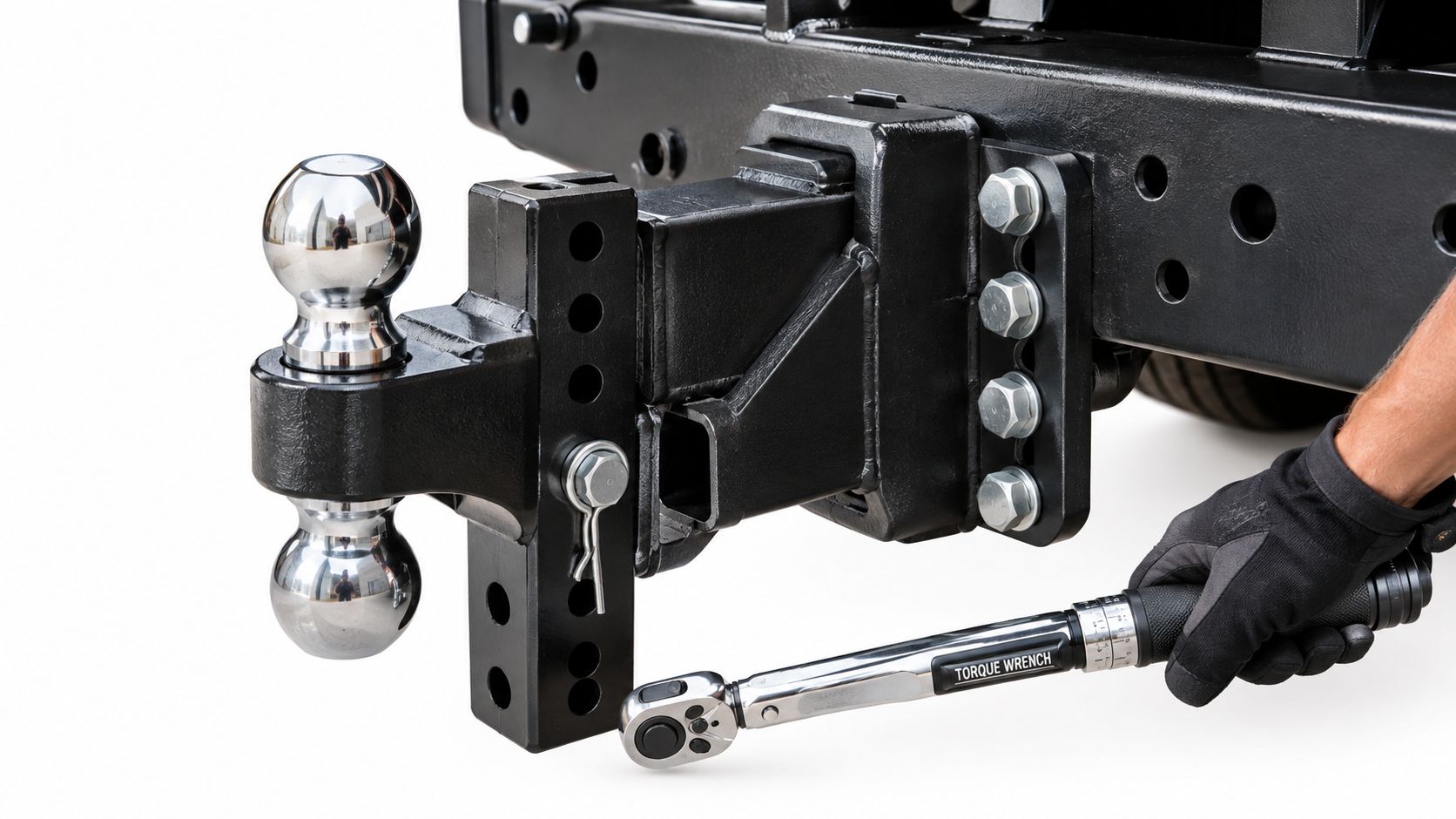
A ball installation is not finished when the nut feels tight. It is finished when the fastener is secured, the mount is sound, and the coupler sits fully on the ball.
Ball security: the ball has to be tight and properly torqued.
Coupler engagement: the coupler has to sit fully on the ball.
Locking control: the latch must accept its safety pin before towing.
Mount integrity: the frame or bracket has to resist distortion under load.
An Airstream service publication hosted in the NHTSA document library recommends inspecting the receiver, mounting hardware, ball, coupler, safety chains, and breakaway switch for wear, cracks, corrosion, and loose components. This is manufacturer service guidance, not a separate NHTSA inspection rule. Use the instructions and torque specifications for the actual equipment being inspected. Airstream hitch-inspection guidance
Why reinforcement matters on repair work
Repair work must protect the load path and follow the equipment manufacturer's approved repair or replacement procedure. Do not assume that adding weld metal or reinforcement makes a damaged hitch mount safe. A qualified repair assessment must identify the material, damage, required attachment, and inspection criteria before the unit returns to service.
For replacement mounts, brackets, and hardware, the Brothers Truck Trailer Repair and Welding Corp. parts catalog lists components matched to common hitch and frame repairs.
Inspection standard: if the ball or coupler shows deformation, corrosion-related section loss, cracking, or persistent play, it comes out of service.
A fleet that adjusts damaged parts to make them work is postponing the failure, not preventing it.
The Weakest Link Principle and Tongue Weight
A high-rated ball doesn't make a safe tow by itself. The entire system is only as strong as the weakest rated part, and that includes the receiver, insert, ball, truck, coupler, and related hardware.
Why the lowest rating controls everything
Purdue Extension treats the receiver, insert, ball, truck, and related components as one assembly whose practical limit is the weakest rating. That's the right mental model for fleet work, because it keeps mechanics from chasing one shiny component while missing a lighter-duty part elsewhere in the chain. Purdue Extension trailer connection guidance
A trailer can look simple from the yard and still be underspecified at the hitch. The ball may carry a huge number on the stamping, but the receiver, coupler, or mounting hardware can still be the bottleneck.
Tongue weight changes the whole picture
Loading matters as much as hardware selection. The cited Dexter DX8.5 brake-actuator instructions, Rev. B (2022.03), specify 5-10% tongue weight for that installation. This is model-specific guidance, not a universal target for every ball-coupled trailer and not a fifth-wheel pin-weight rule. Follow the trailer, actuator, hitch, and tow-vehicle instructions for the actual setup, and verify both measured tongue load and the applicable weight limits. Dexter DX8.5 installation and tongue-load instructions
The wrong tongue load causes real problems even when the ball rating looks generous. Too light and the trailer starts hunting. Too heavy and the front of the system gets overworked.
What good shop judgment looks like
A mechanic should treat hitch selection as a system check, not a parts swap. The right ball only works when the trailer load, latch condition, and mount rating all line up.
Confirm the trailer's GVWR: don't guess from body style.
Check the lowest-rated component: that number wins.
Verify the coupler latch and contact area: fit has to be clean.
Recheck the connection on long trips: vibration and heat expose weak hardware.
If the connection is unsecured, the trailer can sway and control can go away fast.
That's why a stronger-looking 2-inch ball is not the answer to every heavy trailer. A correct, fully rated assembly is.
Pre-Trip Inspection and Annual Compliance Checklist
A 2-inch ball hitch or a multi-ball mount should be inspected as a safety component, using the checklist for the selected coupling. Commercial vehicles subject to the federal periodic-inspection requirements also need the coupling system covered in that inspection. Use separate checks for a fifth wheel and kingpin.
What to check before departure
For commercial vehicles subject to 49 CFR 396.17, each vehicle in a combination must undergo periodic inspection at least once every 12 months, covering the minimum standards in Appendix A to Part 396. Coupling requirements depend on the equipment and operation: 393.70 covers operations other than driveaway-towaway, while 393.71 addresses driveaway-towaway. Pre-trip checks remain necessary between periodic inspections. FMCSA pre-trip and periodic-inspection guidance
A useful pre-trip routine is simple and repeatable:
Hitch ball tightness: check nut torque and ball security.
Ball diameter verification: confirm the ball size matches the trailer coupler.
Locking pin condition: inspect the pin and safety clip.
Weld and frame inspection: look for cracks and deformation.
Safety chain attachment: verify the chains are secured correctly.
Electrical connector: test the lights and brake signals.
Annual rating review: confirm the capacity rating at inspection time.
Documentation log: record the date, inspector, and findings.
What goes in the maintenance record
For fleets, the paperwork is part of the safety system. Document the ball diameter, rating, fastener condition, torque verification, latch engagement, and safety-chain attachment during preventive inspections. That record matters when the trailer comes back with wear, and it matters even more when a defect keeps recurring.
How to handle obvious defects
A coupler that doesn't sit fully on the ball, a latch that won't accept its safety pin, or a ball showing wear, corrosion, cracking, or persistent play should be removed from service. That's not a conditional repair. It's a stop-work issue until the component is corrected or replaced.
For teams that keep Walking Floor, utility, or specialized trailers moving in Tampa Bay, inspection discipline protects uptime as much as it protects the road. If a hitch or mount is questionable, it should be repaired before the trailer leaves the yard, not after it comes back damaged. Brothers Truck Trailer Repair and Welding Corp.
Brothers Truck Trailer Repair and Welding Corp. handles truck and trailer repair, Walking Floor system work, aluminum welding, fabrication, and parts support for fleets that can't afford coupling mistakes. If your hitch hardware, coupler fit, or trailer structure needs a hard inspection before the next load, visit Brothers Truck Trailer Repair and Welding Corp. and get the trailer connection checked by a shop that works on the same kinds of equipment discussed here.
Technical reference for 3500 lbs trailer axles covering GAWR, tire ratings, brake rules, fitment specs, and inspection protocols for commercial fleets.
Learn how etracks in trailer systems work, installation best practices, and repair procedures to keep your cargo secure and compliant on the road.
Master trailer wheel bearings maintenance with expert steps for inspection, repacking, and replacement. Reduce downtime and prevent costly failures today.