Commercial Trailer Repair in Tampa: A Fleet Guide
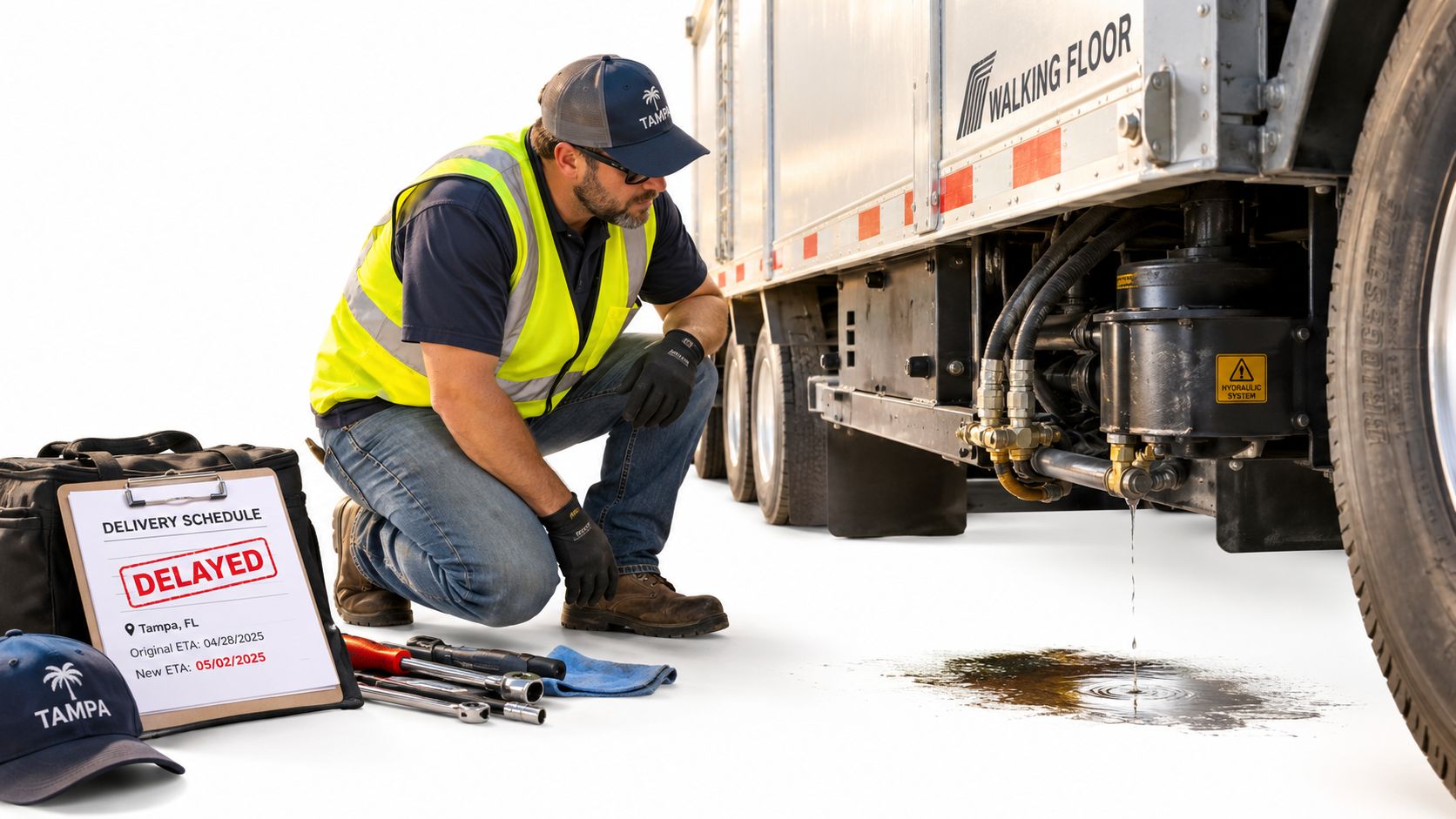
A Tampa fleet manager can lose a full route before the first delivery when a Walking Floor trailer starts leaking hydraulic fluid or an aluminum crack opens under load. The driver may still be able to move the unit, but unloading becomes uneven, a safety defect may go unreported, and the maintenance team suddenly has to find a shop that understands both the equipment and the paperwork that follows the repair.
That pressure is familiar to waste, recycling, aggregate, construction, and regional freight operators. Commercial trailer repair in Tampa isn't only about getting a damaged unit back on the road. It also means diagnosing the actual failure, protecting the next route, and producing records that show what was inspected, corrected, and approved for service.
Table of Contents
- The High Cost of Unexpected Trailer Downtime
- Core Repair and Maintenance Services for Commercial Trailers
- Understanding Common Commercial Trailer Failure Modes
- The Fleet Advantage of Local Direct-Shop Repair
- Preventive Maintenance and Documentation Strategies
- Ensuring Durable Aluminum Welding and Structural Repairs
The High Cost of Unexpected Trailer Downtime
A Walking Floor trailer breaks down at the worst possible point, usually loaded, away from the yard, and tied to a delivery window that can't move. A hydraulic leak may leave the floor cycling slowly or not at all. A structural crack can grow under repeated loading, while the driver and dispatcher debate whether the unit can safely continue.
The immediate problem is mechanical. The business consequences arrive next. A delayed delivery can disrupt a receiving schedule, leave a tractor and driver idle, and force a fleet manager to coordinate towing, parts, diagnosis, and documentation at the same time. If the defect affects a safety system, continuing to dispatch the trailer can also create exposure during a roadside inspection.
Tampa freight creates constant equipment pressure
Tampa Bay's logistics economy gives this problem a local dimension. The Tampa metropolitan area contains more than 2,600 distribution and logistics establishments employing over 51,000 people, and the sector's employment grew by more than 54% over the five-year period measured in the Tampa Bay Economic Development Council's 2024 distribution and logistics industry profile. That activity supports trucks and trailers moving freight, construction materials, waste, recycling loads, and aggregate throughout the region.
A larger logistics base generally means more equipment operating on demanding schedules. Preventive maintenance, rapid diagnostics, parts access, structural repair, and minimized downtime therefore have direct operational value. The invoice is only one part of a breakdown. True cost also includes missed delivery windows, disrupted routes, idle labor, and the possibility that a questionable unit reaches the road before a proper inspection.
Practical rule: A trailer that can move isn't automatically a trailer that's ready to dispatch. Confirm the defect, repair it properly, and document the release decision.
The reliable response starts before the emergency. Fleet managers should know which shop can evaluate Walking Floor hydraulics, repair aluminum structures, inspect brakes, and identify the parts required without sending the unit through several intermediaries. A direct repair relationship doesn't eliminate every delay, but it reduces the time lost explaining the same symptom to multiple people.
For Tampa operators, the right partner is one that understands the equipment's working environment. Waste and recycling trailers deal with contamination and impact. Aggregate equipment sees abrasion, dust, and heavy loading. Regional freight trailers accumulate wear through repeated loading, coupling, braking, and road vibration. Those conditions demand more than a generic visual check.
Core Repair and Maintenance Services for Commercial Trailers
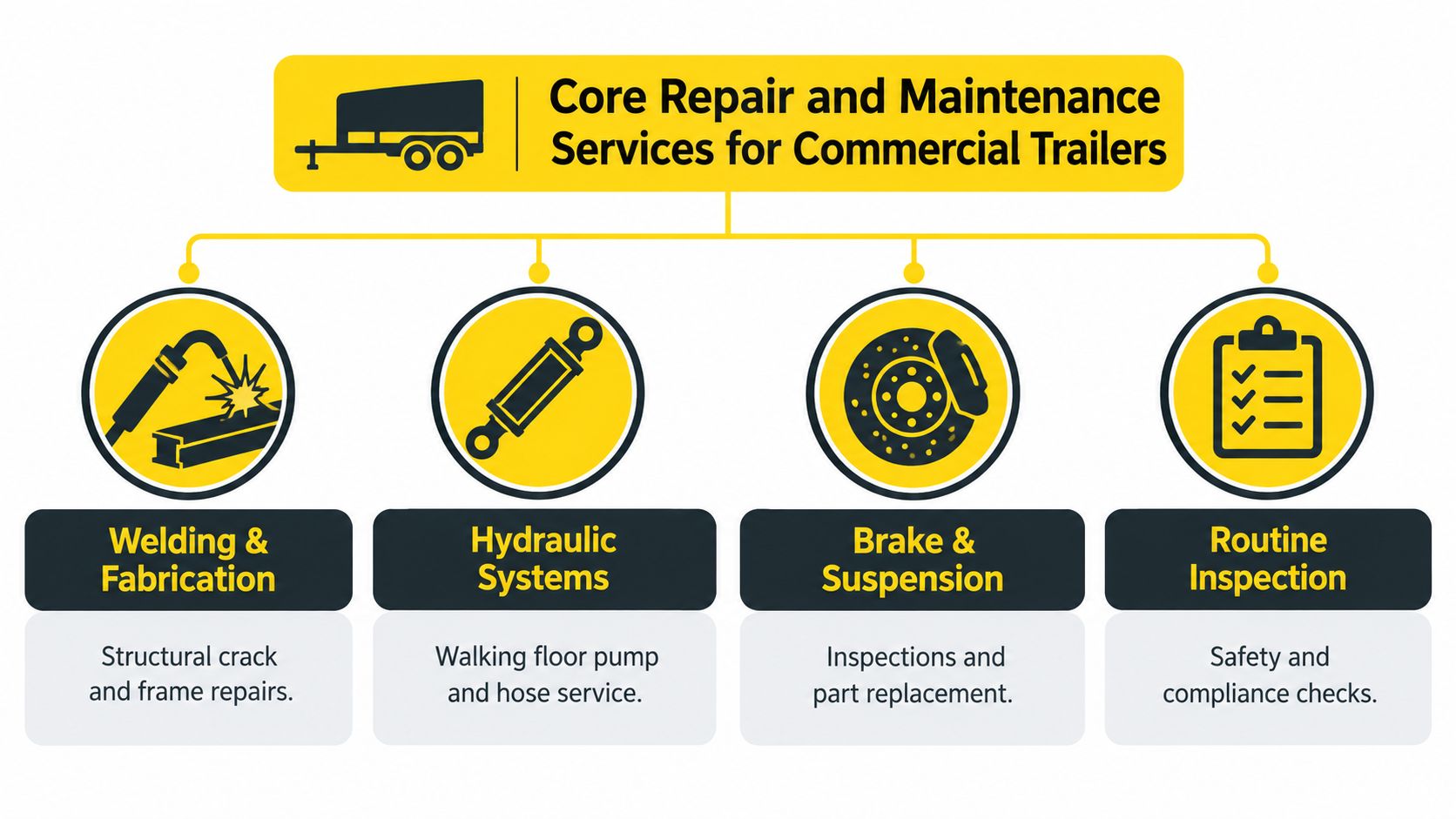
Commercial trailer maintenance works best when the technician treats the trailer as a connected system. A Walking Floor fault can involve hydraulic supply, controls, slats, fasteners, or mechanical resistance. An aluminum crack may be a local defect, or it may point to corrosion, impact, poor fit-up, or repeated flexing around the repair area.
Walking Floor diagnostics and repair
Hydraulic troubleshooting should begin with a controlled safety and performance check, not automatic component replacement. The KEITH RUNNING FLOOR II DX/DXE guidance requires the hydraulic power source to stay within specified pressure and flow ratings, use a relief valve, and follow lockout/tagout before maintenance. Technicians should inspect for leaks and monitor hydraulic oil temperature. Section 1.1.6.2 of the referenced KEITH RUNNING FLOOR II DX/DXE owner/operator manual sets a maximum oil temperature of 140°F (60°C); this is an oil-temperature limit for that system, not a temperature limit for every individual component. For other floor models and wet-kit configurations, use the applicable manufacturer's limits and cooling procedure.
That sequence matters. Excessive pressure or flow can accelerate wear in seals, hoses, valves, and drive components. Localized heat can indicate restriction, internal leakage, inadequate cooling, or an overloaded circuit. Comparing pressure, flow, temperature, and cycle behavior helps separate a hydraulic supply fault from worn slats, mechanical binding, or a control-valve problem.
Walking Floor service can include hydraulic diagnosis, hose and fitting inspection, slat replacement, preventive maintenance, and performance checks. The useful outcome isn't just a floor that moves in the shop. It should cycle smoothly under representative conditions without abnormal noise, leakage, or heat buildup.
Aluminum welding and fabrication
Aluminum repairs require control over preparation, fit-up, and the surrounding material. Structural cracks, damaged body panels, and corrosion-affected sections need an assessment that goes beyond closing the visible opening. A sound repair restores serviceability and accounts for how the trailer will flex, carry loads, and encounter road spray or abrasive materials.
Precision aluminum welding and custom fabrication are particularly relevant to fleets that can't afford repeated patchwork. The repair method must suit the material and the location. A poorly matched section or overheated repair can leave the trailer looking finished while weakening the area around the weld.
Brakes, inspections, and routine maintenance
Routine truck and trailer maintenance includes oil and fluid service, brake inspections, engine diagnostics, suspension checks, and roadworthiness inspections. Brake work deserves special attention because the technician must evaluate the complete system, including air lines, couplings, actuators, slack adjusters, linings, drums, rotors, pads, emergency functions, and breakaway operation.
An on-hand parts inventory can reduce the gap between diagnosis and repair. Fleet teams can also use the commercial truck and trailer parts catalog to identify components and support repair planning. Parts availability doesn't replace diagnosis, but it can prevent a known defect from becoming a second scheduling problem.
Understanding Common Commercial Trailer Failure Modes
The most expensive trailer failures usually announce themselves before they stop the route. A driver notices a wet hydraulic connection, a slower unloading cycle, a slat that doesn't sit correctly, a new noise, or a crack that changes shape under load. The maintenance decision is whether to investigate that symptom now or accept a larger failure later.
Walking Floor symptoms need isolation
A leak around a cylinder, pressure tube, return tube, switching valve, check valve, or quick-disconnect fitting points toward a hydraulic inspection. Retightening a fitting may resolve a straightforward leak, but fluid loss can also indicate damaged components or a larger system problem. A technician should compare the system's behavior under operating conditions rather than replacing the pump based only on a slow cycle.
Uneven unloading has several possible causes. Bent or displaced slats, loose fasteners, contamination, mechanical binding, a control-valve fault, and inconsistent hydraulic supply can produce similar complaints. The useful diagnostic question is not “Which part usually fails?” but “Which measured condition changes when the symptom appears?”
Excess heat deserves the same discipline. Heat at one component can indicate restriction or internal leakage, while broad temperature rise may point to an overloaded circuit or cooling problem. Repeated operation above the manufacturer's stated limit can shorten the life of seals, hoses, valves, and drive components.
Aluminum damage is rarely only cosmetic
A crack in an aluminum panel or structural section may result from impact, corrosion, vibration, or repeated flexing. Grinding the crack and filling it without evaluating the surrounding alloy can create a repair that fails beside the original weld. Corrosion under a panel or around a fastener may also reduce the quality of the material available for a durable repair.
Federal inspection data shows why fleets can't treat these symptoms as minor. Table 2-4 in the FMCSA 2022 Pocket Guide reports 1,962,737 vehicle inspections in 2021, including 420,136 inspections with an out-of-service violation, for a 21.4% vehicle out-of-service rate. The year 2022 identifies the guide's edition; these inspection figures are for 2021. The table includes large trucks and buses, so these are national commercial-vehicle figures, not trailer-only statistics or Tampa shop results. They provide context for the operating environment local fleets face.
A recurring defect is a maintenance decision, not a dispatch preference. If the cause isn't identified, the trailer hasn't been repaired.
The Fleet Advantage of Local Direct-Shop Repair
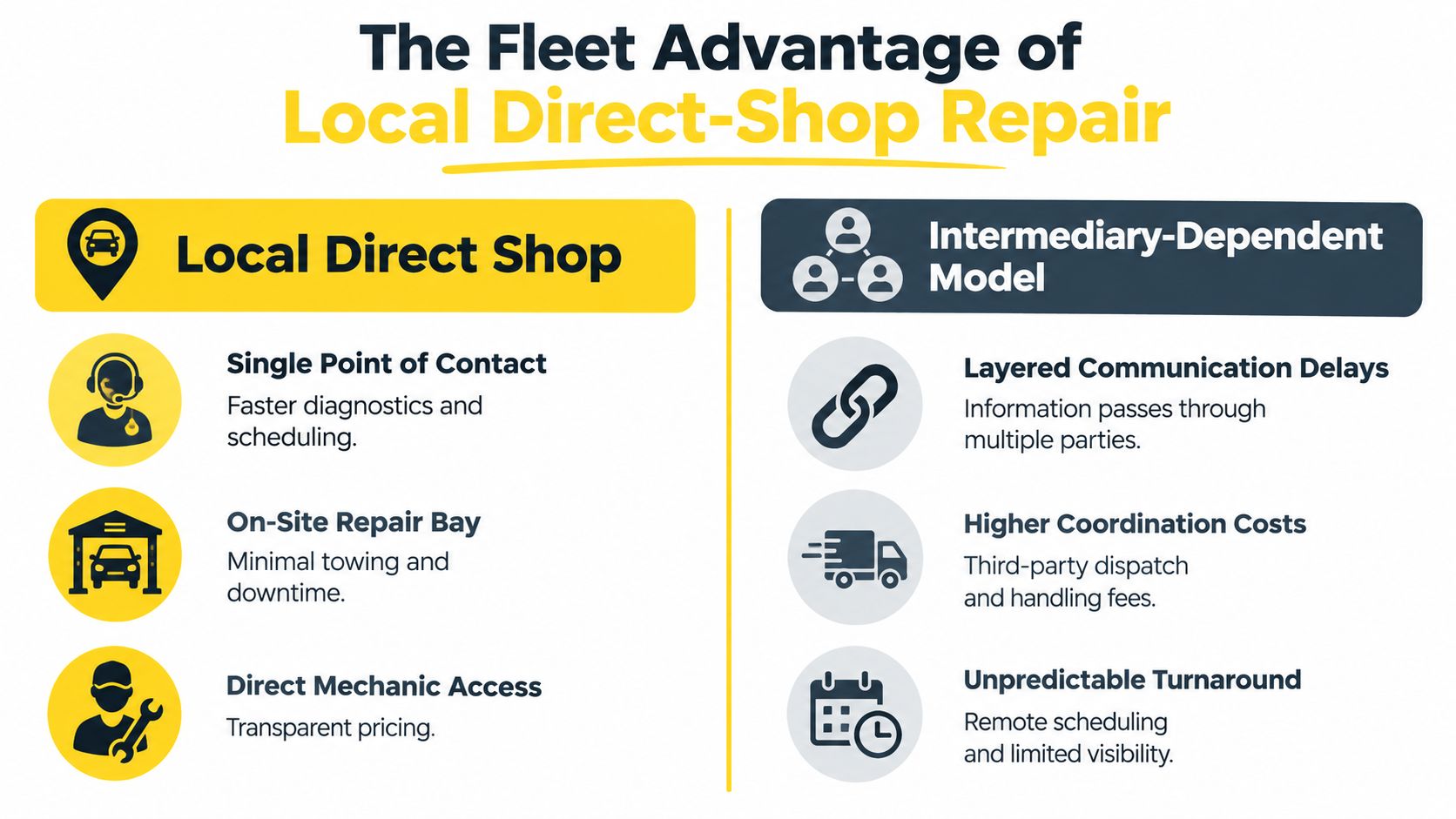
A direct local workshop and an intermediary-dependent model can both arrange repairs, but they don't produce the same communication path. In a direct model, the fleet manager can describe the symptom to the shop, the technician can inspect the unit, and the repair order can reflect the actual findings. With several parties involved, details can be reduced to “hydraulic issue” or “aluminum damage” before the technician sees the trailer.
Compare the working realities
| Local direct shop | Intermediary-dependent model |
|---|---|
| One point of contact for scheduling and diagnosis | Information passes through multiple parties |
| Technicians can discuss symptoms and findings directly | Drivers and mechanics may receive incomplete descriptions |
| On-site parts inventory can support faster repair planning | Parts approval and sourcing may add another delay |
| Shop records can be aligned with the actual work performed | Documentation may arrive separately or lack technical detail |
The advantage isn't a promise that every repair will be completed immediately. Complex structural or hydraulic work still takes proper inspection and testing. The advantage is a shorter decision path, which helps a fleet decide whether to repair, monitor, tow, or remove the unit from service.
Direct access also improves the record
FMCSA requires carriers to systematically inspect, repair, and maintain every commercial motor vehicle under their control, including trailers and safety-related systems such as frames, suspension, axles, wheels, and steering. Carriers must retain inspection, repair, and maintenance records for one year at the vehicle's maintenance location and for six months after the vehicle leaves their control, according to the FMCSA maintenance record guidance.
That makes the repair order part of fleet control. It should identify the unit, describe the defect, record the inspection performed, list parts installed, distinguish corrected defects from monitor-only conditions, and state whether the trailer was safe to return to service. Bilingual communication and public project documentation can also help diverse teams preserve the same information across drivers, dispatchers, and maintenance staff.
The direct workshop model used by Brothers Truck Trailer Repair and Welding Corp. connects scheduling, diagnosis, repair, parts, and documentation through one shop relationship. For a fleet manager, that continuity is often more useful than a broad service list that still leaves the actual repair split among unrelated providers.
Preventive Maintenance and Documentation Strategies
Preventive maintenance fails when it becomes a vague calendar reminder. A useful program assigns a specific inspection, a responsible person, a decision threshold, and a record. That approach catches developing faults while giving the next technician enough history to avoid repeating the same diagnostic work.
Inspect the whole Walking Floor system
The KEITH Running Floor II owner's manual calls for more than a visual check of the floor surface. Operators should inspect for hydraulic leaks around the cylinders, pressure and return hydraulic tubes, switching valve, check valves, and quick-disconnect fitting. Leaking fittings should be retightened, and the system should be cycled in both loading and unloading modes.
The same inspection should look for loose or bent slats displaced by impact, verify barrel-clamp and floor-bolt torque, and confirm that the floor operates smoothly. The manual recommends pressure-washing the drive unit, sub-deck, and slats at least twice per year, or quarterly when possible, as stated in the KEITH Running Floor II owner's manual.
A practical checklist can follow this order:
- Record the symptom: Note whether the floor is slow, uneven, noisy, leaking, or unable to complete a cycle.
- Secure the equipment: Use lockout/tagout before maintenance and prevent unexpected movement.
- Inspect supply and return circuits: Check fittings, hoses, tubes, valves, fluid condition, and visible contamination.
- Cycle the floor safely: Test loading and unloading operation after the initial inspection.
- Check mechanical movement: Look for bent or loose slats, fastener issues, and binding.
- Document the result: Record measurements, parts, corrective action, remaining concerns, and release status.
Make the work order audit-ready
A repair record should be specific enough that another person can understand the unit's condition without calling the original technician. Request a VIN- or unit-specific work order that includes:
- Defect description: Capture the driver's complaint and the technician's confirmed finding separately.
- Inspection points: List the hydraulic, structural, brake, lighting, suspension, or coupling areas examined.
- Parts detail: Identify installed components and note whether a part was adjusted, repaired, or replaced.
- Evidence: Attach photographs of cracks, leaks, damaged slats, worn brake components, or corrected fittings when appropriate.
- Disposition: Mark defects as corrected, monitor-only, or not safe to operate.
- Release status: State the post-repair test and whether the trailer was approved for return to service.
The maintenance team should reconcile that work order with driver inspection reports and annual inspection records. FMCSA guidance requires each commercial vehicle segment, including the tractor, semitrailer, full trailer, and converter dolly where applicable, to receive a periodic inspection at least every 12 months, with records retained for 14 months, as described in the FMCSA inspection and maintenance requirements.
Documentation standard: If the record doesn't show what was checked, what was fixed, and whether the unit was safe to dispatch, it isn't finished from a fleet-control perspective.
The Spanish-language maintenance resources from Brothers Truck Trailer Repair and Welding Corp. can also support communication with multilingual operators. The important point isn't the language of the form. It's that every person handling the trailer receives the same technical and dispatch information.
Ensuring Durable Aluminum Welding and Structural Repairs
Aluminum trailer repair is a material decision before it's a welding decision. The visible crack tells the technician where the failure appeared, but not necessarily why it appeared or how far the affected area extends. A durable repair starts by identifying the base material, examining corrosion and heat-affected areas, and considering the trailer's working environment.
The American Public Transportation Association's aluminum guidance identifies 5xxx- and 6xxx-series aluminum alloys as having good resistance to atmospheric corrosion and notes that 6000-series alloys have good resistance to stress-corrosion cracking. That information doesn't eliminate the need to identify the specific alloy in the trailer. It explains why alloy behavior must inform the repair method.
Appearance is a poor release criterion
A weld can look clean and still be a weak repair if the surrounding metal is corroded, overheated, contaminated, or poorly fitted. The technician needs to evaluate the base alloy and service environment before choosing how to prepare, fit, weld, and control the repaired area.
Waste materials, aggregate dust, road spray, and repeated flexing place different demands on a trailer. A body panel repair may need to resist abrasion and vibration. A structural fabrication may need careful alignment and reinforcement. A crack near a high-stress area may require examination beyond the visible opening so the repair doesn't transfer the failure into adjacent material.
Build the repair around service conditions
The practical sequence is straightforward:
- Identify the material: Determine the base alloy where possible before selecting filler and welding procedures.
- Remove compromised material: Prepare beyond the visible crack or corrosion when inspection shows the surrounding section has lost integrity.
- Control fit-up: Align replacement material so the repaired structure doesn't carry unintended stress.
- Protect the repaired area: Account for exposure to moisture, waste, aggregate, and repeated movement.
- Test before release: Confirm that the repaired panel or structure functions as intended and that no related defect remains.
Aluminum welding, fabrication, and compliance come together here. A repair that restores appearance but ignores material integrity can create repeat downtime. A repair that records the defect, alloy considerations, affected area, work performed, and post-repair condition gives the fleet a more defensible maintenance history.
For Tampa operators, the value of a specialized trailer workshop isn't limited to having welding equipment. It lies in matching the repair to the trailer's load, environment, and failure pattern, then returning a record that helps the maintenance team make the next dispatch decision.
Brothers Truck Trailer Repair and Welding Corp. provides Walking Floor diagnostics and repair, aluminum welding and fabrication, brake and maintenance inspections, structural trailer repair, and parts support for Tampa-area commercial operators. Visit Brothers Truck Trailer Repair and Welding Corp. to discuss a repair that needs both sound workmanship and clear return-to-service documentation.
Preventive maintenance for commercial trailers: inspection checklists, Walking Floor care, aluminum repairs, and fleet service in Tampa Bay.
Master walking floor trailer hydraulic troubleshooting with expert diagnostics, safety protocols, and repair strategies to minimize fleet downtime.
Source the right folding wagon replacement parts with our fitment guide. Learn to measure frames, match wheel brackets, and verify tube dimensions.