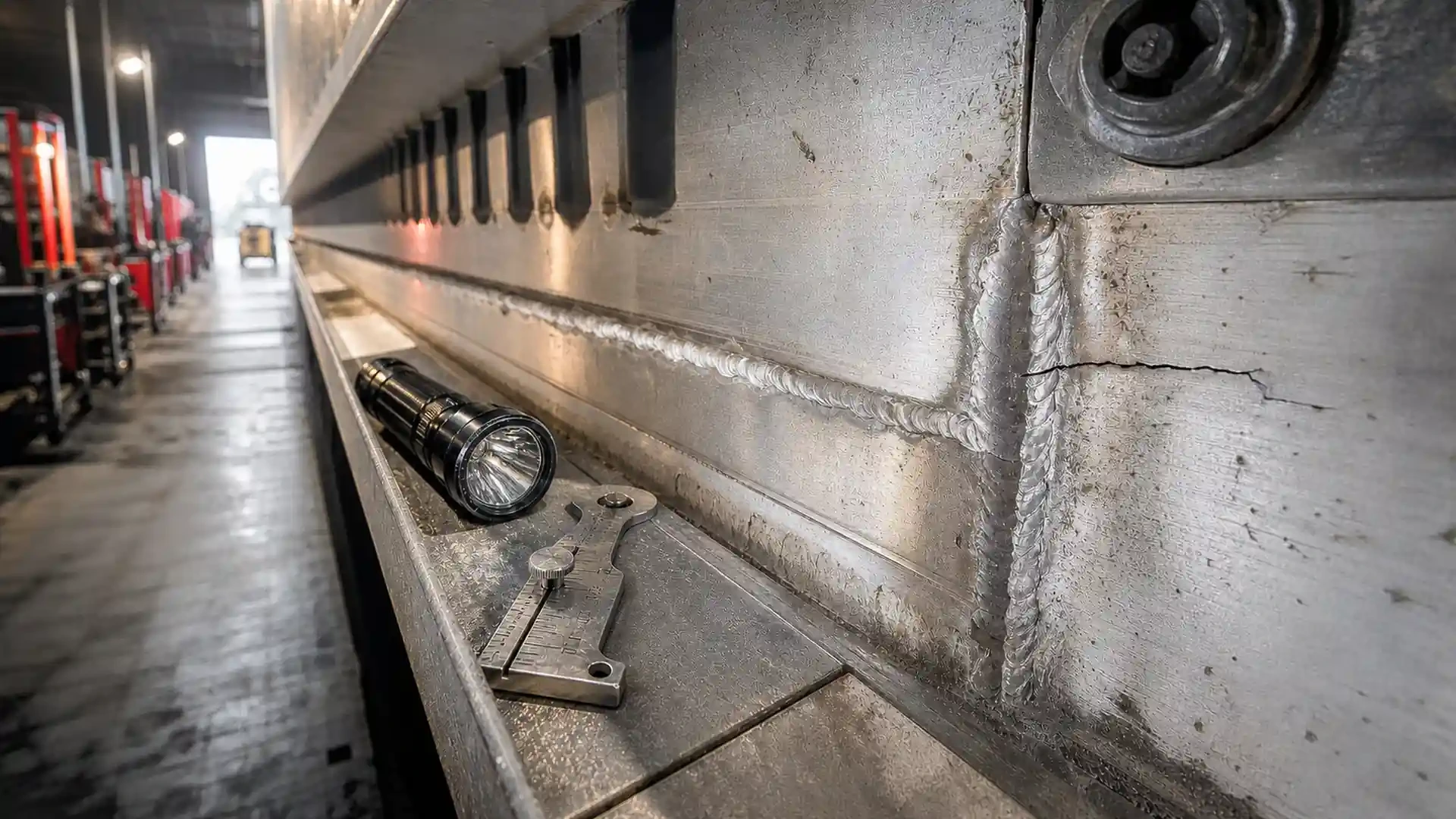
Aluminum cracks on a Walking Floor trailer: what to check before welding
An aluminum crack on a Walking Floor trailer is more than a cosmetic issue. Its location, direction and surrounding condition can reveal whether the damage came from impact, repeated movement, misalignment, concentrated load or another source of stress.
The crack may require welding, but welding should follow an inspection—not replace one. A repair that closes the visible opening without addressing the condition that produced it may leave the trailer vulnerable to recurring damage.
Why the cause of the crack matters
Walking Floor trailers combine moving floor components, hydraulic force, cargo load and an aluminum structure. Those systems interact. A crack can appear where the material has been hit, where two parts are rubbing or where repeated flexing concentrates stress.
Before choosing a repair method, the shop should answer questions such as:
Is the crack in a floor slat, side panel, support or another structural area?
Is the surrounding aluminum straight or visibly deformed?
Does the crack open or change while the floor operates?
Are there new rubbing marks or signs of misalignment?
Did the symptom appear after an impact, a difficult load or a previous repair?
Is hydraulic or mechanical resistance adding stress to the area?
The answers help define the scope of the inspection and reduce the chance of treating only the visible symptom.
Warning signs that deserve prompt attention
The crack is growing or branching
A line that becomes longer, develops branches or reappears after an earlier repair should be inspected. Its changing shape can indicate that the area remains under stress.
The floor is no longer moving smoothly
Irregular, slow or jerking movement may occur alongside structural damage. The floor should be evaluated as a complete system so the welding repair and the movement problem are not treated as unrelated issues.
A slat or panel has changed position
A raised edge, sunken area, wider gap or new contact point can affect alignment. Even when the crack seems small, visible deformation around it may require a broader repair plan.
You see fresh rubbing or metallic debris
New polished marks, scraping or metal particles can indicate contact between components. The source of that contact should be identified before the area is welded and returned to operation.
The damage is close to a loaded or moving area
Cracks near supports, joints, moving floor sections or areas that repeatedly carry load deserve professional evaluation. The correct response depends on the exact location and construction of the trailer.
What to document before bringing the trailer to the shop
If the trailer can be observed safely, collect information that helps the technician understand the history of the damage.
Take clear photos
Capture one close image of the crack and one wider image that shows its position on the trailer. Include surrounding edges, fasteners, joints or floor sections so the location is easy to understand.
Record when you first noticed it
Note whether the crack appeared after an impact, during unloading, after a change in cargo or during routine inspection. If it has changed over time, describe how.
Describe the operating symptom
Explain whether the Walking Floor still moves normally. Mention hesitation, noise, vibration, rubbing, leaking or a section that is no longer aligned.
Identify recent work
Provide information about recent welding, floor replacement, hydraulic repair or component service near the damaged area. Previous work may help explain the repair history.
Note the cargo and operating conditions
The type of cargo and the conditions in which the symptom appears can help a shop understand the forces acting on the trailer. Keep the description factual; the goal is to support diagnosis, not assign blame.
What a professional inspection may evaluate
A complete inspection can include more than the crack itself. Depending on the location, the shop may review:
The length, direction and surrounding condition of the crack.
Deformation, impact marks and nearby rubbing.
Alignment of floor slats and adjacent components.
Bearings, guides or supports associated with the damaged area.
Hydraulic movement that may be contributing to resistance.
Earlier welds or modifications near the crack.
Access needed to prepare and complete the repair correctly.
The inspection determines whether the job is a localized welding repair or part of a larger correction involving alignment, floor components or another source of stress.
Why “just weld it” can be the wrong starting point
Welding addresses damaged metal. It does not automatically correct a binding slat, worn bearing, misaligned component or hydraulic issue. If the source of repeated stress remains, the repaired area or a nearby area may be affected again.
This is why diagnosis and welding belong in the same conversation. The repair plan should consider how the Walking Floor moves before the trailer returns to normal service.
What not to do after finding a crack
Do not continue repeated floor cycles simply to see whether the crack changes.
Do not grind away the area before the shop can inspect the original damage.
Do not attempt welding without appropriate training, equipment and knowledge of the structure.
Do not assume the smallest visible crack is the full extent of the problem.
Do not order a replacement component based only on appearance; confirm configuration and fit first.
These precautions preserve useful diagnostic information and help prevent additional damage or an incorrect parts decision.
Walking Floor aluminum welding in Tampa
Brothers Truck Trailer Repair and Welding Corp. provides Walking Floor repair, aluminum welding, structural service and component support from its Tampa workshop. The team can evaluate the visible crack together with floor movement, hydraulic symptoms and nearby components.
If you have found a crack, deformation or rubbing near your Walking Floor, request an inspection before scheduling a stand-alone weld. Call Brothers Truck Trailer or visit 1620 S 51st St, Tampa, FL 33619.

Expert commercial trailer repair in Tampa for Walking Floor, aluminum welding, and fleet maintenance. Minimize downtime with Brothers Truck Trailer Repair.
Preventive maintenance for commercial trailers: inspection checklists, Walking Floor care, aluminum repairs, and fleet service in Tampa Bay.
Master walking floor trailer hydraulic troubleshooting with expert diagnostics, safety protocols, and repair strategies to minimize fleet downtime.