
Welding Fab Shops: How Fleets Choose the Right Repair Shop
Your Walking Floor trailer is unloading unevenly, there's hydraulic oil beneath the drive unit, and dispatch needs to know whether it can take the next load. You've also found a crack near a repaired crossmember. Calling someone who can weld is easy. Finding a shop that can diagnose the system, obtain the right parts, verify the structural repair, and give you a credible release date takes more work.
For commercial fleets, choosing among welding fab shops is a downtime and repair-verification decision. The right shop needs to understand what failed, what carries load, and what evidence you'll need before putting the unit back into service. A low welding quote doesn't answer those questions.
Table of Contents
- Types of Welding and Fabrication Shops Compared
- Aluminum and Structural Services a Fleet Should Expect
- Walking Floor and Specialized Trailer Repair Checks
- How to Verify Structural Aluminum Repairs Before Return to Service
- Turnaround, Parts Stock and the Cost of Downtime
- Selection Criteria and How to Book the Right Shop
Types of Welding and Fabrication Shops Compared
Which shop type fits the unit's problem? Start there, because “welding shop” covers businesses with very different equipment, workflows, and access requirements. A shop that makes excellent production brackets may have no practical way to accommodate a complete trailer.
Welding joins metal; fabrication also includes measuring, cutting, forming, fitting, and assembling it. Fleet repairs often require both, plus mechanical diagnosis. Replacing a cracked support without correcting its fit or the force acting on it can leave the original problem unresolved.
Shop types, best-fit work and main limits
| Shop type | Core work | Best fit for fleets | Typical limit |
|---|---|---|---|
| General fabrication shop | Custom brackets, mounts and one-off parts | Equipment mounts and replacement parts | Confirm aluminum and floor-system experience |
| Structural steel fabricator | Beams, columns and plates for buildings and bridges | Large construction-related projects | Often not set up for small trailer repairs |
| Mobile welding service | On-site welding and minor repairs | Units stuck at a yard or job site | Work limited to what the van and power supply allow |
| Truck and trailer repair shop | Frame, body, floor and hydraulic repair | Units that must return to service quickly | Bay space and parts stock constrain capacity |
| Aluminum specialty shop | Trailer bodies, tanks and panels in aluminum | Aluminum trailers and dry vans | Specialty availability can be limited; confirm alloy and procedure qualifications |
| Production welding shop | Repeat OEM parts at volume | Standard parts in large runs | Low flexibility for single repair jobs |
Read the table by matching the whole job, not just the metal. An equipment mount might suit a general fabricator. A damaged Walking Floor support with a hydraulic fault needs someone who can evaluate the floor mechanism as well as the attachment.
Mobile work can avoid transporting a disabled unit, but access, weather protection, safe isolation, and available power still govern what's practical. Conversely, a well-equipped structural steel facility isn't automatically a suitable destination for a trailer that needs floor disassembly.
Confirm the shop's stated equipment and bay access before moving the unit. Describe whether the repair requires access underneath, removal of slats, or support of a loaded assembly. Don't assume a large building means the correct lifting equipment is available.
Practical rule: Keep a primary repair shop for structural and floor-system work, plus a qualified backup for overflow. Few shops do every kind of fabrication equally well.
Aluminum and Structural Services a Fleet Should Expect
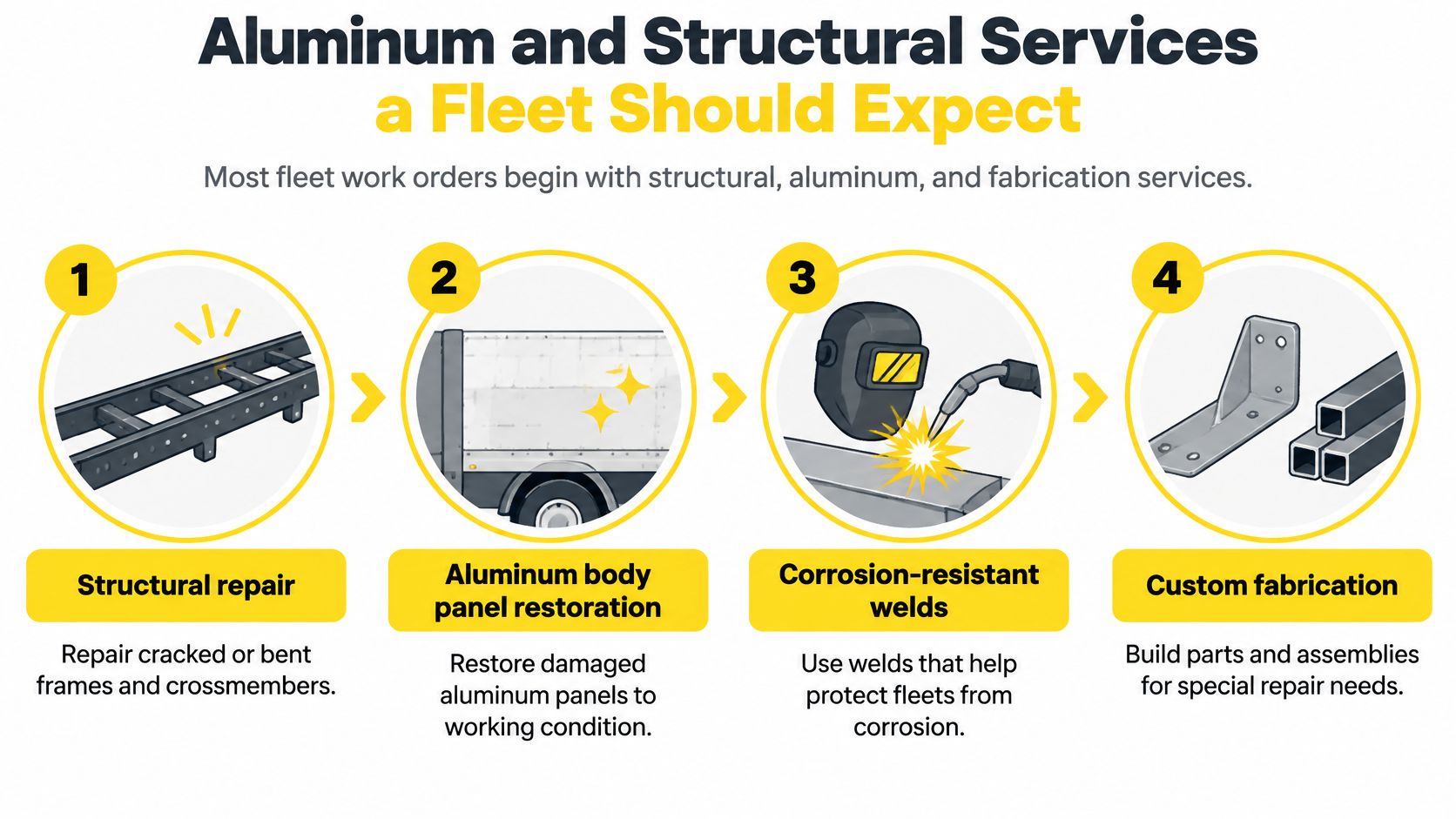
Fleet work orders commonly involve cracked or bent frames and crossmembers, damaged aluminum body panels, corrosion-resistant welds, custom brackets or supports, and component replacement connected to the repair. Those descriptions sound straightforward, but the shop first needs to decide whether it's restoring appearance, containing material, or restoring a load-carrying assembly.
A cosmetic panel patch and a structural crossmember repair shouldn't receive the same repair plan. The latter requires closer attention to material identification, joint geometry, alignment, and how the repaired member transfers force into adjacent components.
The service path below separates the main types of work without treating them as interchangeable.
Why aluminum preparation matters
Aluminum's oxide layer and surface moisture require deliberate contamination control. The American Welding Society's guide to aluminum welds explains that moisture associated with the oxide can produce porosity, and describes solvent cleaning followed by a clean stainless-steel brush reserved for aluminum. It also describes inert shielding gases, commonly 100% argon. Set the extent of weld-zone preparation from the applicable welding procedure, alloy and joint condition.
During welding, that moisture can release gas into the molten pool. Trapped pores reduce the effective metal section and can become leak paths or fatigue-initiation sites. That's why surface preparation belongs in the repair plan, not merely in the welder's personal routine.
Use this sequence when discussing the work:
Degrease the joint with acetone. Remove oil and other residues before mechanical cleaning. Follow solvent safety precautions and let the surface dry before welding.
Brush the joint with a stainless-steel brush reserved for aluminum. A brush shared with steel work can introduce contamination.
Clean the surrounding weld zone to the specified extent, and clean the filler wire. Preparing only the visible crack leaves nearby contamination available to enter the joint.
Protect the prepared area. Keep dirty gloves, oily rags, grinding debris, and moisture away until welding begins.
Shield the molten pool with the selected inert gas. Check gas delivery and drafts rather than assuming a connected cylinder guarantees effective coverage.
Record the alloy, filler selection, shielding gas, cleaning method, and pre-weld condition.
Gas and filler choices aren't interchangeable
Helium can provide deeper, wider penetration and may help reduce porosity in thicker sections. Larger-diameter filler can also reduce contamination exposure relative to the amount of metal deposited. Neither choice replaces correct preparation or a suitable welding procedure.
Corrosion resistance likewise isn't something a bead guarantees by itself. The repair needs compatible materials, appropriate finishing, and attention to joints that retain water or debris.
Before authorizing structural aluminum work, ask for the preparation sequence in writing. A clear answer should describe the actual controls the shop will use, not just promise a clean-looking weld.
Walking Floor and Specialized Trailer Repair Checks
A trailer arrives unloading unevenly, with a hydraulic leak and a bent slat. A shop can replace the slat in an afternoon and still send the unit back with the cause untouched. A walking floor works like a conveyor built into the trailer: the slats carry the load, the cylinders drive the movement, and the hydraulic system supplies the force. Symptoms point to a subsystem, not to a diagnosis.
Track operating hours as well as calendar time before the next Walking Floor service. These systems use moving slats and hydraulic cylinders to unload material, so a trailer can reach a service trigger through intensive operation even when its last appointment does not seem long ago. A low-mileage trailer on short hauls can accumulate more floor cycles than a long-haul unit.
Uneven unloading, hydraulic leaks, and loose or bent slats are useful symptoms, but they are not diagnoses. The shop needs to establish whether the fault comes from the hydraulic drive, damaged flooring, structural movement, or a combination. That distinction sets the repair scope and the downtime. Put the shop's diagnosis time and parts lead time into the same downtime calculation you use for lost hauling hours. A quick repair that leaves the cause in place can cost more than a longer repair that fixes it once.
Walking Floor inspection intervals and reference values
The KEITH WALKING FLOOR Workhorse owner's manual, English version 002, June 2008, marked updated 1.7.11, gives the following references in its section 6 maintenance procedure: an initial check after 6 operating hours, then every 6 months or 150 operating hours, whichever comes first. This is a Workhorse example, not a schedule or torque chart for every KEITH drive or trailer. Verify the actual unit, fastener application, current manual revision and service procedure before using any value below.
| Check | Interval or limit | Reference value | Action |
|---|---|---|---|
| Initial maintenance check | After 6 hours of operation | Initial operating-hours trigger | Inspect structure, hydraulics, floor movement and heat |
| Scheduled service | Every 6 months or 150 operating hours, whichever comes first | Earlier trigger controls | Full inspection and filter replacement |
| Component temperature | During operation | Maximum 70°C | Measure with an infrared or contact thermometer; investigate if higher |
| Hydraulic return filter | At each scheduled service | Replace during scheduled service | Replace |
| Pressure-line filter, optional | At scheduled service if fitted | 20-micron | Service with the system |
| Cylinder-clamp bolts | At inspection | 170 Nm | Retorque to specification |
| Cylinder-to-frame bolts | At inspection | 200 Nm | Retorque to specification |
Treat these as manual-specific references, not universal settings for every moving-floor installation. Confirm the manufacturer, system version, fastener application, and applicable manual before applying torque. Use an infrared thermometer or a contact probe to check component temperature, and let the system cool before service. Do not use bare-hand contact to judge whether a component is safe to touch.
A separate reference, the KEITH Running Floor II owner's manual, DOC06276 Rev C, revised May 19, 2019, gives approximately 3,000 loads as a general slat rotation or replacement guide, with timing affected by the material carried. Its slat-wear wording is ambiguous, so no numerical wear limit is recommended here. Confirm the installed slat profile, measurement location and applicable wear or rotation criterion with the manufacturer before deciding to rotate or replace flooring. Do not combine this guide with the Workhorse torque references above.
| Check | Interval or limit | Reference value | Action |
|---|---|---|---|
| Slat rotation or replacement | About every 3,000 loads | General load-count guide | Rotate or replace flooring |
| Slat wear limit | At each slat check | Manufacturer-confirmed criterion for the installed slat profile | Measure and obtain the applicable rotation or replacement decision |
| Pressure washing | At least twice yearly, quarterly when possible | Drive unit, sub-deck and slats | Wash listed assemblies |
| Slat top cleaning and sealing | Every six months | Top surfaces of slats | Clean and seal |
Turn the references into a usable maintenance record
Keep the trailer identification, system model, service date, operating hours, and load count together. Record the condition found, the work performed, and the next trigger. “Floor serviced” is not a record. It does not tell the next technician whether the hydraulic pump was tested, a cylinder was rebuilt, or a slat was rotated.
For slat wear, distinguish material lost from material remaining. Photograph the measurement location and record the original profile reference so another technician can repeat the check. Use the manufacturer's confirmed criterion for that profile rather than inferring a universal inch or percentage limit. Loose or impact-bent slats still need assessment even when the load-count guide has not been reached.
Before inspection beneath the floor, isolate power and hydraulic energy and secure moving assemblies. Do not search for pressurized hydraulic leaks with a hand. Before the unit returns to service, ask for the repair record that links the symptom to the subsystem repaired: a hydraulic pressure and flow check, a cylinder repair, a slat measurement, or a structural weld.
A shop that can describe symptoms but cannot identify the applicable service intervals may be working reactively. Ask it to name the manual and log operating hours and load counts against the service triggers before accepting the job.
How to Verify Structural Aluminum Repairs Before Return to Service
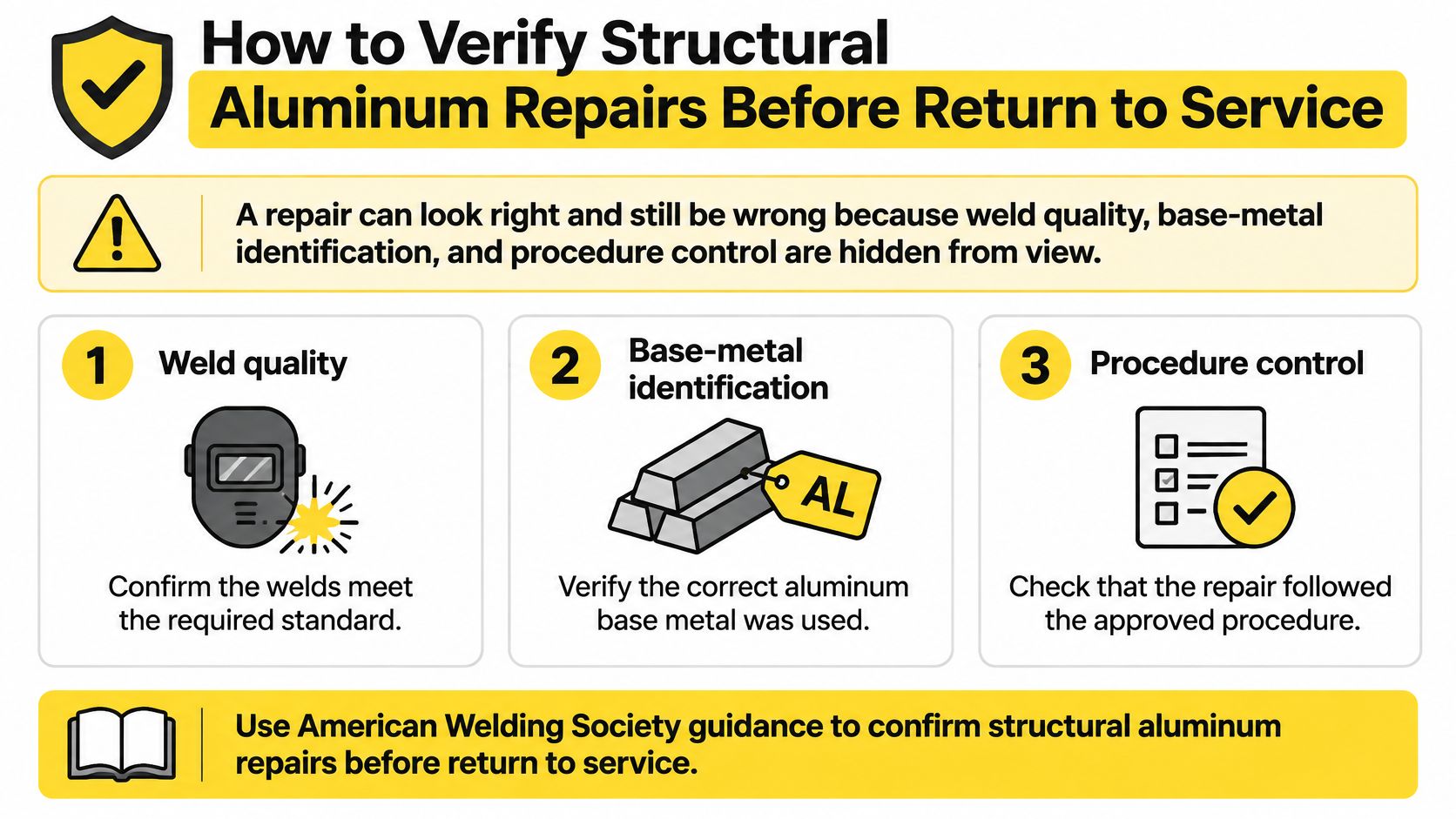
A good-looking weld can still fail. Appearance alone doesn't establish correct base metal, adequate fusion, a suitable joint design, or compliance with the procedure selected for the repair.
The American Welding Society's D1.2 aluminum structural welding code received its 2026 update, the first since 2014, and covers structures made from aluminum structural alloys while excluding pressure vessels and pressure piping. That scope matters: a shop shouldn't present a general reference to an aluminum code as proof that every repair falls within it.
Use the following verification points to frame the pickup conversation.
Match the evidence to the structural consequence
A non-load-bearing panel repair may need a relatively simple work record. A repair to a member supporting the body, floor, or operating equipment needs a documented basis for material selection, joint design, welder qualification, procedure control, and inspection. Manufacturer instructions, the applicable specification, and engineering review should determine the scope.
Ask the shop to account for adjacent conditions too. Galvanic corrosion can occur where aluminum and steel fasteners meet in a wet environment. The heat-affected zone beside the weld has experienced a thermal cycle, so evaluating only the deposited bead misses part of the repaired assembly.
A recurring crack requires more than another pass over the same location. Investigate alignment, attachment stiffness, loading, and transitions between fastened and welded joints before accepting the repair as complete.
Request this package at pickup
Material identification: The base-metal alloy and filler used, with the repaired location clearly identified.
Procedure reference: The welding procedure and joint arrangement applied to the actual repair.
Qualification reference: Evidence that the welder's qualification covers the relevant work, rather than an unrelated process or material.
Inspection findings: Photos, observed defects, corrective work, and results of any specified additional examination.
Process records: Cleaning and shielding-gas records, plus any limitations or follow-up inspection requirements.
Newer equipment and automation don't prove weld integrity on their own. As experienced welders retire or personnel change, traceable procedures help preserve the basis for a repair instead of leaving it in someone's memory.
Request the package before release, not after another failure. It supports later inspections, maintenance handoffs, and a future buyer's review of the trailer's repair history.
Turnaround, Parts Stock and the Cost of Downtime
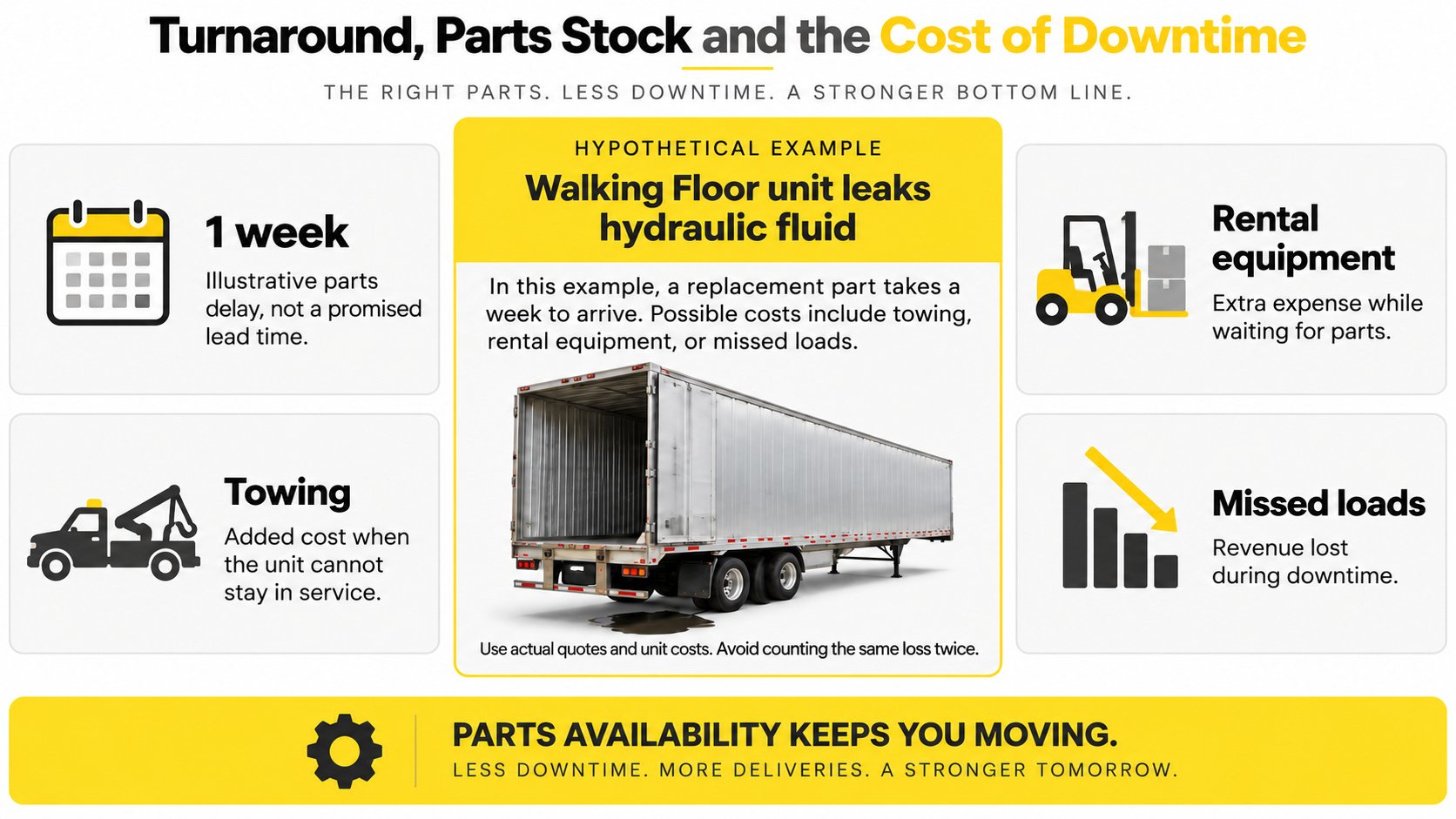
Say a Walking Floor unit develops a hydraulic leak and the required replacement part takes a week to arrive. That hypothetical delay can turn a planned component replacement into towing, rental equipment, and missed loads. The welding invoice may become only a small part of the decision.
The Motive fleet report covered by Commercial Carrier Journal says 80% of respondents identify maintenance and repair costs as a major operational challenge, 67% struggle to predict vehicles at risk of failure or unplanned downtime, and average unplanned downtime is 8.7 days per vehicle annually, with estimated lost productivity of $448 to $760 per vehicle per day.
The scenario below illustrates the cost categories, not a promised or typical parts lead time.
Price the wait separately from the repair
Truck repair and maintenance averaged 21.5 cents per mile in 2025, up 8.6% from 2024, according to ATRI figures reported by Heavy Duty Trucking. That operating-cost pressure makes planned decisions important, but your own unit economics should govern the booking.
Use this calculation:
Expected downtime cost = unavailable days × unit-specific daily loss + towing + incremental rental and expedited-parts costs.
Don't count the same loss twice. If replacement equipment preserves the load revenue, include its incremental cost rather than adding the full missed-load value as well.
Record the symptom and load condition. Note whether the fault appears loaded, empty, during startup, or throughout unloading.
Establish whether the identified part is physically available and compatible, or obtain its expected arrival date.
Estimate this unit's daily downtime cost using dispatch and accounting records.
Schedule planned service when the cost of waiting exceeds the savings from delaying it. Structural and brake safety concerns require a separate serviceability decision.
Check shelf stock, direct workshop access, same-day diagnosis availability, and a firm scheduling window. A truck and trailer parts catalog can help identify candidate components, but a listing isn't confirmation of stock or fitment.
The cheapest repair isn't necessarily the lowest-cost option. Delaying a minor component can produce total costs several times the planned service, but fast turnaround must still include inspection. A rushed repair that fails within weeks can erase the benefit of an early release.
Selection Criteria and How to Book the Right Shop
Choose welding fab shops in a clear sequence: match the problem to the shop type, establish the required technical evidence, then compare the complete schedule and parts plan. Starting with hourly rate reverses that logic. A low rate offers little value when the shop can't complete the mechanical work or document a structural repair.
Give each candidate the same information. Include the trailer identification, Walking Floor system model where applicable, photographs, previous repair details, and a description of the operating condition when the fault occurs. Tell the shop whether the affected member is known to carry load or whether that still needs assessment.
Pre-booking questions and the answers that signal a sound shop
| Criterion | Question to ask | Strong answer | Red flag |
|---|---|---|---|
| Welding qualifications | Which aluminum procedure and welder qualifications apply to this repair? | Names the procedure and provides qualification records with relevant scope | Claims certification without identifying its scope |
| Equipment | Do you weld aluminum with dedicated tools and extraction in place? | Dedicated aluminum brushes, correct process and extraction at the arc | Same brushes used for steel and aluminum |
| Bay and lift capacity | Can you fit the full unit length and lift the floor? | Confirms bay size and lift capacity in writing | Unit must be split unnecessarily or wait indefinitely for space |
| Turnaround | How many days to diagnosis and to a completed repair? | Written estimate in days with a diagnosis window and stated assumptions | No timeline or explanation of unresolved factors |
| Parts inventory | What is on hand for this make and model? | Lists stocked items and lead times for the rest | Every part requires ordering without a sourcing plan |
| Documentation | What repair record does the fleet receive? | Written record with photos, materials and inspection results | Verbal confirmation only |
Treat these answers as job-specific commitments, not a general capability brochure. A qualification record needs a relevant scope. A bay needs sufficient access around the actual unit, and a lifting arrangement needs to suit the work rather than merely raise the trailer.
Ventilation deserves a specific answer too. For ordinary repair-shop work, review the applicable general-industry provisions in OSHA 1910.252(c). The separately cited OSHA 1926.353 addresses construction work; which requirements apply depends on the activity and setting. Ask how the shop assesses and controls welding fumes, including capture near the source where appropriate, particularly inside enclosed trailer compartments, while maintaining effective shielding at the weld.
Weight the criteria by the failure
For a Walking Floor fault, hydraulic diagnosis and compatible parts access generally deserve more weight than the lowest labor quote. A shop that can weld a damaged bracket but can't determine why the drive is binding may leave you coordinating separate repairs.
For a structural aluminum repair, put qualification scope, the repair method, and inspection documentation first. The schedule matters after the shop establishes a defensible repair path. Don't trade those controls for an earlier collection date.
A qualified shop may need diagnosis before it can commit to the complete repair. That's reasonable when it identifies the unresolved condition, explains how it will investigate it, and gives you a decision point. An unexplained open-ended promise is different.
Booking standard: Accept uncertainty that's named and managed. Don't accept uncertainty hidden behind an assurance that the shop can handle anything.
Send a complete booking request
Identify the unit and fault. State the symptom, operating condition, prior repairs, and whether the affected member carries load.
Send the same written questions to at least two shops so the answers describe comparable scopes.
Book diagnosis with written authorization terms. Request an estimate, a timeline with assumptions, and the agreed repair record at pickup.
Put Brothers Truck Trailer Repair and Welding Corp. on that comparison list through our workshop website. We specialize in Walking Floor repair and maintenance, and our welders have specialized aluminum expertise. We offer Walking Floor repairs with fast turnaround times to minimize downtime, but your unit's qualifications, bay requirements, parts needs, and release schedule should still be confirmed in writing.
Don't let a business description replace the booking conversation. Send photographs and system identification before arranging transport, and ask who will authorize additional work if diagnosis uncovers a wider problem. Keep the estimate, approval, and final record under the same unit identification so maintenance and dispatch work from the same information.
Brothers Truck Trailer Repair and Welding Corp. offers Walking Floor repair and maintenance, aluminum welding, custom fabrication, and truck and trailer parts. Visit Brothers Truck Trailer Repair and Welding Corp. and send your unit's symptoms, system details, and repair photographs with the selection questions above. Ask for a written estimate, a repair timeline, and the documentation you'll receive before scheduling.

Find the right diesel truck oil change interval by engine, duty cycle and oil analysis, with manufacturer limits and real fleet practice compared.
Learn the major semi truck parts, how to match replacements using VIN, part numbers and ratings, and how to weigh part price against downtime.
Learn hydraulic cylinder repair basics for trucks and trailers: symptoms, causes, diagnostic checks, repair options and when to call a specialist.