Diesel Truck Oil Change Interval by Engine and Duty
A diesel engine's published oil-drain limit can range from 25,000 miles in severe short-haul work to 60,000 miles in light-duty operation, yet still carry a 500-hour or 12-month limit, according to Cummins X15 maintenance guidance. For vocational operators, that hour limit can matter more than the mileage figure. The right diesel truck oil change interval starts with the engine's schedule, then accounts for what the truck does in daily service while its engine runs.
Table of Contents
- Diesel Truck Oil Change Intervals at a Glance
- Why Intervals Grew From 500 Miles to 50,000
- How Duty Cycle, Engine Hours and Idling Set the Limit
- What Fleets Actually Do and What It Costs
- Using Oil Analysis Before You Extend Any Interval
- Tracking Oil Top-Ups Between Changes
- Confirm Your Interval Before the Next Drain
Diesel Truck Oil Change Intervals at a Glance
| Engine or duty case | Mileage limit | Hour or time limit | Source basis |
|---|---|---|---|
| Cummins X15, severe short-haul | 25,000 miles | 500 hours or 12 months | Cummins X15 maintenance guidance |
| Cummins X15, light-duty operation | 60,000 miles | 500 hours or 12 months | Cummins X15 maintenance guidance |
| International LT with Cummins X15 or A26, standard linehaul | 50,000 to 75,000 miles | Confirm in engine-specific OEM schedule | Repairius 2023 International LT listing |
| International LT with Cummins X15 or A26, heavier load or lower fuel economy | 30,000 to 40,000 miles | Confirm in engine-specific OEM schedule | Repairius 2023 International LT listing |
| PACCAR severe-duty vocational | 30,000 miles or 48,000 km | 800 hours or 12 months | PACCAR service bulletin |
| Euro 6 truck, severe use | 48,000 km | 800 hours | Euro 6 fleet methodology |
| Euro 6 truck, idle above 20 percent | 80,000 km | 1,500 hours | Euro 6 fleet methodology |
| Euro 6 truck, idle below 20 percent | 120,000 km | 2,250 hours | Euro 6 fleet methodology |
| Ford F-250 2023 diesel, standard | 10,000 miles | 1 year | Repairius 2023 Ford F-250 listing |
| Ford F-250 2023 diesel, severe duty | 5,000 to 7,500 miles | 6 months | Repairius 2023 Ford F-250 listing |
| Ford F-350 2023 diesel, normal | 7,500 to 10,000 miles | Confirm in Ford's engine-specific schedule | Repairius 2023 Ford F-350 listing |
| Ford F-350 2023 diesel, towing or idling | 5,000 to 7,500 miles | Confirm in Ford's engine-specific schedule | Repairius 2023 Ford F-350 listing |
| Ram 2500 2023 6.7L Cummins, maximum | 15,000 miles | 500 hours | Repairius 2023 Ram 2500 listing |
| Ram 2500 2023 6.7L Cummins, extensive idling or construction | 5,000 to 7,500 miles | 250 hours | Repairius 2023 Ram 2500 listing |
These are published reference values, not a universal rule or permission to select the longest interval. Your engine's current manual determines the applicable mileage, operating-hour and calendar limits, with whichever limit comes first controlling service.
Match the application, not just the badge
Start with the engine identification and model year, then select the operating category. A tractor pulling a Walking Floor trailer on regional waste routes shouldn't automatically receive the same schedule as a similar tractor doing steady linehaul work. Likewise, a fleet pickup assigned to construction support doesn't necessarily qualify for its normal-service schedule.
The source basis matters, too. An OEM maintenance document applies to the configurations and conditions it specifies, while a third-party model listing is a reference to check against the actual manual. The Euro 6 rows describe a published fleet methodology, not a replacement schedule for every engine meeting that emissions standard.
Where the table directs you to an OEM schedule, the cited listing doesn't supply the missing hour or calendar value. Don't interpret that absence as unlimited operating time.
Before choosing an interval, identify:
- Engine configuration: Confirm the installed engine rather than relying on the truck's exterior model designation.
- Actual assignment: Separate linehaul, regional hauling, stop-start vocational work and extensive idling.
- Applicable limits: Record mileage, hours and elapsed time wherever the manual specifies them.
Note the row closest to your truck's engine and work assignment, then use the manual to confirm the exact requirements.
Why Intervals Grew From 500 Miles to 50,000
Gulf recommended oil changes approximately every 500 to 1,000 miles in 1949, compared with modern heavy-duty trucks that can reach about 50,000 miles or more under suitable conditions, according to the historical comparison in Machinery Lubrication India's oil-interval guide. That represents a potential increase of roughly 50 to 100 times across the older recommendation's range.
The change didn't come from a single improvement. Manufacturers improved engine design, filtration, fuel quality and lubricant chemistry together. Better control of contaminants and more capable lubricants allow oil to remain useful much longer in an appropriate application.
What changed, and what didn't
Engine oil still has demanding jobs. It must maintain a protective film, carry contaminants, help control deposits and retain enough chemical reserve to manage combustion-related acids. A longer published interval means the engine, lubricant and filtration combination can meet those demands under defined conditions.
It doesn't mean every truck can use a modern maximum.
Say a regional tractor moves from predictable highway routes to waste-transfer work. Its engine model hasn't changed, but the assignment now includes more waiting, low-speed maneuvering and loaded departures. A service limit selected for its previous work needs review before the maintenance team carries it into the new assignment.
A historical maximum tells you what became possible. It doesn't tell you what your truck should do.
Treat route changes as maintenance changes
The practical ceiling depends on engine model, oil specification, duty cycle, fuel economy, idling, load and oil-analysis results. Selecting a premium lubricant addresses only part of that list. It doesn't remove the engine's operating limits or correct contamination caused by a developing fault.
For a Walking Floor combination, distinguish the tractor engine's oil schedule from the trailer's hydraulic and mechanical maintenance. Those systems work together operationally, but they don't share a single service interval.
When dispatch changes a unit's assignment, maintenance should review the duty category alongside the route. Interval length is an engineered maintenance decision tied to oil condition and operating severity, not a fixed property of being a diesel truck.
How Duty Cycle, Engine Hours and Idling Set the Limit
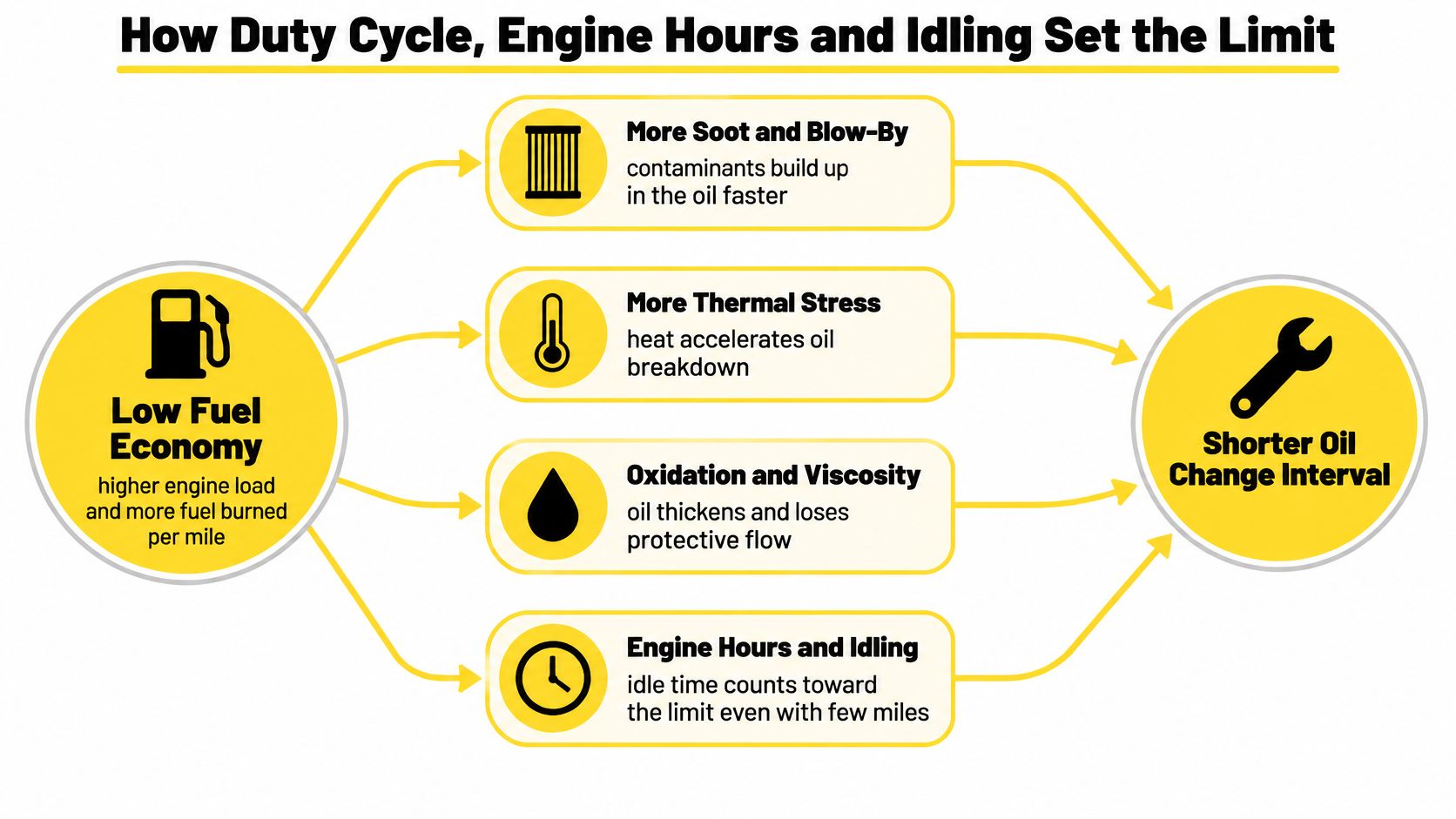
Low fuel economy can reflect higher engine load and more fuel burned per mile. Under demanding operation, the engine can introduce more soot and blow-by contamination into the lubricant while exposing it to greater thermal stress. The oil may reach its oxidation, viscosity, dispersant or contamination limit sooner.
That's why an odometer alone gives an incomplete maintenance picture. It measures distance traveled, not all the work performed while the engine runs.
The relationship between workload and oil condition is summarized below.
Why vocational trucks need an hour-based check
Refuse, construction, aggregate and Walking Floor operations often involve waiting, loading, unloading and stop-start movement. If the engine stays running, the truck accumulates hours even when the odometer barely changes. Engine-powered PTO operation belongs in that operating record as well.
A PACCAR severe-duty vocational service bulletin lists limits of 30,000 miles, 48,000 kilometers, 800 hours or 12 months, with the first applicable limit controlling. A truck that idles for long periods can reach the hour threshold well before the mileage threshold.
Consider a waste-transfer tractor waiting at a facility and then powering unloading equipment. The driver may finish with modest road mileage, but the engine has operated throughout much of the assignment. Scheduling its oil change from highway mileage alone leaves that running time unaccounted for.
Practical rule: When the manufacturer specifies an engine-hour limit, treat the hour meter as a service trigger, not as optional background information.
Separate operating symptoms from automatic drain rules
Frequent active diesel-particulate-filter regeneration, rising oil level or a change in running behavior deserves investigation. However, a regeneration event doesn't automatically mean the oil needs changing. The useful questions concern fuel dilution, viscosity loss, soot loading and whether the engine is operating within its manufacturer's instructions.
For example, a rising dipstick level isn't evidence that the engine needs less maintenance. Fuel entering the crankcase can increase the measured level while weakening the lubricant. Record the symptom and arrange diagnosis rather than adjusting the drain reminder.
Build the duty assessment from:
- Fuel economy and payload: Identify whether the assignment places the truck in a more demanding operating category.
- Idle and PTO time: Record engine-running work that mileage misses.
- Route behavior: Note queueing, low-speed loading, repeated stops and changes in assignment.
- Engine requirements: Verify calibration, oil capacity, filter specification, emissions configuration and oil-performance category in the current OEM manual.
Use the same mileage-and-hour entries in the service log and top-up record. Applying a highway-only assumption to vocational work can postpone service beyond the manufacturer's intended interval.
What Fleets Actually Do and What It Costs
The Texas Department of Transportation study reported that 83 percent of surveyed fleets used oil-change intervals between 12,000 and 22,000 miles. Fleet practice and manufacturer guidance do not always match, so treat that figure as a description of surveyed operators, not a recommended schedule.
For a truck traveling 100,000 miles annually, a 25,000-mile interval works out to about four services. At 12,000 miles, it is about eight to nine; at 22,000 miles, roughly four to five. The exact count depends on where the service cycle falls at the beginning and end of the year.
Count the full service event
Each drain involves more than the oil. Filters, technician time, scheduling and time away from the truck's assignment all affect the cost. A service-event worksheet can separate those expenses:
- Consumables: Record the specified oil quantity, filters and disposal-related charges shown on the work order.
- Labor: Include the work performed, rather than assuming a flat service package.
- Operational time: Track travel to the shop, waiting and time out of assignment.
- Inspection findings: Record required repairs separately from the oil-service cost.
Short intervals add service events and expense. Extending an interval without support can leave contamination or abnormal wear undetected.
Low mileage doesn't always justify a longer interval
The Texas Department of Transportation study found very low oil degradation beyond 10,000 miles and supported manufacturer guidance of 15,000 miles for vehicles traveling 6,000 to 60,000 miles annually. It retained 10,000 miles for severe-service trucks traveling under 6,000 miles annually. These findings show why mileage alone can mislead: a truck may cover few miles while spending substantial time in demanding service.
A 2025 Overdrive survey found that about two-thirds of owner-operators were extending oil changes beyond the traditionally conservative 15,000-mile interval. That describes what those operators reported doing; it does not establish a suitable interval for another truck.
Compare your documented maintenance requirement with your actual practice, including how the truck is used. A vocational truck that accumulates engine hours while covering little distance can reach its service limit sooner than a highway-only mileage rule suggests.
Using Oil Analysis Before You Extend Any Interval
Begin by sampling oil at the current drain interval. Record the unit, engine, lubricant, filter, mileage, engine hours, makeup oil and operating assignment so the laboratory result has a usable context. Analysis should validate the OEM schedule and diagnose problems, not replace the manufacturer's requirements.
Take samples consistently. Use a clean sampling valve or dedicated sampling equipment, avoid dirty drain containers, and follow the laboratory's collection instructions. Inconsistent collection can make a contamination trend difficult to interpret.
Establish a baseline before changing the schedule
A California state-fleet study evaluated 119 vehicles, including 40 buses and 18 trucks, tracking viscosity, total base number, oxidation, nitration, water, dirt and wear metals. It found that oil analysis, higher-quality oil and high-efficiency filters could safely support longer intervals in some studied vehicles.
The important feature is the controlled process. Compare a unit with its own previous samples under comparable work, then check the results against manufacturer limits. Don't combine unlike engines or routes into a fleet average and use that average to approve every truck.
Historical Canadian truck-engine testing summarized by OSTI found a favorable cost-risk relationship at 30,000 to 40,000 km, with filter life approximately 40,000 km maximum; samples after 28,000 km were frequently unsatisfactory when contamination or wear particles accumulated. Those findings aren't contradictory: a useful operating range doesn't guarantee that every sample within it will remain acceptable.
Oil analysis indicators and what they signal
| Indicator | Problem signal | Action |
|---|---|---|
| Fuel dilution | Lower viscosity and weaker oil film | Diagnose immediately and change oil and filter |
| Coolant contamination | Corrosion and bearing wear | Diagnose immediately and change oil and filter |
| Soot or insolubles | Weak dispersancy or excessive blow-by | Inspect blow-by before any extension |
| Iron, a wear metal | Abnormal cylinder, ring or valvetrain wear | Diagnose before any extension |
| Total base number, or TBN | Depleted alkalinity reserve | Hold or shorten the interval and retest |
| Viscosity change | Oxidation, nitration or fuel dilution | Shorten the interval and retest |
Total base number, or TBN, describes the oil's remaining alkalinity reserve. Interpret it alongside acid number, oxidation, contamination and the engine manufacturer's criteria, rather than using an isolated result as a universal pass-or-fail threshold.
Wear metals need context as well. Rising iron can suggest cylinder, ring or valvetrain wear, while copper and lead can help direct further investigation. Silicon deserves attention as a possible contamination indicator, but the laboratory and technician should interpret its likely origin.
A clean-looking sample isn't proof of healthy oil. A laboratory trend is more useful than appearance alone.
Extend cautiously and stop when symptoms change
If the manufacturer permits an analysis-supported program, extend in small steps while keeping a conservative safety margin. Retain the same sampling method and compare each result with earlier samples from that engine.
Coolant contamination, fuel dilution, abnormal wear or rapidly degrading viscosity calls for immediate diagnosis and an oil-and-filter change, not an extension. Repair the cause as well. Fresh oil won't correct an injector problem, coolant leak or abnormal blow-by.
After repeated regens or an unexplained rise in oil level, collect the operating history with the sample. Don't invent a universal fuel-dilution threshold: use the laboratory's interpretation and the engine manufacturer's limits to decide what requires action.
Tracking Oil Top-Ups Between Changes
The California Air Resources Board's heavy-duty diesel maintenance guidance advises changing lube oil at the engine manufacturer's mileage intervals, tracking vehicle use and keeping a log of oil added between changes. A rising makeup-oil requirement can indicate leaks, abnormal consumption or developing engine wear.
Keep the log accessible wherever drivers check the oil.
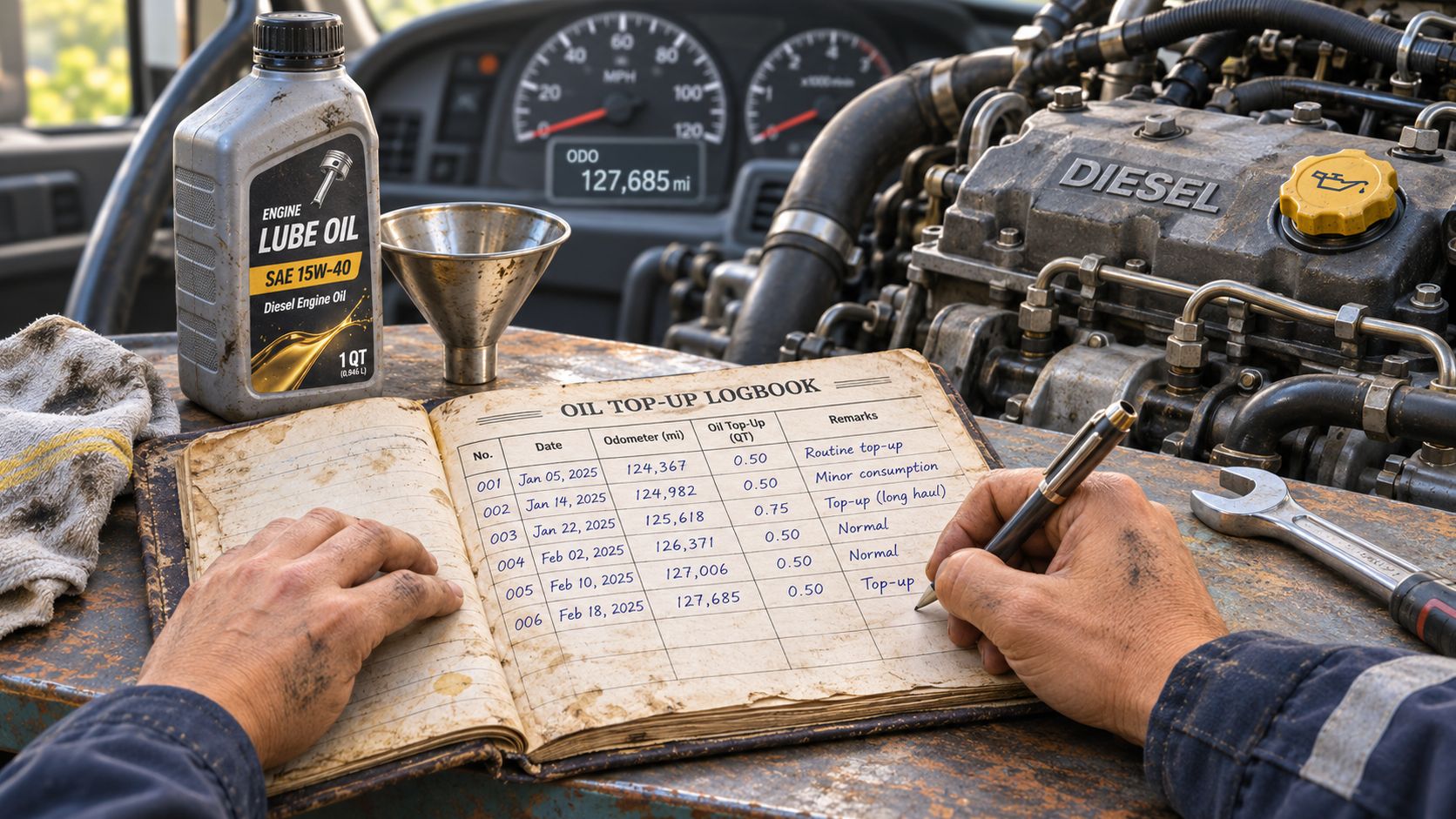
Make every addition traceable
- Record the drain starting point. Enter odometer mileage and engine hours at every oil change, together with the service date.
- Note the quantity added and date at each top-up. Record the oil product, too, so technicians can identify an incorrect addition.
- Calculate a consumption rate. Divide oil added by miles or hours run over the same period. Keep the units consistent.
- Compare each new rate with that unit's earlier rate, rather than another truck with a different engine or assignment.
- When consumption rises, check external leaks, inspect the crankcase breather and send an oil sample. Note whether the duty cycle changed during the same period.
- Decide whether to shorten the interval only after investigating. More frequent drains won't repair a leak or an internal engine fault.
Check the level using the manufacturer's procedure, including the specified parking condition and drain-back time. Otherwise, inconsistent dipstick readings can create a misleading consumption record.
Keep oil-level checks and written entries part of the same maintenance routine.
The log turns a routine top-up into an early warning rather than an unexplained breakdown. It also gives the laboratory a documented service history, including makeup oil that may affect how the sample should be interpreted.
Confirm Your Interval Before the Next Drain
The useful maintenance decision is specific: which schedule applies to this engine, in this assignment, with this oil and filter? A mileage number without those details isn't a complete service plan. A documented interval gives drivers, dispatchers and technicians the same instruction.
Check the schedule before resetting the reminder
Use these checks before authorizing the next drain interval:
- Match the truck to its duty case. Use the reference table to identify the likely category, then confirm it against the current engine manual.
- Verify the configuration. Check engine calibration, oil capacity, filter specification and oil-performance category rather than assuming all engines in the same truck model share identical requirements.
- Set every applicable trigger. Treat the first mileage, engine-hour or calendar limit reached as controlling.
Make the service record usable by the next person who opens it. Include the actual oil and filter installed, the readings at service, any unresolved symptoms and the next due limits. A reminder sticker that shows mileage alone can leave a vocational truck's hour-based requirement out of view.
Give the next decision a documented basis
Start the mileage-and-hour log, schedule an oil sample at the current interval and note any change in top-up consumption. If dispatch changes the truck's work, flag that change for maintenance review. Don't carry an old duty classification forward because the truck itself hasn't changed.
At Brothers Truck Trailer Repair and Welding Corp., our truck maintenance includes routine oil changes and fluid checks, brake and suspension inspections, engine diagnostics and repairs, preventative maintenance programs, and thorough roadworthiness inspections. Bring the engine manual, service log and sample results so the interval can be reviewed against a documented history rather than a remembered mileage target.
Confirm the interval, log it, test it, then change it only with evidence.
We offer truck and trailer repair, maintenance, parts, Walking Floor work, aluminum welding and custom fabrication, alongside routine oil and fluid service. Bring your engine details, mileage-and-hour records and available oil-analysis results when you visit Brothers Truck Trailer Repair and Welding Corp. to discuss an oil-service plan that fits your truck's actual work.
Learn the major semi truck parts, how to match replacements using VIN, part numbers and ratings, and how to weigh part price against downtime.
Learn hydraulic cylinder repair basics for trucks and trailers: symptoms, causes, diagnostic checks, repair options and when to call a specialist.

Step-by-step guidance on assessing damage, matching alloy and thickness, and confirming a safe return to service for aluminum trailer repair panels.