
Fleet Truck Repair: How to Cut Downtime in Tampa Bay
Out-of-service defects are a fleet truck repair problem before they're a paperwork problem: an unavailable tractor or trailer can leave a driver waiting, a load stranded, and dispatch rebuilding the day's schedule.
For Tampa Bay operators, the useful question isn't what the replacement part costs. It's which repair prevents the greatest safety exposure and avoidable downtime, given the next load, available technician hours, and parts lead time. Walking Floor equipment and aluminum trailers make that decision more demanding because a unit can remain roadworthy yet lose its ability to load or unload reliably.
Table of Contents
- Which Fleet Truck Repairs Prevent the Most Downtime
- What Repair and Downtime Really Cost a Fleet
- Preventive Maintenance Versus Reactive Repair
- Inspection Checklist for Brakes, Hoses, Lights and Tires
- Deciding Whether to Repair Now or Keep Running
- Walking Floor and Aluminum Repairs That Need a Specialist
- Confirm Your Repair Plan Before the Next Breakdown
Which Fleet Truck Repairs Prevent the Most Downtime
Brakes deserve the first look. Brake problems were among the most frequently coded factors for trucks examined in the FMCSA large-truck crash-causation analysis, and lighting, tires and suspension complete the list of systems worth checking first.
Systems to check first
| System | Why it matters for downtime | First check |
|---|---|---|
| Brake systems | Out-of-service when defective brakes reach the applicable service-brake threshold | Air pressure, slack adjusters, chamber stroke |
| Lighting, markers and signals | A qualifying defect can stop the unit at roadside inspection | Brake lamps, markers and turn signals |
| Tires | Blowouts and tread loss cause immediate breakdowns | Tread depth, sidewall condition, inflation |
| Suspension | Affects handling, trailer alignment and wear | Springs, bushings, axle alignment |
| Walking Floor hydraulics and slats | Uneven unloading and hydraulic leaks can idle the unit | Hose and cylinder leaks, slat wear |
Use this list to direct inspection effort, not to predict an individual unit's failure.
Translate the finding into a repair action
A brake complaint needs a system diagnosis, not an automatic lining replacement. Check air supply, automatic slack-adjuster operation, chamber stroke, hose condition, and drum or rotor condition across the combination. Uneven wear or heat damage at a wheel position can indicate an adjustment, air-delivery, or loading problem elsewhere.
Lighting work often involves modest components, but diagnosis still matters. Replacing a lamp won't correct a corroded ground, damaged connector, or harness rubbing against the trailer frame. Test the circuit under operating conditions before closing the work order.
With tires and suspension, inspect the failure pattern together. Shoulder wear, irregular tread wear, damaged bushings, and axle misalignment can point to a shared cause. Replacing the tire without correcting that cause leaves the next tire exposed.
Walking Floor inspection adds an operational question: can the trailer discharge its assigned load without binding, leaking, or damaging the floor? A trailer that reaches the customer but can't unload is still unavailable for its next assignment.
Priority rule: Correct unsafe conditions first, faults capable of immobilizing the unit next, and schedulable wear items after that. Dispatch convenience never overrides a safety defect.
What Repair and Downtime Really Cost a Fleet
Repair and maintenance averaged $0.196 per mile in 2022, a 12% increase over the previous year, according to ATRI's operational-cost report. At that reported rate, a truck traveling 100,000 miles would incur approximately $19,600 in repair and maintenance expense.
For reliability, ATRI reported 38,249 miles between breakdowns or unscheduled repairs in 2024, up from 37,700 miles in 2023, as summarized by Fleet Maintenance. Don't treat differently worded measures from separate reporting periods as a clean deterioration trend without checking their definitions and fleet samples.
Put the lost work beside the invoice
The repair invoice captures labor, components, and shop materials. It doesn't necessarily capture towing, recovery, replacement equipment, driver waiting time, freight transfer, or a missed receiving window.
Hypothetical Walking Floor example: Say a trailer normally completes two loads a day and remains idle for one working day. That leaves two loads uncompleted, so the immediate revenue exposure is:
Uncompleted loads × your revenue per load
That's lost revenue exposure, not automatically lost profit. If another trailer completes the work later, calculate the added operating expense instead of counting the entire load revenue as permanently lost. For an economic repair decision, compare lost contribution after avoided variable costs, then add recovery and substitute-equipment costs without double-counting them.
Track these measures monthly:
- Repair cost per mile: Use a consistent definition of included maintenance expenses.
- Miles between failures: Define a failure consistently so shop visits and roadside events don't get mixed unpredictably.
- Days out of service per unit: Record when the unit became unavailable and when dispatch could use it again.
A cheap repair that leaves a trailer waiting for an unidentified fitting can become an expensive repair. Maintenance cost is a utilization problem as much as a parts problem.
Preventive Maintenance Versus Reactive Repair
Maintenance approaches compared
| Approach | What it catches | Downtime pattern | Best fit |
|---|---|---|---|
| Reactive repair after breakdown | Failures that have already reached the road | Unplanned stops, towing and missed loads | Rarely the lowest-cost option for critical systems |
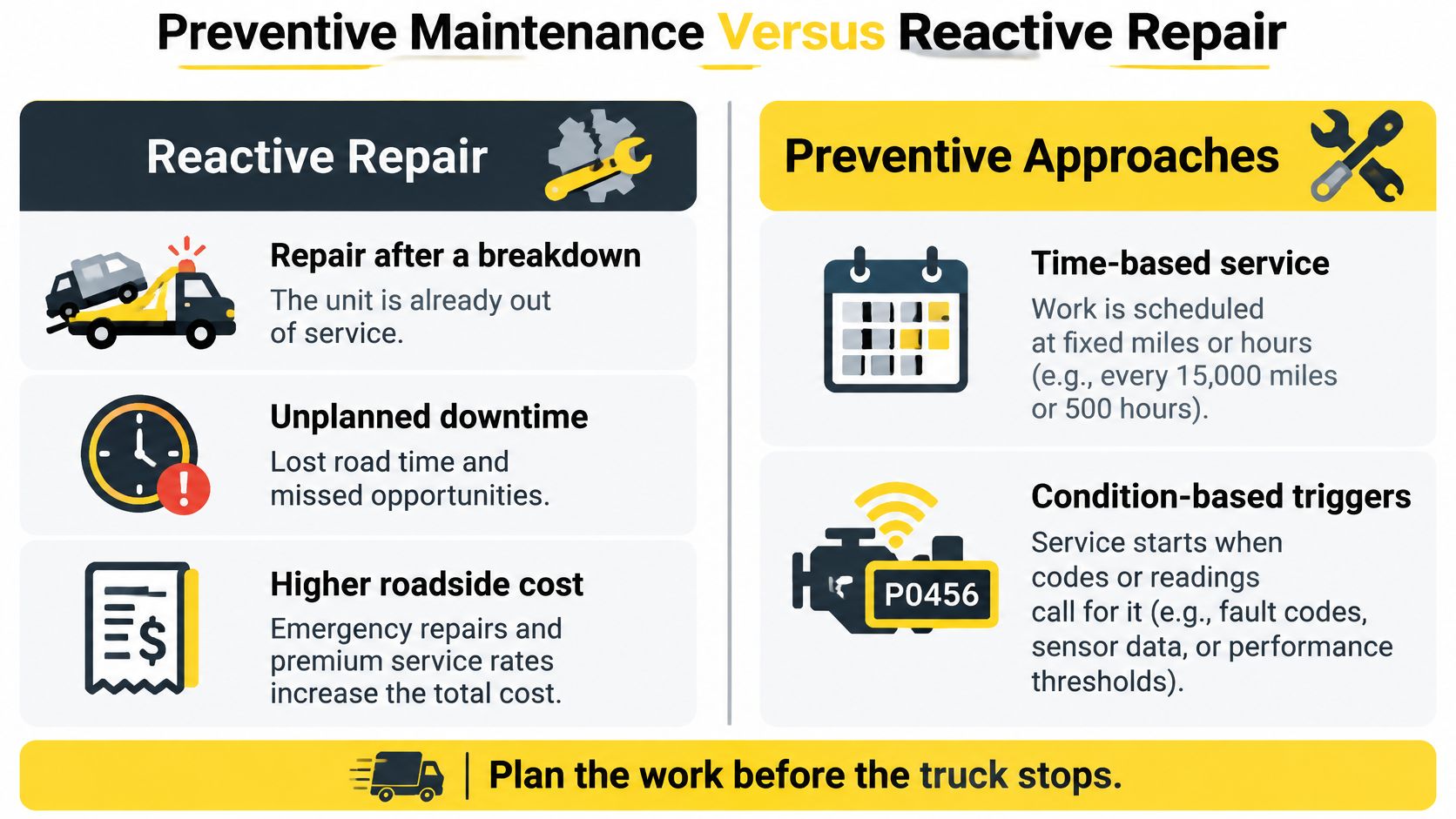
| Time-based service at fixed miles or hours | Wear items on a set schedule | Planned stops that dispatch can work around | Baseline for every unit |
| Condition-based triggers | Fault codes, leaks, measured wear and structural cracks | Work initiated before functional failure | Walking Floor and aluminum trailer units |
| Documented preventive program | Recurring defects across shifts and technicians | Roughly 20% fewer days out of service per repair in the reviewed fleets | Fleets that need repeatable results |
The preventive-program result comes from a third-party analysis of approximately 130,000 repair transactions across 100 fleets, reported by Work Truck. It supports planned maintenance as a downtime-control strategy, but it doesn't guarantee the same reduction for every fleet or establish that scheduling alone produced the difference.
The practical distinction is when the fleet commits labor and parts.
Use intervals and condition together
Time-based service provides a dependable baseline for fluids, filters, lubrication, and inspections. It doesn't replace condition checks when a driver reports a new hydraulic leak, a technician finds a structural crack, or diagnostic software identifies a recurring fault.
A documented program connects those findings to a work order, an owner, and a release decision. Without that connection, technicians can repeatedly inspect the same defect while nobody reserves the parts or removes the unit from dispatch.
Safety evidence supports that distinction. An FMCSA-commissioned evaluation of its Safety Measurement System found that carriers targeted for intervention because of vehicle maintenance violations had a 65% higher crash rate than the national average, as cited in FMCSA's maintenance research overview. That association doesn't prove every maintenance defect causes a crash, and it doesn't establish a universal service interval.
Assign the work before reserving the bay
Fleet Maintenance reports that 64.4% of fleet repairs and maintenance were completed by in-house diesel technicians in 2025. Internal capacity therefore matters, but so does the handoff to outside repair facilities.
Most fleets split work between internal technicians and outside shops. Decide beforehand which jobs stay inside and which need specialist equipment or expertise, particularly Walking Floor hydraulics and aluminum welding. Confirm component compatibility and order known requirements before the unit arrives rather than using bay time as storage time.
Reactive repair still has a limited place. A non-safety accessory with no consequential damage risk may reasonably remain in service until a convenient stop; a developing brake or structural defect may not.
End every unit review with symptom, measurement, and parts on the shelf. Those details turn an inspection finding into executable work.
Inspection Checklist for Brakes, Hoses, Lights and Tires
Build the inspection around a recorded result, not a checked box. Brake adjustment, brake hoses and tubing, other brake defects, trailer ABS indicators and brake lamps are recurring roadside violations, so record a measured result for each.
The following checklist connects the components to the inspection action.
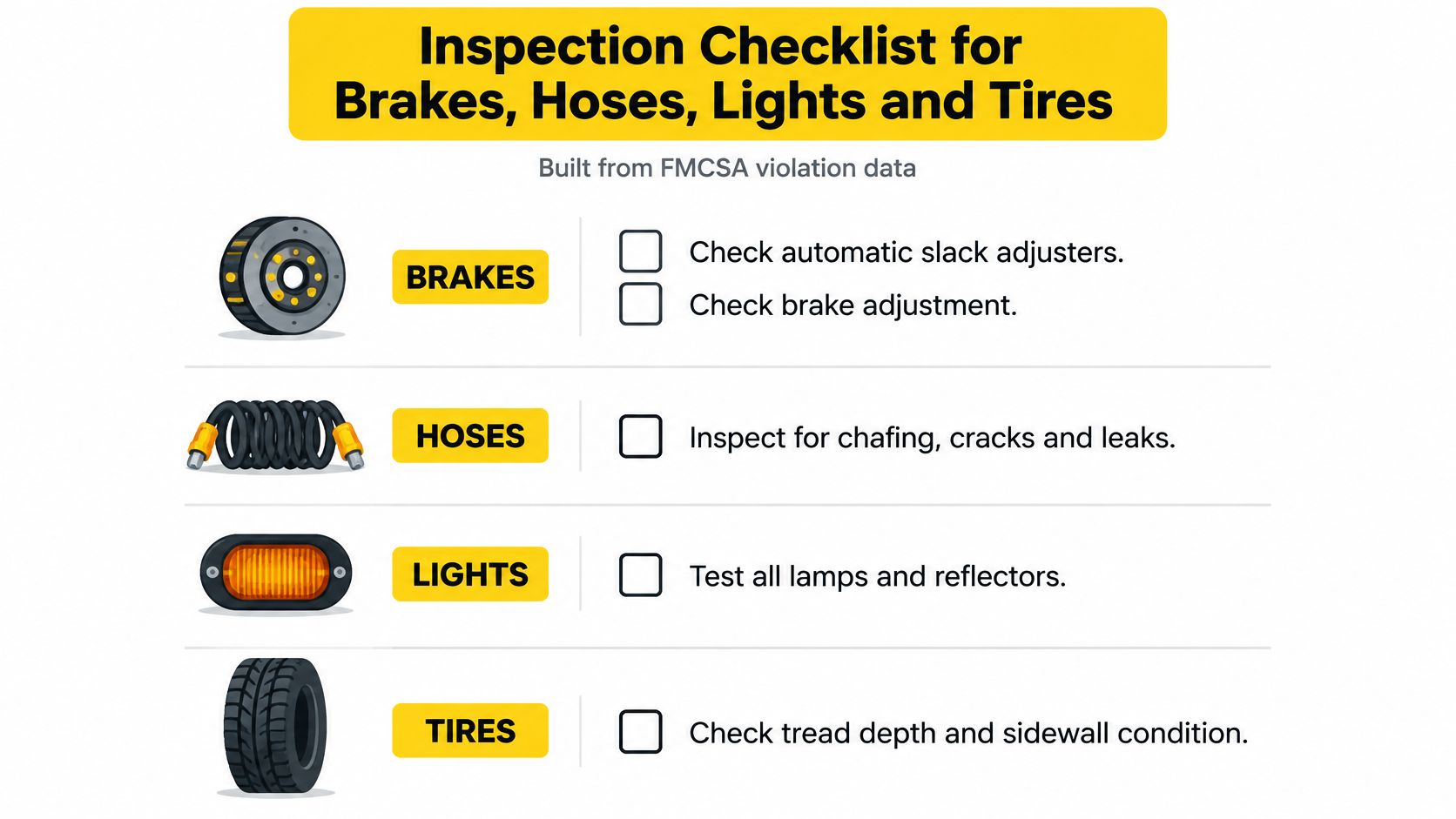
Under the North American Standard out-of-service criteria, a vehicle or combination is placed out of service when 20% or more of its service brakes have an out-of-service condition.
Record a measurement or functional result
- Brakes: Secure the vehicle against movement, identify the chamber type, and measure applied pushrod stroke against the applicable specification. Investigate excessive stroke rather than treating repeated manual adjustment of an automatic slack adjuster as a repair.
- Hoses and tubing: Follow routing through suspension travel and connection points. Look for abrasion, flattened sections, kinks, insecure supports, and contact with hot or moving components.
- Trailer ABS: Verify the indicator's expected operation and investigate stored faults. The ABS malfunction-indicator requirement in 49 CFR 393.55 applies to trailers manufactured on or after March 1, 1998.
- Lighting: Operate brake lamps, turn signals, markers, and other required lamps. Check connectors and grounds when lamps flicker or fail intermittently.
- Tires and suspension: Use a tread-depth gauge and pressure gauge, record the tire position, and inspect sidewalls, springs, bushings, and alignment-related wear.
Don't count an air-pressure reading as proof that the whole brake system works. Likewise, an illuminated lamp doesn't prove it stays functional when the harness moves.
Close the handoff
Photograph the defect, record the measurement, identify the repair, and attach the post-repair result to the unit's work order. Have the receiving shift confirm that the repair is closed before dispatch releases the vehicle.
A checklist works only when every item has an owner and a documented result.
Deciding Whether to Repair Now or Keep Running
Symptoms, likely causes and the right action
| Symptom | Likely cause | Keep running? | Action |
|---|---|---|---|
| Brake pull, long pedal or air leak | Brake or air-system fault | No | Stop the unit and repair before dispatch |
| ABS or brake warning lamp | Sensor, wiring or trailer ABS fault | Only to a yard or shop after a qualified safety assessment | Check the indicator, codes and wiring before the next trip |
| Uneven unloading or slat drag on Walking Floor | Worn slats, binding or hydraulic imbalance | Short relocation only if the load and equipment are confirmed safe | Inspect slats and cylinders the same day |
| Hydraulic leak under the trailer | Hose, fitting or cylinder seal | No, under load | Isolate the leak, replace the failed part and validate safely |
| Tire bulge, cut or heavy tread loss | Tire damage or wear | No | Replace the tire before dispatch |
| Marker or brake lamp out | Bulb, wiring or lamp fault | Usually no on public roads | Repair before highway travel |
These are triage directions, not permission to operate a defective vehicle. An ABS warning requires diagnosis; a warning accompanied by reduced braking or an air-system fault belongs in the stop category.
Shop capacity makes early decisions valuable. Shop surveys point the same way: ATRI found that 65% of surveyed shops were understaffed, and Noregon's shop survey ranked hiring technicians as the top issue for 61% of shops, as summarized by Fleet Maintenance.
Those findings don't predict a particular shop's queue. They do make it unwise to assume an open bay and the correct component will be available after a roadside failure.
Send a diagnosis-ready triage packet
Prepare a concise packet before calling:
- Unit identity: Tractor and trailer identifiers, component details, and configuration.
- Symptom timing: When it began, whether it occurs loaded or empty, and what changed beforehand.
- Evidence: Photos, fault codes, visible leakage, and relevant measurements.
- Operating context: Load type, next commitment, current location, and whether the unit can move safely.
- Repair history: Previous work on that component and likely parts, without presenting an unconfirmed diagnosis as fact.
A clear packet helps the shop distinguish inspection time from parts procurement and actual repair time.
Compare the contribution lost from a missed load, substitute-equipment expense, and potential recovery cost against a confirmed same-day repair option. Waiting can cost more, but a rush repair isn't automatically cheaper if it leaves the root cause unresolved.
Stop-work boundary: Symptoms affecting braking, steering, tire integrity, or an active hydraulic leak under load aren't continue-operating cases.
Temporary mitigation belongs only to a qualified, documented decision involving a non-safety defect. It's not a way to keep a questionable loaded trailer earning revenue.
Walking Floor and Aluminum Repairs That Need a Specialist
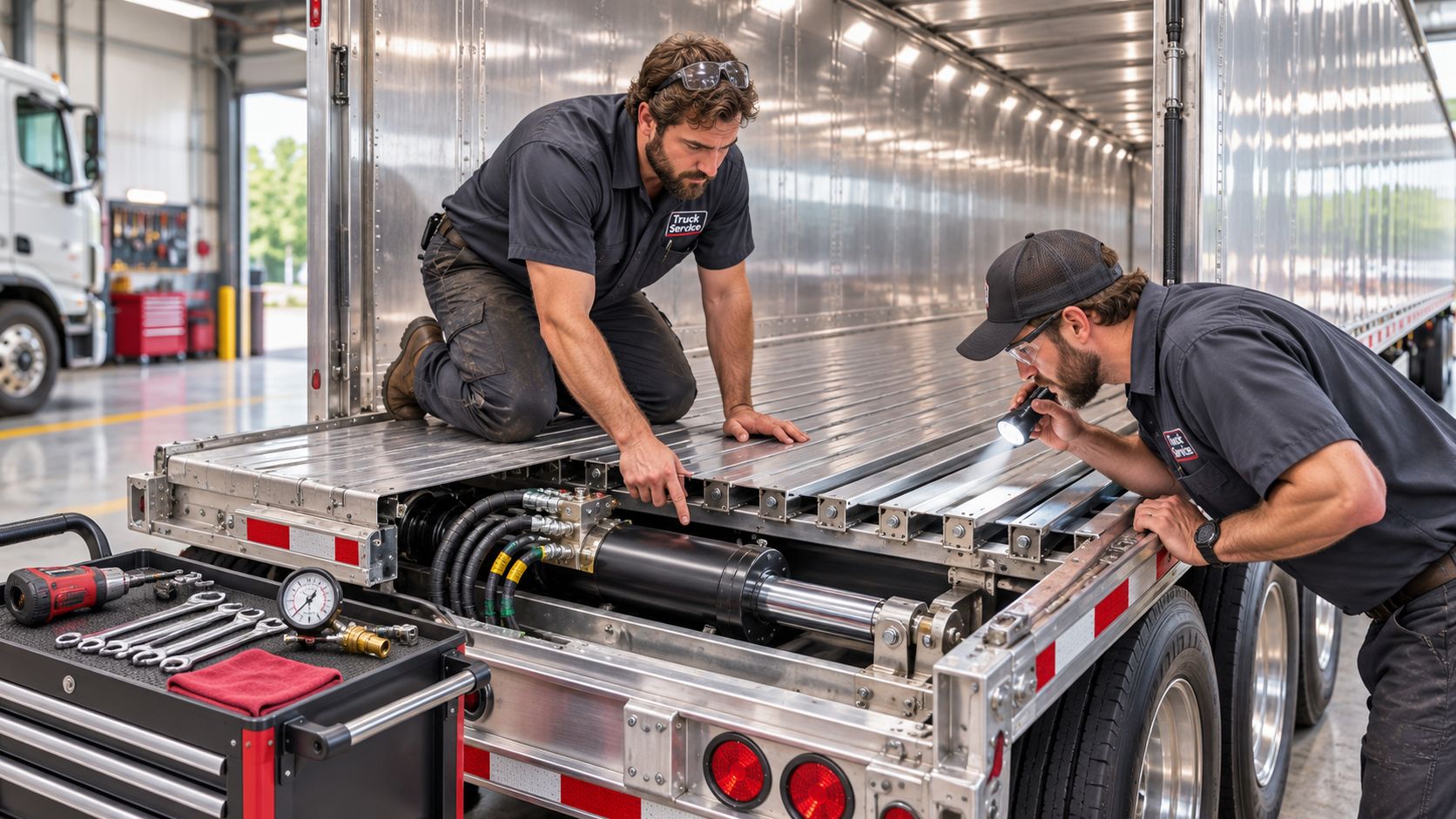
A Walking Floor trailer combines hydraulic power, moving slats, controls, and the structure supporting them. Slow movement or uneven discharge can originate in more than the component that first attracts attention.
Hydraulic inspection needs access to the complete system, not just the visible drip.
Diagnose the floor in operating order
- Confirm the reported symptom under representative load conditions. Establish whether the problem appears during startup, sustained movement, or a particular discharge stage. Don't recreate a loaded test until active leaks and other unsafe conditions are controlled.
- Check hydraulic pressure and hose condition. Use rated gauges and the equipment's test procedure. Isolate stored energy before opening connections, and never use a hand to search for a pressurized leak.
- Measure slat wear and inspect mechanical interference. Look at guides, supports, fasteners, and the wear pattern across the floor. Replace worn or damaged slats as appropriate, but investigate why wear is uneven.
- Validate under the conditions that produced the complaint. An empty-floor cycle doesn't establish that the trailer can discharge its normal material reliably.
The repair record should distinguish a failed seal from cylinder damage, binding, or a control issue. Otherwise, a successful short test can conceal the original fault.
The equipment demonstration below provides a visual reference for the system.
Repair aluminum without hiding the cause
Cracks at stress points, damaged body panels, and corrosion around joints require different repair decisions. Before welding, determine whether the damage is cosmetic, load-bearing, or evidence of repeated movement at a connection.
A sound aluminum repair starts with cleaning and contamination removal, then a welding process and filler suited to the material. Heat control limits distortion; post-repair inspection checks the weld and surrounding material for cracking, fit, and alignment. Welding over a crack without addressing its extent or loading can leave the failure mechanism intact.
At Brothers Truck Trailer Repair and Welding Corp., we offer aluminum welding, fabrication, maintenance, and parts support, including custom fabrication for specific needs. Our welders have specialized aluminum expertise, with precision welding for structural integrity and welds designed to resist corrosion.
Bring the load type, symptom timing, photographs, and service history. Those details help separate an isolated component failure from an equipment or structural problem before repair work begins.
Confirm Your Repair Plan Before the Next Breakdown
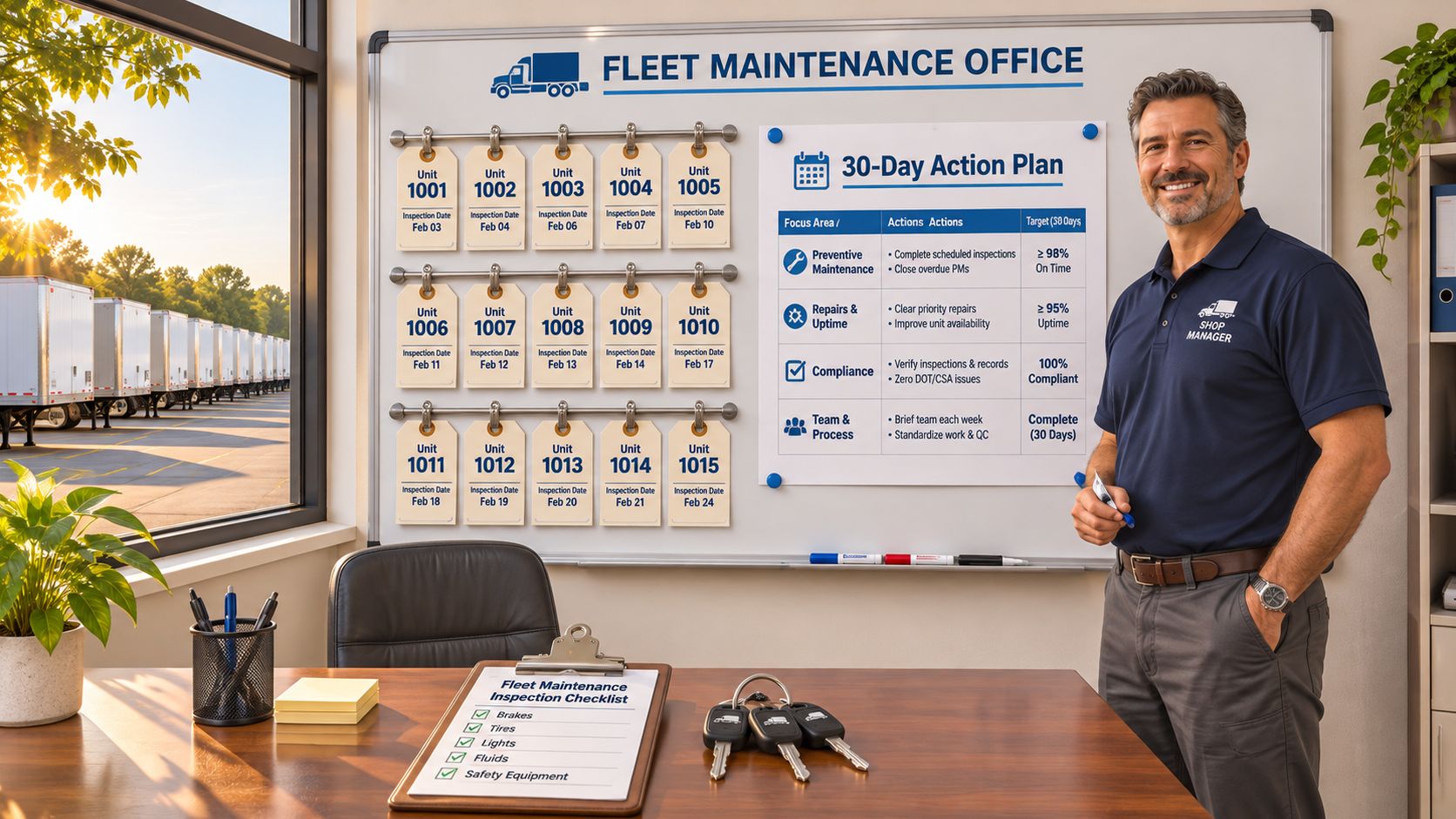
- List every unit and its last inspection date. Include trailers and equipment waiting in the yard, not just tractors currently earning miles. Mark missing records for follow-up.
- Rank open defects by safety risk, then downtime risk. Keep a harmless nuisance from consuming the bay needed by a unit with a developing immobilizing fault.
- Assign an owner to each defect category. Name who diagnoses, who authorizes work, who orders components, and who confirms release.
- Confirm parts are on hand or on order. Review brakes, lights, tires, seals, and slats against the actual fleet configurations. An available component isn't useful if its fitment is wrong.
- Review miles between failures and days out of service monthly. Separate time spent diagnosing, waiting for approval, waiting for parts, and completing work so the corrective action matches the delay.
Use this as a 30-day action plan, not a replacement for scheduled inspections. Keep the board simple enough that dispatch and maintenance can use the same status without a separate explanation.
A visible maintenance board helps make ownership and release status clear.
Tampa Bay operators with a down unit or an unresolved Walking Floor or aluminum problem can contact Brothers Truck Trailer Repair and Welding Corp. through our website or call +1 (813) 750-6380. Send the triage packet ahead so diagnostic preparation can begin before arrival at 1620 S 51st St, Tampa, FL 33619. We work directly from our workshop to the customer, with no middlemen.
After the first month, ask: did days out of service fall?
Brothers Truck Trailer Repair and Welding Corp. offers truck and trailer maintenance, Walking Floor diagnostics and repair, aluminum welding, custom fabrication, and parts support. Visit Brothers Truck Trailer Repair and Welding Corp. with your unit details, open defects, and next load requirements so we can discuss a repair plan focused on safe return to service.
Hydraulic system troubleshooting for trucks and trailers: match symptoms to causes, check fluid and pressure safely, and know when to call a technician.
Truck suspension repair guide: spot air leaks, broken springs and U-bolt faults, learn federal inspection limits and know when to park the truck.

Fleet maintenance services explained: inspections, preventive maintenance, repairs and downtime control for Tampa Bay trucks and trailers, with FMCSA rules.