
Fleet Maintenance Services Explained for Tampa Bay Fleets
In 2023 the Federal Motor Carrier Safety Administration recorded 1,994,946 commercial-vehicle inspections, and 450,477 of them found at least one vehicle out-of-service violation. That 22.6% vehicle out-of-service rate, reported in the FMCSA motor carrier statistics overview, means more than one in five inspected vehicles had a defect serious enough to keep it parked until someone fixed it. The rate had climbed from 20.6% in 2019. FMCSA also counted 678,529 vehicle out-of-service violations that year.
For a Tampa Bay fleet, those numbers aren't a roadside curiosity. They're a picture of lost loads, missed municipal routes, and trailers that can't dump. Fleet maintenance services exist to catch that defect in the shop, on a schedule you control, instead of at a scale house on a Friday.
Table of Contents
- What Fleet Maintenance Services Cover
- Why Preventive Care Costs Less Than Breakdowns
- Inspection Types and How Often to Run Them
- Building a Preventive Maintenance Schedule That Holds
- Walking Floor and Aluminum Repairs Done Safely
- Where Downtime Actually Comes From
- Choose Your Maintenance Setup and Request Service
What Fleet Maintenance Services Cover
A parked truck is usually the last step in a chain that started as a small defect. The useful question for a manager isn't "do we do maintenance?" It's "which failure modes does our program own?"
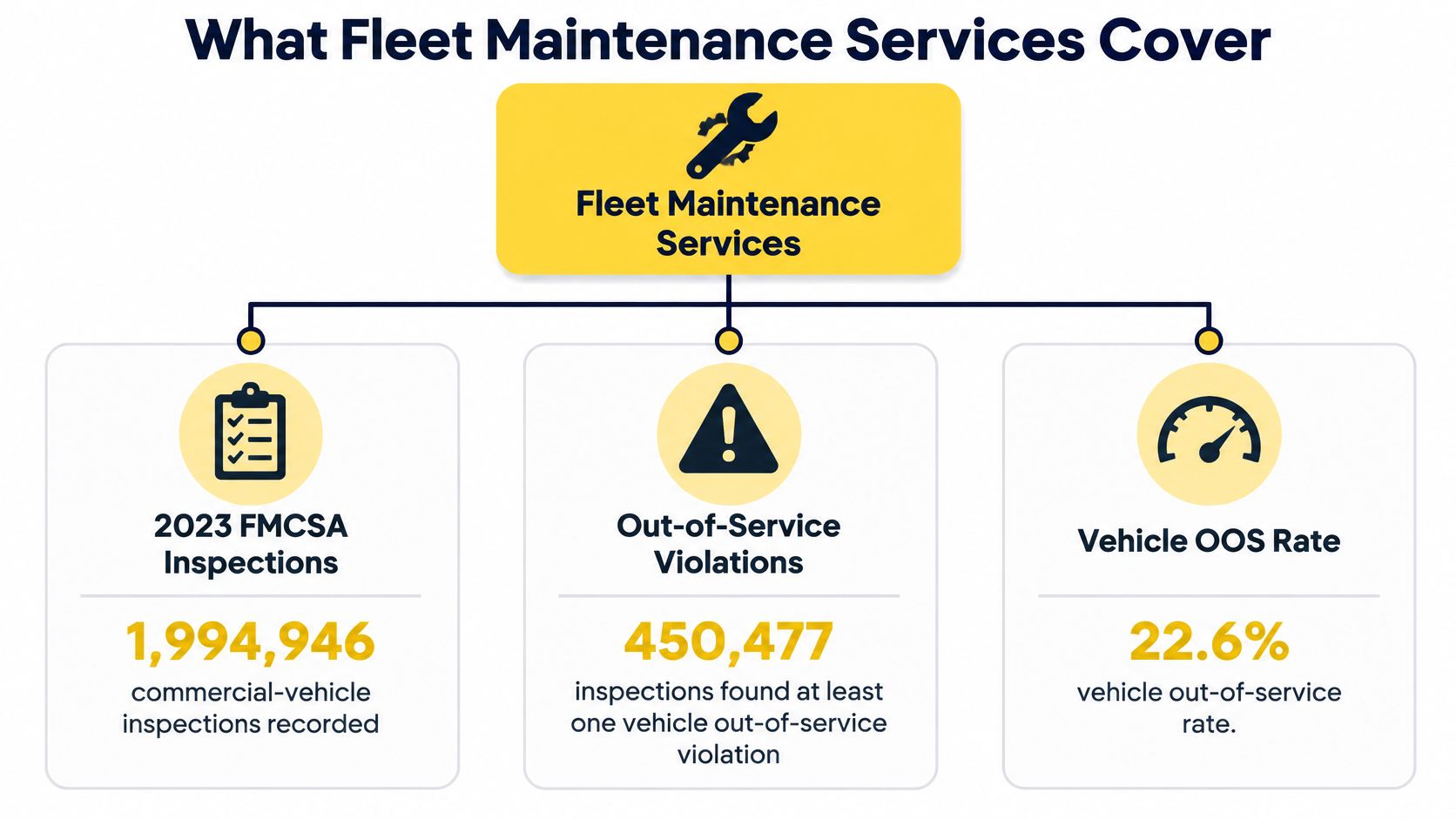
Six areas belong in one program. They aren't six vendors. An inspection finds the defect, preventive work reduces the next one, repair closes the one you already have, and parts keep the calendar from stalling.
| Service area | What it includes | What it protects against |
|---|---|---|
| Inspections | Daily driver reports, annual federal inspections, roadworthiness inspections | Defects that become out-of-service violations |
| Preventive maintenance | Oil changes, fluid checks, brake and suspension inspections, PM programs | Breakdowns on scheduled routes |
| Corrective repair | Engine diagnostics, trailer repair | Extended downtime from known faults |
| Walking Floor service | Hydraulic diagnosis and repair, slat replacement, preventive maintenance | Uneven unloading and hydraulic failure |
| Aluminum welding and fabrication | Structural repairs, custom fabrication | Cracks, corrosion and fitment problems |
| Parts supply | Truck and trailer components | Waiting on parts after diagnosis |
How the six areas connect
Inspections are the intake. A driver report, a roadworthiness check, and the annual federal inspection each look at the same truck on a different clock. If nobody owns the written schedule, the annual sticker expires while the oil changes still look tidy.
Preventive maintenance is the work you book before a fault code. That includes oil changes, fluid checks, brake and suspension inspections, engine diagnostics when a symptom shows up, and a program that repeats by miles or hours. We run preventative maintenance programs and roadworthiness inspections as part of truck maintenance, not as a separate product line.
Corrective repair starts once a fault is known. Engine diagnostics tell you whether the unit can finish the week. Trailer repair covers structural wear that a power-unit PM never sees.
Floors, aluminum, and parts
We specialize in the repair and maintenance of Walking Floor systems. A moving floor unloads by shifting slats with hydraulic cylinders. When a cylinder lags or a slat wears through, the load sits in the trailer even though the tractor is fine. Hydraulic diagnosis, slat replacement, and floor preventive maintenance belong in the same work order as the truck, or the route still fails.
Aluminum is a different failure. We offer aluminum welding for trailers and trucks, including repair of aluminum trailer bodies and components, plus custom fabrication when a bracket or guard no longer fits the body you run. Cracks and corrosion don't show up on an oil sticker.
Parts supply is the quiet row. Truck and trailer components on the shelf are what stop a diagnosed job from becoming a week of downtime.
Practical rule: List each row above for your own fleet. Mark whether it has a written schedule and a named owner. Any blank row is the first gap to close, before you buy another software screen.
Why Preventive Care Costs Less Than Breakdowns
A smoke detector doesn't stop a kitchen fire by being expensive. It warns you while the problem is still a pan, not a structure. Scheduled maintenance works the same way. The components that fail in crashes are usually still letting the truck roll, right up to the moment they don't.
The FMCSA Pocket Guide reports an analysis of 407 trucks inspected by the Michigan Fatal Accident Complaint Team. 66.1% had at least one violation before the crash. 35.1% had at least one defect that would have qualified as out-of-service at a roadside inspection.
| Defect category | Share of trucks |
|---|---|
| Any violation before crash | 66.1% |
| Defect that would be out-of-service | 35.1% |
| Brake problems | 32.7% |
| Lighting or marker and signal violations | 23.1% |
| Tire violations | 14.5% |
| Steering axle violations including brakes | 14.0% |
| Suspension violations | 9.6% |
Why a running truck can still be unsafe
Driver complaints and visible damage miss a lot of this list. Brake problems showed up on 32.7% of those trucks, ahead of lights, tires, steering-axle items, and suspension. Brakes, tires, steering parts, suspension, and lamps can all deteriorate while the unit still pulls a load. The defect shows up under weight, in an emergency stop, or on a rough approach to a landfill or a job site.
Hoses, trailer structure, and floor hardware do the same thing. A Walking Floor can keep cycling with a weeping fitting until a cylinder goes soft on one side and the load walks crooked. Preventive maintenance on that system is there to avoid the breakdown and to keep the floor moving the way it was built to move. Waiting for the driver to "feel it" is how a latent leak becomes a dumped schedule.
The cost of the missed check
Repair and maintenance costs rose 8.6% in 2025, reaching an average of $0.215 per mile, according to ATRI figures reported by Trucking Info. A skipped brake inspection doesn't save that money. It moves the spend into towing, a missed route, and a repair done at the worst hour.
Rank every component by what happens if it fails on the road, not by how cheap the part looks on a shelf. Start the program with the top rows of the table: brakes, lighting, tires, steering, and suspension. Those are the checks that belong in every recurring inspection, with a written result and a repair sign-off before the unit is dispatched again.
Inspection Types and How Often to Run Them
Managers mix up three clocks and then wonder why a unit is legal on paper and still breaks down. Daily reports, the annual federal inspection, and oil service are not the same job.
The daily driver report
49 CFR 396.11 requires a motor carrier to require drivers to prepare a written driver vehicle inspection report at the completion of each day's work for each vehicle operated, with a stated exception for intermodal equipment tendered by an intermodal equipment provider. The Electronic Code of Federal Regulations text of 49 CFR 396.11 says the report must identify the vehicle and list each defect or deficiency discovered by or reported to the driver that could affect safe operation or result in mechanical breakdown. Before the carrier requires or permits the driver to operate the vehicle, the carrier or its agent must repair any listed defect or deficiency likely to affect safety.
That report is a maintenance input, not a shift note. Brake pull, a suspension knock, a fluid leak, a damaged trailer rail, a Walking Floor that unloads unevenly, or a slat that chatters all belong on it. Someone has to evaluate the note and route the repair. Parking the paper in a folder doesn't satisfy the duty.
The annual inspection is a different clock
49 CFR 396.17 requires every commercial motor vehicle to be inspected, and the inspection must include at least the parts and accessories in Appendix A to Part 396. A motor carrier may not use the vehicle unless each of those components has passed an inspection at least once during the preceding 12 months, and documentation of that inspection is on the vehicle. The current 49 CFR 396.17 text also recognizes qualifying state, Canadian, or Mexican government inspections that meet the federal minimum standards. Those count for 12 months beginning on the last day of the month in which the inspection occurred.
A roadworthiness inspection is not an oil change, a fluid top-off, or a repair visit that happened to include a look underneath. Our truck maintenance covers routine oil changes and fluid checks, brake and suspension system inspections, engine diagnostics and repairs, preventative programs, and thorough inspections for roadworthiness. You still have to confirm that the inspection process, the inspector's qualifications, the paperwork, and the state or federal rules that apply to your operation are met. A shop visit doesn't create that compliance by itself.
Under 49 CFR 396.3, the carrier's systematic inspection, repair, and maintenance program has to be backed by records. Read the current wording on the eCFR Part 396 page before you design the file. Don't treat a shop invoice as a substitute for the record the rule describes.
| Inspection | Frequency | Basis |
|---|---|---|
| Driver vehicle inspection report | Each day the vehicle operates | 49 CFR 396.11 |
| Annual periodic inspection | At least every 12 months | 49 CFR 396.17 and Appendix A to Part 396 |
| Roadworthiness inspection | Per fleet policy and state requirements | Fleet policy and applicable state rules |
| Oil and fluid service | Per OEM manual interval for make and model | OEM manual |
| Brake and suspension inspection | Per fleet PM program and OEM manual | Fleet policy and OEM manual |
| Engine diagnostics | When a warning or symptom appears | Driver report and OEM diagnostic procedure |
Brake and tire checks before dispatch
Federal inspection practice treats brakes, tires, and air-system faults as safety-critical. FMCSA defines a brake out-of-service condition when defective brakes reach at least 20% of the service brakes on a vehicle or combination. A unit can also fail a periodic inspection for missing braking action, broken brake parts, or an audible air leak at a brake chamber.
On each brake and tire pass, do the functional work, not only a walk-around.
- Measure brake lining and drum or rotor condition against the limit in the OEM manual for that axle.
- Check pushrod travel and listen for air leakage at chambers, valves, and hose ends.
- Inspect hoses for chafing, kinks, and rub points where the chassis moves.
- Confirm tire inflation and tread, including the trailer axles the driver sees least.
- Close every defect with a documented repair disposition before the dispatcher releases the unit.
Follow the OEM manual for that make and model. An oil interval from one engine, or a brake spec from one trailer builder, is not a general rule for the rest of the yard.
Building a Preventive Maintenance Schedule That Holds
A short job can still eat three days. That gap is where most "we do PM" programs fail.
A 2025 City of San Diego fleet audit found that preventive-maintenance work averaged about 2 labor hours when performed, while delays stretched average turnaround to 3 calendar days. 77% of those PM services were delayed, mainly because labor wasn't available. The same audit cited an external benchmark of roughly 90% on-time PM compliance among leading North American fleets, against an average of about 86%, as reported in the City of San Diego fleet maintenance audit.
Two measures, not one
Wrench time is the hours a technician spends on the job. Calendar-time availability is the days the unit is out of service, including the wait before anyone picks up a tool. If you only count completed work orders, a two-hour service that sat for three days looks like a success.
For a regional truck or a Walking Floor trailer, those lost days are the route. The tractor can be ready while the trailer is still in line for a bay. Track both numbers, plus parts-wait time and days unavailable. The split tells you whether the delay is mechanical or whether the process around the wrench is the problem.
Controls that keep the calendar honest
- Book by use, not memory. Schedule PM by mileage or engine hours, whichever the OEM manual uses for that unit, and put the due point on a shared list.
- Pre-kit the common parts. Filters, fluids, seals, and the wear parts you replace on almost every visit should be staged before the unit arrives.
- Hold diagnostic time each week. Reserve capacity for brakes, steering, air leaks, and floor hydraulics so a safety defect doesn't wait behind an oil change.
- Escalate a miss before the next dispatch. A unit that slips its window needs a named person and a new date, not a hope that next week is quieter.
Compare your own on-time PM compliance and calendar-time availability for one full quarter before you rewrite the program. If wrench time is already short and the calendar is still long, the next fix is staging, labor, and approval, not a thicker checklist.
Walking Floor and Aluminum Repairs Done Safely
A moving floor and a fixed wood deck fail in different ways, and the checks aren't interchangeable. A Keith Walking Floor unloads by driving hydraulic cylinders that shift groups of slats in sequence. Leaks, uneven cylinder travel, and worn slats stop that sequence. A fixed wood deck has no hydraulic slat drive, so pressure tests and slat measurements don't apply to it. Treat them as two machines that happen to sit on a trailer frame.
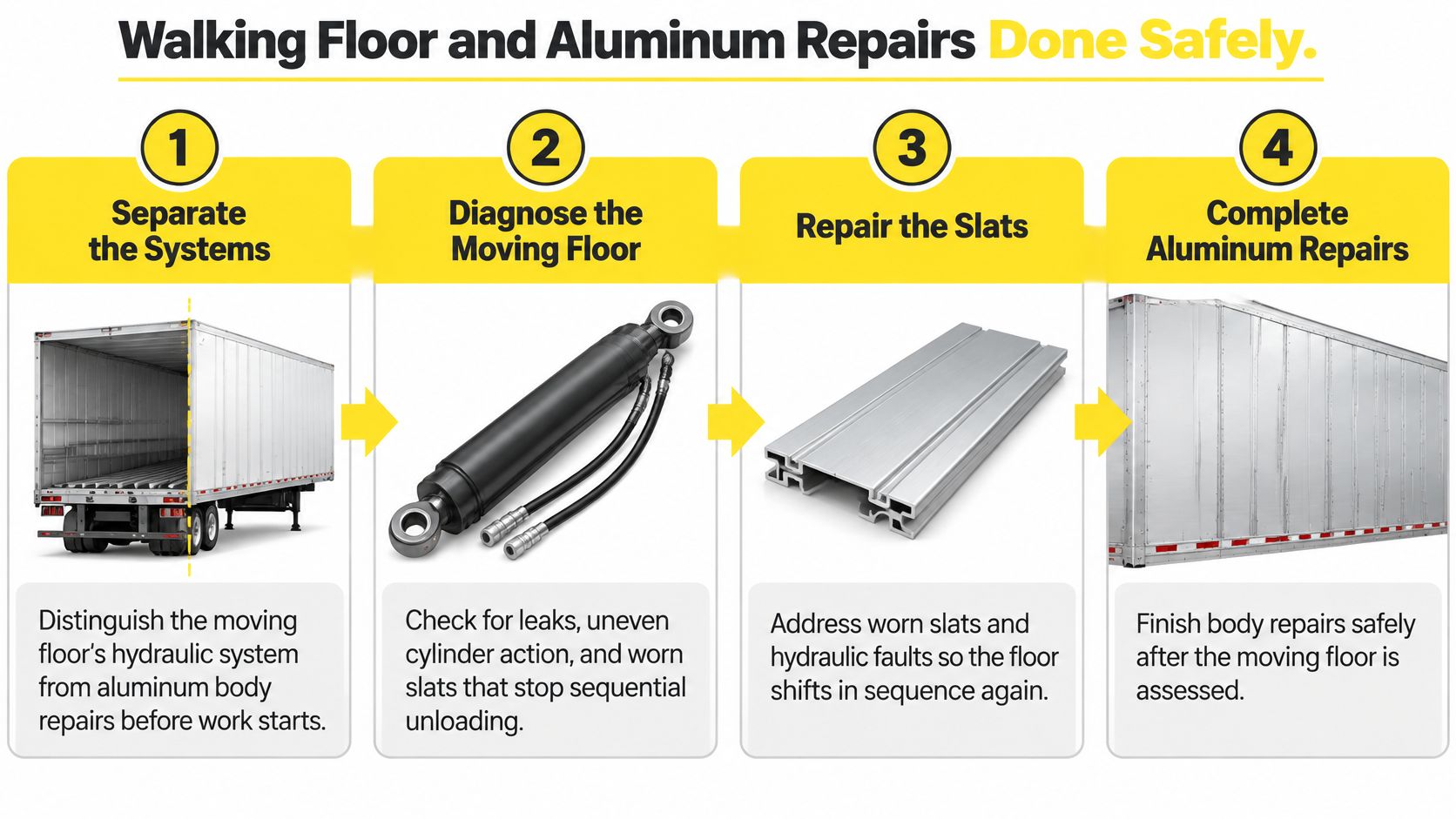
Before you order slats or bearings, match the size to the model manual for that trailer. Keith Walking Floor bearings are available for 3.5" slats and 6" slats. Each bearing has two cutout sizes for fitting over cross-members, 2-5/8" and 3-1/8". The Keith Walking Floor Splash Guard Bearing is 60" long. Cylinders are sold in 3.0" i.d. / 3.5" o.d. or 3.5" i.d. / 4.0" o.d. Those are catalog sizes, not a guess you can transfer from a different floor brand. If the manual and the trailer tag disagree, stop and identify the model before parts are cut or ordered.
Hydraulic work, in order
We diagnose and repair Walking Floor hydraulic systems and replace worn or damaged floor slats. Hands-on work follows a lockout sequence. Skip a step and a pressurized line or a raised floor can move while someone is under it.
- Park on level ground, set the brakes, and chock the wheels.
- Lock out and tag out the power source so nobody can start the system from the cab or a remote.
- Relieve hydraulic pressure before you open any line or fitting, and confirm the gauge reads zero.
- Block any raised body, floor, or cylinder with rated blocks before you reach under it.
- Inspect hoses, fittings, and cylinders for leaks, rub-through, and chafing.
- Measure slat wear and look for cracks or broken fasteners along the deck.
- Replace worn or damaged slats and restore the bearings, seals, or cylinders the inspection called out.
- Test operation under controlled conditions. Remove the lockout only after that test is finished and the floor is back at rest.
Uneven unloading is often one slow cylinder or a row of slats that no longer tracks, not "the whole floor is bad." Replacing every slat because one zone drags wastes the day. Replacing nothing because the truck still drives leaves the hauler stuck at the tip floor.
Aluminum body work
Aluminum trailer bodies crack at welds, door frames, and rub rails, and corrosion starts where dissimilar metals and road salt meet. We weld aluminum on trailers and trucks and fabricate pieces to a specific fit when a stock panel won't match the repair.
Before welding, disconnect the battery, protect hydraulic hoses and wiring from spatter, and clean the aluminum so the weld bonds to metal rather than oxide. After the repair, look at the weld for lack of fusion and for cracks at the ends. Follow the OEM manual for the make and model for structural limits, and don't treat a cosmetic skin patch as a fix for a cracked cross-member.
Where Downtime Actually Comes From
Say a waste-hauling fleet in Hillsborough County pulls a Walking Floor trailer for slat wear. This is a hypothetical, not a shop record. Diagnosis takes a day. Approval waits another day. Parts take three days. Then the trailer waits for a bay. The deck is down nearly a week. The repair itself takes hours. The tractor could have kept working the whole time.

That pattern shows up at scale. Benchmark data covering 1.2 million vehicles, 17.5 billion miles, about $7 billion in service spending, and 9 million work orders found a 31-minute median time to start a work order and a 6.7-day average, according to reporting in Trucking Info's Fleetio benchmark coverage. A few badly delayed jobs dominate the average. In the same set, communication gaps were cited by 31.5% of respondents as a leading barrier to on-time maintenance, technician availability by 27.4%, and unscheduled work by 25.2%.
Who owns which link
A shop can shorten diagnosis and the hours on the wrench. The fleet owns the quality of the intake, the speed of approval, and whether parts were confirmed before the unit was sent. Faster labor on the repair line doesn't shrink a three-day parts wait.
| Delay source | What to measure | Control |
|---|---|---|
| Intake communication | Share of defect reports missing symptoms or photos | Standard intake form with photos |
| Diagnostic time | Hours from drop-off to confirmed diagnosis | Complete symptom descriptions at intake |
| Authorization time | Hours waiting for repair approval | Pre-approve common repairs |
| Parts-wait time | Days waiting for parts after diagnosis | Confirm parts before dispatch |
| Queue time | Days waiting for a bay or technician | Reserve capacity for safety-critical failures |
| Repair time | Labor hours on the job | Scheduled work orders with defined scope |
Photo-based defect reports and a full symptom note cut the first delay. "Floor not working" sends a technician hunting. "Driver's side slats lag after the third stage, wet fitting at the front cylinder, photos attached" lets diagnosis start at the fitting.
We sell truck and trailer parts from inventory, which is the practical control on parts-wait time when the component is one we stock. Walking Floor repairs are set up for fast turnaround so the trailer isn't the unit that strands the route. Turnaround still depends on the links above. A complete intake and parts confirmed before the trailer arrives are fleet-side controls. Bay time and the repair itself sit with the shop.
For a closer look at how staged unloading and delayed handoffs eat a route, this walkthrough is worth ten minutes before you redraw the board.
Track diagnosis, authorization, parts, queue, and repair as separate days. If you only celebrate a shorter labor ticket, the trailer can still miss the week.
Choose Your Maintenance Setup and Request Service
In 2025, 65.5% of surveyed fleets outsourced truck maintenance to third-party providers, while 34.5% managed it in-house, according to Fleet Advantage's Transportation Industry Benchmark Survey as reported by The Trucker. Outsourcing isn't automatically more control. In-house isn't automatically cheaper. The setup you want is the one that shortens your delay chain.
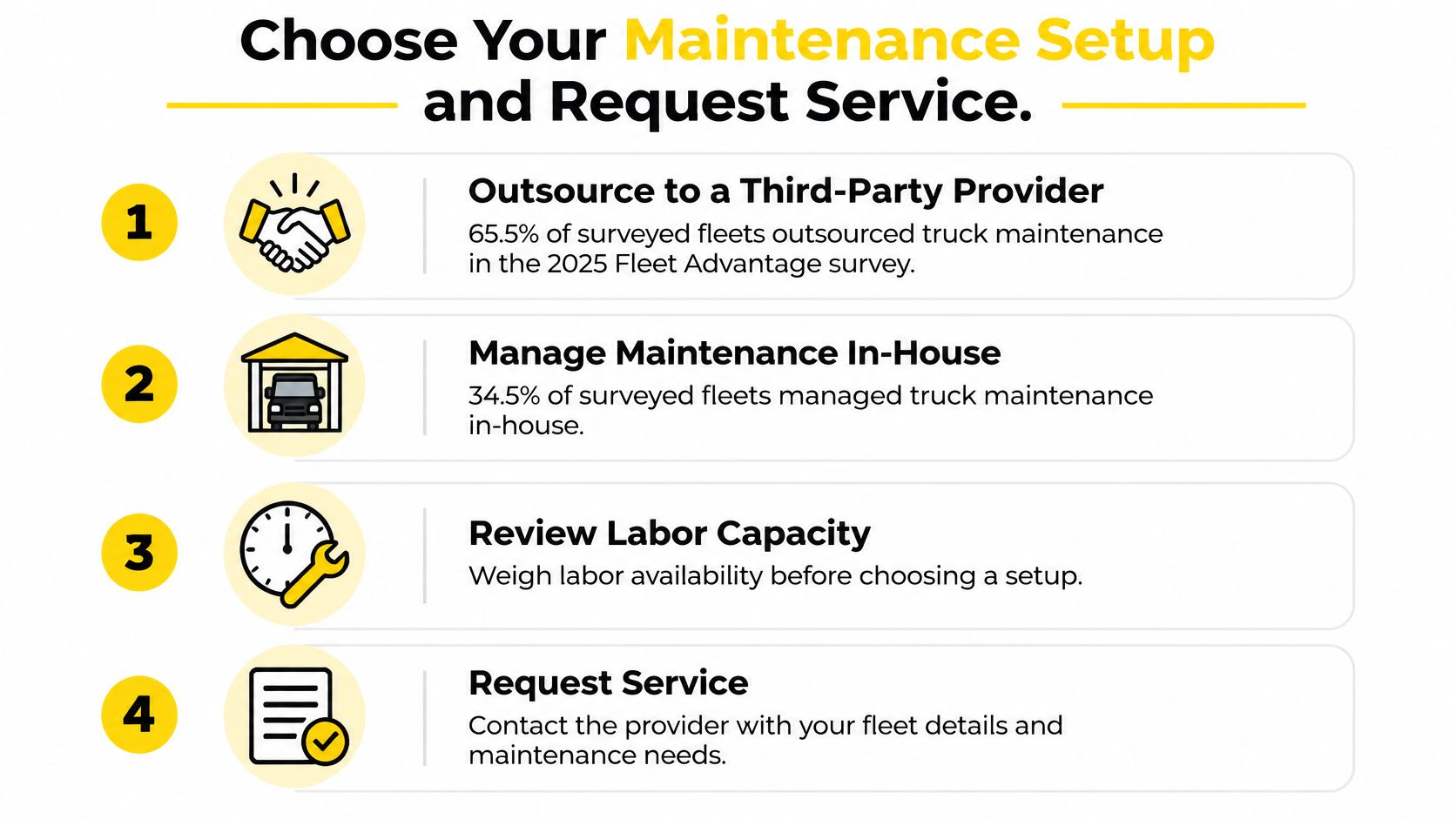
Labor makes the choice sharper. Coverage of 2025 industry research said 65.5% of diesel shops were understaffed, with an average of 19.3% of positions unfilled, and Bureau of Labor Statistics projections cited in that coverage point to roughly 26,500 annual openings for diesel technicians and mechanics during 2024–2034, as summarized by GPS Tracking America. Fewer than 10% of fleets in related benchmark reporting said they hit consistently on-time maintenance. Hiring your way out isn't a plan most small Tampa Bay fleets can execute this year.
Three levels, in the order they pay off
Level one is standardized inspections and symptom-based work orders. Daily reports, a roadworthiness routine, and a written fault description. A five-truck waste fleet should remain at this level until the paperwork is boring and reliable.
Level two is parts and service history. You know which slats, bearings, filters, and brake parts you use, and you can see the last repair on that VIN without calling three people. An on-hand strategy for those parts beats a predictive dashboard that has no failure history to learn from.
Level three is telematics or predictive analytics. Useful once the first two levels are stable. Software doesn't repair a missing handoff or a hose that isn't on the shelf.
What to require from any shop
- Written inspection process: You can see what was checked, not only what was replaced.
- Records that line up with 49 CFR 396.3: Identification, the maintenance schedule, and inspection and repair history the carrier can provide.
- OEM manual use: Intervals and specs come from the make and model, not from a generic mileage guess.
- State and federal fit: The shop's work doesn't replace your duty to confirm the inspection and the paperwork meet the rules that apply to you.
- Parts availability: Common truck, trailer, and floor parts are identifiable before the unit is dispatched to the bay.
- Turnaround in writing: You agree on scope before the job starts, without treating a verbal "soon" as a commitment.
- Clear communication: One intake path for symptoms, photos, and approvals.
Brothers Truck Trailer Repair and Welding Corp. is a single truck and trailer shop at 1620 S 51st St, Tampa, FL 33619. We repair Walking Floor systems, weld and fabricate aluminum, handle truck maintenance and trailer repair, and supply parts from inventory. Custom fabrication is built to the truck or trailer in front of us, not to a catalog silhouette. We aren't a software vendor and we don't run a national fleet program.
Describe the symptom, the unit, and the records you already have, in writing, before the visit. Use the Request Service button at brotherstruckrepairfl.com so the intake arrives with the photos and the fault note attached.
Walking Floor hydraulics, slat replacement, aluminum body repair, truck PM, and trailer parts are the work that keeps a Tampa Bay route from stopping at the first defect. Bring the symptom, the last inspection, and the unit's make and model, and visit Brothers Truck Trailer Repair and Welding Corp. to request service before the next missed window.
Hydraulic system troubleshooting for trucks and trailers: match symptoms to causes, check fluid and pressure safely, and know when to call a technician.
Truck suspension repair guide: spot air leaks, broken springs and U-bolt faults, learn federal inspection limits and know when to park the truck.
Hydraulic hose repair guide: spot failure signs, replace hoses safely, and know when to call a Walking Floor specialist.