Fleet Maintenance Schedule Guide for Trucks and Trailers
A study of one municipal bus fleet found that 92.23% of maintenance hours were unplanned and operational availability averaged 78.47%. The authors found a positive correlation between the share of planned maintenance and availability in that fleet. Use it as an example of what a fleet can measure, and establish a baseline from your own trucks and trailers.
A working fleet maintenance schedule gives each task a due date or service trigger. Start with the manufacturer’s schedule for each unit and component. Duty cycle, load, heat, and driver reports can bring work forward. Track unloading cycles or operating hours when the Walking Floor manual calls for them.
Table of Contents
- Fleet Maintenance Schedule Intervals at a Glance
- How to Build Your Schedule in Six Steps
- Walking Floor Checks to Add to Every Service Visit
- Adjusting Intervals for Duty Cycle and Tampa Heat
- Records That Satisfy Compliance and Shop Handoffs
- Stocking Parts to Cut Unplanned Downtime
- Confirm Your Schedule Before the Next Service Due Date
Fleet Maintenance Schedule Intervals at a Glance
Use the table to separate pre-operation checks, scheduled service and the federal periodic inspection. Set service intervals from the manuals for the truck, trailer and installed components. Before driving a covered commercial vehicle, the driver must be satisfied that listed equipment such as brakes and tires is in good working order under 49 CFR § 392.7.
| Task | When to check or service | Earlier trigger |
|---|---|---|
| Driver pre-trip defect check | Before driving | New pull, noise or other reported defect |
| Walking Floor hydraulic fluid and leak check | Installed drive manual and operating hours | Pressure drop or visible leak |
| Tire pressure and visual tread check | Pre-operation condition check plus scheduled measurements per fleet and manufacturer guidance | Uneven wear or cut sidewall |
| Brake adjustment and air-system function check | Brake and vehicle manufacturer schedule for the actual duty cycle | Pulling, delayed braking, air loss |
| Oil and filter service | Engine manufacturer schedule for the actual duty cycle | Oil analysis or fault code |
| Structural trailer and aluminum weld inspection | Trailer manufacturer inspection guidance and duty cycle | Crack, corrosion or impact damage |
| Federal periodic inspection, each unit | Every 12 months | Address roadside defects when found |
The 12-month periodic inspection is a separate requirement under 49 CFR § 396.17. Each vehicle in a covered combination, including the trailer, needs its own inspection coverage. Keep manufacturer service and condition checks on their own schedule.
Override Triggers That Move a Task Forward
A driver-reported pull, a new fault code, a drop in hydraulic pressure, or a slower unloading cycle can bring an inspection forward. Route the symptom to the shop and document what the technician finds. A condition that makes driving unsafe requires immediate action before dispatch.
Track overdue tasks, the time it takes to close defects, and the due dates for each truck and trailer. Unsafe defects need a documented disposition before the vehicle returns to service.
How to Build Your Schedule in Six Steps
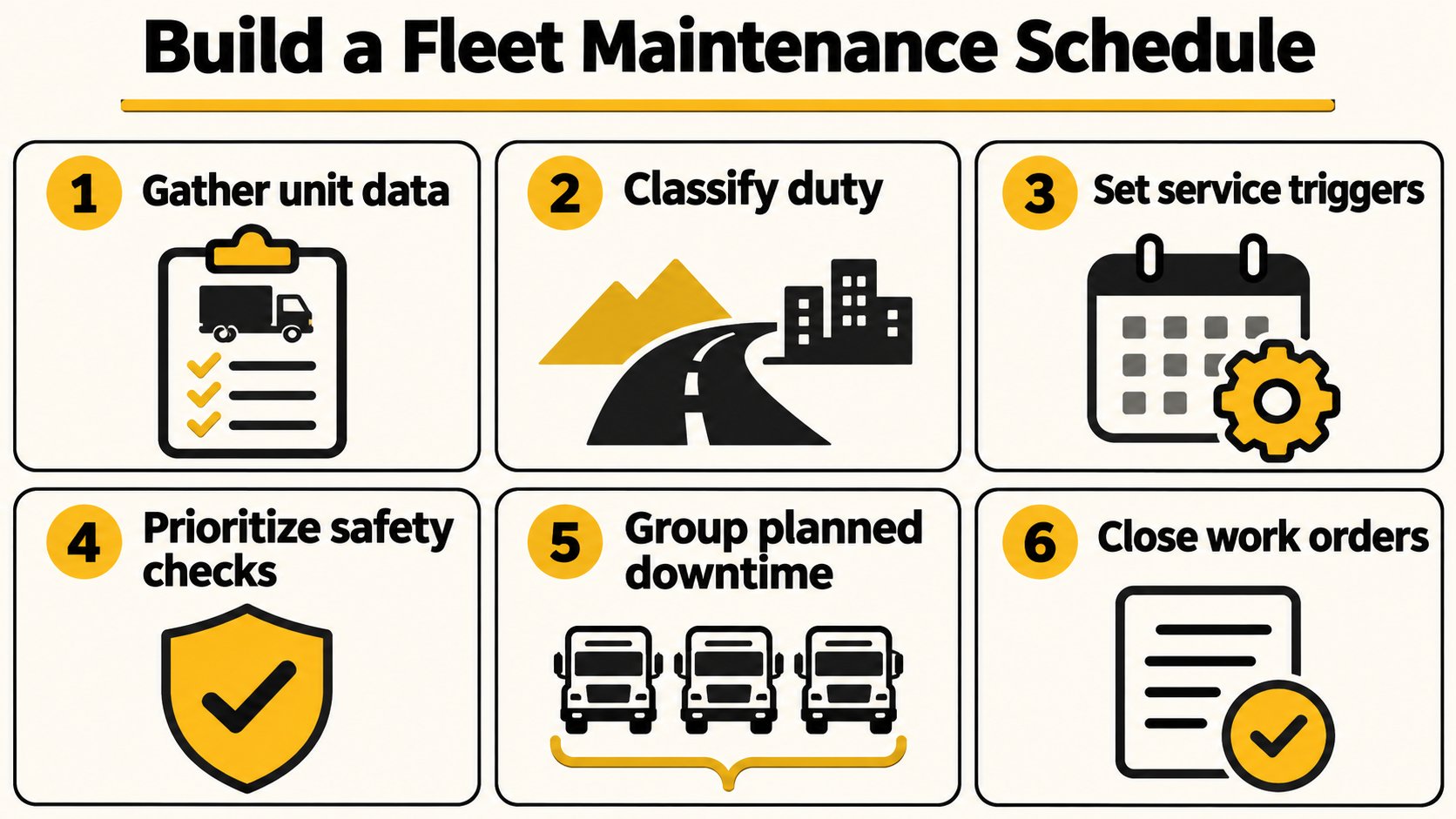
Pull each unit's data into one list. Gather odometer reading, engine hours, fault codes, inspection history, and component replacement dates for every truck and trailer. You can't set a next due point from a history that's split across invoices, memory, and a driver's notebook.
Classify each unit by duty. Sort units into highway, stop-start, waste, aggregate, or municipal service. Two identical trailers age at different rates if one runs long highway miles and the other unloads heavy loads all day at transfer stations.
Set each trigger by whichever limit comes first. Use mileage, engine hours, calendar time, or a monitored condition, and service at the first one reached. This stops an idling-heavy, low-mile unit from sailing past an oil interval just because the odometer barely moved.
Put safety-critical items on shorter cycles. Set inspection frequency for brakes, steering, tires, suspension, trailer structure and the moving floor from the applicable manuals and duty cycle. Escalate unsafe conditions immediately.
Group jobs into planned downtime windows. Reserve bay time and parts before each due date, and bundle tasks that fall close together into one visit. One planned day in the shop beats three half days spread across a month.
Close every work order completely. Record the defect, root cause, parts, labor, measured result, and next due trigger before the unit leaves. That closing note is what turns a repair into usable history for the next technician.
The Calendar-Only Slip
Scheduling by calendar alone is the most common mistake. High-cycle, high-load, and idling-intensive units hit component limits well before a fixed date, while lightly used trucks get over-serviced and burn labor and parts for nothing. Match the trigger to the unit's operating conditions.
Say a Walking Floor trailer's cycle time starts creeping up over two weeks. Don't wait for its scheduled slat check next month. Pull it forward now, check pressure against its own baseline, and look for slat wear or a weakening pump while the problem's still cheap.
How Telematics Alerts Should Change the Schedule
An alert doesn't change the schedule on its own. Treat it as a prompt for a hands-on inspection, and move the task only after a technician confirms the condition. If you don't have full sensor coverage, your trigger inputs are the driver defect log, manual cycle-time readings taken at the same point in the unload, and the shop's repeat-fault notes. That's enough to start. I'd rather have clean manual readings logged every visit than a dashboard full of alerts nobody verifies.
Track more than PM completion. Watch your planned-to-unplanned labor-hour ratio, mean time between failures, mean time to repair, roadside events, and availability. Those numbers tell you whether the schedule's buying uptime.
Walking Floor Checks to Add to Every Service Visit
Identify the installed drive and follow its manual. Before hands-on service, isolate hazardous energy and follow the manufacturer’s lockout/tagout procedure. The KEITH RUNNING FLOOR II DX/DXE manual is one model-specific example. A trained technician should perform any required operating tests under the manual’s safe test conditions.
Hydraulics
Hoses, fittings, and cylinders: With the system isolated, visually inspect for leaks, chafing and wet fittings.
Pressure and cycle time: During a controlled test, compare readings with the unit’s baseline and the manufacturer’s limits for the test conditions.
Fluid condition: Check for contamination and use the fluid specified for the installed system. Investigate fluid loss before returning the equipment to use.
Floor and Slats
Slat wear: Measure wear at the high-contact points and note cracked or bent slats.
Alignment: On a hydraulic KEITH system, inspect slat alignment, cross-drive supports, wear bearings and fasteners as directed by the installed model’s manual.
Driver input: Log any uneven unloading the driver reports, since that's often your earliest floor symptom.
Frame, Bearings, and Supports
Inspect cross-members, welds and aluminum body panels for cracks, corrosion or impact damage. Have a qualified technician evaluate cracks in load-bearing parts. For replacement bearings or splash guards, match the drive model, serial number and part number, then confirm dimensions. KEITH troubleshooting and drive identification shows where to find the serial plate.

Record pressure and cycle time when the service procedure calls for an operating test. Compare readings taken under similar conditions and investigate trends before assigning a cause.
Hold a trailer with suspected structural damage or another unsafe condition for qualified assessment. Take an affected floor system out of operation if a leak, cracked slat or other defect makes its use unsafe.
Group these checks with the brake and tire visit whenever the due dates are close. The trailer's already spotted, wheels are accessible, and the driver isn't losing the unit twice in one month. Bundling is what makes a thorough checklist manageable for a small shop. A checklist that demands a separate pull for every system gets abandoned by week three.
Adjusting Intervals for Duty Cycle and Tampa Heat
High-cycle Walking Floor work changes a schedule more than anything else. A trailer unloading heavy waste or mulch loads all day wears hydraulics and slats on cycles, so its floor checks belong on load counts and cycle time, not trailer miles. Stop-start urban runs hammer brakes and tires first. Aggregate and construction work with frequent loading beats up structure, fasteners, and welds, so those inspections move up for units working rough sites.
Here's a shop-floor look at how duty-based scheduling gets reviewed against real trucks.
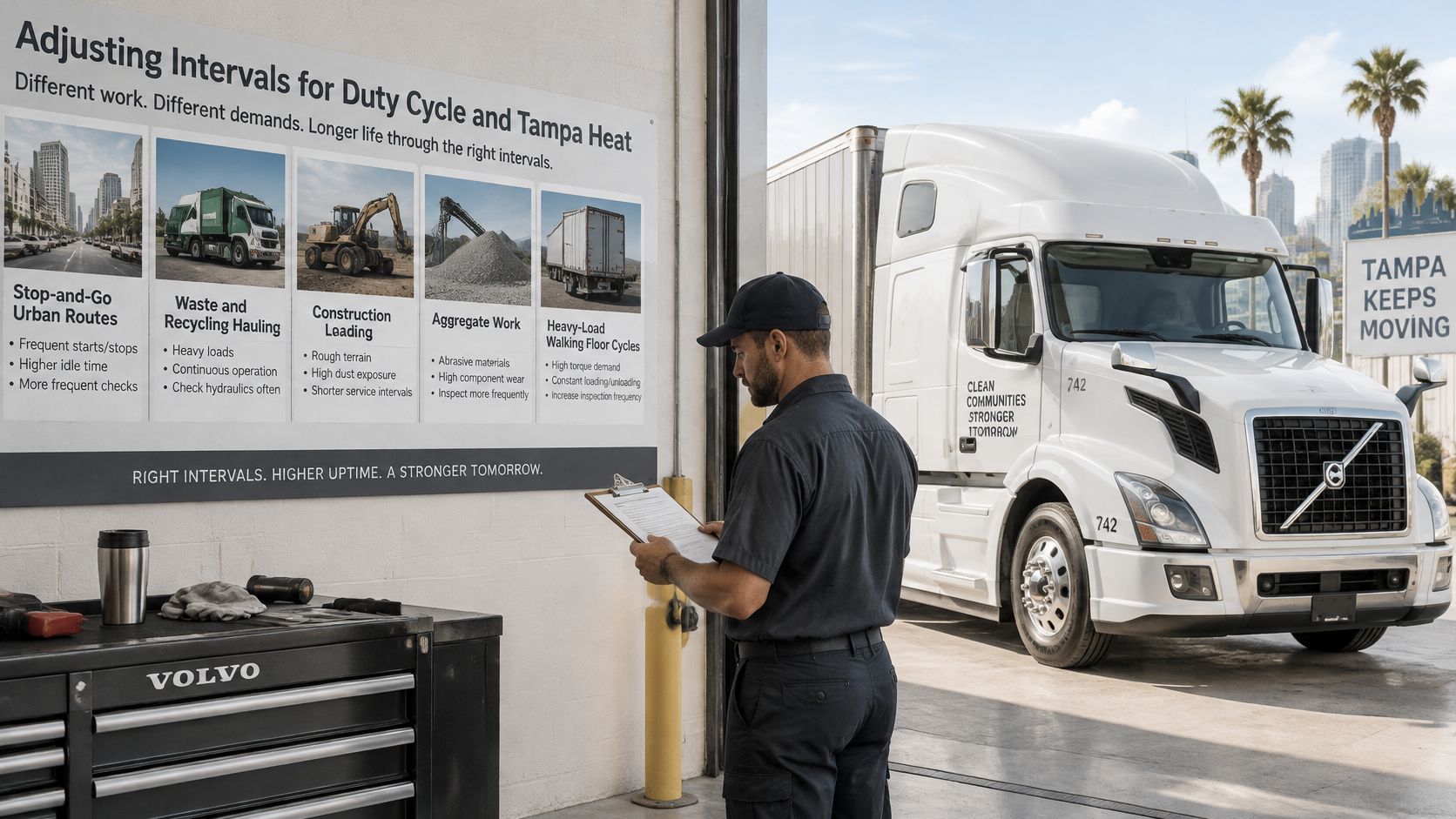
Tampa heat, moisture and corrosion exposure can increase wear. Start with the manufacturer’s guidance for the actual duty cycle. Use inspection results, operating hours and repeat faults to bring checks forward, and document why the interval changed.
The 2025 CVSA International Roadcheck report recorded 56,178 inspections across North America and an 18.1% vehicle out-of-service rate. Brake systems led the vehicle out-of-service violation categories. Tires accounted for 2,899 violations, or 21.4% of vehicle out-of-service violations. Use inspection findings from your own fleet alongside these results when prioritizing checks.
Document brake and tire defects and assess them before dispatch. Under 49 CFR § 396.7, a vehicle must not be operated in a condition likely to cause a crash or breakdown. Keep unsafe units out of service pending repair and follow any official out-of-service order.
Records That Satisfy Compliance and Shop Handoffs
Start with the retention rules, then build the file to match.
| Record | How long to keep | Where to keep it |
|---|---|---|
| Maintenance file with unit identity and due dates | 1 year and for 6 months after the unit leaves the carrier’s control | Where the unit is housed or maintained |
| Periodic inspection report | 14 months from the report date | Where the vehicle is housed or maintained, subject to the rule’s exception |
| Documentation of the current periodic inspection | While the unit is in service, with a qualifying inspection in the preceding 12 months | On the vehicle |
| Work order supporting a required maintenance record | Same retention as the required maintenance record it supports | Where the vehicle is housed or maintained |
Keep one maintenance file per unit. 49 CFR § 396.3 sets out maintenance records for covered vehicles controlled for 30 consecutive days or more, including required unit identification, due dates and the date and nature of completed work. 49 CFR § 396.21 covers retention of the periodic inspection report. Keep qualifying documentation of the current inspection on the vehicle under 49 CFR § 396.17.
The Shop Handoff
Every work order should carry the defect, the parts used, and the return-to-service status. That's how the next technician spots a repeat fault instead of treating the third hose failure on the same trailer as bad luck. Write the measured result too. "Checked brakes" helps nobody. A pushrod stroke measurement does.
The Five-Minute Audit Test
Pick one trailer at random and try to produce three things in five minutes: its last inspection, its open defects, and its next due date. If you can't, your records exist but they aren't usable. Fix the filing before an auditor or a roadside inspector finds the gap for you.
Stocking Parts to Cut Unplanned Downtime
Track maintenance-related downtime per truck and month using a consistent definition and minimum duration. Record time waiting for parts separately from diagnosis and repair time. Your own records can show which parts repeatedly delay a return to service and help set stock levels.

What to Keep on Hand
Hydraulic hoses and fittings: Walking Floor units need these on short notice, and odd lengths carry long lead times.
Filters and fluids: Stock for your most common service so a routine job never waits on a delivery.
Brake pads and air-system components: High-wear, safety-critical, and the last thing you want to overnight.
Slats and fasteners: Floor repairs stall without the right slat profile in the rack.
Tires in your fleet's sizes: A cut sidewall shouldn't sideline a trailer for days.
The Brothers Truck Trailer Repair and Welding Corp. parts catalog can help you match common truck and trailer components against what your schedule calls for next. Reserve parts for each task when its trigger is about 30 days out, so planned work never waits on an order. Review your downtime events and repeat faults monthly. If repeat hose failures on one trailer start rising, move its hydraulic check forward and raise the hose stock level at the same time. The failure trend and the stocking level should change together.
Confirm Your Schedule Before the Next Service Due Date
Do this with three units this week, one truck, one trailer, and one Walking Floor unit. Confirm each one has its own due dates in its own file, with the trailer standing alone rather than riding on the tractor's paperwork. Then confirm the parts for each unit's next task are in stock or reserved, using the same reorder logic you applied to hoses, brake components, and slats.
Book the planned downtime window before the next due date, not after a failure forces your hand. That's where we fit: Walking Floor preventive maintenance to avoid costly breakdowns and optimize system performance, aluminum welding and fabrication for structural repairs identified during scheduled or condition-based inspections, and parts support from our truck and trailer inventory for each unit's next task. Walking Floor repairs run with fast turnaround times to minimize downtime, which only helps if the unit arrives on a planned window with parts ready.
Start from the Brothers Truck Trailer Repair and Welding Corp. homepage and send us your unit list with due dates. We'll schedule the first planned window from that list, and your schedule stops being a document and starts being a booking.
Send Brothers Truck Trailer Repair and Welding Corp. your truck, trailer, and Walking Floor unit list with next due dates, and we'll turn it into planned service windows covering Walking Floor maintenance, aluminum welding, fabrication, and parts from our in-stock inventory. Visit Brothers Truck Trailer Repair and Welding Corp. to get your first window booked before the next due date turns into downtime.

Find the right diesel truck oil change interval by engine, duty cycle and oil analysis, with manufacturer limits and real fleet practice compared.
Learn the major semi truck parts, how to match replacements using VIN, part numbers and ratings, and how to weigh part price against downtime.

Learn hydraulic cylinder repair basics for trucks and trailers: symptoms, causes, diagnostic checks, repair options and when to call a specialist.