Fleet Maintenance Checklist Template: Fields and Records
Dispatch wants the trailer back, the driver reported a hydraulic leak, and the shop has already replaced a hose. But the work order doesn't show which hose failed, whether the Walking Floor completed its operating cycle, or who approved the trailer for service. You're left chasing signatures while the next load waits.
A useful fleet maintenance checklist template prevents that handoff problem. It connects the driver's finding to a unit, a repair decision, the parts installed, a verification test, and a release record. For commercial trucks and trailers, that connection matters more than a page full of checked boxes.
Table of Contents
- Core Fields Every Fleet Template Must Record
- Inspection Intervals From Daily Walk-Around to Annual Review
- Condition Codes and What Each One Requires
- Copyable Quick-Reference Checklist by Component
- Walking Floor and Aluminum Trailer Modules to Add
- Defect-to-Release Workflow From Driver Report to Dispatch
- Linking Work Orders, DVIRs and Parts
- Records to Keep and How Long to Keep Them
- Test the Template on One Unit Before Your Next Inspection
Core Fields Every Fleet Template Must Record
Required template fields and what each one records
| Field | What to Record | Example Entry |
|---|---|---|
| Unit number | Company or unit ID for every truck and trailer | Trailer TR-2041 |
| Make, model and year | Identifies the asset and its parts catalog | Make, model and year from the unit record |
| VIN or serial number | Ties records to the physical unit, including trailers | VIN from door placard |
| Odometer or engine hours | Sets the mileage-based service trigger | Meter reading at inspection |
| Inspection type and due date | Shows which scheduled task is due and when | Scheduled hydraulic inspection, due date from maintenance calendar |
| Defect and status code | Records what was found and how urgent it is | Brake chamber leak, out of service |
| Work-order number | Links the defect to the repair | Assigned shop work-order ID |
| Parts used | Documents each component installed | Hose assembly, part number from invoice |
| Technician and driver sign-off | Confirms repair and driver review | Initials and date |
| Release to service | Final approval before dispatch | Supervisor signature and time |
| Records location | Shows where the original file is kept | Named file or system location |
These fields form the backbone of the template, not a substitute for inspection details. Add the inspection date, completion date, responsible person's name, findings, corrective action, and supporting attachments to each event. Where ownership matters, identify the leasing or owning party too.
Under 49 CFR Part 396, carriers must systematically inspect, repair, and maintain controlled commercial motor vehicles and keep records identifying the vehicle and documenting scheduled and completed maintenance. The table combines that recordkeeping foundation with practical shop controls. Not every individual field is a separately prescribed federal form requirement.
Give each field a clear job
The VIN or serial number keeps a trailer's history attached to the trailer when tractors change. The meter reading establishes when usage-based service becomes due. Record the reading's unit of measure so engine hours aren't mistaken for distance.
The work-order number gives a reported symptom a repair destination. Parts entries identify what was installed, while signatures distinguish the person who performed the repair from the person who authorized dispatch.
Practical rule: A checked box establishes little unless another person can identify the asset, the finding, the action, and the approval.
Records location should name a usable folder or system path, not say office. A missing field can leave a gap in the evidence even when the mechanical work was sound.
Set up one master row per unit, then attach separate inspection and repair records beneath it. Keep the field order identical across trucks and trailers so drivers and technicians learn one form.
Inspection Intervals From Daily Walk-Around to Annual Review
Inspection intervals and what each one covers
| Interval | Typical Checks | Trigger or Rule |
|---|---|---|
| Daily driver checks and applicable end-of-day DVIR | Driver inspection findings covering service brakes, trailer brake connections, parking brake, lights, tires, wheels, coupling devices, fluid leaks | Resolve safety defects before dispatch and follow the applicable DVIR rule |
| Weekly | Hydraulic fluid level, slat and floor condition on Walking Floor trailers | Fleet policy sets the schedule |
| Monthly | Tire pressure and tread depth, lighting, fastener torque on guards and cross-members | Fleet policy sets the schedule |
| Mileage or engine hours | Oil and fluid service, filters, belts | Manufacturer interval, next-due reading stored |
| Annual | Full periodic inspection by a qualified inspector | At least once during the preceding 12 months for each covered vehicle |
| After any repair | Appropriate functional test, leak check, weld re-inspection | Fleet release procedure, using safe test conditions |
Treat the weekly and monthly rows as starting points for fleet policy, not universal legal intervals. A heavily used unloading system may need attention more often than a lightly used trailer. A developing defect needs action when discovered, not when its calendar row comes due.
Separate inspection from scheduled service
A daily walk-around identifies obvious damage, leaks, lighting failures, and operating concerns. It doesn't replace measured tire checks, access-dependent chassis inspections, or hydraulic-system maintenance. Likewise, placing tire pressure in a monthly service row doesn't mean drivers should ignore a visibly low tire between services.
Store both the last completed reading and the next-due reading for mileage- or hour-based tasks. Use the manufacturer's maintenance schedule for the installed engine, hydraulic power unit, and other equipment. Don't copy a generic oil-change interval across dissimilar assets.
Under 49 CFR 396.17, each covered vehicle in a combination must pass a periodic inspection at least once during the preceding 12 months and carry the required documentation. Keep the report in the unit file and make the next due date visible to dispatch and maintenance.
Federal maintenance responsibility continues between periodic inspections; FMCSA's inspection, repair, and maintenance guidance requires safety-related parts and accessories to remain in safe and proper operating condition.
Add a schedule basis field beside each task: regulation, manufacturer, or fleet policy. That small distinction lets a supervisor explain why a task exists and who can authorize a change to its interval.
Condition Codes and What Each One Requires
Defect status codes and required actions
| Status | Meaning | Required Action | Timing |
|---|---|---|---|
| Pass | No defect found | Sign and record the next due date | Next scheduled check |
| Monitor | Wear or condition that isn't affecting safe operation | Record a measurement and recheck | At the next inspection interval |
| Repair before next trip | Defect affects safety or operation | Repair the safety defect and certify it on the applicable DVIR before operation | Before next dispatch |
| Internal hold | Defect makes the unit unsafe or immobile | Hold the unit from dispatch and open a work order | Immediately |
These are internal maintenance-control codes. They don't replace official roadside out-of-service criteria or authorize a technician to disregard an enforcement order.
Roadside inspectors can record violations without issuing an out-of-service order. Under 49 CFR 396.9(c), authorized personnel place a vehicle out of service when its mechanical condition or loading is likely to cause an accident or breakdown. Keep an officially marked unit out of operation until the repairs specified in the notice are completed. Record internal dispatch holds separately from enforcement orders.
Make monitor measurable
A monitor entry needs a baseline: measured tread depth, a fluid-level reading taken under specified conditions, or a photographed wear location. Record who will recheck it and when. Don't use monitor to postpone a known safety repair.
For example, a hose with superficial outer-cover wear might receive a documented assessment and a planned recheck. If the next inspection finds exposed reinforcement or leakage, the technician changes the status and preserves both findings in the defect history. The current condition determines whether it requires repair before travel or immediate isolation.
If a technician can't determine whether a defect affects safety, hold the unit out of service until a qualified person evaluates it.
Certification that a repair is unnecessary must explain that decision. It isn't a waiver allowing dispatch with an unresolved safety defect.
Copyable Quick-Reference Checklist by Component
Use P for pass, M for monitor, R for repair before next trip, and O for out of service. Select one status per inspection line, then attach measurements and defect notes.
Component inspection worksheet
| Component and Items to Inspect | P | M | R | O |
|---|---|---|---|---|
| Brakes: service brake, parking brake, trailer brake connections, air chambers, lines and hoses | ☐ | ☐ | ☐ | ☐ |
| Steering and suspension: steering linkage, springs, air bags, U-bolts, axles and attaching parts | ☐ | ☐ | ☐ | ☐ |
| Wheels and tires: tread depth, pressure, rims, lug fasteners | ☐ | ☐ | ☐ | ☐ |
| Frame and structure: rails, cross-members, floor and body welds, corrosion at fasteners | ☐ | ☐ | ☐ | ☐ |
| Lighting and reflectors: each lamp, lens and reflector | ☐ | ☐ | ☐ | ☐ |
| Coupling devices: tractor fifth wheel and trailer upper coupler or kingpin, as equipped | ☐ | ☐ | ☐ | ☐ |
| Fluid and air leaks: engine fluids, fuel system, air system | ☐ | ☐ | ☐ | ☐ |
| Emergency equipment: fire extinguisher, warning triangles | ☐ | ☐ | ☐ | ☐ |
| Load securement: tie-downs, chains, straps and attachment points | ☐ | ☐ | ☐ | ☐ |
The visual reference highlights component checks that belong in the working form.
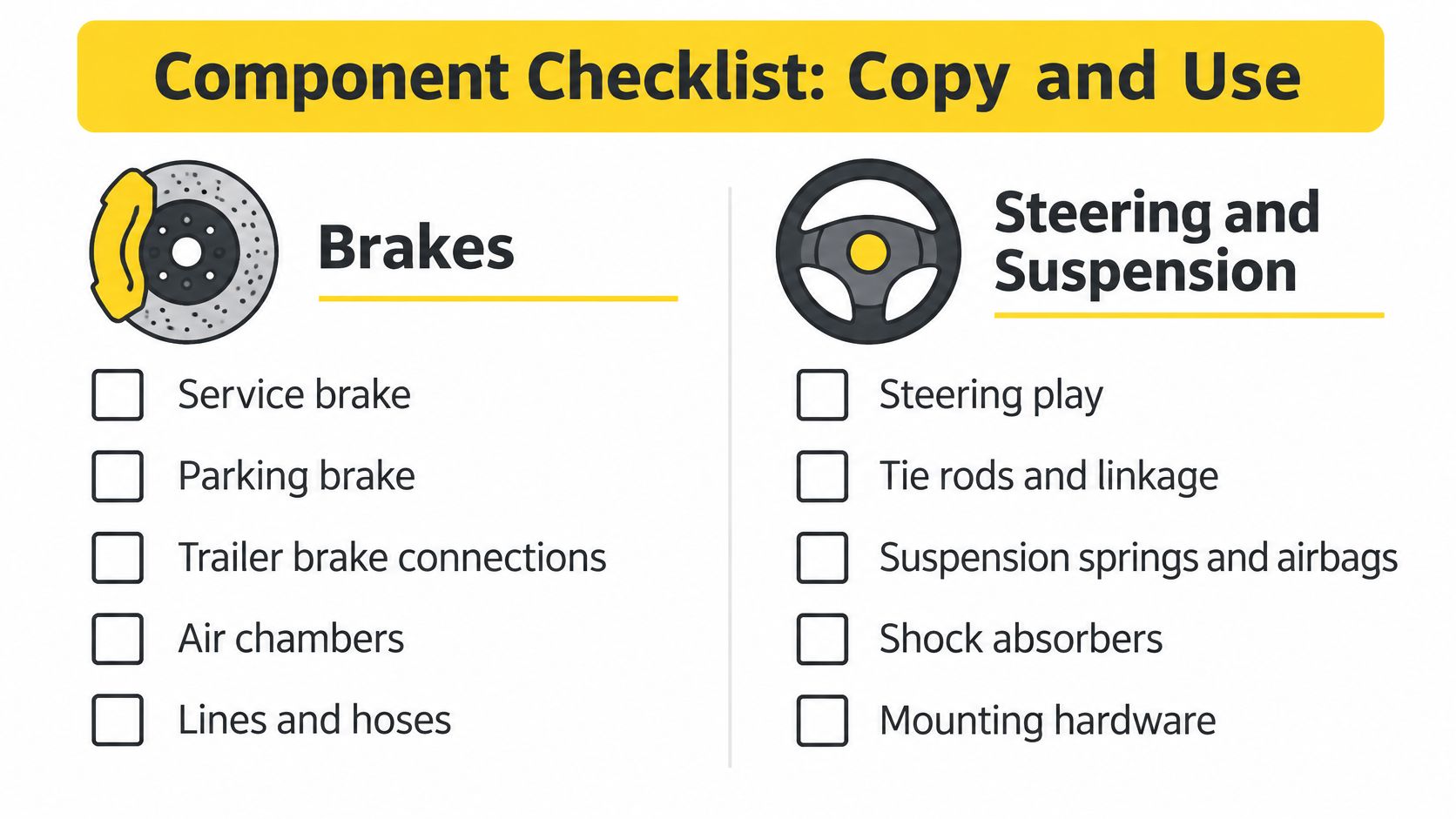
Expand categories into inspection lines
The table is a compact supervisor's reference. In the technician's form, give each listed component its own line so a failed air hose doesn't disappear inside a general brakes pass.
Use a tire-pressure gauge, tread-depth gauge, suitable lighting, and the specified torque procedure where applicable. Record actual measurements rather than acceptable when a limit determines the result.
FMCSA's maintenance guidance supports coverage of frames, suspension, axles, wheels, steering, and other components affecting safe operation. Include those less-visible assemblies, not only lamps and fluid levels.
Keep the active list limited to equipment the fleet operates. Remove irrelevant categories from asset-specific forms, or mark individual absent components not applicable with a reason. Don't let a blank box mean either not inspected or not fitted.
Walking Floor and Aluminum Trailer Modules to Add
A moving floor can move without completing its sequence correctly. The KEITH Workhorse owner’s manual describes a four-phase cycle driven by three double-acting hydraulic cylinders. That example is specific to the Workhorse. The KEITH RX2 uses two cylinders.
Record the installed drive’s make, model and serial number. Follow that model’s manual for the test setup, safe operating conditions and expected cycle. Note any incomplete phase, binding or abnormal movement before deciding which parts to replace.
Walking Floor operating checks
Reservoir condition: Record fluid level in the specified checking position and note contamination symptoms.
Hydraulic connections: Inspect hoses, fittings, cylinders, and valves for leakage, damage, and correct operation.
Sequence and slats: Observe even advancement, abnormal timing, binding, and incomplete retraction.
Protection and attachment: Inspect guards, fasteners, floor alignment, and surrounding clearance.
Never search for a pressurized hydraulic leak with your hand. Isolate and depressurize equipment before hands-on inspection, and keep personnel clear of the moving floor during testing.
Aluminum and structural repair checks
Damage description: Identify crack location, damage extent, and measured base-material thickness.
Repair plan: Distinguish panel work from damage to a load-bearing part. For structural work, document whether the manufacturer permits repair, the approved method, and when replacement is required.
Accountability: Name the welder or technician. Record applicable qualifications, the approved welding procedure, and supporting photographs.
Verification: Use the applicable acceptance criteria. Document inspection results, alignment, and any remaining distortion or interference before release.
A useful hypothetical entry reads: uneven unloading during the return phase, suspected cylinder-specific interruption, diagnosis pending. Open the repair record before replacing parts, then add the confirmed cause, installed components, and final cycle-test result as the work proceeds.
Don't treat a new weld bead as proof that the underlying structural problem is resolved. Inspect the surrounding material and attachment areas, too.
Give each module its own page or dedicated screen. Technicians should be able to complete a Walking Floor diagnosis or aluminum repair record without scrolling through unrelated tractor items.
Defect-to-Release Workflow From Driver Report to Dispatch
Record the driver's report. Identify the unit, report date, operating symptoms, and each defect separately so the technician knows what to investigate. The common slip is a vague entry such as floor problem with no location or operating condition.
Assign a condition code after assessment. A technician confirms the concern and selects the appropriate status, preventing dispatch from interpreting an unreviewed note as approval. The slip is assigning pass from the desk without checking the affected equipment.
Open the work order. Write its identifier on the driver report and carry the report identifier into the repair record, giving both teams a traceable handoff. The slip is opening an unrelated job with no reference to the original finding.
Repair and document the parts. Record the corrective action, each installed component, its part number, and its invoice reference so the repair can be reconstructed later. The slip is recording hose replaced without identifying the hose or its routing.
Test under operating conditions. Use the applicable brake or moving-floor test procedure and document the results. Test with a load only if the installed floor manufacturer’s procedure calls for it and the shop can control the test area. Keep personnel clear and check for leaks, interference, uneven movement or distortion before signing off.
Certify the repair on the applicable DVIR. Under 49 CFR 396.11(a)(3), repair listed defects likely to affect safe operation before the vehicle operates again. The carrier or its agent certifies on the DVIR that the defect was repaired or that repair was unnecessary, as applicable. Record separate technician and reviewer signatures if shop policy calls for them.
Record driver review and release to dispatch. Before driving, the driver reviews the last required DVIR and signs it as applicable under 49 CFR 396.13. The signature exception covers defects on a towed unit no longer in the combination. Once required actions are complete, record the fleet’s release decision and notify dispatch.
Keep reporting rules distinct from shop policy
A fleet can require a report after every shift. Under 49 CFR 396.11(a), when the rule applies, drivers prepare and sign a DVIR at the end of the workday for each vehicle with a discovered or reported defect that could affect safe operation or cause a breakdown. The federal rule does not require a report when no such defect is found or reported. Check the applicable exceptions and separate rules for intermodal equipment.
Release check: The loop is closed when the release signature is traceable to the original report number and its resolved defects.
Linking Work Orders, DVIRs and Parts
Consider a hypothetical Walking Floor trailer identified as TR-2041. Its driver reports a leaking hydraulic hose and records where the leak appears during unloading. Maintenance opens WO-0873, carrying the driver's report identifier into the work order.
The technician identifies the hose assembly, records the installed part number, and attaches the invoice. After the repair, the trailer completes the appropriate loaded operating test, the technician signs the repair certification, and the driver acknowledges the completed work. The release record carries the same report and work-order references.
Use identifiers rather than memory
| Linking Key | What It Connects |
|---|---|
| Unit number | Every inspection and repair to the correct vehicle |
| DVIR or driver-report number | The reported finding to its maintenance response |
| Work-order number | Diagnosis, labor, parts invoices, tests and certification |
| Periodic-inspection reference | The inspection report to the scheduled next due date |
When identifying replacement components, use the truck and trailer parts catalog alongside the equipment identification and confirmed part specification. A catalog selection doesn't replace checking fitment against the installed system.
A repair without a matching report or inspection finding leaves an unexplained gap. A parts invoice without a unit reference proves a purchase, not installation on that trailer.
Keep the original symptom even when the diagnosis changes. The driver's observation and the technician's confirmed cause serve different purposes.
Review repeated failures
As a fleet policy, review defect history by unit and component each quarter. If the same trailer suffers another hose failure, compare routing, clamps, abrasion points, fitting alignment, and movement before authorizing another replacement.
Preserve those findings in the next work order. Otherwise, a technically correct replacement can leave the cause of the repeat failure untouched.
Records to Keep and How Long to Keep Them
Retention periods for each maintenance record
| Record | Retention Rule | What It Holds |
|---|---|---|
| Maintenance file for each covered vehicle | One year where housed or maintained, and six months after the vehicle leaves carrier control | Vehicle identity, scheduled work, inspections and repairs |
| Applicable DVIR and related certifications | Three months from the date the written report was prepared | Driver findings, certification of corrective action and certification of driver review when applicable |
| Periodic-inspection reports | Fourteen months from the date of the inspection report | Annual inspection record |
| Required records at a regional office or driver work-reporting location | Produce within 48 hours of an authorized request, excluding Saturdays, Sundays and federal holidays | Make available at the principal place of business or another location specified by the authorized representative |
Keep the retention periods separate from the deadline for producing records. 49 CFR 390.29(b) applies to required records kept at a regional office or driver work-reporting location. After a request from an authorized FMCSA representative, make them available within 48 hours at the principal place of business or another location specified by the representative. Saturdays, Sundays and federal holidays do not count. Carry evidence of the periodic inspection on the vehicle as required by §396.17(c).
A checklist alone does not establish a maintenance record. Under 49 CFR 396.3(b)–(c), the applicable carrier recordkeeping requirement covers vehicles the carrier controls for at least 30 consecutive days. Include the vehicle’s identity, who furnishes it if the carrier does not own it, scheduled work and due dates, and the date and nature of completed inspections, repairs and maintenance.
Make storage usable during an audit
Electronic storage doesn't fix missing evidence. A scanned invoice named receipt won't help a supervisor locate the repair certification or determine whether the correct trailer was tested.
Use a consistent folder structure or searchable record fields. Include unit identity, trailer identification, meter reading where applicable, defect severity, service status, work-order reference, parts, signatures, and the location of the original supporting documents.
Mixed fleets: Keep truck and trailer histories separate even when they operate together.
Leased assets: Record the controlling party and preserve the maintenance history needed during your control.
Outsourced repairs: Obtain the completed repair detail, not just the payment receipt.
Remote files: Assign someone responsible for retrieving current records when requested.
Set deletion rules by record type
Create a retention label for each document category rather than applying one automatic deletion date to everything. When a document serves multiple purposes, preserve it for the longest applicable period, including any additional legal hold.
Test retrieval using an actual defect file. A supervisor should be able to locate the original finding, repair evidence, and release approval without relying on the technician who performed the job.
Test the Template on One Unit Before Your Next Inspection
Complete asset identities for every truck and trailer.
Confirm schedule triggers and distinguish regulation, manufacturer guidance, and fleet policy.
Adopt the condition codes with clear responsibility for status changes.
Assign retention rules and a named records location.
Run a complete defect-to-release trial before issuing the form fleetwide.
Use a trailer inspection as the practical trial, not just a desk review.

Choose a Walking Floor trailer or tractor with a recent defect. Ask a supervisor who didn't perform the repair to retrieve the driver report, work order, parts documentation, test result, and release. If the supervisor can assemble that chain within minutes, the template is usable; if not, correct the missing reference or unclear field before expanding it.
At Brothers Truck Trailer Repair and Welding Corp., we specialize in Walking Floor repair and maintenance, with fast turnaround practices intended to minimize downtime. Our truck maintenance includes preventative maintenance programs and thorough roadworthiness inspections, alongside aluminum welding, fabrication, and parts support.
Keep the final form short enough to use but detailed enough to reconstruct a repair. Remove duplicate questions, not the evidence needed to explain why a unit returned to service.
We offer Walking Floor diagnostics and repair, aluminum welding, fabrication, truck maintenance, and parts support for commercial truck and trailer operators. Bring your unit identification, recent defect report, and draft checklist to a shop discussion so the repair and verification fields match the equipment you run. Visit Brothers Truck Trailer Repair and Welding Corp. to discuss the next inspection or maintenance job.

Find the right diesel truck oil change interval by engine, duty cycle and oil analysis, with manufacturer limits and real fleet practice compared.
Learn the major semi truck parts, how to match replacements using VIN, part numbers and ratings, and how to weigh part price against downtime.
Learn hydraulic cylinder repair basics for trucks and trailers: symptoms, causes, diagnostic checks, repair options and when to call a specialist.