DOT Trailer Inspection Requirements Explained for 2026
Every commercial motor vehicle, and every segment of a combination, must pass a DOT periodic inspection at least once every 12 months, and that includes the tractor, the semitrailer, any full trailer and any converter dolly. The inspection report stays on file for 14 months, and proof of the most recent inspection has to ride on the vehicle itself.
Most compliance failures aren't exotic. They're schedule gaps, split documentation, and trailers that changed hands without the paperwork following them. That's why the annual inspection works best treated as one layer of three: unit-level inspections, continuous maintenance between them, and the in-route cargo and securement checks drivers owe on every loaded trip.
Table of Contents
- DOT Trailer Inspection Requirements at a Glance
- Trailer Scope, Timing and Paperwork Controls
- What Inspectors Check on a Trailer
- Annual Inspection vs Roadside Inspection
- Staying Compliant Between Annual Inspections
- Turn Inspection Findings Into a Repair Plan
DOT Trailer Inspection Requirements at a Glance
The rule that catches more fleets than any other is scope. Federal rules treat a trailer as an independently inspectable commercial motor vehicle whenever it's part of a combination, and under 49 CFR §396.17 every commercial motor vehicle, and each segment of a combination vehicle, must receive a periodic inspection at least once during every 12-month period. Inspecting only the tractor doesn't satisfy the requirement for the combination, as the FMCSA guidance on periodic inspection requirements makes clear.
A carrier may not use a covered commercial motor vehicle unless the applicable unit has passed an inspection within the preceding 12 months. The inspector must be qualified under Appendix A to 49 CFR Part 396, meaning someone who understands those standards and can identify defective components against them. The federal minimum scope runs through brakes, coupling devices, lighting and electrical equipment, tires, wheels and rims, suspension and the vehicle frame.
Federal trailer inspection requirements at a glance
| Requirement | What it covers | Frequency or deadline | Rule | Proof or record |
|---|---|---|---|---|
| Periodic (annual) inspection | Every commercial motor vehicle and each segment of a combination: tractor, semitrailer, full trailer, converter dolly | At least once every 12 months | 49 CFR §396.17 | Decal, sticker or report carried on the vehicle |
| Qualified inspector | Inspector trained or experienced in 49 CFR Part 396 Appendix A standards who can identify defective components | Every periodic inspection | 49 CFR §396.17 | Inspector qualification records |
| Report retention | Original periodic inspection report or a copy held by the carrier | Keep for 14 months | 49 CFR §396.17 | Report showing unit ID, date, defects and approval |
| Continuous maintenance | All parts and accessories in safe and proper operating condition at all times | Ongoing between inspections | 49 CFR §396.3 | Maintenance records and defect reports |
| Driver cargo rechecks | Cargo and securement checked within the first 50 miles, then at 3 hours, 150 miles or a duty-status change | Every loaded trip | 49 CFR §392.9 | Driver verification records |
| Roadside inspection | North American Standard Inspection Program checks by enforcement officers | As encountered on the road | FMCSA NAS program | Roadside inspection report and any out-of-service order |
These requirements aren't abstract filing duties. Structural, brake, suspension, coupling, tire and lighting work all feed directly into whether a trailer can pass, which is why inspection dates and repair schedules belong in the same conversation.
States can layer their own inspection rules on top of the federal floor. Fleets running out of Tampa, or anywhere else in Florida, should confirm state-specific requirements before treating the federal baseline as the whole obligation.
Baseline test: if the inspection date on the trailer doesn't match the unit number in your file, that trailer isn't cleared, however well it pulls.
Treat the table as the compliance baseline. The work below breaks it down unit by unit, because the trailer is usually where the paperwork falls apart first.
Trailer Scope, Timing and Paperwork Controls
Each unit in the combination needs its own record
A semitrailer, a full trailer and a converter dolly each need an inspection record that identifies that unit. A tractor sticker does not cover the trailer behind it. The periodic inspection regulations in 49 CFR Part 396 apply to every component of a combination vehicle, so a borrowed trailer must have its own current inspection documentation before dispatch.
The record trail must stay with the equipment as it moves between fleets. A trailer may be mechanically sound yet fail a compliance review if its inspection record cannot be matched to the unit.
The 12-month clock has no grace period
A trailer must pass inspection within the 12 months before it goes into service. Calculate the due date for each unit, not from the date a shop emailed an invoice or a fleet-wide service contract renewed. A calendar-year reminder can miss a unit whose inspection expires earlier.
Use these controls to keep each trailer's inspection current:
- Schedule by VIN or unit number. A change in tractor assignment does not change the trailer's due date.
- Verify equipment you did not inspect. Borrowed, leased and interchanged trailers need current documentation identifying that unit before dispatch.
- Keep one record per unit. Record the inspection date, inspector qualification, findings, corrective work and approval status together.
- Book before expiry. An inspection scheduled ahead of the due date leaves time to address any findings.
A qualified inspector can perform the inspection for the carrier. The text of 49 CFR 396.17 sets out the applicable requirements.
Paperwork that survives a review
Keep the inspection report or a copy for 14 months where the vehicle is housed or maintained. Carry proof of the latest inspection on the vehicle, such as the report, a decal or a sticker showing the date. Federal rules do not require a specific form or sticker location, but the documentation must identify the inspected unit and include the inspection date. Each segment of a combination needs its own inspection record and on-vehicle documentation identifying that unit, as described in the FMCSA safety planner's guidance on inspection records.
Practical control: Match the trailer's VIN or unit number, inspection date, findings, corrective work and approval status in its record. Make sure the proof carried on the trailer identifies that same unit.
A missing report, an outdated record after repairs or absent on-vehicle proof can create a compliance failure even when the trailer is mechanically sound. Annual inspection records, maintenance records and in-route cargo checks serve different purposes, so keep each control current and tied to the right unit.
What Inspectors Check on a Trailer
The federal pass/fail list is short and unforgiving, and every item on it is something a shop can test before an inspector ever sees the trailer. Appendix A to 49 CFR Part 396 covers brakes, coupling devices, lighting and electrical equipment, tires, wheels and rims, suspension and the frame, and the inspector's job is to find defective components against those standards, not to admire the paint.
| Inspection area | Inspector checks | Common defects that fail a trailer |
|---|---|---|
| Brakes and ABS | Brake shoes and pads, drums and rotors, air lines, chambers, slack adjusters, trailer ABS | Out-of-adjustment brakes, air leaks, worn linings, inoperative ABS |
| Coupling devices | Fifth wheel, kingpin, pintle hook, safety chains and cables, mounting hardware | Worn kingpins, cracked fifth wheel plates, missing safety devices, loose mounting bolts |
| Lighting and electrical | Required lamps, reflectors, wiring harnesses, connectors, turn signals, brake lights | Inoperative lamps, corroded connectors, damaged wiring, missing reflectors |
| Tires | Tread depth, sidewall condition, inflation, matching, cuts and bulges | Tread below minimum, exposed ply or cord, flat spots, mismatched sizes |
| Wheels and rims | Rim condition, lug nuts, cracks, runout | Cracked or bent rims, loose or missing lug nuts, rust bleed at studs |
| Suspension | Springs, air bags, shocks, shackles, torque arms, axle attachments | Broken springs, leaking air bags, loose U-bolts, damaged axle-positioning parts |
| Frame and body | Main frame rails, cross-members, welds, floor, walls, doors, tailgate | Cracked rails, corroded cross-members, floor holes, damaged tailgate hardware |
Where high-cycle trailers fail first
Trailers that load and unload all day wear differently from long-haul vans. Walking Floor, dump and refuse units put repeated stress on floor slats, cross-members, hydraulic components and lamps, so those areas need attention between inspections rather than once a year. Air-brake trailers also draw trailer ABS scrutiny, and an ABS lamp that never lights is as much of a finding as one that stays on.
Inspectors don't go looking for the hardest defect. They go looking for the cheapest one to document, and lamps, reflectors and tire tread are almost always the cheapest.
Walk the same areas yourself a week before booking the inspection. Check every required lamp with the hazards and the brakes applied, measure tread across the center grooves, look for rust bleed at the studs and cracks at the rim edge, and put a pry bar under each spring shackle. What you find that way becomes a scheduled repair instead of a failed inspection result.
Annual Inspection vs Roadside Inspection
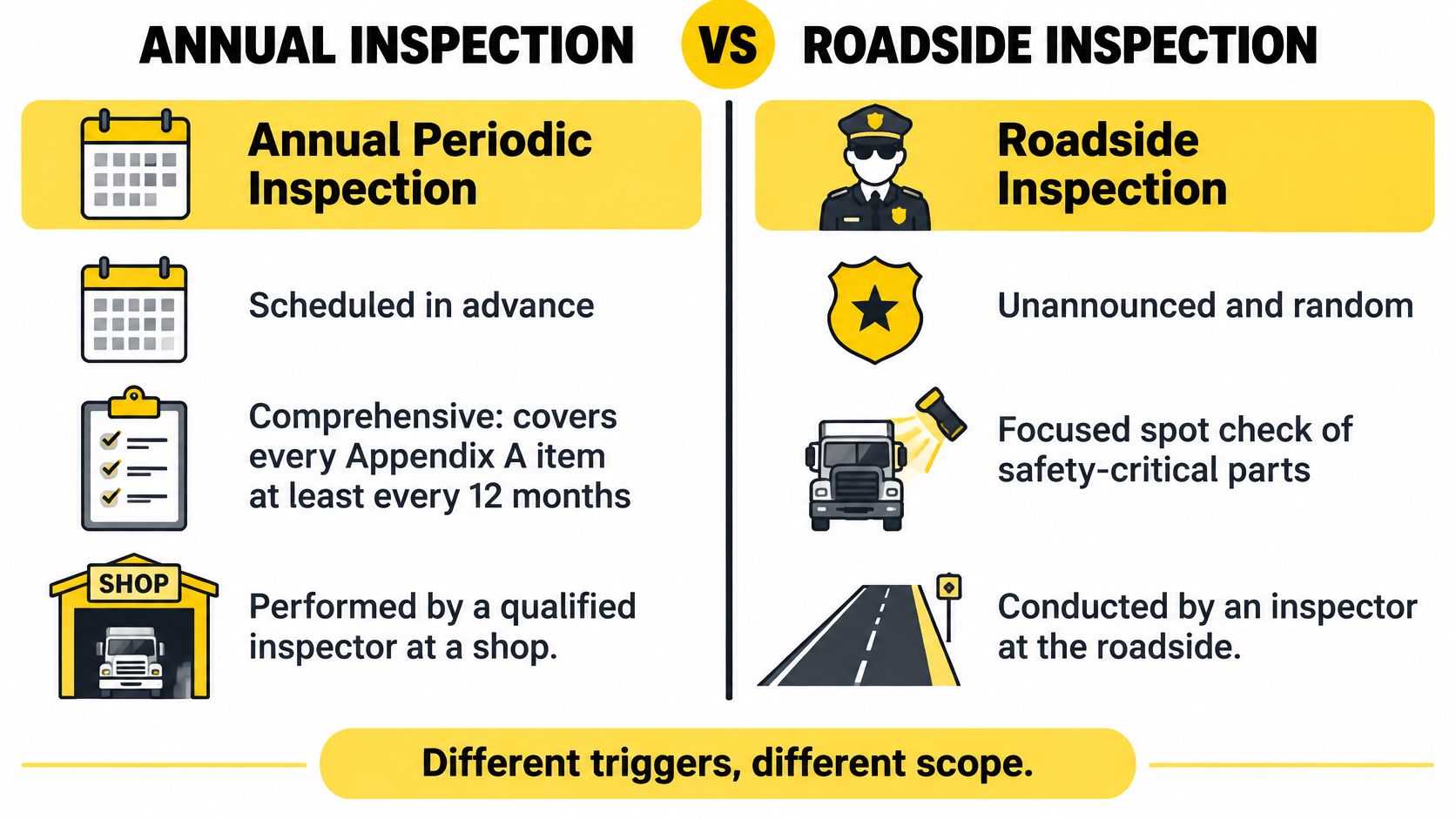
A trailer can pass a roadside check and still need its scheduled annual inspection. The two inspections serve different purposes, so fleets need to track them as separate layers of compliance.
Under 49 CFR §396.17, each covered vehicle must receive a periodic inspection at least once every 12 months. Roadside inspections are conducted under the North American Standard Inspection Program, whose inspection procedures and levels vary in scope. A roadside inspection may not cover every part and accessory listed in Appendix A.
| Criterion | Annual periodic inspection | Roadside inspection |
|---|---|---|
| Purpose | Confirm the trailer meets Appendix A standards | Enforcement check during operation under the NAS program |
| Frequency | At least once every 12 months under 49 CFR §396.17 | As encountered on the road |
| Location | Qualified inspector, typically at a shop | Roadside, conducted by enforcement officers |
| Scope | Every Appendix A item | May not cover every periodic inspection item |
| Outcome | Proof carried on the vehicle and report kept for 14 months | Inspection report and possible out-of-service order |
A clean roadside encounter does not replace the annual inspection. The reverse is also true: current annual paperwork does not prevent an out-of-service order if an officer finds a serious defect. If a roadside inspection identifies a defect, arrange the required repair before the trailer returns to service.
Here's the practical walkthrough of what enforcement is looking at:
Use three connected controls: the annual inspection for each unit, maintenance between inspections, and cargo rechecks while in route. Record roadside findings alongside the annual inspection file, including repairs made in response. That gives each trailer a continuous compliance record rather than two disconnected sets of paperwork.
Staying Compliant Between Annual Inspections
The maintenance obligation that runs all year
The annual inspection is one layer of a three-part compliance program: inspect each unit at least annually, maintain it between inspections, and recheck cargo in route. Federal rules require carriers to systematically inspect, repair and maintain every commercial motor vehicle under their control, keeping parts and accessories in safe operating condition. The FMCSA safety planner's vehicle maintenance guidance describes that ongoing duty. It applies to defects that emerge after the annual inspection, including cracked structure, loose hardware, suspension wear and wheel-end problems.
High-cycle equipment needs attention between stickers. A Walking Floor trailer running several loads a day puts repeated cycles on its floor mechanism, so an annual inspection alone cannot show how the system is performing throughout the year.
Rechecks drivers owe on every loaded trip
Under federal cargo securement rules, drivers must inspect cargo and securement within the first 50 miles, then reexamine them after a duty-status change, after 3 hours of driving, or after 150 miles, whichever comes first. Roadside enforcement of cargo securement rules is another reason to keep these checks routine. The annual inspection confirms a unit at a point in time; in-route rechecks address cargo and conditions that can change during a trip.
| Trigger | When to recheck | What to verify |
|---|---|---|
| First 50 miles | Within 50 miles after loading | Cargo settlement, securement tension, tailgate and door security, tarp condition |
| 3 hours of driving | After 3 hours on the road, if this comes before the 150-mile point | Cargo and securement, visible leaks, lamp function and tire condition |
| 150 miles | After 150 miles traveled, if this comes before the 3-hour point | Securement straps or chains, hydraulic lines, floor and tailgate |
| Duty-status change | Whenever the driver changes duty status | Walkaround: brakes, tires, lamps, couplings, cargo and fresh leaks |
| After loading or unloading | Before the next leg | Slat and floor condition, hydraulic cylinders and hoses, tailgate latches, debris clearance |
What bulk haulers check at each stop
Bulk haulers should pair cargo checks with a look at equipment exposed to each load cycle. Material can shift, and a tailgate that latched at the yard may develop a problem on the road. Check the tailgate, tarp and doors, floor slats and hydraulic lines. Look underneath for fresh leaks.
Some defects call for parking the trailer and arranging repair rather than continuing the trip. That includes brake or tire problems, lighting defects, structural damage, an insecure tailgate or hydraulic leakage.
Park it: If a hydraulic line is leaking onto a hot brake drum or the tailgate will not lock, stop operating the trailer and arrange repair. Do not treat the next scheduled shop visit as a substitute for addressing the defect.
Turn Inspection Findings Into a Repair Plan
Preparation beats luck. Four steps cover most of it.
- Pull every trailer's due date by VIN. Book annual inspections early rather than at expiry, and let the list drive the shop schedule instead of the shop schedule driving the list.
- Run a pre-inspection walkaround. Use the brake, coupling, lighting, tire, wheel, suspension and frame checks, with a pry bar and a tread gauge in hand.
- Repair known defects first. Findings that arrive before the inspection become scheduled work. Findings that arrive during it become failed results and a second appointment.
- Assemble the packet. Current report, legible decal or sticker with the date, and repair records tied to the unit number, all in one place before the trailer rolls.
When the pre-check turns up structural cracks, aluminum body damage, brake or suspension wear, or Walking Floor hydraulic and slat problems, get the repair on the calendar before the next dispatch. Repairs made with parts already on the shelf are the fastest route back into service, and a trailer parked waiting on a bearing or a cylinder is a trailer that's missing revenue.
Our shop runs preventive maintenance programs and roadworthiness inspections, handles precision aluminum welding on trailer bodies and structural components, diagnoses and repairs Walking Floor hydraulics and slats, and keeps a parts inventory on hand to shorten the wait.
The point of all of it is simple. Treat the annual inspection as a scheduled maintenance event with a date on the calendar, and the trailer arrives at the sticker healthy, documented and ready. Treat it as a scramble, and the scramble shows up at a scale house instead.
Brothers Truck Trailer Repair and Welding Corp. handles the repair side of DOT trailer inspection requirements for Tampa Bay fleets and owner-operators, from brake and suspension work to structural and aluminum welding, Walking Floor hydraulic and slat repairs, custom fabrication and parts pulled straight from inventory. If a trailer is due for its annual, failed a pre-check, or needs a defect fixed before the next dispatch, bring it in and we'll get it back on the road. Visit Brothers Truck Trailer Repair and Welding Corp. to schedule service or check what's in stock.
Find the right diesel truck oil change interval by engine, duty cycle and oil analysis, with manufacturer limits and real fleet practice compared.
Learn the major semi truck parts, how to match replacements using VIN, part numbers and ratings, and how to weigh part price against downtime.
Learn hydraulic cylinder repair basics for trucks and trailers: symptoms, causes, diagnostic checks, repair options and when to call a specialist.