
Diesel Engine Diagnostics for Commercial Trucks
The truck has lost power halfway through a route, the driver has sent a dashboard photo, and dispatch needs to know whether to send another tractor. There's a fault code, but it doesn't tell you whether the truck needs a sensor, an injector, a wiring repair, or attention to its exhaust system. Ordering the part named in the code description could leave you with the same fault and another missed delivery.
Diesel engine diagnostics starts by separating the reported symptom, the system's response, and the failed component. For commercial truck and trailer fleets, the most useful evidence often already exists in driver reports, electronic fault records, maintenance history, and operating conditions. The job is to turn those records into a testable explanation before replacing anything.
Table of Contents
- Symptom-to-Cause Lookup for Diesel Faults
- Read Fault Codes and Freeze-Frame Data Before Clearing
- How to Run a Diesel Diagnostic Workflow Step by Step
- How to Test Injectors and Fuel Pressure on Common-Rail Engines
- Diagnosing DPF Soot Loading and Regeneration Faults
- Decide When to Book Professional Diagnosis
Symptom-to-Cause Lookup for Diesel Faults
Diesel symptoms, likely causes and first checks
| Symptom | Likely cause | First check |
|---|---|---|
| Hard starting or long cranking | Low rail pressure, injector leakage or air in fuel | Fuel-drain and rail-pressure data |
| Low power or derate | Boost fault, EGR restriction or clogged DPF | Boost and backpressure readings |
| Frequent regeneration or DPF warning | Repeated low-temperature duty, failed EGR or injector fault | Differential pressure at equal speed and load |
| NOx or DEF warning | Dosing fault, NOx sensor, exhaust leak or control logic | DEF quality and sensor plausibility |
| Black or white smoke | Over-fuelling, injector fault or cold-start issue | Smoke colour under load and injector return volume |
| Blue smoke | Oil consumption or turbo seal leak | Oil level trend and crankcase pressure |
| Rough idle or misfire | Injector imbalance or harness fault | Cylinder balance and wiring inspection |
Read the table from left to right. Start with what the driver experienced, identify the competing explanations, then choose a check that separates them. The likely-cause column is a shortlist, not permission to order parts.
For example, hard starting and low rail pressure can occur together, but low pressure doesn't establish that the high-pressure pump has failed. Fuel may be escaping through an injector's return circuit, or the supply side may be admitting air. The first useful question is whether the system can achieve commanded pressure and where fuel is going when it can't.
Describe the operating condition precisely
Low power needs more detail than “the truck feels weak.” Ask whether the engine struggles during acceleration, climbing, highway operation, or stationary equipment use. Record whether the dashboard announces a derate or the driver notices reduced pulling power.
For a Walking Floor combination, distinguish poor engine response from slow or uneven trailer unloading. Note engine behaviour, hydraulic operation, and whether the complaint occurs only while the floor runs. Don't classify every unloading complaint as an engine fault, and don't assume a hydraulic symptom explains an engine warning.
Smoke also needs context. Record its colour, whether the engine is cold or warm, and whether it appears at idle or under load. Don't send a driver out to reproduce severe smoke merely to complete a report.
Working rule: A symptom suggests where to investigate. A targeted measurement determines whether that explanation survives.
Cylinder-balance results, crankcase pressure, boost readings, and return-flow measurements each answer different questions. None should be interpreted without the engine's specifications and test conditions. Treat every table row as a starting hypothesis that needs confirmation.
Read Fault Codes and Freeze-Frame Data Before Clearing
A fault code identifies a detected condition, not necessarily the defective part. A low signal might come from a failed sensor, damaged wiring, a poor ground, or a missing reference voltage. A plausible-looking signal can also be wrong if the sensor reports a value that doesn't make sense alongside other operating data.
Consider a NOx-efficiency fault. The engine controller has detected inadequate emissions-system performance, but that doesn't prove the NOx sensor is defective. Exhaust leaks, incorrect DEF dosing, wiring trouble, or control logic can produce a similar outcome; the EPA's diesel exhaust fluid guidance addresses diagnostic-information access and software-related derate concerns.
The technician should therefore inspect the conditions around the code. Did it appear after an exhaust repair? Did the warning begin after a DEF purchase? Does the sensor response change sensibly as operating conditions change?
Why electronic evidence matters
Heavy-duty diesel emissions limits became progressively tighter, bringing fuel delivery, air management, exhaust treatment, and electronic controls into the same diagnostic process. The EPA regulatory history documents the earlier milestones in the following timeline, including the reduction in particulate-matter limits from 0.6 g/bhp-hr in 1988 to 0.1 g/bhp-hr by the mid-1990s.
Heavy-duty diesel emission limits by standard
| Standard or year | PM limit (g/bhp-hr) | NOx or combined limit (g/bhp-hr) |
|---|---|---|
| 1974 | Not specified in this timeline | 16.0 combined HC and NOx |
| 1988 | 0.6 | Not specified in this timeline |
| Mid-1990s | 0.1 | 5.0 combined HC and NOx |
| 1998 | Not specified in this timeline | 4.0 NOx (scheduled) |
| 2004-and-newer engines (1997 rule) | 0.10 (truck engines) | 2.4 NMHC + NOx, or 2.5 combined with NMHC capped at 0.5 |
| 2007 heavy-duty rule | 0.01 | 0.20 NOx, phased in by 2010 |
The 1997 EPA final rule set the combined NMHC and NOx limits for model year 2004 and later. The 2001 EPA final rule established the 2007 standards and the NOx phase-in through 2010. These emissions limits apply to engine certification. Use the manufacturer’s specifications for pressure-gauge and scan-tool diagnostics.
For covered engines installed in vehicles above 14,000 pounds GVWR, federal onboard-diagnostic requirements specify how the OBD system monitors emissions-related components, reports diagnostic trouble codes, and commands the malfunction indicator. The system must have nonvolatile memory capacity for at least four current MIL-on codes as permanent codes. If the number of qualifying codes exceeds that capacity, the system prioritizes the earliest detected faults and retains existing permanent codes. The rule also addresses separate codes for circuit faults and rationality checks.
That distinction matters: an electrical circuit fault and a rationality fault call for different tests. A rationality fault means the controller finds a reading inconsistent with expected behaviour, even if the electrical signal isn't entirely missing.
Capture the record before changing anything
Save the following information before clearing faults or disconnecting components:
Code and status: Record the exact identifier, description, controller, and whether it's active, pending, or historical.
Freeze-frame conditions: Save available engine speed, load, temperatures, and other readings captured when the fault set.
Derate and complaint: Preserve the dashboard message and the driver's description of what the truck would and wouldn't do.
Recent changes: Include repairs, parts replacements, fuel and DEF purchases, and the timing of the first warning.
Clearing faults can erase useful context while leaving the cause unresolved. A saved record lets the technician test competing explanations against the truck's actual behaviour instead of reconstructing events from memory.
How to Run a Diesel Diagnostic Workflow Step by Step
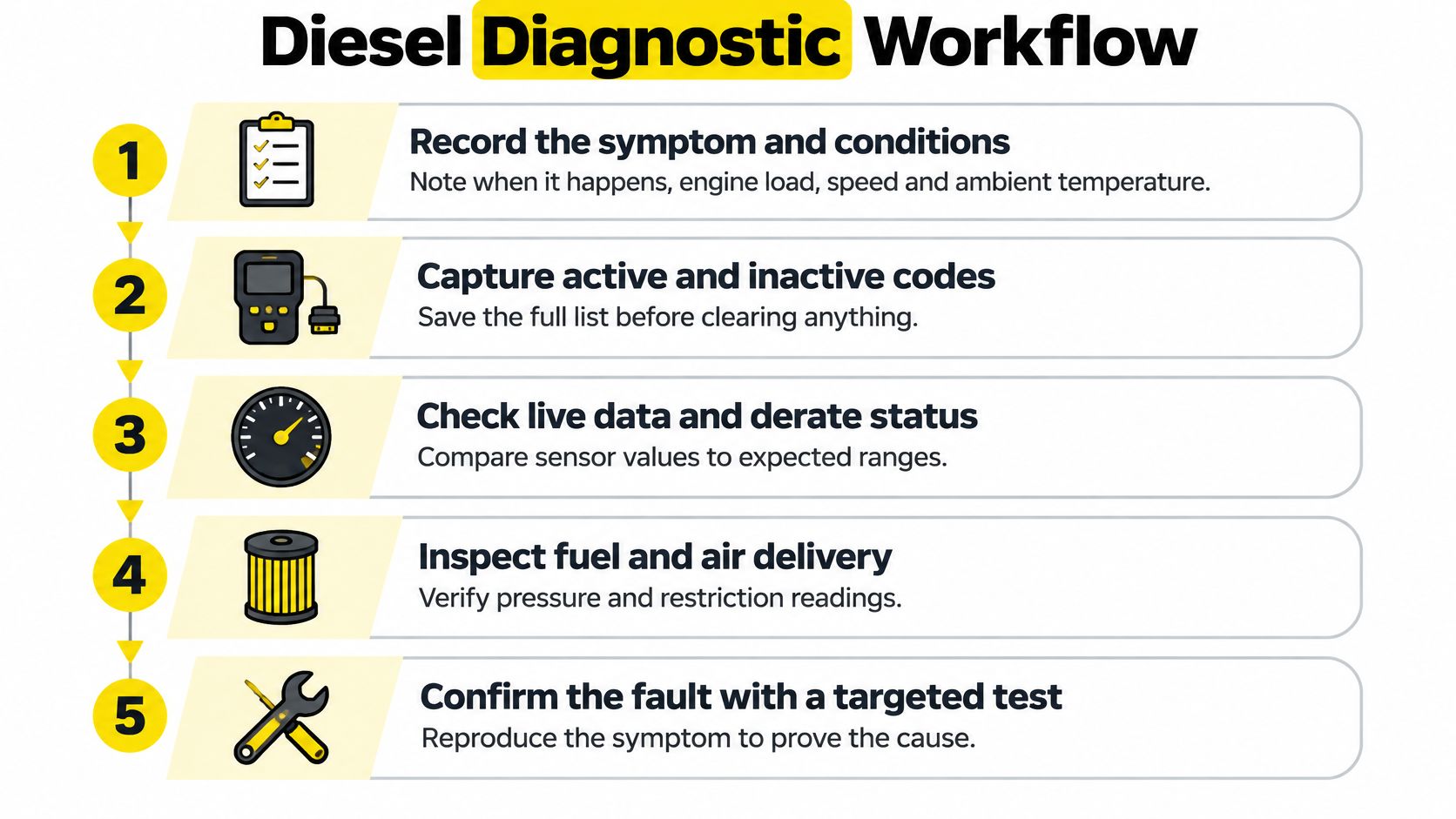
Use a consistent procedure, but let the evidence determine which component gets tested. A scan tool, digital multimeter, suitable pressure-testing equipment, and manufacturer service information serve different purposes; none replaces the others.
The workflow keeps those checks in a practical order.
Move from observations to confirmation
Record the symptom and conditions. Note when the problem happens, engine load, speed, ambient temperature, and any derate message, because an intermittent fault may disappear after the truck reaches the workshop. Separate what the driver observed from their proposed cause, such as “loses power climbing” versus “needs a turbo.”
Retrieve and preserve the electronic record. Pull active, pending, and inactive codes together with available freeze-frame data, then save the complete capture as a dated file before repairs. Include the vehicle identity and mileage so a later technician doesn't confuse an old report with the current condition.
Check sensor plausibility and wiring. Compare related live readings and test power, ground, and reference circuits against manufacturer specifications, because a shared electrical problem can mimic several failed sensors. Inspect connector terminals, harness rubbing points, and corrosion; for NOx or DEF complaints, check DEF concentration with a suitable refractometer before condemning dosing or sensing components.
Confirm the suspected mechanical fault. Select compression, fuel-pressure, injector-return, intake-restriction, or exhaust-backpressure testing according to the evidence rather than running every available test. This separates a controller's report of poor performance from the physical reason for it.
Verify the repair under the original operating conditions. Use a controlled road or load test that safely matches the speed, load, and temperature associated with the complaint, then reread the controllers for returning faults. If the applicable monitor hasn't run, record verification as incomplete rather than declaring success.
Define what counts as a completed diagnosis
A repair order should connect the complaint to a measured failure. “Replaced sensor” describes work performed; “confirmed incorrect sensor output with verified power and ground, then restored normal readings” explains why the work was justified.
Don't close a diagnostic job merely because the warning light is off. Close it when the original complaint has been addressed and the relevant operating checks pass.
A closed diagnosis identifies the root cause, documents the repair, and confirms acceptable operation under load without returning faults after the applicable drive cycle. If the symptom can't be reproduced, say so plainly and preserve the test results. That's more useful than presenting an unconfirmed part replacement as a proven repair.
How to Test Injectors and Fuel Pressure on Common-Rail Engines
Hard starting, excessive cranking, uneven combustion, low power, and below-target rail pressure are reasons to investigate injector leakage. They aren't reasons to replace the high-pressure pump immediately.
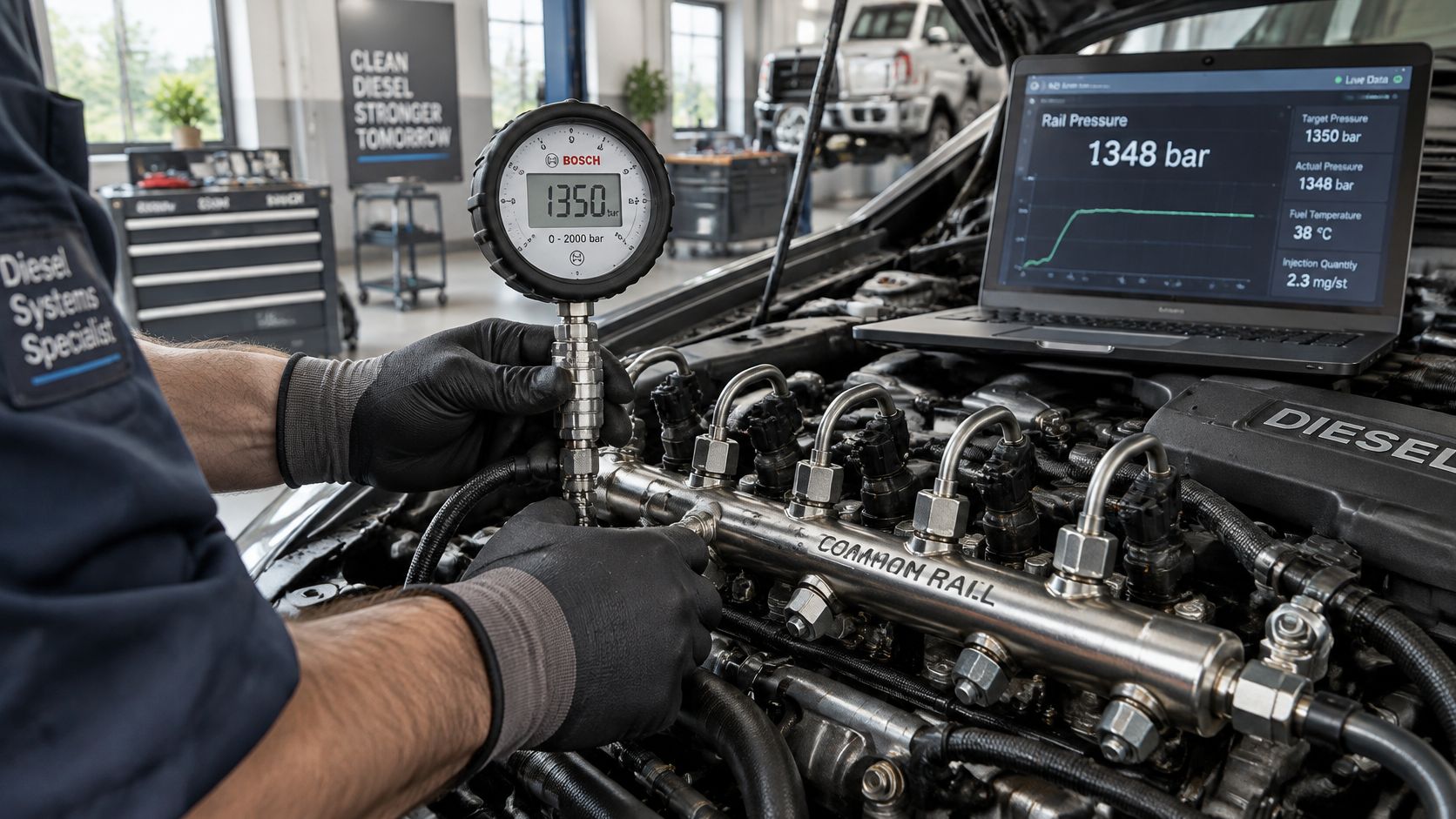
The test setup must match the engine and its approved adapters.
Measure return flow under controlled conditions
The Cummins high-pressure common-rail fuel-systems workbook places injector and pressure-relief-valve return-flow checks before condemning the high-pressure pump. That order matters because internal leakage can prevent an otherwise functioning pump from maintaining rail pressure.
Bring the engine to operating temperature when the approved procedure permits. Isolate the specified fuel-drain circuit, use the manufacturer's diagnostic routine to command or induce maximum rail pressure, and collect return fuel in a graduated cylinder for the specified duration. Compare the collected volume with the limit for that exact engine and test setup.
Don't loosen high-pressure fuel lines on a running engine to look for a weak cylinder. Use approved isolation equipment and depressurisation procedures; high-pressure fuel can penetrate skin. A no-start engine also requires its applicable diagnostic procedure rather than an improvised warm-engine test.
Excessive return flow means fuel is bypassing the intended metering path through internal injector or high-pressure-connector leakage. The controller may command more pressure, but the rail can't build or sustain it because fuel is escaping through the return path.
The Oregon Fuel Injection video shows a removed common-rail injector being tested on a Bosch EPS205 bench. For return-flow testing with the injector installed, follow the engine manufacturer’s procedure.
Isolate the leak before selecting parts
Use the prescribed cylinder-isolation test to identify the injector or connector responsible. A high combined return volume shows a system problem, but it doesn't identify which cylinder needs attention.
Keep a test sheet containing:
Engine temperature: Record the actual test condition.
Collection duration: Use the procedure's specified timing.
Rail-pressure behaviour: Save commanded and actual pressure during testing.
Return volume: Identify each cylinder and its measured result.
Comparison limit: Record the applicable manufacturer specification.
Decision rule: If total return flow is within limits, investigate other causes of the pressure shortfall. If a cylinder stands out, isolate and confirm that injector or connector fault before authorising replacement.
Diagnosing DPF Soot Loading and Regeneration Faults
A diesel particulate filter behaves somewhat like a clogged coffee filter: as material accumulates, flow becomes more restricted. The useful diagnostic evidence is measured backpressure supported by a believable differential-pressure signal, not whether a forced regeneration turns off a warning.
Regeneration oxidises accumulated soot. It doesn't remove noncombustible ash, which eventually requires physical cleaning. Treating both materials as the same problem leads to repeated regeneration attempts without correcting the restriction.
Match temperature evidence to the filter
Passive regeneration uses sufficiently hot exhaust during normal operation. Active regeneration adds heat when the truck's duty cycle doesn't provide enough.
The EPA's technical guidance on diesel particulate filters identifies about 500°C as a typical requirement for an un-catalyzed filter and roughly 250–300°C as an effective oxidation range for catalyzed systems, as summarised below.
DPF regeneration temperature reference
| Filter or regeneration case | Typical temperature | What to check |
|---|---|---|
| Un-catalyzed DPF | About 500°C | Duty cycle reaches the required temperature |
| Catalyzed system | Roughly 250–300°C | Exhaust-temperature sensor and low-speed running |
| Passive regeneration | Hot normal exhaust, no fixed value | Enough sustained load for soot to oxidise |
| Active regeneration | Added heat when duty cycle is too cool | Frequency of forced regeneration and cause of soot loading |
These reference temperatures aren't universal scan-tool targets or permission to initiate regeneration. The engine's procedure determines the enabling conditions, safety precautions, and acceptable results.
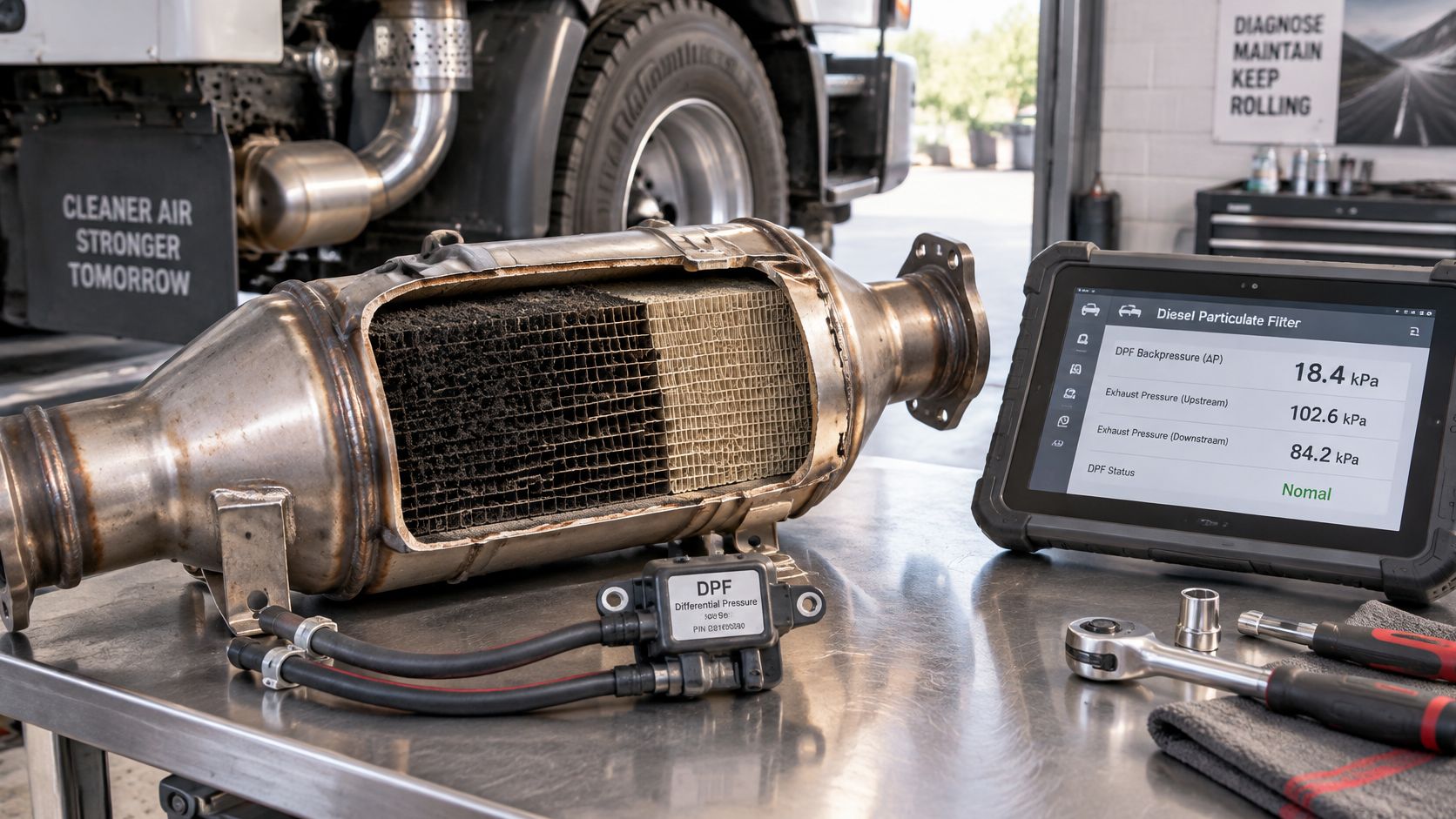
The filter, pressure circuit, and temperature measurements need to be considered together.
Find why restriction or soot loading returns
Compare pressure readings at comparable engine speed and load. An unloaded idle reading and a loaded road reading don't provide a useful before-and-after comparison.
Pressure hoses: Inspect for blockage, cracks, disconnected lines, and incorrect routing.
Sensor baseline: Check the zero-pressure reading using the manufacturer's procedure.
Temperature sensors: Look for implausible values and responses inconsistent with operating conditions.
Soot sources: Investigate EGR faults, poor injector performance, turbocharger problems, and repeated low-temperature operation.
For stop-start collection routes or equipment that spends substantial time idling, record how the truck works. A maintenance record that says only “DPF regenerated” leaves out whether the operating pattern or an engine fault continues to load the filter.
Cleaning decision: Use a verified backpressure trend and the manufacturer's limits, not the regeneration light alone.
Repeated regeneration without investigating the cause can conceal fuelling, sensor, or air-management faults. It also doesn't resolve retained ash, so a temporary improvement shouldn't be mistaken for a completed diagnosis.
Decide When to Book Professional Diagnosis
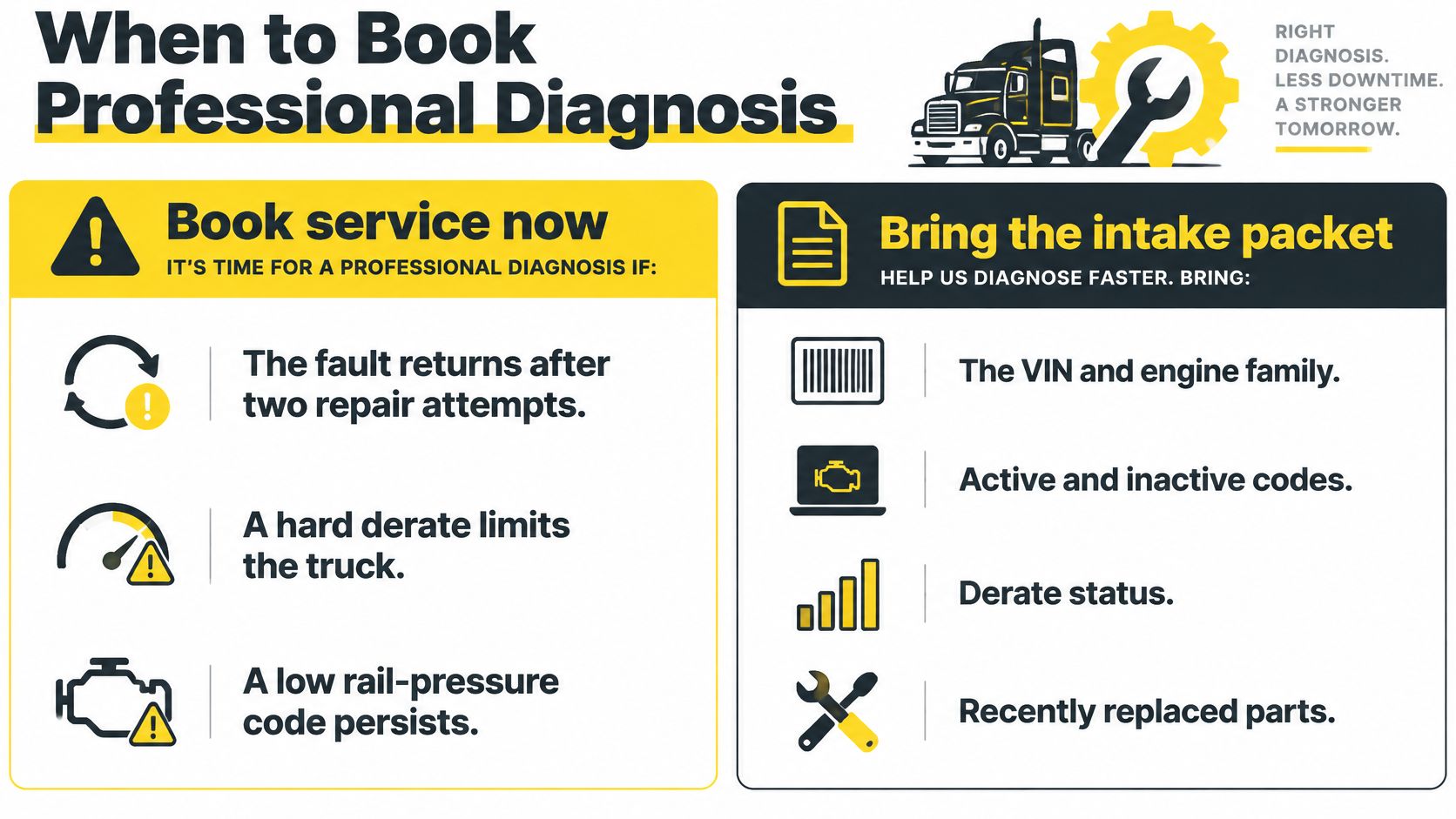
Book professional diagnosis when the fault persists, the available tests don't separate the likely causes, or further work requires controlled high-pressure, electrical, or load testing. A recurring low-rail-pressure complaint, unresolved emissions warning, or hard derate isn't a good setting for more speculative parts replacement.
Make the safety decision before arranging the appointment. A truck that can still move isn't necessarily safe to send across town.
Decide whether to drive or tow
Limited travel may be reasonable: There's no derate or safety-critical warning, temperatures and pressures remain normal, braking and steering function correctly, and the operator's manual permits continued operation. Confirm the plan with the workshop and stop if conditions change.
Stop and arrange recovery: The truck overheats, loses braking, displays a critical shutdown warning, produces severe smoke, or develops serious knocking or instability. Shut down as appropriate once safely stopped and arrange suitable towing or recovery.
Inspect the whole combination: Don't let an engine complaint distract from trailer, brake, suspension, or structural defects that independently prevent safe travel.
Federal commercial-vehicle maintenance rules address brake inspection and repair requirements and identify serious brake defects. An engine scan doesn't establish that the truck and trailer are roadworthy.
Use the service checklist to organise the handoff, not to postpone an urgent safety decision.
Bring a complete intake packet
Documentation matters when workshop resources are stretched. FreightWaves' reporting on U.S. industry survey findings stated that 65.5% of repair shops were short-staffed in 2025, nearly one in five technician positions was unfilled, and 61.8% of new technicians entered without formal training.
A clear handoff doesn't replace qualified diagnosis, but it reduces the need to reconstruct missing history. Put the following in a shared file that dispatch, maintenance, and the workshop can access:
Vehicle identification: VIN, engine family, and relevant configuration.
Electronic evidence: Saved code reports, freeze-frame records, dashboard photos, and current derate status.
Repair history: Recently replaced parts, previous test results, and whether each intervention changed the complaint.
Consumables history: Fuel and DEF purchase records, including when symptoms began relative to purchases.
Operating description: Route type, duty cycle, symptoms under load, and any connection to trailer equipment use.
Maintenance records: Fluid service, filter changes, inspections, and unresolved defects.
For Walking Floor operators, include hydraulic complaints separately from engine symptoms. For trailers with cracks, damaged aluminum components, or fabrication needs, add photographs and identify the affected location rather than combining everything under “truck losing performance.”
At Brothers Truck Trailer Repair and Welding Corp., our truck maintenance includes routine oil changes and fluid checks, brake and suspension inspections, engine diagnostics and repairs, preventative maintenance programs, and thorough roadworthiness inspections. Our truck and trailer repair and welding work can be considered alongside the diagnostic complaint without treating every defect as the same problem.
Clearing codes isn't a repair. Assemble the packet, complete only the checks your team can perform safely, and book professional diagnosis whenever the root cause remains unconfirmed.
Bring your saved fault reports and maintenance history to Brothers Truck Trailer Repair and Welding Corp. to discuss engine diagnostics, truck and trailer maintenance, and the checks needed before returning the combination to service. We also provide Walking Floor hydraulic diagnosis and repair, aluminum welding, custom fabrication, and truck and trailer parts from our inventory, so include related equipment defects in your service request.
Find the right diesel truck oil change interval by engine, duty cycle and oil analysis, with manufacturer limits and real fleet practice compared.
Learn the major semi truck parts, how to match replacements using VIN, part numbers and ratings, and how to weigh part price against downtime.
Learn hydraulic cylinder repair basics for trucks and trailers: symptoms, causes, diagnostic checks, repair options and when to call a specialist.