
Aluminum Welding Shop Near Me: How to Vet One in Tampa Bay
Your driver finds a crack in an aluminum cross-member during the morning walkaround, and that trailer's already booked for the next load. A search for an aluminum welding shop near me gives you names, not answers. Before you tow it anywhere, you need to know whether the damage is structural, how long the unit will sit, and whether the shop can prove the repair was done right.
Table of Contents
- Why Aluminum Trailer Repair Needs a Specialist Shop
- What to Ask an Aluminum Welding Shop Before You Book
- Matching Aluminum Damage to Repair Risk Before You Call
- Walking Floor Parts and Sizes to Confirm Before Ordering
- Inspection Rules That Set Your Repair Deadlines
- Turnaround Times and Downtime You Can Plan Around
- Build Your Shortlist and Book an Inspection in Tampa
Why Aluminum Trailer Repair Needs a Specialist Shop
Say a Tampa Bay waste hauler rolls in with a cracked aluminum floor section and a route schedule that doesn't pause for shop time. The decision isn't whether someone can lay a bead on it. It's whether welding that section returns a safe, load-carrying trailer, or whether it puts a weak repair back into service.
A shop that's strong on steel may not handle aluminum the same way. Aluminum shows up in trailer bodies, floors, and structural assemblies because it's light and resists corrosion, and that use is central, not marginal. Transportation represented 36% of domestic aluminum consumption in 2025, ahead of packaging and construction, according to the U.S. Geological Survey aluminum summary. That scale explains why aluminum-specific repairs now sit on so many fleet work lists.
The Two Costs You're Actually Paying
The invoice: Labor, filler, parts, and fabrication for the repair itself.
The idle days: A unit sitting in a queue misses routes and loads, and that lost work can outweigh the shop bill.
Every shop in your search results says it welds aluminum. The useful question is which one can document the work, diagnose before quoting, and return the unit on time. Work through it in this order: what to ask before booking, how to match damage to risk, which Walking Floor parts to confirm, how inspection rules and turnaround set your deadlines, and how to book. Each step gives you something you can act on this week, before the tow truck moves.
What to Ask an Aluminum Welding Shop Before You Book
| Question to ask | Strong answer | Red flag |
|---|---|---|
| Which aluminum alloy and temper will you weld? | Identifies alloy and temper, or states how it will test them | Treats all aluminum as the same material |
| How do you handle welding inside an enclosed trailer body? | Assesses the enclosure and materials, explains fume capture and airflow, and identifies any confined-space controls | Assumes an open door or a fan alone is enough |
| How do you prepare the joint before welding? | Removes oxide, oil, paint and corrosion and names the filler | Grinds the surface and starts welding |
| What does the work order record? | Damaged section, joint prep, filler, procedure and post-weld inspection | Only an invoice line that says aluminum weld |
| Do you diagnose before you estimate? | Inspects the damage and shares photos before quoting | Gives a quote without inspecting |
| Are the parts you may need on hand? | Stock confirmed and parts timeline stated before work starts | Parts source and timing left vague |
| What warranty applies to the weld? | Written terms stated before work starts | Verbal promise only or no answer |
| Have you worked on Walking Floor systems? | Names Walking Floor experience and the procedures used | Only general body work offered |
Start with alloy and temper, because filler choice, heat input, and expected strength all depend on it. A shop that can't tell you what it's welding is guessing at every step after that. We work directly from our workshop to the customer, with no middlemen, and our welders have specialized aluminum expertise, so those answers come from the people doing the work.
Why Ventilation Outranks Price
Welding inside a trailer body isn't the same as welding on an open bench. The enclosure restricts airflow and concentrates fumes in the welder's breathing zone, which affects both safety and weld consistency. Smoke around the arc also makes it harder to see the puddle and control the bead.
A low hourly rate means little if the shop can't control fumes inside your trailer or show you a work order that records what was done.
OSHA’s general-industry welding standard specifies when mechanical ventilation is required for materials covered by its general provisions. It lists a general mechanical ventilation rate of 2,000 cubic feet per minute per welder, with exceptions for qualifying local exhaust or approved airline respirators. The shop also needs to assess the alloy, filler, coatings, airflow and worker exposure, and apply the additional requirements if the job is in a confined space. Ask how it captures fumes near the arc, supplies clean replacement air and keeps exhaust from recirculating.
Documentation Is the Other Half
Joint preparation and the work order tell you whether the repair is traceable. You want the damaged section, preparation, filler, procedure, and post-weld inspection recorded, not a single line on an invoice. If a crack returns, that record is how you and the shop figure out why instead of starting over.
A shop that answers all eight questions with specifics is worth a visit. A shop that answers with generalities, or quotes before inspecting, should move down your list no matter how close it is.
Matching Aluminum Damage to Repair Risk Before You Call
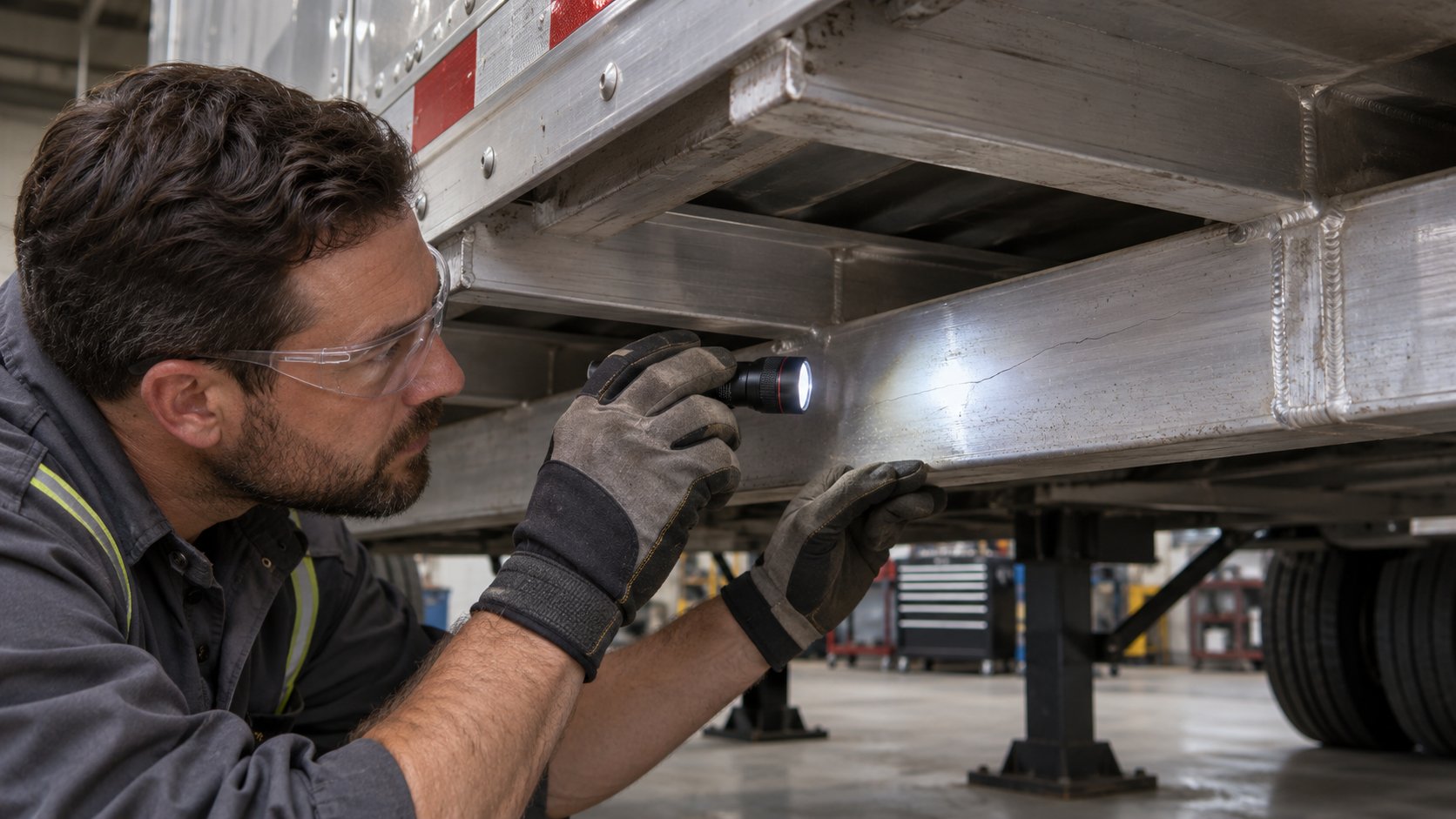
A hairline crack at a weld toe on a frame member looks minor next to a big dented panel. It isn't. Fatigue cracks start at stress concentrations such as fastener holes, weld toes, and corrosion pits, and they grow under repeated loading. The dent may be cosmetic. The small crack may be structural.
| Damage | Likely repair path | Escalate when |
|---|---|---|
| Cosmetic dent in a body panel | Panel straightening or patch weld | Dent sits on a rib, corner or near a load point |
| Crack at a weld toe on a frame member | Hold the unit for qualified assessment and check the vehicle manufacturer’s repair procedure | Any suspected frame or load-path crack |
| Corrosion pitting near fastener holes | Clean back to sound metal and check remaining wall thickness | Holes are elongated or metal is thin |
| Cracked floor cross-member | Inspect the load path and determine whether the manufacturer permits repair or calls for replacement | Any crack in a load-bearing cross-member |
| Aluminum in contact with steel and corroding | Isolate the joint and inspect coating and fasteners | Corrosion has reached a structural member |
Why a Clean Bead Proves Little
Aluminum oxide has a much higher melting point than the base metal, so it has to come off before welding. Leftover oxide, oil, paint, or corrosion can interrupt fusion and leave porosity or a cold lap under a bead that looks fine. Heat input also changes the metal next to the weld. The heat-affected zone can lose strength even when the visible bead appears sound, and too much energy widens that zone and adds distortion.
OSHA’s general-industry welding standard requires ventilation to control exposure to fumes, gases and dust. For structural repairs, verification can include visual checks for crater cracks and undercut, dimensional checks for distortion, and dye-penetrant testing where the repair procedure calls for it.
Gather Three Things Before You Call
Trailer make and use: Include payload and whether the unit is currently loaded.
Damage photos in good light: Shoot close-ups and a wider shot showing where the damage sits.
Repair history: Note any earlier weld or patch in the same area.
Decision rule: Keep a trailer with a suspected frame or load-path crack out of service pending a qualified assessment. Ask the shop how it will check the crack’s origin and determine whether repair or replacement is appropriate. Any welded repair of a commercial vehicle frame must follow the vehicle manufacturer’s recommendations under 49 CFR § 393.201(d).
That rule keeps you from treating every crack as a cosmetic patch, and it gives the shop what it needs to triage by risk instead of by how the damage looks in a photo.
Walking Floor Parts and Sizes to Confirm Before Ordering
A bearing and slat have to match the installed floor system. The dimensions below are examples from BTT’s catalog. Identify the exact drive and part number before ordering. We specialize in Walking Floor repairs and can help check fit against the installed system.
| Component | BTT catalog example | Fitting check |
|---|---|---|
| Keith Walking Floor bearing, first cutout | 2-5/8 inch cutout for fitting over cross-members | Match to the existing cross-member |
| Keith Walking Floor bearing, second cutout | 3-1/8 inch cutout for fitting over cross-members | Match to the existing cross-member |
| Keith Walking Floor bearing for slats | Built for 3.5 inch slats or 6 inch slats | Measure the slat width first |
| Keith Walking Floor Splash Guard Bearing | 60 inch long | Confirm length against the installed position |
| Keith Walking Floor cylinder, smaller bore | 3.0 inch inside diameter by 3.5 inch outside diameter | Verify drive and cylinder part number |
| Keith Walking Floor cylinder, larger bore | 3.5 inch inside diameter by 4.0 inch outside diameter | Verify drive and cylinder part number |
| Keith Walking Floor cylinder, assembled | Can be ordered completely assembled | Ask whether the assembled unit fits the trailer |
How to Use These Numbers
Start with the drive model and serial number on the KEITH drive identification plate. Match the part number to the catalog for that drive and use the existing cross-member, slat and bore measurements as cross-checks. The truck and trailer parts catalog lists examples, including assembled cylinders. Confirm the exact assembly before ordering.
Slat replacement is a common fix for worn or damaged slats, and it's part of our Walking Floor services. A wrong width or cutout doesn't just delay that job. It delays everything queued behind the trailer.
Symptoms That Point to Parts, Not a Weld
Uneven unloading: Material moves to one side or stalls partway.
Slats traveling unevenly: Sections advance at different rates or bind.
Hydraulic leaks at the cylinder: Fluid at seals, fittings, or the barrel.
Before calling, collect the trailer make and model, a photo of the drive identification plate, the existing part number if readable, and the relevant dimensions or photos. Uneven movement or a leak can have several causes. Have the shop diagnose the issue before ordering parts.
Inspection Rules That Set Your Repair Deadlines
A defect found during a post-trip inspection can keep a trailer off the road until it is corrected. Federal inspection requirements set the baseline; a repair schedule cannot override a condition that makes the unit unsafe to operate.
Under 49 CFR § 396.11, drivers of covered property-carrying commercial vehicles complete a driver vehicle inspection report (DVIR) at the end of the workday when they find or are told about a defect that could affect safe operation or cause a breakdown. A no-defect report is generally not required for these vehicles. Before the vehicle is operated again, the carrier must address defects likely to affect safe operation and certify on the report that the defect was repaired or that repair was unnecessary.
Every commercial vehicle, including each segment of a tractor-trailer combination, must receive a periodic inspection at least once every 12 months under 49 CFR 396.17. Between inspections, frames and frame assemblies, suspension systems, axles and attaching parts, wheels and rims, and steering systems must remain in safe operating condition.
The 12-month interval is a regulatory minimum, not a maintenance schedule.
On trailers equipped with a reciprocating floor, repeated unloading cycles wear the hydraulic system and moving slats. Aggregate and waste trailers can use other unloading systems, so identify the equipment on your unit before setting maintenance checks. Use the applicable service manual and adjust checks for load, corrosion exposure, and use.
Conditions That Hold a Unit
Federal equipment rules set minimum tire requirements, and Part 396 identifies brake defects that can make a vehicle unsafe. A tire with tread below the applicable federal minimum, exposed body-ply or belt material, or a serious separation or leak needs correction before dispatch.
| Component | Condition that fails inspection | Action before dispatch |
|---|---|---|
| Tire tread | Below the minimum depth set in federal equipment rules | Hold the unit until corrected |
| Tire plies | Exposed body-ply or belt material | Hold the unit until the tire is replaced |
| Tire condition | Tread or sidewall separation, exposed-ply cut, overloaded tire, flat or noticeable leak | Hold the unit until corrected |
| Brake axle | Required brakes are absent on an axle | Hold the unit until brakes are installed |
| Brake parts | Missing or broken shoes, linings, pads, springs, anchor pins, spiders, cam rollers, pushrods or air-chamber mounting bolts | Hold the unit until repaired |
| Brake mounting | Loose air chambers, spiders or camshaft support brackets | Hold the unit until tightened or replaced |
Keep repeat brake, tire, and structural findings in one history per unit. Recurring loose brackets or cracking weld toes can point to a condition that needs more than a one-time repair.
Turnaround Times and Downtime You Can Plan Around
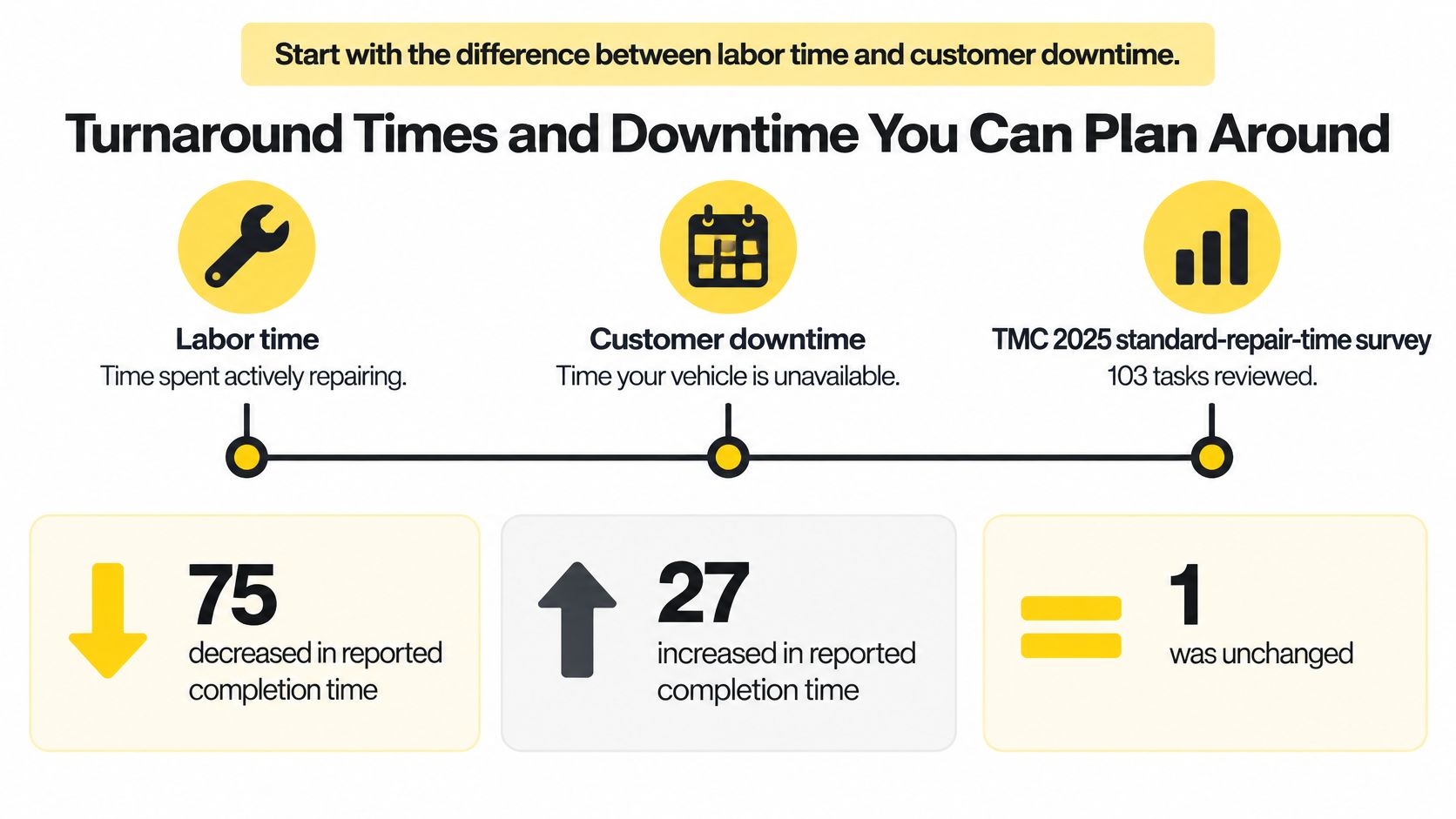
A weld may take less time than the trailer spends waiting for intake, approval, parts, or a shop slot. The Technology & Maintenance Council's 2025 standard-repair-time report collected responses for 103 tasks: reported completion times decreased for 75, increased for 27, and stayed unchanged for one. These figures cover labor time, not the total days a unit is out of service.
Where Downtime Actually Accrues
Tow-in and intake: Confirm when the shop can receive the trailer and whether it must be unloaded first. If a loaded unit cannot be worked on, unloading becomes another step in the schedule.
Diagnosis: Ask when the inspection and photos will be ready, and whether the shop will provide a diagnosis before estimating. A clear assessment helps prevent disputes about the repair scope.
Approval: Identify who can authorize work and how quickly they can respond. Time waiting for approval still counts as downtime.
Parts: Confirm whether the required part is available or ask for the order timeline. A missing bearing or cylinder can hold up a Walking Floor repair.
Queue: Ask when a welding or fabrication slot is expected to open. Receiving the trailer does not mean work starts immediately.
Repair path: A weld may return a unit to service sooner; fabrication or section replacement may take longer. Choose the repair path according to structural risk and how much downtime the operation can absorb.
Closeout: Allow time for finishing, cleaning, inspection, and a road test. The repair is not complete when the welding stops.
For Walking Floor equipment, a mechanical or structural problem can interrupt unloading. Brothers Truck Trailer Repair and Welding Corp. offers Walking Floor repairs with fast turnaround times to minimize downtime. Ask what completion depends on, and what could extend the schedule.
Get the expected completion condition and any schedule dependencies in writing. A same-day promise is useful only if the scope, parts, and approval timing support it.
For waste, recycling, construction, and municipal fleets, downtime can mean missed routes. Compare the cost of waiting with the structural risk of the proposed repair, then schedule the tow and approvals around the full repair window.
Build Your Shortlist and Book an Inspection in Tampa
Start today: pick three aluminum welding shops in the Tampa Bay area and score each against the eight-question checklist. Keep only the shops that answer the traceability questions with specifics. If none do, keep looking rather than settling for the closest name in the results.
Send one packet to each shop: Damage photos in good light, trailer make, alloy if known, load status, and any prior repair to the same area.
Ask three things before committing: A diagnosis before any estimate, a completion condition in writing, and confirmation of parts on hand or the order timeline.
Book the drop-off window once the shop confirms, and keep any applicable driver vehicle inspection report with the work order so the carrier can document the repair.
Brothers Truck Trailer Repair and Welding Corp. is one shop to evaluate: a Tampa workshop at 1620 S 51st St, Tampa, FL 33619, reachable at +1 (813) 750-6380, offering aluminum welding for trailers and trucks, Walking Floor repair, custom fabrication, and an in-stock parts catalog. Score our answers against the same checklist, and don't treat any availability, price, or warranty term as settled until it's stated in writing.
If your trailer is sitting with aluminum damage and a schedule that won't wait, send us the photos, trailer make, and load status and we'll diagnose before we estimate. Visit Brothers Truck Trailer Repair and Welding Corp. to see our aluminum welding, Walking Floor repair, fabrication, and parts capabilities, then call to book an inspection window at our Tampa workshop.

Find the right diesel truck oil change interval by engine, duty cycle and oil analysis, with manufacturer limits and real fleet practice compared.
Learn the major semi truck parts, how to match replacements using VIN, part numbers and ratings, and how to weigh part price against downtime.
Learn hydraulic cylinder repair basics for trucks and trailers: symptoms, causes, diagnostic checks, repair options and when to call a specialist.